Cyclones of 1903
pp. 31-35 · Read in the full issue


and 1983
Postmark Papeete Marie-Therese and Bengt Danielsson
In the local parlance of Tahiti “the cyclone” invariably means the one that, in 1903, devastated the islands of the Tuamotu group, east of Tahiti, and drown ed more than 500 people. The best account of “the cyclone” is to be found in the novel, The Hurricane , by Nordhoff and Hall, which builds on informa tion obtained by the authors from survivors.
“The cyclone” was followed in 1905 and 1906 by two others of much less destructive force.
But in the popular tradition, these have been overshadowed by, and even merged with, the big one of 1903.
It was not until January 1983 that the Tuamotus were once
again hit by a comparable, full scale, cyclone. This one fully lived up to its code name of Nano, the Tahitian word for “ex plosive force” applied, for example, to a spear or a bullet.
Nano’s first exploit was to deluge the Marquesas on January 21-22. From the Marquesas it travelled slowly southwards along the eastern edge of the Tuamotus, generating whirl winds of up to 200 kilometres per hour, and stirring up 10-metre high waves which engulfed at least 15 atolls, including Hao, the site of a military communica tions centre, and the nuclear test ing base of Moruroa. Although the destruction wrought on houses, wharves, airstrips and
coconut plantations was terrific, surprisingly enough no human lives were lost.
The explanation for this fortunate circumstance most commonly heard in the present situation in French Polynesia is the prevalence of transistor radios in the territory. Even in the remotest islands practically every family owns a radio and listens regularly to the Tahitian-language programs which include weather forecasts. Since Cyclone Nano originated in the Marquesas, and moved across the ocean at the rather slow rate of 20-odd kilometres per hour, the Tuamotuans were warned well in advance of its coming.
But proud as we may be of the technical achievement represented by modem radio communications, we should not forget that the naked Tuamotuans of old had their own extensive weather lore, and were perfectly able to read all the signs of sea and sky that
warned them of the approach of a cyclone.
All existing records show, for example, that in 1903, through out the Tuamotu group, people were aware that the cyclone was coming, and had taken shelter in good time. Not in palm trees as the South Seas books and movies would have it but in the most solid buildings they could find, which usually meant the churches. There were also on most islands prisons with equally solid walls, built for the purpose of locking up offenders against the missionary-inspired codes of behavior, which forbade practic ally everything that had given pleasure to the Tuamotuans from time immemorial; uninhibited love-making, frenzied singing and dancing, heroic warrior deeds, and cannibal feasts. On an island like Raroia, where we lived from 1949 to ’5l, the old folk were still at that time debat ing the relative merits of the
church and the jail as cyclone shelters. On the neighboring island of Takume, to the conster nation of all, the home of the sinners had withstood the 1903 cyclonic onslaught much better than the gathering place of the saints: only a small piece of the apse of Takume’s church was left standing after the cyclone’s passage.
But if the Tuamotuans were so well prepared in 1903, how was it that 500 lives were lost?
The simple answer is: bad luck.
Against every law of probabil ity, the cyclone struck the one and only island where there was a heavy concentration of people without shelter.
The island was Hikueru, where, at that precise moment, about 1300 men, women and children a third of the popula tion of the whole Tuamotu group at that time had gathered to dive for pearls and mother-of pearl shell. They were living in hastily erected shacks and palm leaf huts some distance from the
village church which could only have held a small number of them anyway. No fewer that 377 of the total of 515 cyclone vic tims perished at Hikueru, most of them because they had been swept too far out to sea to be able to swim back.
Still, a few days after the cyclone, several dozen men and women did return, swimming.
In 1983, the situation was the reverse: the only explanation for the surprising and fortunate fact that no lives were lost was sheer good luck.
When Cyclone Nano eventual ly ran smack into an island on the night of January 23-24, it was Hao, which had long since been transformed by the French milit ary into a formidable bastion of bunkers, blockhouses, and other forms of solid shelter.
Hao’s days of glory were bet ween 1966 and 1974, when bombs to be detonated in the atmospheric nuclear tests at near by Moruroa were assembled there. Since 1975, when the tests went underground, assembly has taken place at Moruroa itself.
But Hao still functions as a sup ply and communications base for air force and naval traffic. About
-300 military personnel are stationed there, on the outskirts of the village of Otepa, whose Polynesian population is about As soon as the first cyclone alert was sounded, the base commander saw to it that the whole population was herded into the most solid shelters, and provided with food and water. The villagers remained in the shelters for the next 36 hours, listening, with sinking hearts, to the furious roaring of the sea and the terrifying hissing of the wind.
When they were finally let out again, their village looked as if it had been bombed, and the few canoes and boats left were lying smashed and high up on the land, among the uprooted palm trees.
As for the splendid 3000-metre airstrip, which had sometimes been used by commercial aircraft unable to land in Tahiti, it was covered with a thick layer of coral rubble.
There were many victims of the 1903 cyclone who are not accounted for in the statistics, which relate only to those who perished in a violent manner.
These other victims died during the days and weeks following the
cyclone from starvation and epidemics. Their gardens and plantations had been destroyed, and their villages were littered with dead animals and rotting vegetation.
Such dangers still exist after the passage of a cyclone, and as soon as the airstrip at Hao had been cleared by troops, the French authorities decided to play it safe and evacuated almost the entire population to Tahiti.
The day after it had destroyed Otepa village at hao. Cyclone Nano sought out another military base, one whose name has a sinister import for people the world over the nuclear testing base of Moruroa.
Although the base commander has all the necessary radio equip ment, and at time of writing a whole week has passed since the base was hit, no news bulletin of any kind has been forthcoming out of Moruroa. As everyone in French Polynesia knows from long experience, no news from Moruroa is bad news.
The most likely chain of events is as follows.
In view of the early warnings, all the 3000 men and 12 women serving on Moruroa were prob
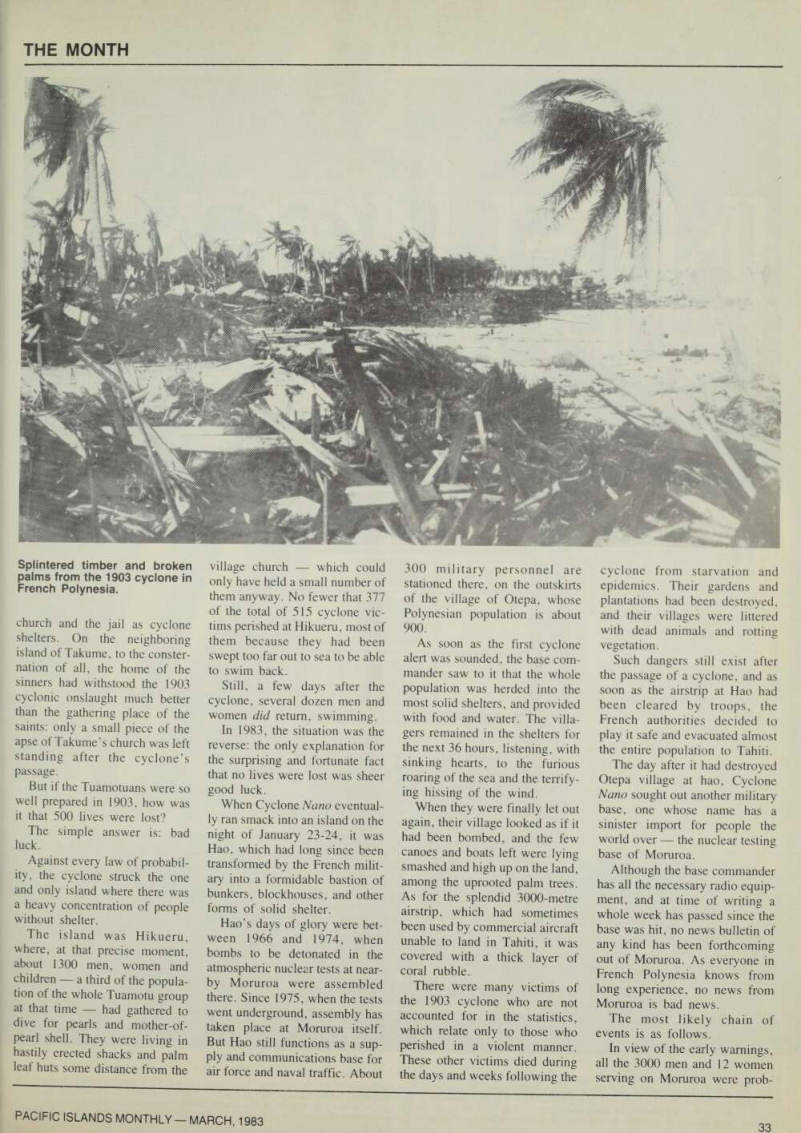
Splintered timber and broken palms from the 1903 cyclone in French Polynesia.
ably able to take shelter in good time on the 23 four-and-a-half metre high platforms erected two years ago on the reef near the village, with precisely such an emergency in mind. They all
probably escaped relatively un
hurt, without any other problem than the destruction of their liv ing quarters. It is also possible that by some miracle the drilling platform erected in the waters of the lagoon withstood the fierce onslaught of hurricane-force winds and waves.
But there remains the terrible problem of the huge amounts of nuclear waste which for years have been piling up on Moruroa’s north coast, and which now and then have spilled over into the ocean and even been carried to foreign shores.
The Moruroa base people should at least tell us how much of this
lethal stuff some of it consists
of plutonium was dispersed
by Cyclone Nano, and what mea sures are comtemplated to meet similar situations in the future.
Looking at the other islands in the Tuamotu group, there is not much difference at all between the ravages caused by the two
cyclones occurring 80 years
apart. The shelters available to the islanders are also the same
although the prisons have long
since disappeared with the ad vent of a more secular and de mocratic form of government.
But on the other hand the number of churches has increased many times over, due to the ever in
creasing competition from new
sects. Whatever divisions and bitterness they cause, the new churches serve the whole com munity in times of natural disas ters, and their multiplication in
fact corresponds to the needs of a population which has at least doubled since 1903.
Finally, we can now clearly see that the 1903 cyclone destroyed not only human lives, but also speeded up the erosion of the traditional Polynesian culture. Polynesian-type houses, canoes, fishing gear and tools were carried away and replaced with houses and gear of European materials and manufacture. innumerable manuscripts in which the islanders had written down genealogies and other ancient lore as soon as the missionaries had taught them the three Rs were lost. More often than not, the islanders who perished were elderly people, who had acted as repositories and transmitters of the Polynesian culture.
The mass media have already
announced that the Hao islan ders, evacuated by the army to Tahiti, “have settled down hap pily in their new surroundings”, which, unfortunately, most like ly means that they will be staying for good. Their ranks are already
being rapidly swelled by other
“refugees” from the Tuamotus
whose only justification for
abandoning their home islands is the awful fright Nano has given them and their apparently com plete unawareness that such dis asters occur in this part of the Pacific at most once in a lifetime.
Unfortunately, moving from
the relative security of life on their home islands to the urban, Western-style life they find at tractive in Papeete, means for most Polynesians a journey on a one-way ticket to poverty and
disarray.
Marie-Thérèse and
Bengt Danielsson.