Hawaii: Pacific
pp. 43-45 · Read in the full issue
connections
A View from Honolulu Robert C. Kiste
In the early 1880 s Hawaii’s King Kalakaua and his Premier Walter Murray Gibson looked to the islands to the south with a vision of creating a grand Polynesian Confederacy, in which the Hawaiian kingdom would be “primarily in the family of Poly nesian states’’. The dream was short-lived, and with the collapse
of the monarchy and the later annexation of the islands by the United States in 1898, political and economic interests tied Hawaii to the American mainland.
During World War 11, Hawaii served as a staging area for the American war effort in the Pacif ic and Asia.
Afterwards, some individuals and institutions in Hawaii played roles in the administration of the U.S. Trust Territory, and for a few years the small and distant islands of Micronesia were gov erned from Fort Ruger in the hills behind Honolulu’s Diamond Head.
Hawaii’s basic orientation did not change, however, and with the coming of statehood in 1959, Hawaii identified even more closely with the U.S.: its people, as citizens of the 50th state, thought little of their place at the apex of the Polynesian triangle.
Business interests, and the concerns of officialdom in Washington, DC, did not en courage Hawaii to think of itself as a part of the Pacific, or urge it to play a role in the region. In fact, as long as U.S. defence interests were preserved, the Pacific was taken for granted and was considered to be a relatively unimportant backwater of the world.
For a time, the vast changes which swept the Pacific in the 1960 s and 1970 s drew little in the way of an American re sponse. However, the decolon
isation of the Pacific, and all its attendant implications, could not be long ignored, and, by 1978, there were several signs that
Washington recognised the trans
formations that were occurring.
Then Vice-President Walter Mondale made a goodwill tour of the region. For the first time, an office of Pacific Islands Affairs was established in the U.S. De partment of State. Ambassadors with multiple accreditation were posted to embassies in Fiji and Papua New Guinea, and an aid program was initiated by the U.S. Agency for International Development. An air of some excitement surrounded these in itiatives, and talk about a Pan- Pacific Community was heard in government and business circles.
Inevitably, Hawaii was caught
up in this American rediscovery of the Pacific. Public statements by Governor Ariyoshi and other state officials projected a role for Hawaii in the region but just what forms this might take re
mains unspecified.
Three international confer
ences on Pacific affairs have been held in Honolulu, and each has resulted in the formation of a new organisation. In January, 1979, the first annual Pacific Telecommunications Conference met to discuss a wide variety of technical, political, economic and social issues. The following year, the Pacific Telecommuni cations Council (PTC), a private corporation, was formed with headquarters in Honolulu. The fifth annual conference was held during the third week of January this year.
In February, 1980, the U.S.
Department of Commerce spon sored the Pacific Basin Develop ment Conference to promote economic development and co operation among the “American flag” islands. Following the con ference, the governors of Ameri can Samoa, Guam, Hawaii, and the Commonwealth of the North ern Marianas formed the Pacific Basin Development Council (PBDC) to co-ordinate develop ments among the American is lands. Its secretariat is also
located in Honolulu, and Gover nor Ariyoshi wa selected as its first chairman. The council’s next annual meeting is scheduled for the first week of March, 1983, in Washington, DC. More will be reported in this column about the PBDC and PTC and
their undertakings.
Fast upon the heels of PBDC in March, 1980, the East-West Center (EWC) sponsored the “Pacific Islands Conference: De velopment the Pacific Way”. As reported in PIM, May, 1980, the event was large in scope, bring ing together leaders of more than 20 Pacific nations and territories, including 12 heads of govern ment. The conference was chaired by Fiji’s Prime Minister Ratu Sir Kamisese K. T. Mara and was intended to provide a forum for Pacific leaders to chart mutually agreed research and de
velopment strategies.
To ensure follow-up to the conference, a standing commit tee was formed. It is also chaired by Ratu Mara and has five other members: the president of Kiribati, the prime ministers of the Cook Islands and Papua New Guinea, a representative of the PBDC, and the Vice-President du Conseil de Gouvernement, Territory of New Caledonia and
Dependencies.
Within the EWC, the Pacific
Islands Development Program
(PIDP) was created to serve as
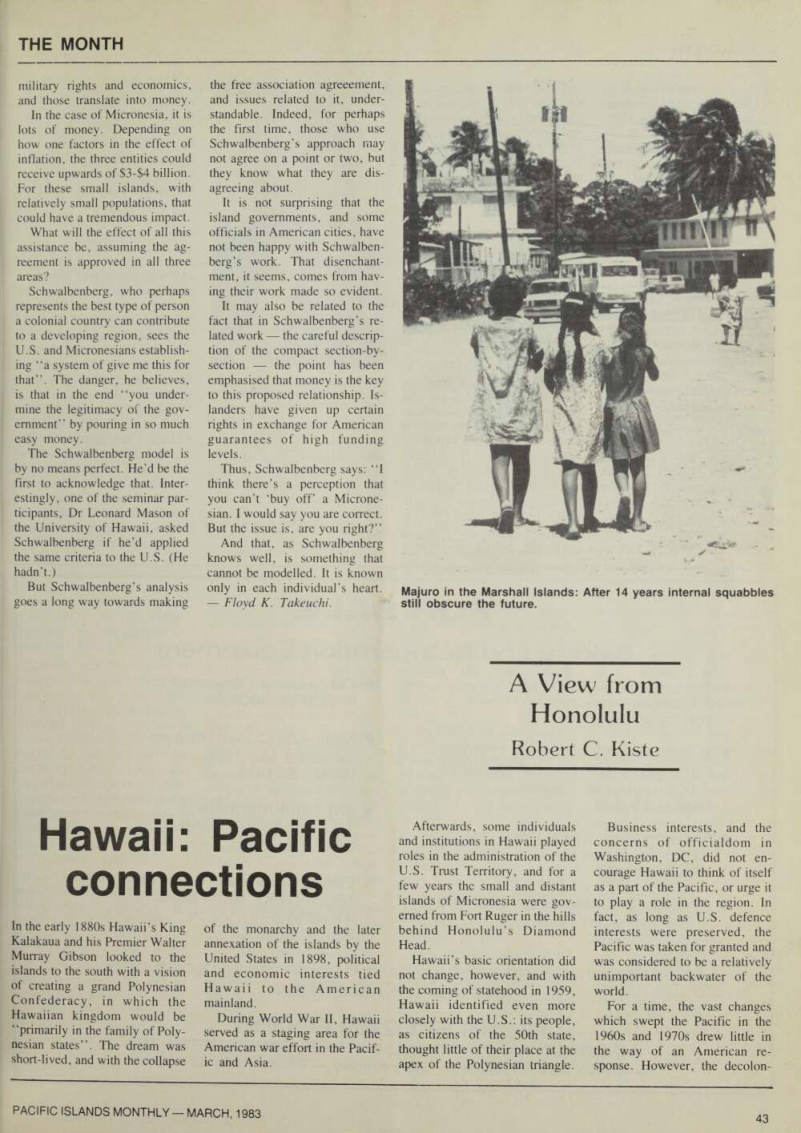
Fiji Prime Minister Ratu Sir Kamisese Mara who chaired the 1980 Pacific conference.
the secretariat to the standing committee and to develop, ad minister, and obtain funding for projects as designated by the latter. Dr. S. Langi Kavaliku, a minister with several portfolios in Tonga, serves as secretary general to the conference and the PIDP. In early 1981, Mr James Makasiale, a former divisional commissioner in Fiji, was ap pointed as administrator of PIDP (PIM May 1981).
The 1980 conference marked a revival of the EWC’s interest in the Pacific. During the EWC’s first decade of existence in the 1960 s a major effort was made to involve Pacific Islanders in short-term practical skills train ing programs. During the decade of the 19705, Islands students took academic degree programs at the University of Hawaii (UH) with financial support from the EWC, but the Center had no special focus on the Pacific region.
As the PIDP gained momen tum, interest in the Pacific in creased. In early 1982, Mr Wil liam Bodde, former American ambassador to Fiji, and Dr.
Macu Salato, former Secretary- General of the South Pacific Commission, took appointments in the EWC’s new Diplomat-in- Residence program and have as sisted with Pacific affairs.
The new year has ushered in more Pacific activity. During the week of January 16-22, 1983, and in an effort separate from the PIDP, the EWC in co-operation with the UH sponsored a “Pacif ic Islands Area Seminar’’ for mid-level diplomats and ad ministrators with professional in terests in the region. Ambassador Bodde served as the seminar’s co-ordinator. It is covered by Floyd K. Takeuchi in an article in this issue of PIM.
The following week, on January 24-25, the Pacific Is lands Conference Standing Com mittee held its sixth meeting since its inception in 1980. (Of the previous five, one was in Fiji and a second in American Samoa; three were conducted via Peacesat). In addition to Chair man Ratu Mara, in attendance were Governor Coleman, Prime Ministers Davis and Somare, and Mr Ata Teaotai, secretary to the
cabinet, Kiribati, who represent ed his country during the politic al hiatus there. New Caledonia was not represented.
The first day of the commit tee’s meeting was open to invited observers. According to estab lished procedures, the standing committee makes known what projects it wishes to have de veloped. The staff of PIDP under the direction of its research co ordinator, Dr. Michael Hamnett, prepares project proposals. The standing committee accepts, modifies, or rejects proposals and monitors projects in prog ress. On this occasion, the open meeting was devoted to a review of 10 projects ranging from those that are well advanced to others still on the drawing board.
Of the more advanced efforts, a research project on achieve ments in regional co-operation is being conducted jointly with the Institute of Pacific Studies, Un iversity of the South Pacific with IPS playing the lead role. The project was to culminate with a conference on Pacific Regional Development in Apia between February 23 and March 3. Con ference papers are scheduled for publication.
A survey of energy needs and alternatives co-sponsored by the Australian National University, the South Pacific Bureau for Economic Co-operation, the Un ited Nations Development Prog ram, and the European Economic Community is also well advanc ed. More than a year’s research has been conducted on the capabilities of Islands countries
to respond to natural disasters. A case study inventory of aquacul ture projects and their relative success or lack thereof is near completion. A project which will certainly attract atten tion is the gathering of data on the hazards of nuclear waste materials, and ensuing questions of long-term legal respon sibilities. Other projects concern tilapia (freshwater fish) farming, the magnetic orientation of tuna, government and administrative systems, the role of muli national corporations, and the problems of small business ventures.
The second day’s meeting was closed to observers. But it was leaned that Mr Makasial was due to return to Fiji at the beginning of March to become permanent secretary in that country’s ag riculture ministry. There was speculation that Dr Salato may shed his diplomatic hat to be come PIDP’s interim adminis trator while the EWC searches for a replacement. It was also rumored that a second Pacific Islands Conference will be held some time in 1984.
How can one assess PIDP after less than three years of opera tion? At the South Pacific Confe ence in Port Moresby in October, 1980, fears were expressed that PIDP represented the emergence of yet another regional organisa tion that would duplicate existing
efforts and place yet another drain on the limited time and manpower of Pacific countries.
Worse, PIDP would turn out to be an American-dominated in stitution insensitive to the needs of the region.
To date, this does not seem to be the case. The strength of PIDP is probably to be found in pro jects undertaken in collaboration with other regional institutions.
As long as projects are delineated and monitored by the standing committee, PIDP can be used to generate useful information and perhaps outline potential de
velopment strategies for consid
eration by decision-makers in the region. As in all such efforts, there is always a problem of getting information into the right hands and in useable form.
Indeed, PIDP seems to be off to a promising start. It is general ly acknowledged that once he had mastered the peculiarities of American culture as manifested in an American bureaucracy, Mr Makasiale has shown consider able administrative skill and has been responsible for much of PIDP’s success.
As for the future, there is certainly always the danger that, being embedded in an American institution, PIDP will take on a life of its own that is self-serving and less sensitive to the real needs of the region. It is too early to tally up the score, and much will be determined by the qual ities and skills of Makasiale’s successor.
The future also rests in the standing committee and the amount of direction and control that is maintained over PIDP.
The committee’s meeting in January was marked by a spirit of co-operation, and concern for the region as a whole. There was no doubt, however, that Ratu Mara was the dominant force, and much of the future must also rest with his leadership.
In the meantime as the U.S. and various institutions in the country attempt to define their roles in the Pacific, those in Honolulu with interests in the
region talk knowingly about
Pidp, Ptc, Ewc, Pbdc, Along
with the SPC, SPEC, etc.
Kalakaua’s dream was simple all this is simply confusing at
times.
Robert C. Kiste.
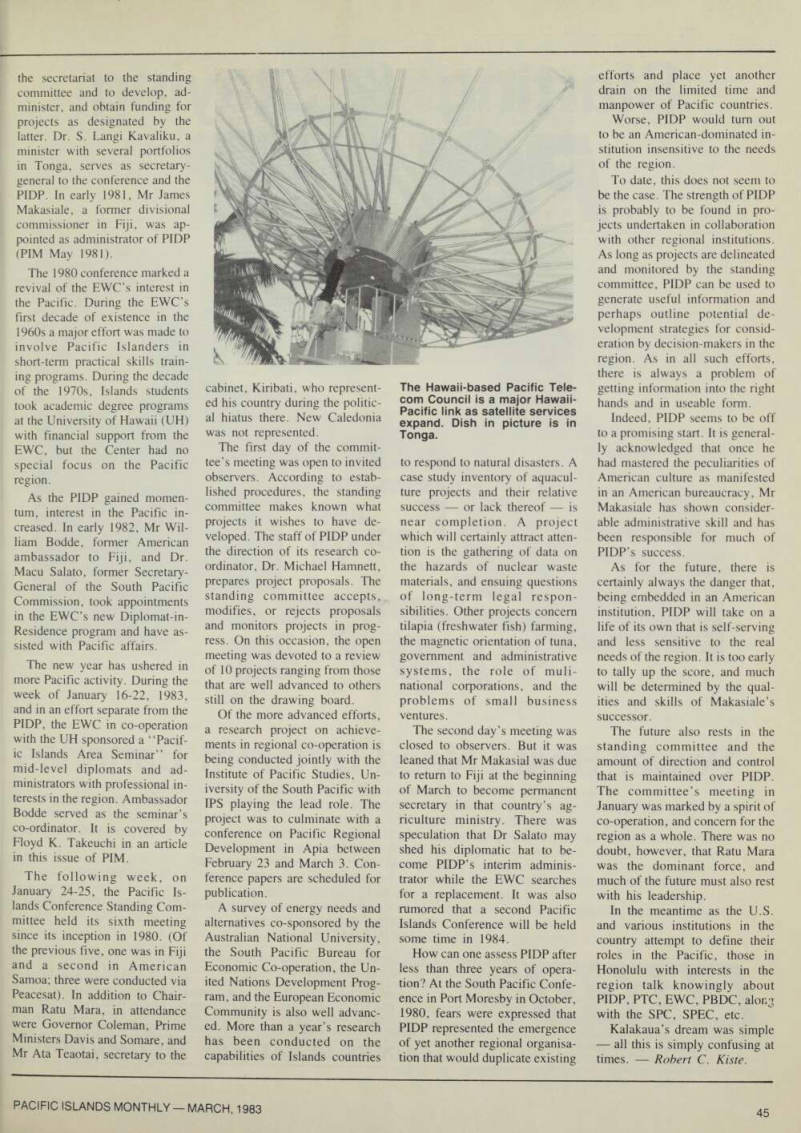
The Hawaii-based Pacific Tele com Council is a major Hawaii- Pacific link as satellite services expand. Dish in picture is in
Tonga.