Controversial, but Muldoon has
pp. 23-25 · Read in the full issue
Political Currents
Controversial, but Muldoon has successful tour of PNG
in Pacific Islands terms Robert Muldoon and Michael Somare are not just ordinary leaders.
Both of them have managed to accumulate that little extra bit of
legend or reputation some
times good, sometimes bad which puts them outside the
ranks of ordinary leadership.
Mr Muldoon, as prime minis ter of New Zealand, leads a country which represents the de veloped nations of the Pacific.
Geographically it is an island country, but politically it is not one of the Pacific Islands states.
Part of the controversy which surrounds Mr Muldoon stems from his alleged attitudes to wards the Islands states. The suggestion is that he gives lip service to Pacific coexistence and provides a relatively gener ous measure of aid, but at the same time stands aloof from a real involvement. He has re ceived wide publicity on a num ber of occasions for criticising
Allegations that Prime Minister Muldoon of New Zealand had snubbed Prime Minister Somare of Papua New Guinea failed to disrupt a successful Muldoon tour of PNG in February. The two leaders discussed aid and regionalism.
some regional conferences as a waste of money and time.
Mr Somare, as prime minister of Papua New Guinea, leads a country which is the biggest of the Pacific Island states. Many foreign observers who meet him for the first time come away puzzled. Thy are not sure whether they have met a particu larly naive national leader, or an incredibly devious politician who has sidestepped the contentious issues of the moment. His rela tionships with New Zealand and Australia are good, but from time to time he has not hesitated to be highly critical of specific aspects of these relationships.
It was against this background that the two prime ministers re
met in February when Mr Mul doon made an official visit to PNG. Mr Muldoon had previous ly visited PNG, with a number of other Pacific leaders, a few years earlier. Mr Somare, for his part, had visited New Zealand a little less than three years ago.
It was typical of the controver sy which so often surrounds Mr Muldoon that his PNG visit was no exception. While he was still in the country he was accused through a newspaper article of having insulted Mr Somare.
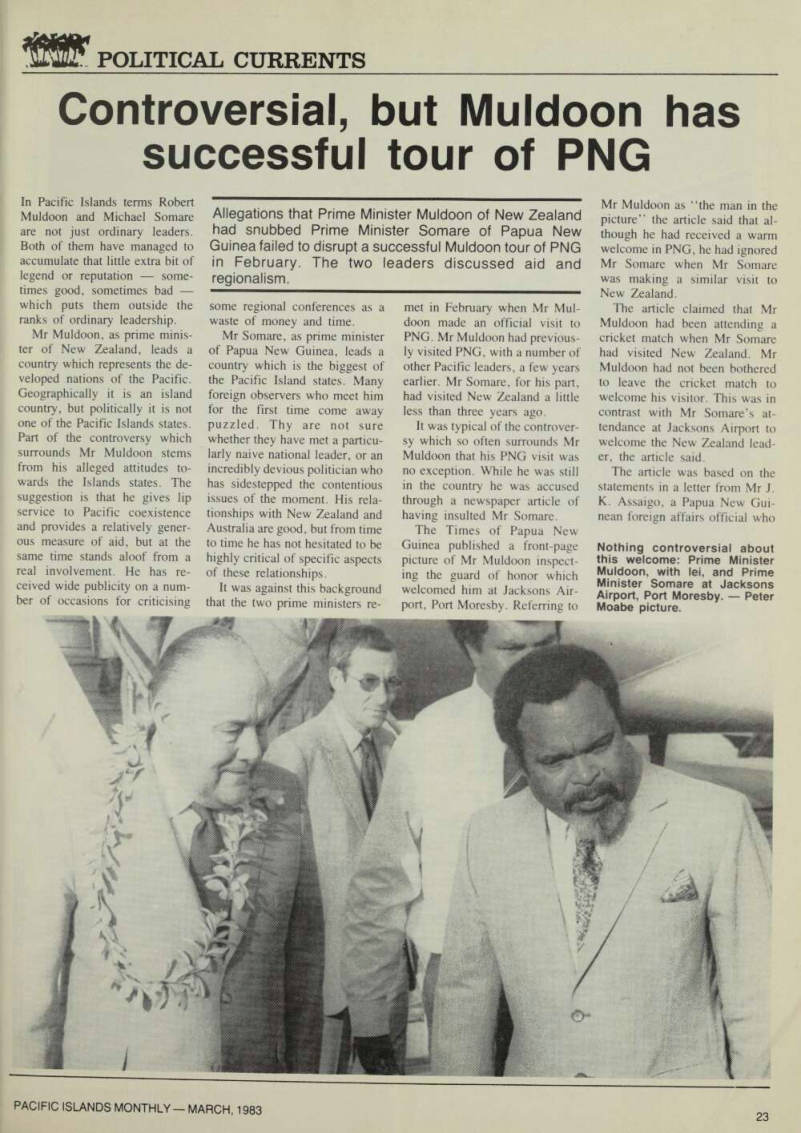
The Times of Papua New Guinea published a front-page picture of Mr Muldoon inspect ing the guard of honor which welcomed him at Jacksons Air port, Port Moresby. Referring to
Mr Muldoon as “the man in the picture” the article said that al though he had received a warm welcome in PNG, he had ignored Mr Somare when Mr Somare was making a similar visit to New Zealand.
The article claimed that Mr Muldoon had been attending a cricket match when Mr Somare had visited New Zealand. Mr Muldoon had not been bothered to leave the cricket match to welcome his visitor. This was in contrast with Mr Somare’s at tendance at Jacksons Airport to welcome the New Zealand lead er, the article said.
The article was based on the statements in a letter from Mr J.
K. Assaigo, a Papua New Gui nean foreign affairs official who
Nothing controversial about this welcome: Prime Minister Muldoon, with lei, and Prime Minister Somare at Jacksons
Airport, Port Moresby. - Peter
Moabe picture.
had been serving in New Zealand during the Somare visit.
Mr Assaigo said he had spo ken out because he believed too many Papua New Guineans were unaware of the treatment which Mr Muldoon had handed out to Mr Somare. Mr Assaigo accused Mr Muldoon of wanting to play the big man in South Pacific affairs. As part of this policy he
was consistently opposing the
regional policies of Mr Somare and of the Fiji prime minister, Ratu Sir Kamisese Mara.
The accusations in the paper appeared to be the only blot in an otherwise highly successful visit in which relations between the two leaders were amicable and matters of mutual interest were discussed. Mr Muldoon denied to journalists that he had shown discourtesy to Mr Somare. He
obtained a telephone briefing
from officials in Wellington and said that the accusations were not founded in fact. He said he found the accusations personally em barrasing, and he believed they were equally embarrassing to Mr Somare who was conversant with the protocol of New Zealand and PNG. Mr Somare did not com ment directly on the incident, but
spoke of the success and the established accord of the Mul doon visit.
Aid from New Zealand to PNG and regional matters affect ing both countries were the main items discussed by the two lead ers during the visit. Mr Muldoon and Mr Somare both commented on the success of their talks.
New Zealand aid to PNG at present represents about $2.6 million a year, but Mr Muldoon indicated the amount was under review and was likely to be in creased. New Zealand aid is in the form of tied grants, that is the money is made available for specific projects rather than as
unspecified budget support.
However it became apparent from the Muldoon-Somare talks that the concept of tied aid in itself is acceptable provided it is administered with sensitivity and consultation. There appeared to be no criticism from PNG about the manner in which the New Zealand aid was being administered.
Some Australian officials are known to be critical of the heavy goodwill value which New Zea land appears to extract from its aid. The handing over of water
craft or the opening of a building attracts wide publicity because of its individual interest whereas Australia’s massive bulk aid for the PNG budget escapes public attention.
Mr Muldoon has not committ ed his country to a specified increase in aid, but announced that future aid “is likely to go up rather than go down.” One de velopment which will divert ad ditional aid is the end of a geoth ermal project which New Zea land has been supporting in Indonesia.
Mr Muldoon said that New Zealand was restructuring its in ternational aid to concentate on the South Pacific, and this would have benefits for PNG. It would be largely up to PNG to deter mine how the aid should be spent, Mr Muldoon said.
Mr Muldoon spent four days in PNG, and inspected some of the aid projects already establish ed with New Zealand aid. These
included an experimental sheep
smallholding, a timber training
centre and a bee-keeping venture.
He was guest at a dinner host ed by Mr Somare in which Mr
Somare said that New Zealand aid was an appreciated ingredient of PNG development. Mr So mare also said that a number of New Zealand companies in PNG were contributing to
development.
Answering suggestions that
New Zealand had kept aloof from the Pacific community, Mr Somare said he believed there had been big changes in recent years. He saw New Zealand as working towards a much closer relationship with the Pacific
community.
Mr Somare made brief refer ence to the trade imbalance bet ween PNG and New Zealand, but said he was aware of moves to reduce the imbalance. The ratio at present favors New Zea land by 10 to one. Mr Somare said that one of the moves to improve the trade ratio was in the South Pacific Regional Trade and Economic Co-operation Agreement.
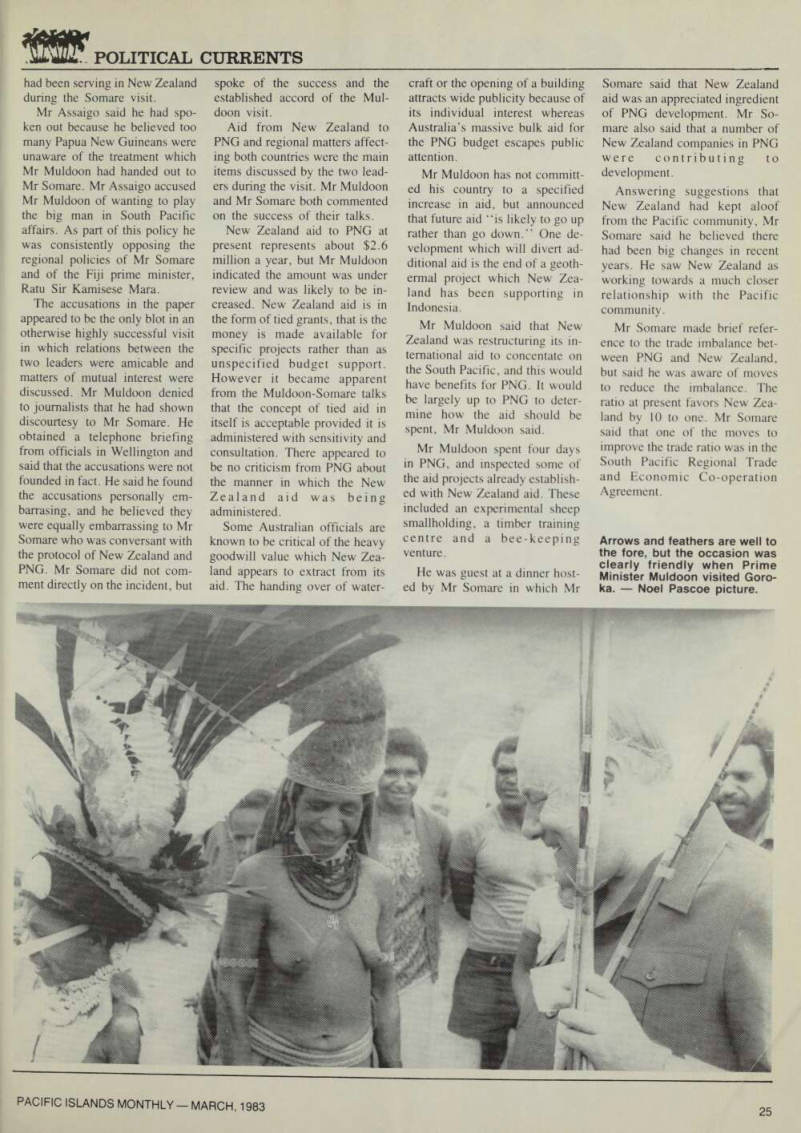
Arrows and feathers are well to the fore, but the occasion was
clearly friendly when Prime
Minister Muldoon visited Goro
ka. - Noel Pascoe picture.