Maori art goes
p. 22 · Read in the full issue
to New York
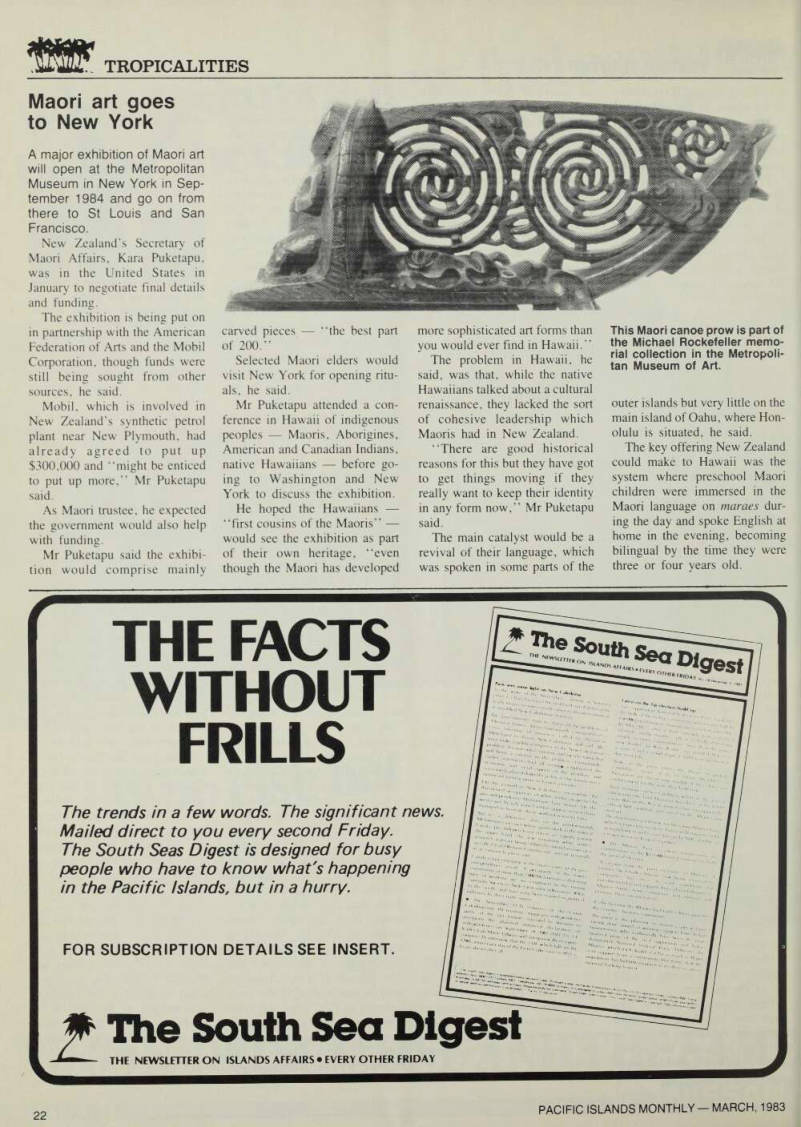
A major exhibition of Maori art will open at the Metropolitan Museum in New York in Sep tember 1984 and go on from there to St Louis and San Francisco.
New Zealand’s Secretary of Maori Affairs, Kara Puketapu, was in the United States in January to negotiate final details and funding.
The exhibition is being put on in partnership with the American Federation of Arts and the Mobil Corporation, though funds were still being sought from other sources, he said.
Mobil, which is involved in New Zealand's synthetic petrol plant near New Plymouth, had already agreed to put up $300,000 and “might be enticed to put up more,” Mr Puketapu said.
As Maori trustee, he expected the government would also help with funding.
Mr Puketapu said the exhibi tion would comprise mainly
carved pieces “the best part of 200.”
Selected Maori elders would visit New York for opening ritu als, he said.
Mr Puketapu attended a con ference in Hawaii of indigenous
peoples Maoris, Aborigines,
American and Canadian Indians, native Hawaiians before go ing to Washington and New York to discuss the exhibition.
He hoped the Hawaiians “first cousins of the Maoris” would see the exhibition as part of their own heritage, “even though the Maori has developed
more sophisticated art forms than you would ever find in Hawaii.”
The problem in Hawaii, he said, was that, while the native Hawaiians talked about a cultural renaissance, they lacked the sort of cohesive leadership which Maoris had in New Zealand.
“There are good historical reasons for this but they have got to get things moving if they
really want to keep their identity
in any form now,” Mr Puketapu said.
The main catalyst would be a revival of their language, which was spoken in some parts of the
outer islands but very little on the main island of Oahu, where Hon olulu is situated, he said.
The key offering New Zealand could make to Hawaii was the system where preschool Maori children were immersed in the Maori language on maraes dur ing the day and spoke English at home in the evening, becoming
bilingual by the time they were
three or four years old.
This Maori canoe prow is part of the Michael Rockefeller memo rial collection in the Metropoli tan Museum of Art.