The Maori-China
pp. 18-21 · Read in the full issue

Connection?
Over the years, certain New Zea
land ethnologists have suggested
a Chinese influence in the art of the Maori, particularly in the art of classic Maori woodcarving.
But archaeologists deny the pos sibility. Classic Maori art, they
claim, is completely indigenous,
its uniquely complex style hav ing its origins in 1000 years of evolution from a simple eastem-
Polynesian naturalism dating
back to about the ninth century AD.
For New Zealand archaeolog ists, there is neither romance nor mystery in Maori pre-history.
Theirs is a relentless scientific discipline that allows little room
for imaginative speculation. If
there are “lacunae in the re cord”, they will ultimately be resolved with dendrochronology,
Cl 4 carbon dating, and other
scientific methods. The highly
subjective, comparative studies
of ethnologists into Maori art are anathema to them. So, too, is
any close ethnological scrutiny
of archaeological “lacunae” re lating to the origins of classic Maori culture.
As a result of the discovery of what is believed to be the wreck of a Portuguese or Spanish caravel off the coast of New Zealand’s North Island (PIM Ju ly ’B2 p 27), the lacunae of ar chaeology have become a lively issue. Some ethnologists see the possibility that the wreck is the answer to the “enigma” of class ic Maori cultural development from the 14th century, a develop ment of extraordinary sudden ness and power. In archaeologic al terms, New Zealand’s pre historic sequence from archaic to classic Maori was remarkably
abrupt, embodying cultural
changes unprecedented else
where in Polynesia.
Archaeology, according to Peter Bellwood (in Man’s Con quest of the Pacific, 1978), can not explain it. However, despite Bellwood’s opinion to the con trary, some ethnologists believe that the sudden change was brought about by “outside con tact’’, probably Chinese navigators, whose ship, or sea going junk ( chiangsu ), has er-
roneously been identified as a
16th-century caravel.
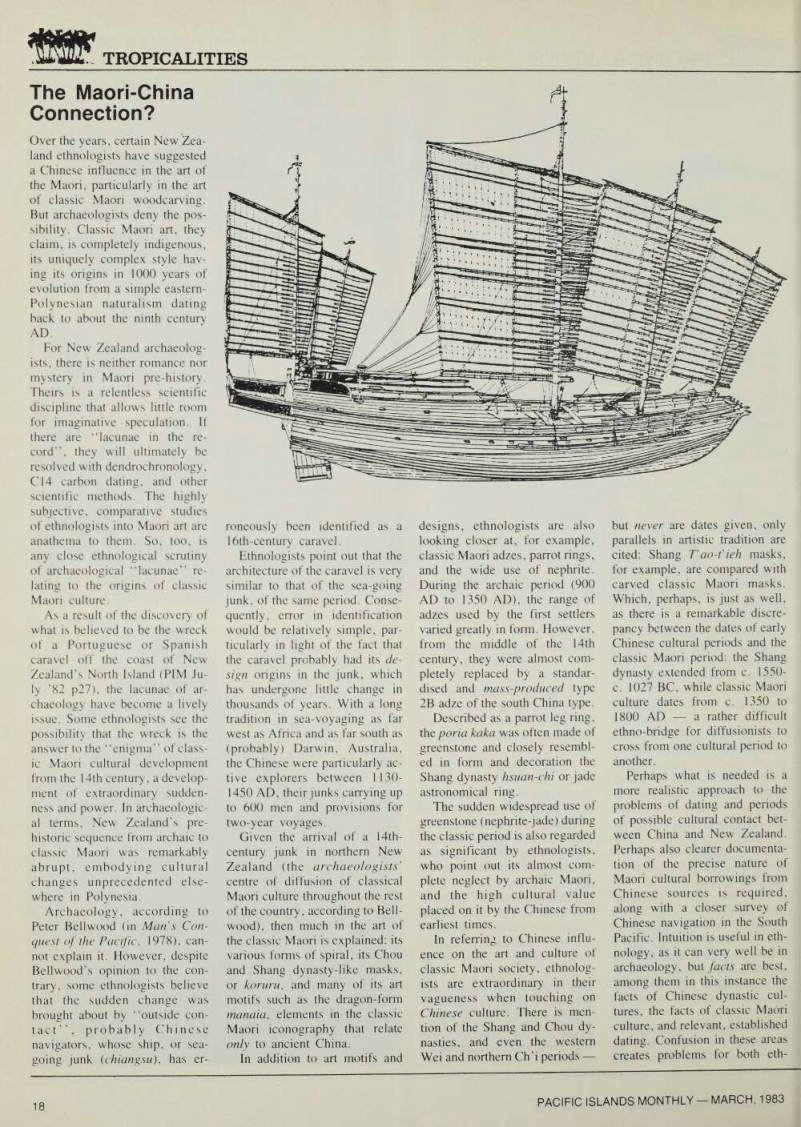
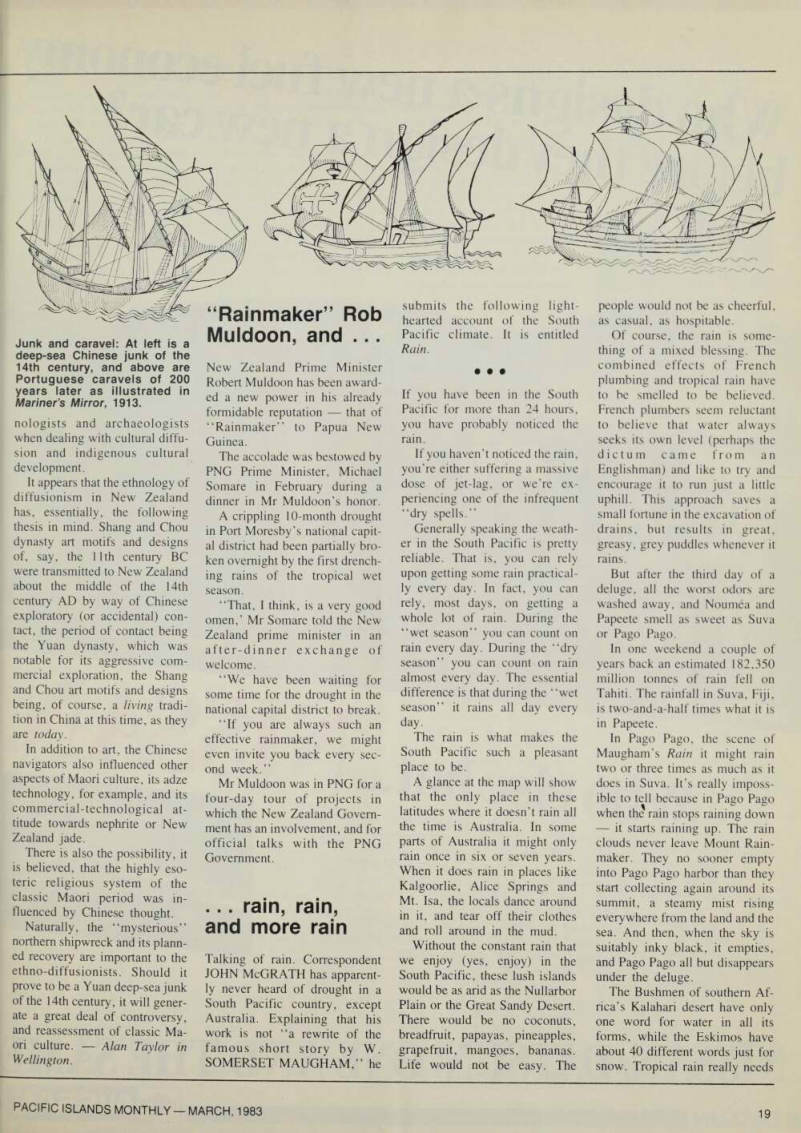
Ethnologists point out that the architecture of the caravel is very similar to that of the sea-going junk, of the same period. Conse quently, error in identification would be relatively simple, par ticularly in light of the fact that the caravel probably had its de sign origins in the junk, which has undergone little change in thousands of years. With a long tradition in sea-voyaging as far west as Africa and as far south as (probably) Darwin, Australia, the Chinese were particularly ac tive explorers between 1130- 1450 AD, their junks carrying up to 600 men and provisions for two-year voyages.
Given the arrival of a 14th century junk in northern New Zealand (the archaeologists’ centre of diffusion of classical Maori culture throughout the rest of the country, according to Bell wood), then much in the art of the classic Maori is explained: its various forms of spiral, its Chou
and Shang dynasty-like masks,
or koruru, and many of its art motifs such as the dragon-form manaia, elements in the classic Maori iconography that relate only to ancient China.
In addition to art motifs and
designs, ethnologists are also looking closer at, for example, classic Maori adzes, parrot rings, and the wide use of nephrite.
During the archaic period (900 AD to 1350 AD), the range of adzes used by the first settlers varied greatly in form. However, from the middle of the 14th century, they were almost com pletely replaced by a standar dised and mass-produced type 2B adze of the south China type.
Described as a parrot leg ring, the poria kaka was often made of greenstone and closely resembl ed in form and decoration the Shang dynasty hsuan-chi or jade astronomical ring.
The sudden widespread use of greenstone (nephrite-jade) during the classic period is also regarded as significant by ethnologists, who point out its almost com plete neglect by archaic Maori, and the high cultural value placed on it by the Chinese from earliest times.
In referring to Chinese influ ence on the art and culture of classic Maori society, ethnolog ists are extraordinary in their vagueness when touching on Chinese culture. There is men tion of the Shang and Chou dy nasties, and even the western Wei and northern Ch’i periods
but never are dates given, only parallels in artistic tradition are cited: Shang Tao-t’ieh masks, for example, are compared with carved classic Maori masks.
Which, perhaps, is just as well, as there is a remarkable discre pancy between the dates of early Chinese cultural periods and the classic Maori period: the Shang dynasty extended from c. 1550c. 1027 BC, while classic Maori culture dates from c. 1350 to 1800 AD a rather difficult ethno-bridge for diffusionists to cross from one cultural period to another.
Perhaps what is needed is a more realistic approach to the
problems of dating and periods
of possible cultural contact bet ween China and New Zealand.
Perhaps also clearer documenta tion of the precise nature of Maori cultural borrowings from Chinese sources is required, along with a closer survey of Chinese navigation in the South Pacific. Intuition is useful in eth nology, as it can very well be in archaeology, but facts are best, among them in this instance the facts of Chinese dynastic cul tures, the facts of classic Maori culture, and relevant, established dating. Confusion in these areas creates problems for both eth-
nologists and archaeologists when dealing with cultural diffu sion and indigenous cultural development.
It appears that the ethnology of diffusionism in New Zealand has, essentially, the following thesis in mind. Shang and Chou dynasty art motifs and designs of, say, the 11th century BC were transmitted to New Zealand about the middle of the 14th century AD by way of Chinese exploratory (or accidental) con tact, the period of contact being the Yuan dynasty, which was notable for its aggressive com mercial exploration, the Shang and Chou art motifs and designs being, of course, a living tradi tion in China at this time, as they are today.
In addition to art, the Chinese navigators also influenced other aspects of Maori culture, its adze technology, for example, and its
commercial-technological at
titude towards nephrite or New Zealand jade.
There is also the possibility, it is believed, that the highly eso teric religious system of the classic Maori period was in fluenced by Chinese thought.
Naturally, the “mysterious” northern shipwreck and its plann ed recovery are important to the ethno-diffusionists. Should it prove to be a Yuan deep-sea junk of the 14th century, it will gener ate a great deal of controversy, and reassessment of classic Ma ori culture. Alan Taylor in Wellington.
“Rainmaker” Rob
Muldoon, and ...
New Zealand Prime Minister Robert Muldoon has been award ed a new power in his already formidable reputation that of “Rainmaker” to Papua New Guinea.
The accolade was bestowed by PNG Prime Minister, Michael Somare in February during a dinner in Mr Muldoon’s honor.
A crippling 10-month drought
in Port Moresby’s national capit al district had been partially bro ken overnight by the first drench ing rains of the tropical wet season.
“That, I think, is a very good omen,’ Mr Somare told the New Zealand prime minister in an after-dinner exchange of welcome.
“We have been waiting for some time for the drought in the national capital district to break.
“If you are always such an effective rainmaker, we might even invite you back every sec ond week.”
Mr Muldoon was in PNG for a four-day tour of projects in which the New Zealand Govern ment has an involvement, and for official talks with the PNG Government.
... rain, rain,
and more rain
Talking of rain. Correspondent
JOHN McGRATH has apparent ly never heard of drought in a South Pacific country, except Australia. Explaining that his work is not “a rewrite of the famous short story by W.
Somerset Maugham,” He
submits the following light
hearted account of the South Pacific climate. It is entitled Rain. • • • If you have been in the South Pacific for more than 24 hours, you have probably noticed the rain.
If you haven’t noticed the rain, you’re either suffering a massive dose of jet-lag, or we’re ex periencing one of the infrequent
“dry spells.’’
Generally speaking the weath
er in the South Pacific is pretty reliable. That is, you can rely upon getting some rain practical ly every day. In fact, you can
rely, most days, on getting a
whole lot of rain. During the “wet season” you can count on
rain every day. During the “dry
season” you can count on rain almost every day. The essential difference is that during the “wet season” it rains all day every
day.
The rain is what makes the South Pacific such a pleasant place to be.
A glance at the map will show that the only place in these latitudes where it doesn’t rain all the time is Australia. In some parts of Australia it might only rain once in six or seven years.
When it does rain in places like
Kalgoorlie, Alice Springs and
Mt. Isa, the locals dance around in it, and tear off their clothes and roll around in the mud.
Without the constant rain that
we enjoy (yes, enjoy) in the
South Pacific, these lush islands would be as arid as the Nullarbor Plain or the Great Sandy Desert.
There would be no coconuts, breadfruit, papayas, pineapples, grapefruit, mangoes, bananas.
Life would not be easy. The
people would not be as cheerful, as casual, as hospitable.
Of course, the rain is some thing of a mixed blessing. The combined effects of French plumbing and tropical rain have to be smelled to be believed.
French plumbers seem reluctant to believe that water always seeks its own level (perhaps the dictum came from an Englishman) and like to try and encourage it to run just a little uphill. This approach saves a small fortune in the excavation of drains, but results in great, greasy, grey puddles whenever it rains.
But after the third day of a deluge, all the worst odors are washed away, and Noumea and Papeete smell as sweet as Suva or Pago Pago.
In one weekend a couple of years back an estimated 182,350 million tonnes of rain fell on Tahiti. The rainfall in Suva, Fiji, is two-and-a-half times what it is in Papeete.
In Pago Pago, the scene of Maugham’s Rain it might rain two or three times as much as it does in Suva. It’s really imposs ible to tell because in Pago Pago when the rain stops raining down it starts raining up. The rain clouds never leave Mount Rain maker. They no sooner empty into Pago Pago harbor than they start collecting again around its summit, a steamy mist rising everywhere from the land and the sea. And then, when the sky is suitably inky black, it empties, and Pago Pago all but disappears under the deluge.
The Bushmen of southern Af rica’s Kalahari desert have only one word for water in all its forms, while the Eskimos have about 40 different words just for snow. Tropical rain really needs
Junk and caravel: At left is a deep-sea Chinese junk of the 14th century, and above are Portuguese caravels of 200 years later as illustrated in Mariner’s Mirror, 1913.
a similarly expanded vocabulary
to do justice to its variety.
There’s the soft sprinkle show er. The sun is barely concealed behind a fleecy cloud, or may even be shining through the rain.
This is the very best time to walk around. You become a sort of air-conditioned pedestrian, a water-cooled ambulator. Your clothes (of course you’re wearing pure cotton) dry out in the warmth just about as fast as they get wet. And what our science teachers pompously called the “latent heat of vaporisation’’ transfers your body heat from the skin to the cotton and thence to the air with a consequent drop in skin temperature and a delightful sensation of coolness.
The next step up the rain scale is just as pleasant it’s rather too heavy to walk around in, and so provides an excellent excuse to sit around and do nothing.
Great weather for sipping gin and tonic you might even care to try it in the old Pacific style short, no ice, the tonic at room temperature. That’s the way the drink was invented in the days before refrigeration, and it’s sur
prisingly refreshing and very
tasty.
Rainy days like these are espe cially pleasant in the bars and sidewalk cafes of Papeete.
Tahitians don’t give a damn about getting wet, so the passing parade of brightly dressed, gaily
chatting Polynesians continues.
And in the bars around the “quartier latin” you are sure to find small groups singing, and
maybe dancing, to a couple of
guitars or ukeleles.
Then there’s rain Suva-style which happens all over the Pacific, but especially in Suva.
This rain comes crashing
down, completely obscuring the
landscape and drowning out ev ery sound other than its own stupendous percussion. Especial ly pleasant at night provided you’re snug indoors with some
whisky, and maybe some pleas
ant company.
Definitely not weather for
strolling in. And driving is right
out of the question.
Pago Pago-style rain is like Suva rain, but magnified about five times. A fantastic downpour that falls so heavily and so fast that the percussive effect is blurr
ed into one great continuous rushing roar. The water literally pours out of the sky a foot
loose Niagara.
Sweetest of all, perhaps, is the scattered, pattering rain that comes at the end of a heavy deluge and signals that the rain is being blown away.
There are random musical ef fects as light breezes move the rain this way and that. A tinkling concerto for water, played by the wind.
This rain is for listening to and is best appreciated in bed.
Introducing
Shark Callers
and Namaki
Dr. W. G. COPPELL writes on two new documentary films on significant themes from Pacific Islands life: Dennis O’Rourke must be seen as the pre-eminent figure among Australian documentary film makers who have turned for themes to social issues of the
Pacific Islands region. Following
his most recent study of the impact of television in Yap, Mr O’Rourke’s latest film is to my mind his finest yet.
Entitled The Shark Callers of Kontu, the film could only be made after he had spent consider able time in the village of Kontu, New Ireland, Papua New Guinea, in order to obtain the co operation of the people which alone made possible the filming
of quite unique material.
Shark-calling is a traditional ritual associated with manhood for the Kontu villagers, it is a dangerous and complex custom ary practice which entails the men going to sea in one-man canoes to entice large sharks to enter into nooses attached to pro peller-shaped floats. The sharks are then man-handled into the small canoes and despatched in a struggle in which the shark is clubbed to death.
When I saw the film I marvell ed not only at the bravery of the Kontu men, but also at Dennis O’Rourke’s skill and courage as a cameraman as he filmed the struggle of man and shark from his vantage point in the small canoe.
The film explains in great depth, using Tok Pisin dialogue with English sub-titles and com mentary, the origins and signifi cance of the full ritual and the manner in which it is passed on from one generation to the next.
The film’s most significant message for me was the weight of the impact of the Western social system upon the traditional New Ireland way of life. The installations of modernisation the school, the Christian church, government and the cash economy are all working to undermine and destroy the sig nificance of shark-calling.
For the men their strength as men has always been demon strated by the display in the men’s house of their shark fins.
Today, they must raise cash to meet the needs of the new way of life, they have to pay school fees, and meet their families’ demands for Western goods.
As the film shows, in order to meet these pressures, they are reduced to selling their fins to the Chinese trader.
Some of the money goes to meet the outside pressures. Some is spent on beer. When the al cohol takes effect their inhibi tions go and they pour out their frustrations at the affronts they have suffered to their manhood.
In PIM of June ’B2 (p 23) I referred to the film The Fly and the Axe, which was concerned with problems of social change and urbanisation in Vanuatu.
This film, which has been well received by those familiar with the Vanuatu scene, was made by David Knaus, Annie Cocksedge and Stephen Burstow, who were, at that time, students at the Aust ralian School of Film and Televi sion. The Fly and the Axe, which was funded by the Australian Freedom From Hunger Cam paign, took the three young film makers to Vanuatu and it was there that they received a re quest, from the people them selves, to film the Namaki, a chiefly initiation ceremony of the Big Namba of Malekula. The film Namaki is a significant re cord in that it depicts the cere mony in its 1980 form, and com pares it with the style of the same ceremony a quarter of a century ago. They were able to do this because a French anthropologist
who handed me the earlier film record was present at both ceremonies.
Namaki is a clever example of the art of the cinematic documen tary. It moves across the two periods to indicate quite clearly that apart from minor details, the form of the ritual has remained unchanged. Because the Aust ralian group were present at the invitation of the Big Namba they were able to film quite detailed aspects of the Big Namba in volvement in Namaki.
The costumes of both men and women, the preparations for the ceremony, the details of the dance rituals, and the final dis tribution of items of food, are all fully recorded. Namaki is a sig nificant film record of a cere mony which could well soon pass into the memories of the Big Namba, as the film suggests that its future observance is in doubt.
It distresses me that, as David Knaus has indicated in conversa tion, the prospects of this film being widely seen are limited.
He says that Australian cinema and television outlets, for exam ple, are unlikely to be interested it it. They are much more in clined to take the products of major American and British
documentary producers.
I suppose that people who live in countries with television ser vices and who wish to see such films as The Shark Callers and Namaki and also do some thing to advance the cause of film-making in the Pacific Is lands could do worse that let the television channels of their
choice know their feelings.
w.
G. Coppell.
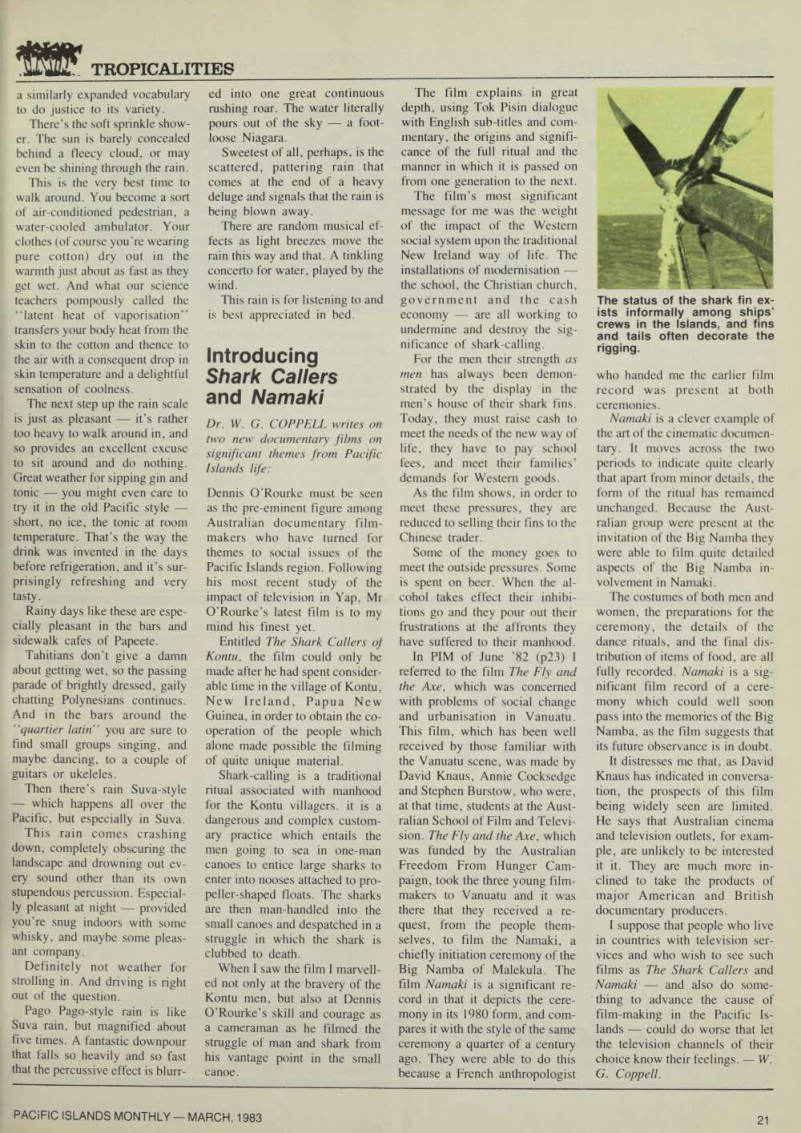
The status of the shark fin ex ists informally among ships’ crews in the Islands, and fins and tails often decorate the
rigging.