When Fiji, Tonga,
p. 17 · Read in the full issue
Tropicalities
The Vitiaz Arc
When Fiji, Tonga, and Vanuatu were one
New evidence found by scientists at the University of California shows that Fiji broke away from the islands of Vanuatu and Tonga around five to eight million years ago.
Before that, geologists thought the split in the seabed which caused Fiji to separate from its neighbors happened between 10 to 15 million years ago.
Professor of Earth Sciences James Gill and graduate students Allen Stork and Peter Whelan presented their new findings in San Francisco at this year’s meeting of the American Geophysical Union in a paper entitled “Volcanism Accom panying Arc Fragmentation in Fiji.”
According to Gill, the scien tists focused on Fiji because it is “a place where there have been many changes in lava composi tions particularly over the last 10 million years.” The scientists hoped to link these chemical changes to events in Fiji’s com plex geological history.
Perhaps 50 million years ago, Fiji, Tonga and Vanuatu made up a single island arc called the Vitiaz arc.
The Vitiaz arc is believed by most scientists to have formed along the north-east margin of the Australian-Indian plate a huge slab of the earth’s crust that includes the continents of Aust ralia and India and part of the seafloor beneath the Indian and Pacific Oceans.
The ancient arc ran parallel to a “subduction zone” where the Pacific plate was diving, or being
ing of different source rocks much as brands distinguish range cattle owned by different ranchers.
Isotopes atoms of the same elements that differ in atomic
mass help geochemists deter
mine to what extent molten mate rial from deep source rocks has been contaminated by melting and mixing with upper rocks on its way to the earth’s surface.
Radiometric ages tell scientists when the lavas erupted.
The scientists believe this melting of plate material very likely marked the onset of the break-up of the Vitiaz arc.
Dramatic trace element differ ences in Fijian lavas erupted after three million years ago suggest that by three million years ago arc fragmentation was complete
“subducted”, beneath the Indian
plate.
Between eight and five million years ago, according to the scien tists, the Vitiaz arc began to break up as Vanuatu slowly separated from Fiji and Tonga.
Fiji and Tonga appear to have remained intact until three mill ion years ago, when the config uration of the three arc fragments was established.
At that time also, the Califor nia scientists say, subduction ceased beneath the Fiji portion of the sundered arc.
“That there is some relation ship between subduction and is land arc volcanism has been known for some time,” says Gill, “but the exact nature of that relationship is not known.” To understand it better, Gill, Stork, and Whelan made their study of Fiji’s volcanic rocks.
“Our interpretations,” the sci entists write, “are outgrowths of several almost-completed studies at UCSC about Fiji over the last five years, which have yielded over 100 new radiometric ages and over 500 new rock analyses, including extensive trace element and isotope data.”
Trace elements elements such as lead and strontium which are present in barely detectable or “trace” amounts disting uish lavas derived from the melt
and subduction beneath Fiji had ceased.
Gill says that the Californian study of Fiji marks “the first time that rocks from a 30-
million-year-old history of one
island arc have been so thorough ly studied by chemical analysis and age dating.”
But, he notes, the “frustra tion, or the dilemma, is that we still don’t know why” certain geologic events such as arc fragmentation and cessation of subduction are reflected as they are in lava compositions.
The Fiji Times.
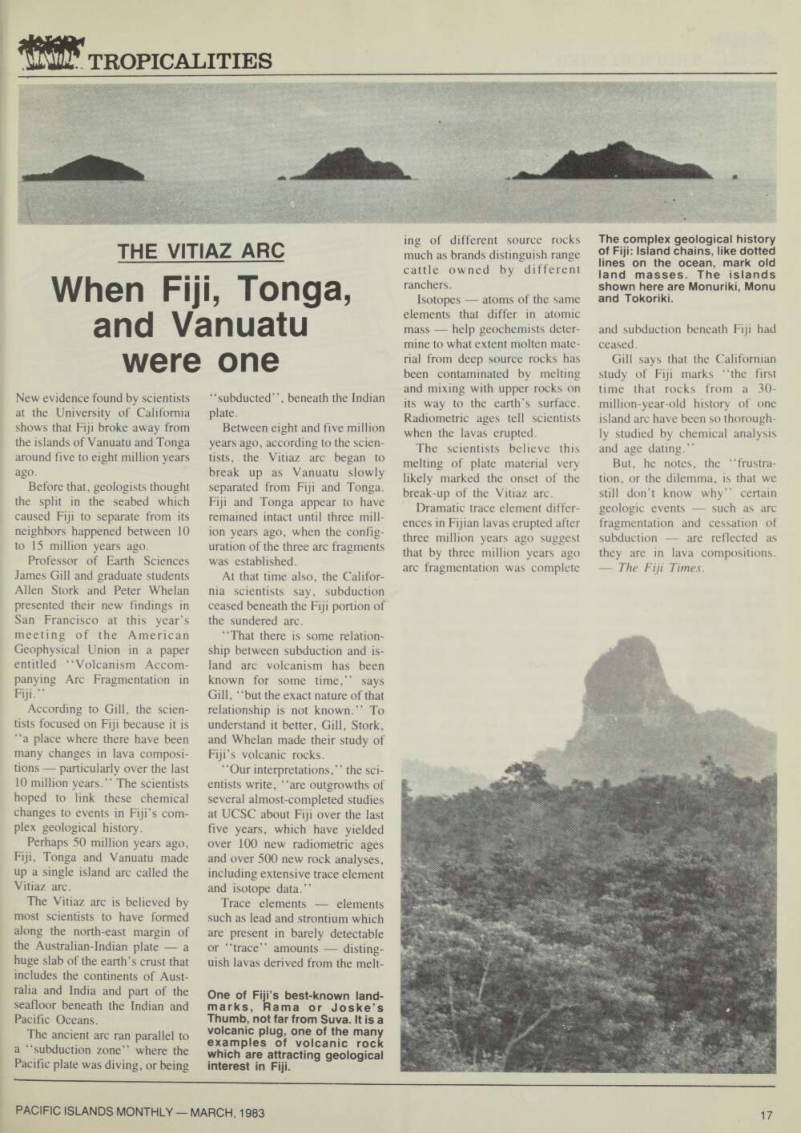
One of Fiji’s best-known land marks, Rama or Joske’s Thumb, not far from Suva. It is a volcanic plug, one of the many examples of volcanic rock
which are attracting geological
interest in Fiji.
The complex geological history of Fiji: Island chains, like dotted lines on the ocean, mark old land masses. The islands shown here are Monuriki, Monu and Tokoriki.