‘Coming of Age’ at the eye of a new scholarly storm
pp. 11-16 · Read in the full issue

new scholarly storm
U.S. anthropologist Margaret Mead was internationally acclaimed for her writings on life, love and social mores in American Samoa. Australian anthropologist Derek Freeman, who commands considerable support, is ques tioning the validity of her research. But in a sensitive overview beginning on this page, JOSEPH THEROUX looks behind the controversy to what he sees as enduring values of the Mead-in-Samoa story.
Coming of Age in Samoa, that pioneering work of field-research anthropology, written by a girl in her early 20s and influencing generations of social scientists, found its origins on the remote island of Ta’u, in American Samoa, in the South Seas.
Since that time, the book has been lauded and reprinted scores of times. And yet many Samoans have denied its truthfulness and, recently, anthropologists, seek ing to advance their own theories and reputations, have revised their opinions of the study, some calling it an outright hoax. The book has gained a reputation as a running account of teenage sex habits in a South Seas paradise.
Nothing could be further from the truth. Where, then, does its value lie?
In August of 1926, some 10 years after Somerset Maugham paid a visit, along with a Re verend Davidson and a certain Sadie Thompson, Margaret Mead arrived in Pago Pago, the capital of an American territory then adminstered by the navy.
She had been urged by her men tor, Franz Boas, to seek an out of-the-way but safe place to study stress and storm, or the lack of it, among “primitive” adolescents. She was told that the Manu’a group (not to be confused with Manus, in Papua New Guinea, where she did a later study), which included Ta’u, the largest island, was among the most traditional of the Samoan Islands. (This was true as far as the American territory is concerned, but Samoa includes the independent State of Western Samoa. So when I was sent to
teach there for a year in 1975, the island of Savai’i, Western Samoa, was considered the most traditional. I therefore felt able to compare observations, keeping in mind the 50-year-old gap.)
Makelita, as she was called, lived for a month or so on Tutui la, the largest island in American Samoa, and then set off on an inter-island schooner for Ta’u.
She lived there with the Chief
Pharmacist Mate and his family at the dispensary, on the beach and not far from the present-day dispensary (where I stayed on a recent visit).
Though she took language les sons and boasted of her facility with Samoan, even its polite or chiefly language (full of poetic allusions to legends and songs and having a distinct vocabul ary), her knowledge of the lan guage appears to have been slight. Many constructions and words in her books are inconsis tent or in error. She resorted to translators and set about making charts and tests, having inter views and observing daily life.
She suggests that she was accept ed by the local people as one of them. A foreigner coming to a small town in the U.S. speaking little English, and questioning local girls about their private affairs, through a translator, would be viewed, to say the least, askance. But acceptance appears to be the belief of every anthropologist and beachcomber.
She observed a communal soc iety, supervised by chiefs, living a simple life, fishing in the reef and gardening taro in upland plantations. Their staples were fish, coconut, breadfruit, taro,
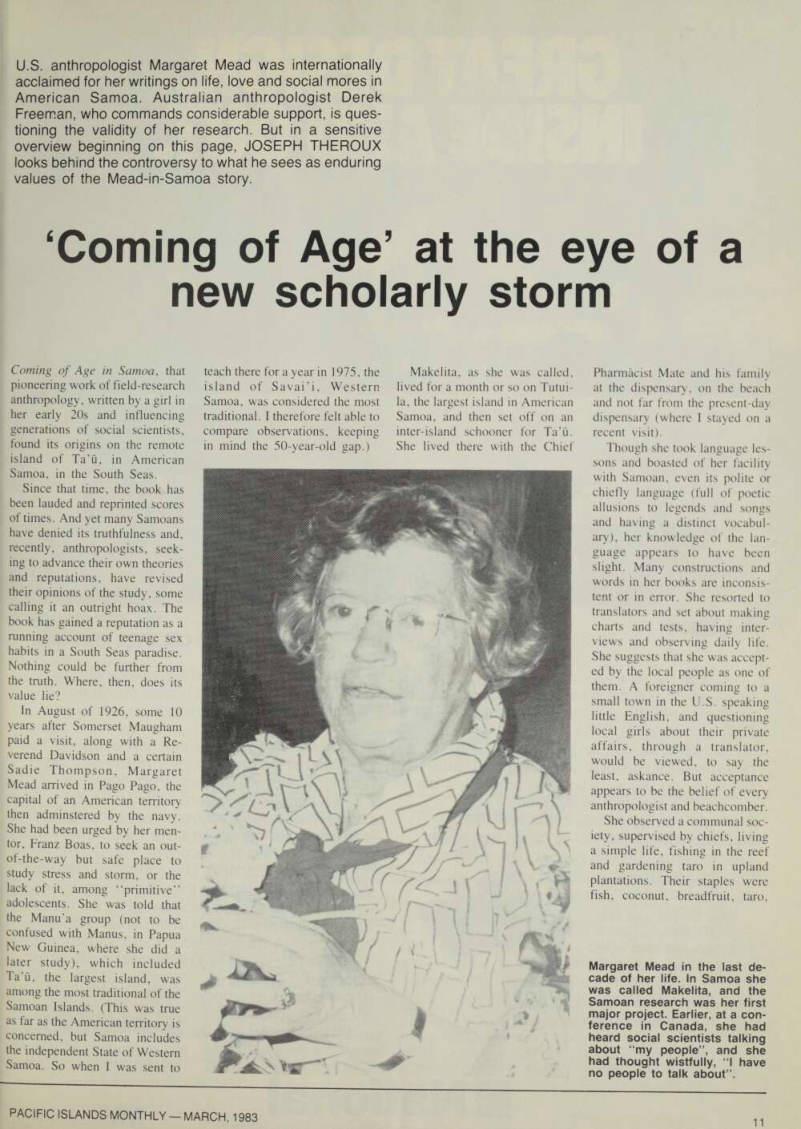
Margaret Mead in the last de cade of her life. In Samoa she was called Makelita, and the Samoan research was her first major project. Earlier, at a con ference in Canada, she had heard social scientists talking about “my people”, and she had thought wistfully, “I have no people to talk about”.
A Legend Reviewed
bananas, pigs and chickens.
Their economy was based on family-owned land, pigs and hand-woven fine mats, ritually exchanged on ceremonial days; marriages, funerals, chiefly investitures.
The smallest unit of the socie ty, then as now, is not the indi vidual but the group, the extend ed family headed by a chief. The family is a large, loose-knit affair that shoulders personal debts and individual shame, but also ac cepts members’ successes and salaries. The group was always seen as the best method for rais ing houses, surrounding schools of fish, raiding neighboring vil lages, entertaining. Solo per formances, save by the village maid, are unknown and found embarrassing.
The family provides security, so that while there is little indi viduality and the biological ties between mother and child are blurred with so many women and children in the family, there are no orphans, beggars or rest homes. The adolescent who finds
his home situation impossible, Makelita found, can move to another family, thus relieving “stress and storm”.
Coming of Age was first pub lished in 1928 and stories began to filter back to the islands that Makelita had written a book, not about their culture of which they were so proud, not about the rituals, the kava ceremonies, or the chiefly investitures, but about their sexual habits. Years later, grown women on the island would say that they made up stories to tell the palagi (foreign) woman. Few people in the is lands had read the book read ing is still not a popular pastime in a group-oriented, gregarious society, where to be alone bes peaks neurosis but to deny what it had to say was a face saving device. The Samoan view of sex is as ambiguous as that of any other culture.
Sex jokes, for example, wildly obscene, are perfectly acceptable as long as no females present are related to anyone in the group and no female relatives are re
ferred to. The sainted pastor’s wife, a pillar of the community, will leer and mutter a double entendre with the abandonment of a sailor, as long as the audi ence is appropriate. Makelita’s book, people thought, found a wider, and therefore inapprop riate audience.
Walking along the beach at Luma, the village where Makeli ta stayed, I came across a white
replied, “We’re going to the plantation to be alone.”
“What will you do there?”
“He wants to plant some ta’amii ” (a long root plant, simi lar to the taro).
“Oh, no, you’re too old for the game!”
“And you’re so jealous!”
By this time both crones were cackling. It was perfectly accept able behavior, these two women in their innocent fun. They cackl ed louder when 1 put my arm around my guide. But they would be shocked to find that I would publish the story, thereby sharing it with a wider audience, many of whom they would not have joked with.
One evening I was strolling on the road there. A fat woman leaned out of a window and greeted me asking where I was from. I told her I was visiting from Pago Pago. Where was I going? Just for a walk. Then she advised me to find a girl because, she said, “Ta’u girls are the best, better that Pago girls.” Then she laughed, pounding the window sill for emphasis.
Again, it was only banter and the situation allowed it. But it struck me later that anthropolog ists, who are a dime a dozen here, have never written of the many facets of sex in Samoa: the humorous aspects of sex, sex to allay boredom, sex in its proper place, the sex taboos. But this flavor is evident in Coming oj Age. In her autobiography.
Blackberry Winter , Margaret Mead relates the story of a chief who makes advances which she rebuffs as gently as possible. He
“We’re going to the plantation to be alone.” ... “Oh, no, you’re too old for the game!”
“And you’re so jealous!”
haired old woman, weeding her garden. I asked if she could tell me the site of the first dispen sary. She rose and said she would take me there. We chatted as we walked along the beach and came upon another old wo man, laying out clothes to dry on rocks. “Where are you taking that young palagi man?” she asked.
Without hesitation, my guide
replies sadly: “White women have such nice fat legs.”
One anthropologist who has taken exception to her book is Derek Freeman of the Australian National University. He has been quoted in Pago Pago’s Samoa News as saying that Mead’s . . conclusions ... are un founded and completely errone ous.” He particularly took issue with what she had to say about
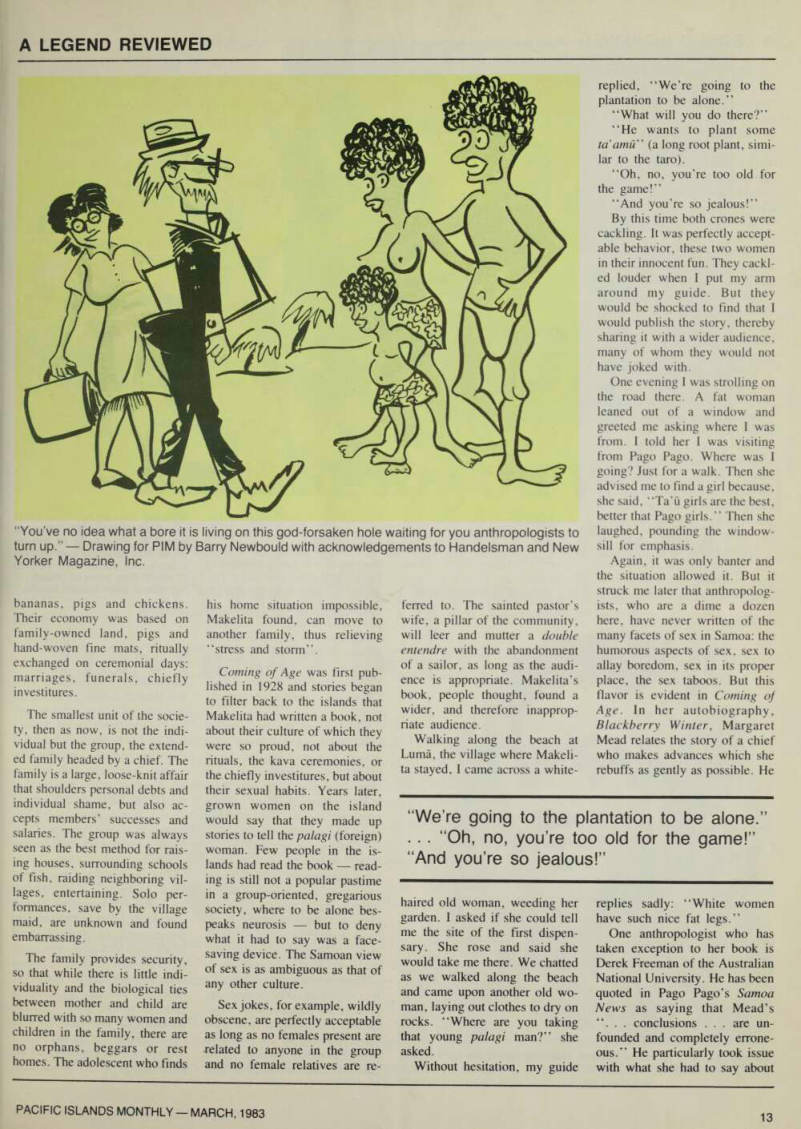
“You’ve no idea what a bore it is living on this god-forsaken hole waiting for you anthropologists to turn up.” - Drawing for RIM by Barry Newbould with acknowledgements to Handelsman and New Yorker Magazine, Inc.
virginity. T know of no place in the world where the status of virginity is so important pract ically sacred as in Samoa," he was quoted as saying. This is true, at least as far as the village maid is concerned. But. Freeman subscribes to a sort of moral “trickle-down theory": because the virginity of the village maid is held sacred, so is that of untitled girls. Of course virginity is important and promiscuity is viewed with disgust. But people make mistakes and Samoans are far more forgiving of such things than most people. The “illegiti mate" child is readily accepted into the family and the girl is not
disgraced.
Samoa is not a paradise of free love as it has been portrayed, but nor is it a cloistered nunnery where virginity is sacrosanct. So much bilge has been written ab out the place, especially in the area of sex, that it is difficult to sort it all out. Unfortunately, Makelita contributed to it, in exaggerations and in her gaps, in ignoring concepts that did not fit her theories.
For example, in writing truth fully about sexual habits, one must include a discussion of Polynesia’s so-called Third Sex,
of which Samoa’s fa’afafines are a part. The word literally trans lates “womanish" and is applied to any effeminate male. These
individuals are simply accepted
and yet have never been studied
by anthropologists, possibly be cause the idea of “perversion" did not fit neatly into their theories of a sexually permissive Eden. Makelita lists only two cases of male homosexuality, one as an isolated case, the other described under the heading “The Mentally Defective and the Mentally Diseased". She recog nised no true cases of female homosexuality (fa’atama “like a boy”) and never uses the words.
Fa’afafines are not always homosexual, though those who are are also transvestites. Some marry, have children, and reach high social rank. One who lived in my village on Savai’i was a respected judge. They undoub tedly had a function in the old, pre-Christian society, possibly as sexual instructors. Now they band together in softball teams and dancing groups. And at titudes are changing: Samoan students, educated in the U.S., have brought back red-neck slang: “faggot" and “queer" are words heard increasingly.
Those who argue that Makelita was wrong in some of her con clusions are unaware of her situa tion in 1926 many, in fact, know nothing of the situation now. Latter-day anthropologists have difficulty deciding just how
traditional or Westernised Ta’u was then or is now: even trained eyes see what they want to see.
Tourists, brought up on the no tion of the South Seas paradise that was got up by 18th and 19th century explorers and writers, are blind to crime, power fai lures, and the litter that covers Ta’u’s coral reefs 20th century problems that would nor mally prevent them from finding paradise.
The changes have been great since Makelita’s time. Thatch roofs have disappeared almost completely, give over to concrete houses with tin roofs. Canned foods and packaged, processed foods are now part of the Samoan diet. Labor-intensive activities, farming, fishing, cooking in ground ovens and washing clothes in the river bed, are now mostly chores “of the old days”.
Most people are employed by the government, while laundromats
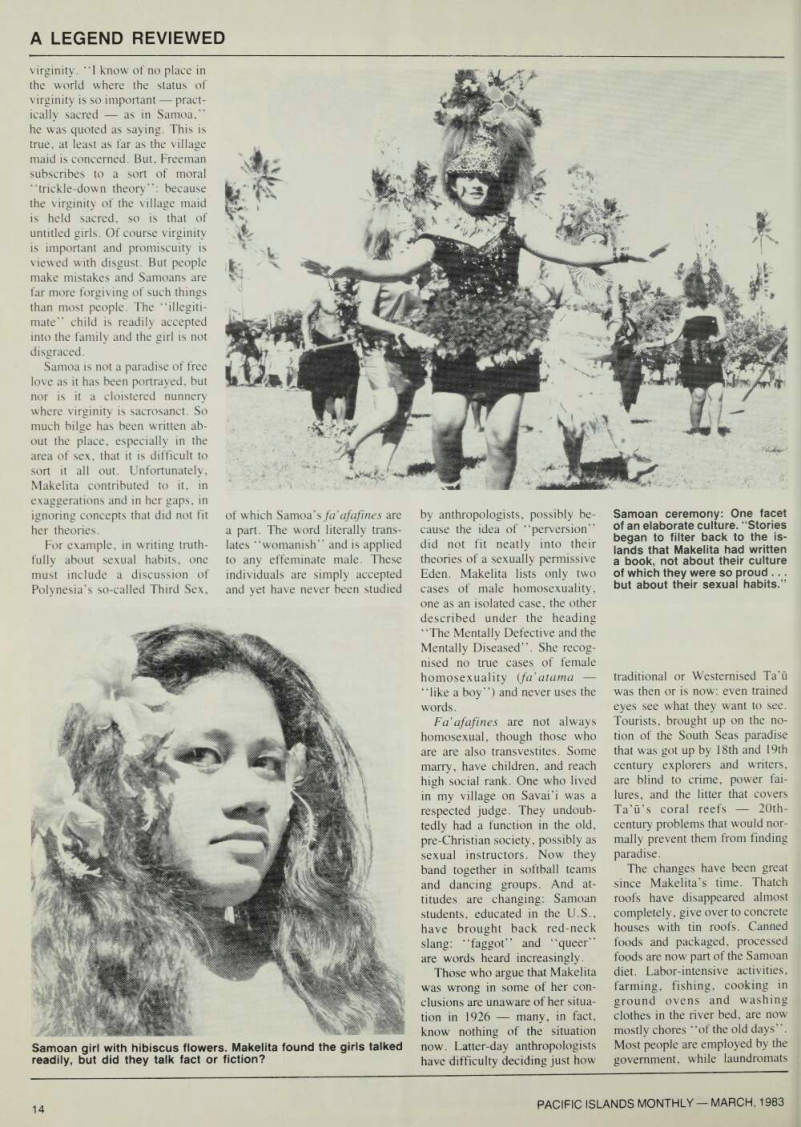
Samoan girl with hibiscus flowers. Makelita found the girls talked readily, but did they talk fact or fiction?
Samoan ceremony: One facet of an elaborate culture. “Stories began to filter back to the is lands that Makelita had written a book, not about their culture of which they were so proud ... but about their sexual habits."
and restaurants are booming and the main industry, tuna canning, is accomplished by other hands: Koreans and Taiwanese do the fishing and Western Samoans, seeking better pay, arrive to can the tuna.
Even basic taboos are chang ing. Makelita noticed the strong brother-sister taboo which for bade them from even speaking directly to each other. Some of my students in American Samoa had never even heard of the injunction, and many had no knowledge of the chiefly lan guage or its function, referring to it as the “old people’s language.”
A few years ago a Samoan girl wrote to a nationally syndicated advice column complaining of the adviser’s reference to the
“free love” in Samoa, and the low value placed on virginity there. “My virginity is the great est gift I can give to my hus band,” she wrote. Makelita anti cipated the questions of later generations and wondered in her autobiography what relevance her first book would have on American-educated Samoans, grandchildren of those she knew.
She wrote cautionary prefaces to succeeding editions of the book, emphasising how long ago the study was made.
It is unfair nowadays to carp, for the Westernisation of Ameri can Samoa and of Samoans, liv ing in Hawaii and as far away as Boston, has distanced them from the old values. Of course virgini ty, for instance, is valued, but how many of them (let alone anthropologists) have seen a de floration ceremony, or the vil lage women parading a bloodied bridal cloth?
One ex-student of mine is now in the army. On a recent leave, she told me that her fellow sol diers had questioned her about a
defloration ceremony they had witnessed in a movie. She had hotly denied that Samoans had ever done such things.
All these changes must be ta ken into account by those who want to unseat Makelita. She was young when she wrote her first book, was not fluent, stayed for less than a year and made mis takes. But one forgets the state of anthropology at the time, when culture was a technical word and reliable field methods were not in existence. She did extremely
well, bringing anthropology
home to the layman and also providing scholarly accounts of just those things the Samoans felt she neglected rites, rituals and ceremonies in The Social Or ganization of Manu’a (1930).
It would be a pity if Makelita’s studies were seen as only mate rial to be debunked. She was a far better writer and shrewder observer of cultures (her own included) than some of these academic barnacles now give her credit for. Though her book was hailed as a classic, it has its
errors and these should be noted.
But it is a picture of a society that barely exits any more. Modem Samoans and some anthropolog ists now disagree with her find ings. New books should and will be written, new studies done and
analysed.
In her autobiography, Makeli ta wrote that in 1924 she attended a conference in Toronto. There she heard social scientists discuss their own studies and each talked about “my people”. She wrote later: “I had no people to talk about.”
If she was defensive of her book, special to her because it was her first major study, the basis for her claim that the Sa moans were, in her phrase, “my people”, her first people (though many other groups would be come hers), it is understandable.
I remember the words of Robert Louis Stevenson, another writer on Samoa (and who is buried there): ‘ ‘The first love, the first sun rise, the first South Seas Island, are memories apart ...”
Professor Derek Freeman, pro fessor emeritus of anthropolo gy at the Australian National University, Canberra, whose book Margaret Mead and Samoa is to be published in April. He is critical of much of her findings. - David Feather ston picture for ANU.