Imports tender scheme
p. 27 · Read in the full issue
Western Samoa
Imports tender scheme lands Tofilau govt. in trouble
SANO MALIFA writes from Apia on problems faced by the new government headed by Tofilau Eti. They arise from food shortages and price rises caused by a new system of tendering for imports, and from a number of other factors.
The new government of Western Samoa’s Prime Minister Tofilau Eti is fast losing popularity among voters stung by basic food shortages and steeply rising prices.
Caused by the government’s system of tendering for imports which limits the number of im porters of “essential goods” most of them basic foods such as flour, mutton flaps, herrings and rice food shortages have push ed the prices of available import ed goods up by an average of 40 per cent.
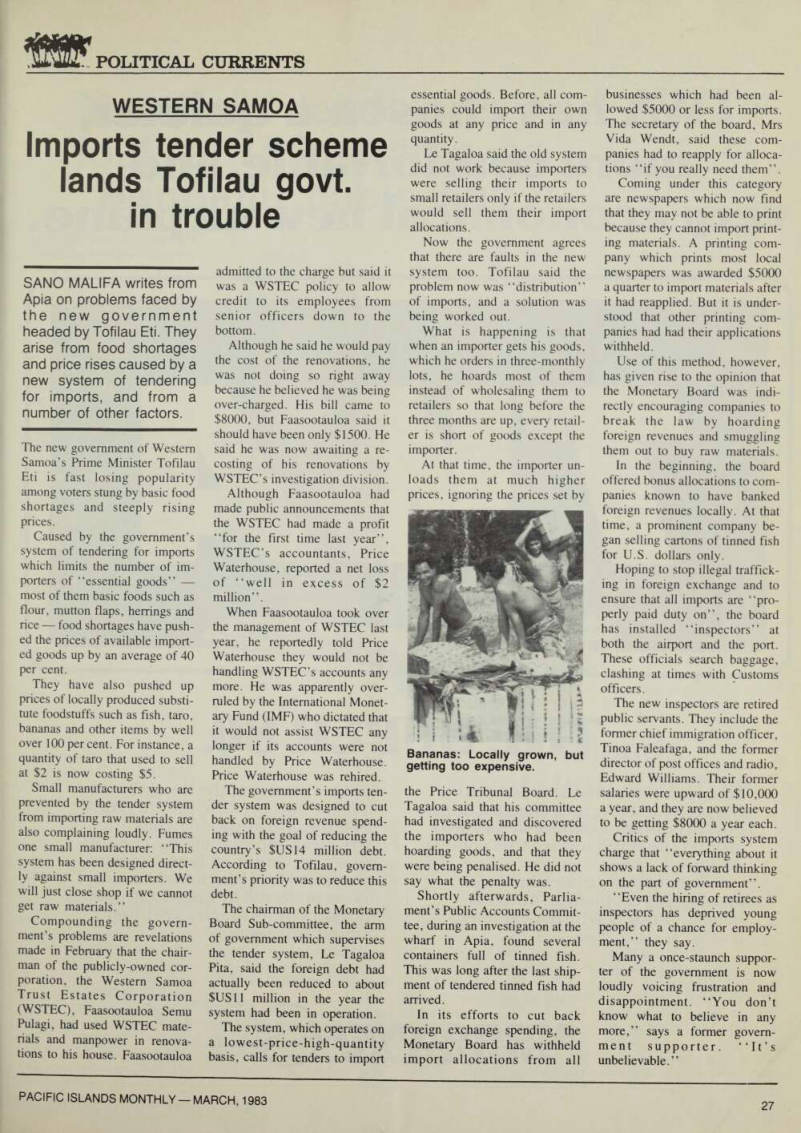
They have also pushed up prices of locally produced substi tute foodstuffs such as fish, taro, bananas and other items by well over 100 per cent. For instance, a quantity of taro that used to sell at $2 is now costing $5.
Small manufacturers who are prevented by the tender system from importing raw materials are also complaining loudly. Fumes one small manufacturer: “This system has been designed direct ly against small importers. We will just close shop if we cannot get raw materials.”
Compounding the govern ment’s problems are revelations made in February that the chair man of the publicly-owned cor poration, the Western Samoa Trust Estates Corporation (WSTEC), Faasootauloa Semu Pulagi, had used WSTEC mate rials and manpower in renova tions to his house. Faasootauloa
admitted to the charge but said it was a WSTEC policy to allow credit to its employees from senior officers down to the bottom.
Although he said he would pay the cost of the renovations, he was not doing so right away because he believed he was being over-charged. His bill came to $BOOO, but Faasootauloa said it should have been only $l5OO. He said he was now awaiting a re costing of his renovations by WSTEC’s investigation division.
Although Faasootauloa had made public announcements that the WSTEC had made a profit “for the first time last year”, WSTEC’s accountants, Price Waterhouse, reported a net loss of “well in excess of $2 million”.
When Faasootauloa took over the management of WSTEC last year, he reportedly told Price Waterhouse they would not be handling WSTEC’s accounts any more. He was apparently over ruled by the International Monet ary Fund (IMF) who dictated that it would not assist WSTEC any longer if its accounts were not handled by Price Waterhouse.
Price Waterhouse was rehired.
The government’s imports ten der system was designed to cut back on foreign revenue spend ing with the goal of reducing the country’s SUSI 4 million debt.
According to Tofilau, govern ment’s priority was to reduce this debt.
The chairman of the Monetary Board Sub-committee, the arm of government which supervises the tender system, Le Tagaloa Pita, said the foreign debt had actually been reduced to about SUSII million in the year the system had been in operation.
The system, which operates on
a lowest-price-high-quantity
basis, calls for tenders to import
essential goods. Before, all com panies could import their own goods at any price and in any
quantity.
Le Tagaloa said the old system did not work because importers were selling their imports to small retailers only if the retailers would sell them their import allocations.
Now the government agrees that there are faults in the new system too. Tofilau said the problem now was “distribution” of imports, and a solution was being worked out.
What is happening is that when an importer gets his goods, which he orders in three-monthly lots, he hoards most of them instead of wholesaling them to retailers so that long before the three months are up, every retail er is short of goods except the
importer.
At that time, the importer un loads them at much higher
prices, ignoring the prices set by
the Price Tribunal Board. Le Tagaloa said that his committee had investigated and discovered the importers who had been hoarding goods, and that they were being penalised. He did not say what the penalty was.
Shortly afterwards, Parlia ment’s Public Accounts Commit tee, during an investigation at the wharf in Apia, found several containers full of tinned fish.
This was long after the last ship ment of tendered tinned fish had arrived.
In its efforts to cut back foreign exchange spending, the Monetary Board has withheld import allocations from all
businesses which had been al lowed $5OOO or less for imports.
The secretary of the board, Mrs Vida Wendt, said these com panies had to reapply for alloca tions “if you really need them”.
Coming under this category are newspapers which now find that they may not be able to print because they cannot import print ing materials. A printing com pany which prints most local newspapers was awarded $5OOO a quarter to import materials after it had reapplied. But it is under stood that other printing com panies had had their applications withheld.
Use of this method, however, has given rise to the opinion that the Monetary Board was indi rectly encouraging companies to break the law by hoarding foreign revenues and smuggling them out to buy raw materials.
In the beginning, the board offered bonus allocations to com panies known to have banked foreign revenues locally. At that time, a prominent company be gan selling cartons of tinned fish for U.S. dollars only.
Hoping to stop illegal traffick ing in foreign exchange and to ensure that all imports are “pro perly paid duty on”, the board has installed “inspectors” at both the airport and the port.
These officials search baggage, clashing at times with Customs officers.
The new inspectors are retired public servants. They include the former chief immigration officer, Tinoa Faleafaga, and the former director of post offices and radio, Edward Williams. Their former salaries were upward of $lO,OOO a year, and they are now believed to be getting $BOOO a year each.
Critics of the imports system charge that “everything about it shows a lack of forward thinking on the part of government”.
“Even the hiring of retirees as inspectors has deprived young people of a chance for employ ment,” they say.
Many a once-staunch suppor ter of the government is now loudly voicing frustration and disappointment. “You don’t know what to believe in any more,” says a former govern ment supporter. ‘‘lt’s unbelievable.”
Bananas: Locally grown, but getting too expensive.