policies in Micronesia
pp. 29-30 · Read in the full issue
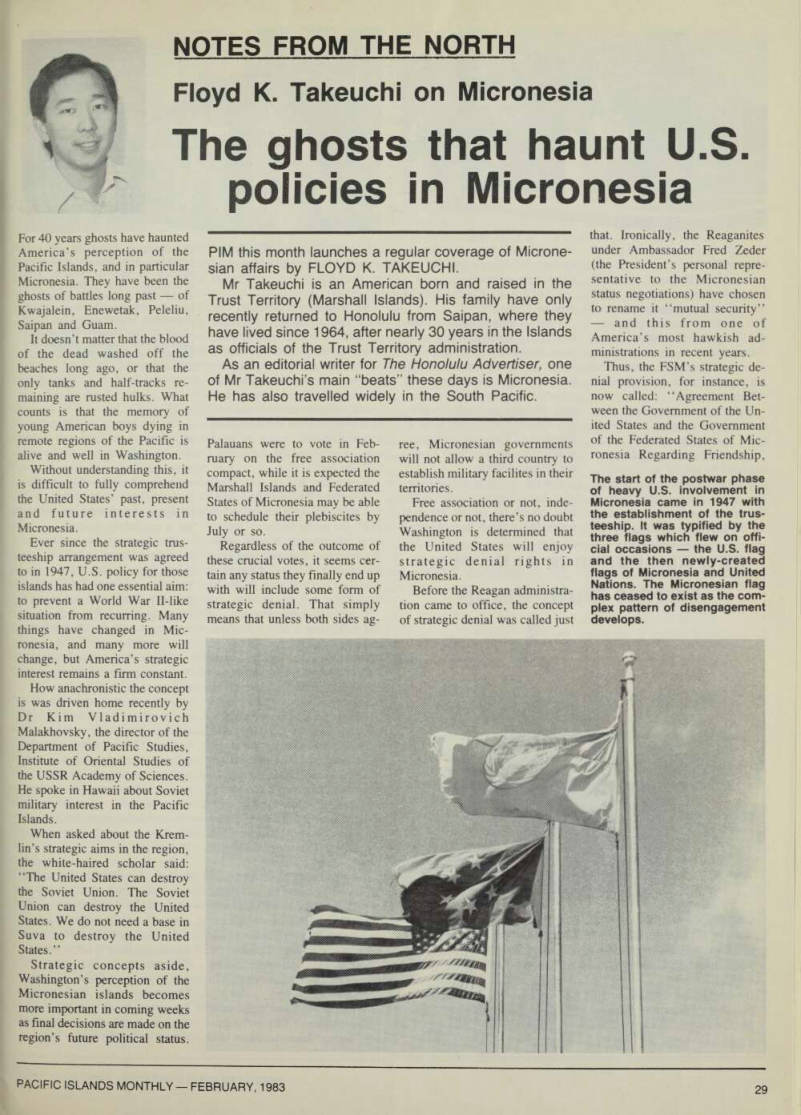
Notes From The North
Floyd K. Takeuchi on Micronesia The ghosts that haunt U.S. policies in Micronesia
For 40 years ghosts have haunted America’s perception of the Pacific Islands, and in particular Micronesia. They have been the ghosts of battles long past of Kwajalein, Enewetak, Peleliu, Saipan and Guam.
It doesn’t matter that the blood of the dead washed off the beaches long ago, or that the only tanks and half-tracks re maining are rusted hulks. What counts is that the memory of young American boys dying in remote regions of the Pacific is alive and well in Washington.
Without understanding this, it is difficult to fully comprehend the United States’ past, present and future interests in Micronesia.
Ever since the strategic trus teeship arrangement was agreed to in 1947, U.S. policy for those islands has had one essential aim; to prevent a World War 11-like situation from recurring. Many things have changed in Mic ronesia, and many more will change, but America’s strategic interest remains a firm constant.
How anachronistic the concept is was driven home recently by Dr Kim Vladimirovich Malakhovsky, the director of the Department of Pacific Studies, Institute of Oriental Studies of the USSR Academy of Sciences.
He spoke in Hawaii about Soviet military interest in the Pacific Islands.
When asked about the Krem lin’s strategic aims in the region, the white-haired scholar said; “The United States can destroy the Soviet Union. The Soviet Union can destroy the United States. We do not need a base in Suva to destroy the United States.”
Strategic concepts aside, Washington’s perception of the Micronesian islands becomes more important in coming weeks as final decisions are made on the region’s future political status.
RIM this month launches a regular coverage of Microne sian affairs by FLOYD K. TAKEUCHI.
Mr Takeuchi is an American born and raised in the Trust Territory (Marshall Islands). His family have only recently returned to Honolulu from Saipan, where they have lived since 1964, after nearly 30 years in the Islands as officials of the Trust Territory administration.
As an editorial writer for The Honolulu Advertiser, one of Mr Takeuchi’s main “beats” these days is Micronesia.
He has also travelled widely in the South Pacific.
Palauans were to vote in Feb ruary on the free association compact, while it is expected the Marshall Islands and Federated States of Micronesia may be able to schedule their plebiscites by July or so.
Regardless of the outcome of these crucial votes, it seems cer tain any status they finally end up with will include some form of strategic denial. That simply means that unless both sides ag
ree, Micronesian governments will not allow a third country to establish military facilites in their territories.
Free association or not, independence or not, there’s no doubt Washington is determined that the United States will enjoy strategic denial rights in Micronesia d Before the Reagan admmistration came to office, the concept of strategic denial was called just
that. Ironically, the Reaganites under Ambassador Fred Zeder (the President’s personal repre sentative to the Micronesian status negotiations) have chosen to rename it “mutual security” and this from one of America’s most hawkish ad ministrations in recent years.
Thus, the FSM’s strategic de nial provision, for instance, is now called: “Agreement Bet ween the Government of the Un ited States and the Government of the Federated States of Mic ronesia Regarding Friendship,
The start of the postwar phase of heavy U.S. involvement in Micronesia came in 1947 with the establishment of the trus
teeship. It was typified by the
three flags which flew on offi cial occasions the U.S. flag and the then newly-created flags of Micronesia and United Nations. The Micronesian flag has ceased to exist as the com plex pattern of disengagement
develops.
Co-operation and Mutual Security’’.
It reads: “If the ... United States determines that any third country seeks access to or use of (the FSM) for military purposes, the (U.S.) has the authority and responsibility to foreclose such access or use, except in instances where the two governments otherwise agree.’’
And, more importantly, the agreement is in effect forever. It states that it remains in force “until terminated or otherwise amended by mutual agreement”.
In practical terms, that means as long as the United States wants. (Of course, as Britain is finding out the hard way in Hong Kong,
even treaties that call for an open-ended association are not necessarily permanent).
All of this is not necessarily by way of criticism.
There is something incongru ous about a metropolitan govern ment ostensibly pushing its is land ward towards “self government”, all the while maintaining a permanent veto.
And, perhaps more significantly, this approach reflects a remark able lack of trust and confidence in Micronesians and their Ameri can-trained leaders.
But the reality is that the pre sent Trust Territory administra tion, which all parties agree is outmoded, will not be terminated
unless Washington officials are assured Micronesia will remain in the American sphere of influence.
By Washington officials, one does not mean just Pentagon planners. They do play a role.
However, it is also true that a number of members of Congress feel the same way. If they are not convinced U.S. interests are pro tected, no new arrangement will receive legislative approval. And unless Congress gives its bles sing, it is clear the trusteeship will not end.
How strong is such sentiment?
When the Reagan administra tion resumed negotiations in late 1981, the senior Defense Depart ment official at the Hawaii meet ing gave an emotional appeal to the effect that those Americans who died in the Pacific in World War II did not die in vain.
It was all rather dramatic and more than a few Americans and Micronesians there were em barrassed by the display of raw chauvinism but no one doubt ed the official’s sincerity of belief.
Along the edges of the U.S. delegation at that meeting, as has been the case for a number of years now, were representatives of key senators and congressmen who are particularly interested in the Pacific. Almost to a man, these representatives take a very conservative view of how much the United States should “give away’’ in Micronesia.
To see what their potential influence is, one need only look at the fate of the so-called Bodde Treaties, the documents negotiated with the Pacific Island countries Kiribati, Tuvalu, the Cook Islands and Tokelau, by former U.S. Ambassador Wil liam Bodde, Jnr.
What is by most reasonable interpretations a fair and equit able arrangement has been held
up in the Senate by lawmakers who believe outdated and dubi ous American claims on the ter ritory of these countries should not be lost because of their inhe rent strategic value. American relations with these new nations are a secondary matter.
The Micronesian negotiators have long been aware of this Washington reality. Palau’s am bassador, Lazarus Salii, put it this way shortly after his govern ment signed their free association agreement with the United States last September: “We knew from the beginning that (acceptance of strategic de nial) was the bottom line.’’
Of course, no responsible gov ernment offical would (or should) knowingly weaken the security of his country. In that sense, the American pre occupation with the strategic is sue in Micronesia is at least understandable, as is the Soviet pre-occupation with the millions of Russian dead lost during World War D.
But if there is considerable truth in that old adage that one should not forget history lest he repeat it, by the same token one must not be blinded by the past.
In dealing with Micronesia, Americans need to know when to differentiate the lessons of the past from the realities of today.
Unfortunately for both parties, the ghosts of another time con tinue to haunt the corridors of power in Washington.
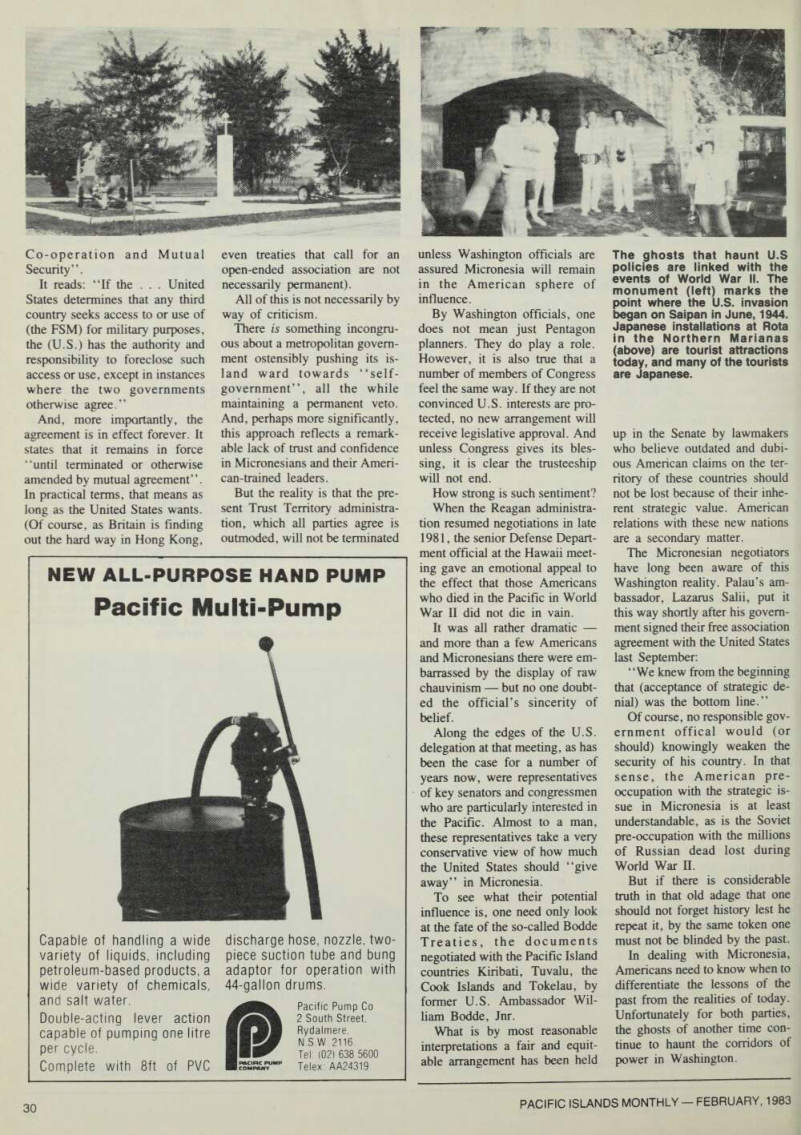
The ghosts that haunt U.S policies are linked with the events of World War II. The monument (left) marks the point where the U.S. invasion began on Saipan in June, 1944.
Japanese installations at Rota in the Northern Marianas (above) are tourist attractions today, and many of the tourists are Japanese.