expats
pp. 19-27 · Read in the full issue

Tropicalities
PNG spat
over tax on
expats
A highly charged and emotional battle is raging in Papua New Guinea over government propos als to tax money which Aust ralians and other non-citizens send out of the country. The battle has been strongly reflected in the columns of the nationally circulated newspaper the Post- Courier which has dubbed the proposal a Robin Hood tax.
Letters published in the Post- Courier’s Viewpoint page have become more than a complaint from people who consider the proposed tax unjustified. The let ters have developed into ex changes in which Australians in PNG have accused Papua New Guineans of ingratitude and bigotry, and in which Papua New Guineans have told Australians to pack up and get out.
The Australians are feeling particularly slighted and dis criminated against by the pro posed tax because of what they say is the high level of reliance PNG places on largely untied aid from Australia and, on a more personal note, the close historical links between the two countries.
Feelings reached a peak late in December when a long letter appeared in Viewpoint from an Australian living in Port Mores by. The letter was headed Aust ralia Owes Nothing. Peter Schaper wrote that he had grown up in PNG and said Australians were tired of looking after “this small boy, PNG, who thinks the world owes him a living because he is black and under developed.”
He said PNG owed its inde pendence to the establishment by Australia of a legal and moral system. He maintained PNG would be like its neighbors in Irian Jaya, who were now in the process of being dispossessed of their land and programmed for extinction within a few genera tions to provide their colonial masters with undisputed land title.
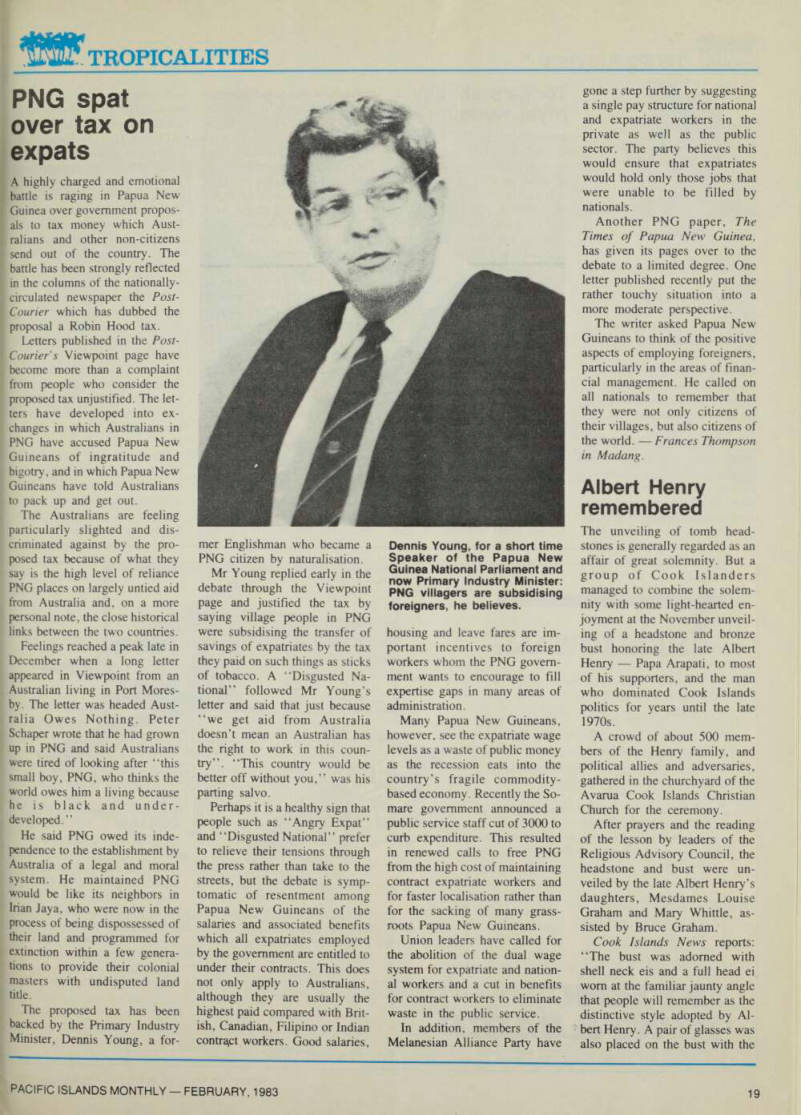
The proposed tax has been backed by the Primary Industry Minister, Dennis Young, a for-
mer Englishman who became a PNG citizen by naturalisation.
Mr Young replied early in the debate through the Viewpoint page and justified the tax by saying village people in PNG were subsidising the transfer of savings of expatriates by the tax they paid on such things as sticks of tobacco. A “Disgusted Na tional” followed Mr Young’s letter and said that just because “we get aid from Australia doesn’t mean an Australian has the right to work in this coun try”. “This country would be better off without you,” was his parting salvo.
Perhaps it is a healthy sign that people such as “Angry Expat” and “Disgusted National” prefer to relieve their tensions through the press rather than take to the streets, but the debate is symp tomatic of resentment among Papua New Guineans of the salaries and associated benefits which all expatriates employed by the government are entitled to under their contracts. This does not only apply to Australians, although they are usually the highest paid compared with Brit ish, Canadian, Filipino or Indian contract workers. Good salaries,
housing and leave fares are im portant incentives to foreign workers whom the PNG govern ment wants to encourage to fill expertise gaps in many areas of administration.
Many Papua New Guineans, however, see the expatriate wage levels as a waste of public money as the recession eats into the country’s fragile commodity based economy. Recently the So mare government announced a public service staff cut of 3000 to curb expenditure. This resulted in renewed calls to free PNG from the high cost of maintaining contract expatriate workers and for faster localisation rather than for the sacking of many grass roots Papua New Guineans.
Union leaders have called for the abolition of the dual wage system for expatriate and nation al workers and a cut in benefits for contract workers to eliminate waste in the public service.
In addition, members of the Melanesian Alliance Party have
gone a step further by suggesting a single pay structure for national and expatriate workers in the private as well as the public sector. The party believes this would ensure that expatriates would hold only those jobs that were unable to be filled by nationals.
Another PNG paper, The Times of Papua New Guinea, has given its pages over to the debate to a limited degree. One letter published recently put the rather touchy situation into a more moderate perspective.
The writer asked Papua New Guineans to think of the positive aspects of employing foreigners, particularly in the areas of finan cial management. He called on all nationals to remember that they were not only citizens of their villages, but also citizens of
the world.
Frances Thompson
in Madang.
Albert Henry
remembered
The unveiling of tomb head stones is generally regarded as an affair of great solemnity. But a group of Cook Islanders managed to combine the solem nity with some light-hearted en joyment at the November unveil ing of a headstone and bronze bust honoring the late Albert Henry Papa Arapati, to most of his supporters, and the man who dominated Cook Islands politics for years until the late 19705.
A crowd of about 500 mem bers of the Henry family, and political allies and adversaries, gathered in the churchyard of the Avarua Cook Islands Christian Church for the ceremony.
After prayers and the reading of the lesson by leaders of the Religious Advisory Council, the headstone and bust were un veiled by the late Albert Henry’s daughters, Mesdames Louise Graham and Mary Whittle, as sisted by Bruce Graham.
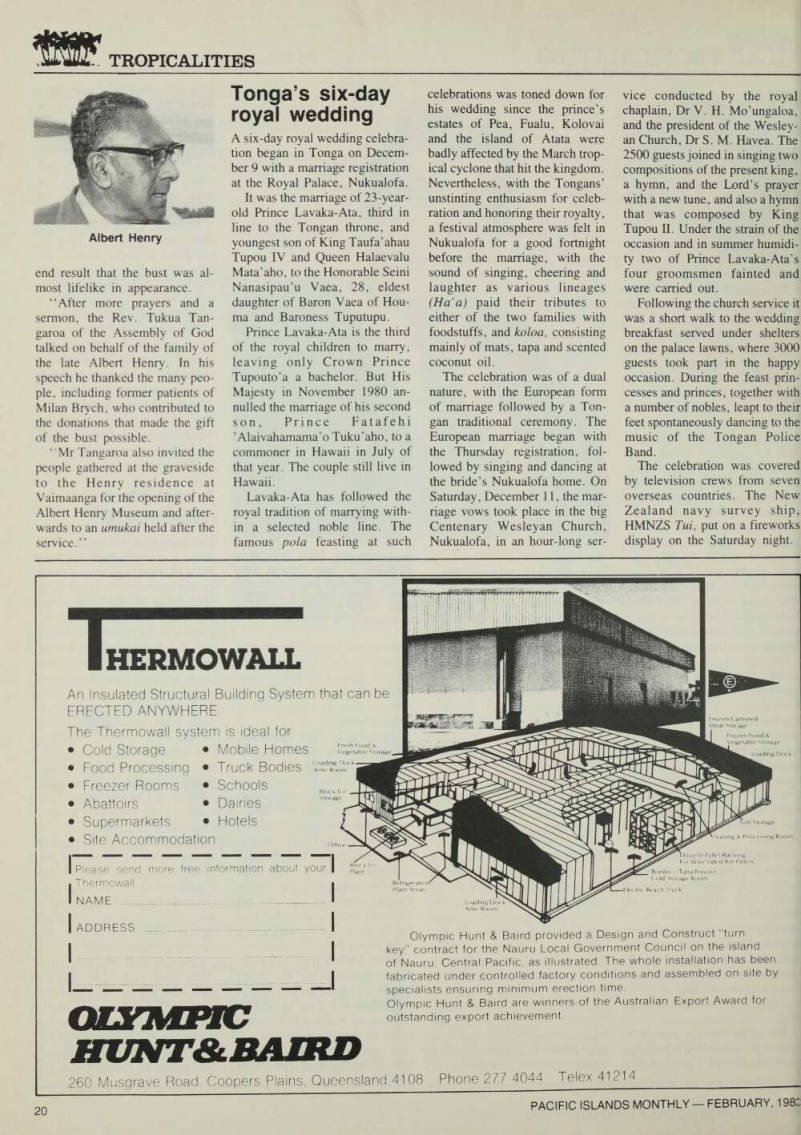
Cook Islands News reports: “The bust was adorned with shell neck eis and a full head ei worn at the familiar jaunty angle that people will remember as the distinctive style adopted by Al bert Henry. A pair of glasses was also placed on the bust with the
Dennis Young, for a short time Speaker of the Papua New Guinea National Parliament and now Primary Industry Minister:
PNG villagers are subsidising
foreigners, he believes.
end result that the bust was al most lifelike in appearance.
“After more prayers and a sermon, the Rev. Tukua Tan garoa of the Assembly of God talked on behalf of the family of the late Albert Henry. In his speech he thanked the many peo
ple, including former patients of
Milan Brych, who contributed to the donations that made the gift of the bust possible.
“Mr Tangaroa also invited the
people gathered at the graveside
to the Henry residence at Vaimaanga for the opening of the Albert Henry Museum and after wards to an umukai held after the service.”
Tonga’s six-day
royal wedding
A six-day royal wedding celebra tion began in Tonga on Decem ber 9 with a marriage registration at the Royal Palace, Nukualofa.
It was the marriage of 23-year old Prince Lavaka-Ata, third in line to the Tongan throne, and youngest son of King Taufa’ahau Tupou IV and Queen Halaevalu Mata’aho, to the Honorable Seini Nanasipau’u Vaea, 28, eldest daughter of Baron Vaea of Hou ma and Baroness Tuputupu.
Prince Lavaka-Ata is the third of the royal children to marry, leaving only Crown Prince Tupouto’a a bachelor. But His Majesty in November 1980 an nulled the marriage of his second son. Prince Fatafehi ’Alaivahamama’o Tuku’aho, to a commoner in Hawaii in July of that year. The couple still live in Hawaii.
Lavaka-Ata has followed the royal tradition of marrying with in a selected noble line. The famous pola feasting at such
celebrations was toned down for his wedding since the prince’s estates of Pea, Fualu, Kolovai and the island of Atata were badly affected by the March trop ical cyclone that hit the kingdom.
Nevertheless, with the Tongans’ unstinting enthusiasm for celeb ration and honoring their royalty, a festival atmosphere was felt in Nukualofa for a good fortnight before the marriage, with the sound of singing, cheering and laughter as various lineages (Ha a) paid their tributes to either of the two families with foodstuffs, and koloa, consisting mainly of mats, tapa and scented coconut oil.
The celebration was of a dual nature, with the European form of marriage followed by a Ton gan traditional ceremony. The European marriage began with the Thursday registration, fol lowed by singing and dancing at the bride’s Nukualofa home. On Saturday, December 11, the mar riage vows took place in the big Centenary Wesleyan Church, Nukualofa, in an hour-long ser
vice conducted by the royal chaplain, Dr V. H. Mo’ungaloa, and the president of the Wesley an Church, Dr S. M. Havea. The 2500 guests joined in singing two compositions of the present king, a hymn, and the Lord’s prayer with a new tune, and also a hymn that was composed by King Tupou 11. Under the strain of the occasion and in summer humidi ty two of Prince Lavaka-Ata’s four groomsmen fainted and were carried out.
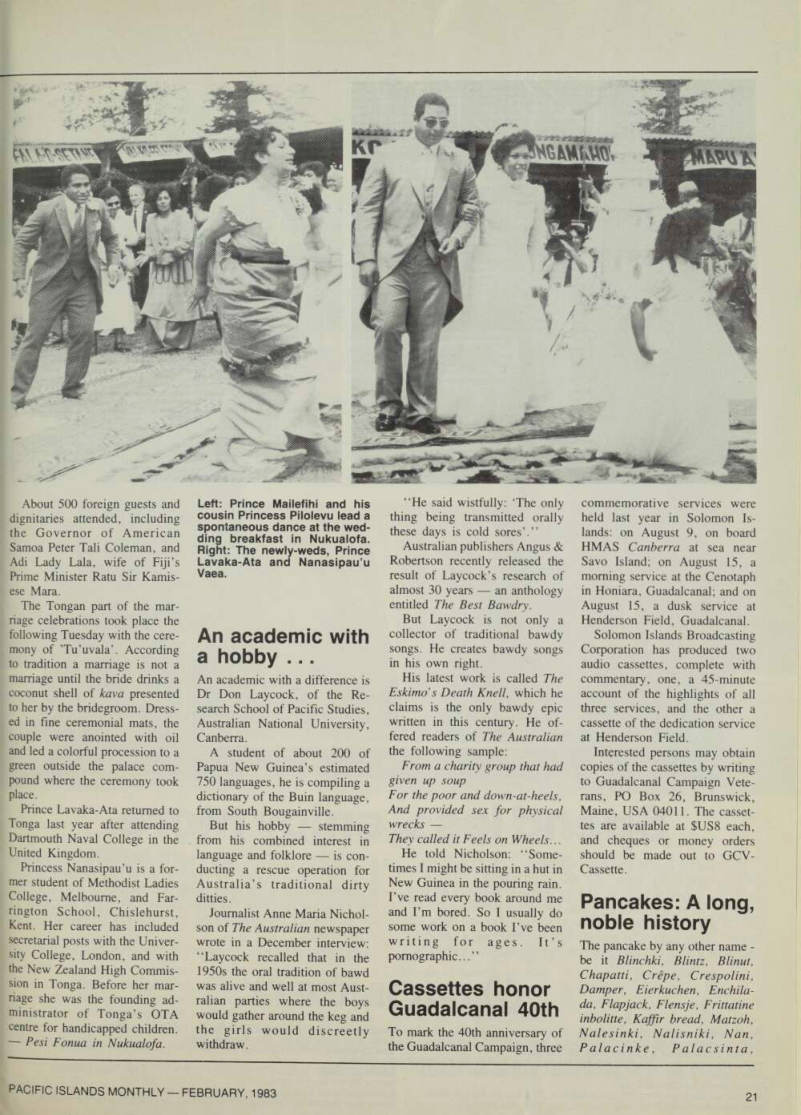
Following the church service it was a short walk to the wedding breakfast served under shelters on the palace lawns, where 3000 guests took part in the happy occasion. During the feast prin cesses and princes, together with a number of nobles, leapt to their feet spontaneously dancing to the music of the Tongan Police Band.
The celebration was covered by television crews from seven overseas countries. The New Zealand navy survey ship, HMNZS Tui, put on a fireworks display on the Saturday night.
Albert Henry
About 500 foreign guests and dignitaries attended, including the Governor of American Samoa Peter Tali Coleman, and Adi Lady Lala, wife of Fiji’s Prime Minister Ratu Sir Kamis ese Mara.
The Tongan part of the mar riage celebrations took place the following Tuesday with the cere mony of Tu’uvala’. According to tradition a marriage is not a marriage until the bride drinks a coconut shell of kava presented to her by the bridegroom. Dress ed in fine ceremonial mats, the couple were anointed with oil and led a colorful procession to a green outside the palace com pound where the ceremony took place.
Prince Lavaka-Ata returned to Tonga last year after attending Dartmouth Naval College in the United Kingdom.
Princess Nanasipau’u is a for mer student of Methodist Ladies College, Melbourne, and Far rington School, Chislehurst, Kent. Her career has included secretarial posts with the Univer sity College, London, and with the New Zealand High Commis sion in Tonga. Before her mar riage she was the founding ad ministrator of Tonga’s OTA centre for handicapped children.
Pesi Fonua in Nukualofa.
An academic with
a hobby ...
An academic with a difference is Dr Don Laycock, of the Re search School of Pacific Studies, Australian National University, Canberra.
A student of about 200 of Papua New Guinea’s estimated 750 languages, he is compiling a dictionary of the Buin language, from South Bougainville.
But his hobby stemming from his combined interest in language and folklore is con ducting a rescue operation for Australia’s traditional dirty ditties.
Journalist Anne Maria Nichol son of The Australian newspaper wrote in a December interview: “Laycock recalled that in the 1950 s the oral tradition of bawd was alive and well at most Aust ralian parties where the boys would gather around the keg and the girls would discreetly withdraw.
“He said wistfully: The only thing being transmitted orally these days is cold sores’. ’’
Australian publishers Angus & Robertson recently released the result of Lay cock’s research of almost 30 years an anthology entitled The Best Bawdry.
But Laycock is not only a collector of traditional bawdy songs. He creates bawdy songs in his own right.
His latest work is called The Eskimo’s Death Knell, which he claims is the only bawdy epic written in this century. He of fered readers of The Australian the following sample: From a charity group that had given up soup For the poor and down-at-heels, And provided sex for physical wrecks They called it Feels on Wheels...
He told Nicholson: “Some times I might be sitting in a hut in New Guinea in the pouring rain.
I’ve read every book around me and I’m bored. So I usually do some work on a book I’ve been writing for ages. It’s pornographic...’’
Cassettes honor
Guadalcanal 40th
To mark the 40th anniversary of the Guadalcanal Campaign, three
commemorative services were held last year in Solomon Is lands: on August 9, on board HMAS Canberra at sea near Savo Island; on August 15, a morning service at the Cenotaph in Honiara, Guadalcanal; and on August 15, a dusk service at Henderson Field, Guadalcanal.
Solomon Islands Broadcasting Corporation has produced two audio cassettes, complete with commentary, one, a 45-minute account of the highlights of all three services, and the other a cassette of the dedication service at Henderson Field.
Interested persons may obtain copies of the cassettes by writing to Guadalcanal Campaign Vete rans, PO Box 26, Brunswick, Maine, USA 04011. The casset tes are available at SUSB each, and cheques or money orders should be made out to GCV- Cassette.
Pancakes: A long,
noble history
The pancake by any other name be it Blinchki, Blintz, Blinut, Chapatti, Crepe, Crespolini, Damper, Eierkuchen, Enchila da, Flapjack, Flensje, Frittatine inbolitte, Kaffir bread, Matzoh, Nalesinki, Nalisniki, Nan, Palacinke, P a lac sinta ,
Left: Prince Mailefihi and his cousin Princess Pilolevu lead a spontaneous dance at the wed ding breakfast in Nukualofa.
Right: The newly-weds, Prince Lavaka-Ata and Nanasipau’u Vaea.
Palatschinke, Pan, Pannekake, Pannekoeke, Pannequet, Pannk aka, Pannukakku, Papadom, Paratha, Pfannkuchen, Pikelet, Pin, Pizza, Scrippelle imbusse, Taco, Tortilla, Tostada (or a host of others even more ancient) is said by food historians to be the first deliberately made dish in any cuisine. And it occurs in every known culinary repertoire.
In Europe, “querns” used to pound grain into meal before mixing with water and baking on a hot stone date from 4000 BC, while in China the tradition if not the evidence goes back much further. The fact that in the present day older cultures of Irian Jaya and Papua New Guinea, sago pancakes are made in an identical manner testifies to the antiquity of the recipe.
The confection which Alfred the Great allegedly burnt was, of course, a dish of pancakes; and, while it may be stretching his tory, it is a pleasant reflection that the chastening experience of being scorned for incompetence by an enraged cowherd’s wife may have played some part in transforming an arrogant layab out into the greatest combination of warrior, scholar and king that England has ever known.
Pancakes were used originally as a means of making starch palatable whether flour from wheat (as in most of Europe and parts of China), rice (Asia), pulses and lentils (India), potatoes and maize (South America), buckwheat (North America), and taro, kumara, cas sava, arrowroots, yams and breadfruit in the Pacific. Buck wheat is not wheat, or even a cereal it is a herb closely related to rhubarb which pro duces achenes resembling beech nuts nor, of course, are the rootcrops and breadfruit. Simi larly, tortillas are made from the starch of a Cycad (a palm), while in South Africa another palm provides the source of kaffir bread. Variation in the basic mix was achieved by the use of starches of different origins, or of different textures; thus flour might be finely “bolted” or sieved to yield semola (as dis tinct from the more coarsely ground semolina) but at best flour and water “damper” was
an uninspired stomach filler de pending greatly on what foods accompanied it for palatability.
Discovery of fermentation, and there is evidence that the Polynesians discovered the art of fermentation of breadfruit many centuries ago, enabled “leaven ing” and led to the admixture of eggs and dairy products, to yield a much more exciting pancake good enough to eat by itself. To this day. Orthodox Jews acknow ledge the ascetic virtues of a simple flour and water matzoh and when it is prescribed guard strictly against possible contami nation by the tastier fermented product. Evidence of a similar religious distinction lies in the English custom of eating pan cakes on Shrove Tuesday to use up the eggs, milk and butter to be foregone during Lent.
It is, of course, the relation between the pancake and its ac companiments that reveals the philosophy of the cuisine. Thus, the American hotcake “stack” or the English pikelet is merely a carrier for gluttonous quantities of maple syrup, jam and cream; Indian chapattis and Mexican tacos provide an edible platter on which to assemble meat and chil lies; the Chinese country pancake is a mundane calorie provider (in
contrast to the haute cuisine pancake served with Peking Duck); while in the Italian pizza, the pancake base is the least important part of the dish.
The supreme art of the dedi cated pancake chef is exem plified (for me) by the French crepe, the Russian blini and the Jewish blintz the very anti thesis of matzah. The crepe is a delicate envelope of finely ground flour, eggs, butter and milk, brandy and sweetings, which complements its contents and sauce. (Even the intoxicating marinade of crepes suzettes be comes just another sticky con coction if the crepe is not proper ly prepared.) The blini is a thin, crisp pancake made of a mixture of wheat and buckwheat flours, always served with sour cream or yoghurt, often with caviar, and as a base for an imperial variety of hors d’oeuvres. The Jewish blintz is made of wheat flour and served with flavored cream; it may be savory, containing goat cheese, liver, etc, or sweet and studded with brandy-soaked dried fruit, cinnamon and lemon peel.
In the Pacific, pancakes have come a long way from the Poly nesian Manua (taro) and Mahi (fermented breadfruit) cakes of yore. Some aficionados would argue that a peak has been reach ed at the Pancake Manor, in Brisbane, where the variety of the fare is enhanced by the uni
que ambiance in which it is serv ed. The Pancake Manor was once a Pro-Cathedral the church which housed the congre gation of Brisbane’s Anglican Cathedral after the closure of St John’s Pro-Cathedral (on the site of what is now part of Queen’s Park), and the consecration of a new Cathedral in 1910. It was originally built as a mission church (in 1904) but among the earlier functions hosted were the enthronement of a new Bishop of Brisbane, in 1904, and the inau guration of the first provincial Synod of Queensland, in 1906.
Later, it came to serve its origin al purpose as a mission church; it housed an ANZAC Club during the 1914-18 war; and it became the centre of endeavors to rescue “poor women who have sunk to the lowest depths of degrada tion’’. As the Anglican church mission, St Luke’s was respons ible for ministering to districts which had no parishes or churches, and it played that role until the 1950 s when it became the meeting place of the Synod of the Diocese. In 1977, it became available for rent and was trans formed into a restaurant.
The Australian company which established the Pancake Manor refurbished the mission church as the great hall of a medieval English castle, with a jousting tent in the middle, hous ing lifesize chess men. It was conceived as a sort of old
The scene in Brisbane: From mission church to cathedral to meeting place; and now to Pan cake Manor.
fashioned coffee house where the customer might sit down at mid day or midnight (or, indeed, from one to the other) and eat, drink coffee, play chess, back gammon, or draughts, and above all talk.
The Pancake Manor menu is a far cry from the austerity of Australian outback damper or even Polynesian Mahi cakes; and the use of a mission church as an exotic restaurant may seem inap propriate. But since the feeding of the five thousand on the shores of Lake Galilee with the bibl ical equivalent of seafood crepe the need to minister to the body as well as the spirit has been accepted. St Luke then like his mission church in Bris
bane to this day was ever concerned with the practicalities
of his vocation.
Dennis
Richardson.
Tonga gets new
sports centre
Sport in Tonga is getting a new impetus from the Hihifo Sports Centre, an organisation estab lished last year to organise sport on a national basis, to encourage new sports and to keep an eye on international sport involving or likely to involve Tongan competitors.
The centre was sponsored by the Hihifo Rugby Club, and the idea came from senior rugby players who had travelled over-
seas to represent Tonga. They saw the extent to which sport was being diversified in other coun tries, and decided to work for similar diversification at home.
Peseti Ma’afu, a former Tonga national rugby captain who is secretary of the new centre, said recently that sport in Tonga had tended to centre on rugby. He said: “For many years rugby has dominated the interests of the people in the Western District.
But not everyone can play rugby.
Others may be good at boxing, tennis, running and other sports.
We decided to form a body to
provide wider sporting facilities,
to bring in expert advice on up to-date techniques, and to organ
ise competitions.”
The organisers found great dif ficulty in obtaining land for the project, but the situation was saved when Fakahau Valu, cap tain of the Hihifo Senior A rugby team, offered his entire tax allot ment as a site for the centre and its grounds. (Tax allotments are the land allocations made to Ton ga citizens. Fakahau Valu’s land totals just over 3.2 hectares. It
was cleared to provide a sports ground and site for a clubhouse and other facilities.) Rugby, basketball, volleyball, tennis and soccer competitions have been held at the centre since it was set up. More than 60 Tongans are putting their time and energy into the development of the centre, and they look forward to the day when interna tional events may be held there.
Fakahau Valu is pleased with the way the centre is developing.
He said recently: “We just had to do something. Too many promis ing sportsmen were getting dis heartened, and too many people were hanging round town with nothing to do. This is one way to help them, and to foster sport in Tonga.”
Fakahau has been a member of the Tonga national rugby team for nine years, and has toured England with the team. Pesi Forma in Nukualofa.
UPNG’s archival
treasures
The New Guinea Collection in the library of the University of Papua New Guinea, besides en deavoring to acquire a copy of everything published in or about PNG, has a large and growing collection of manuscripts used by researchers in the study of PNG’s history.
The National Archives at Waigani is the proper repository for the records of government, but the university remains the only institution in the country which collects manuscripts of all kinds relating to PNG. These include not only the private pap ers of individuals, but the records of non-official national organisa tions, businesses, and church and missionary archives.
The Currie Commission on Higher Education recommended in its report to the Australian Government in 1964 the early establishment of a university in PNG, and a university library as a high priority. At that time it was considered that a separate collection of research materials, dealing exclusively with New Guinea (PNG and Irian Jaya), should be created as a part of the proposed university library. The
Fakahau Valu
first librarian, W. G. Buick, be gan collecting a number of publi cations in 1966 including the remnants of the library of G. A.
V. Stanley, a noted Territorian who had a deep involvement in the literature of the New Guinea region. It was Stanley’s own private papers which were the first manuscript acquisition of the New Guinea Collection.
Since then an active collecting program has been pursued and a wide variety of papers have been deposited. These range in scope from records of the Boy Scout Association, introduced to PNG in 1926, to a handwritten general history of Iso Iso Vapu by the poet Allan Natachee, to the pap ers of W. C. Groves, director of education in Papua New Guinea from 1946 to 1958.
Where possible, microfilm copies are also acquired of sig nificant collections of archives concerned with PNG held by repositories overseas.
But in terms of quantity, the archives of two prominent churches in PNG are the most important collections. The Ang lican and United Churches have made the New Guinea Collection the place of deposit for their records, and groups of papers continue to be transferred as they pass out of currency and become archives.
The United Church was form ed in 1968 by a coming together of the Papua Ekalesia (formerly the London Missionary Society), the Overseas Missions districts of the Methodist Church in Aust ralia and New Zealand, the Kwato Extension Association and the United Church, Port Moresby. Every region of PNG is represented in the United Church archives. The earliest re cords are of the London Missio nary Society which began work on the mainland in 1872 and in the years that followed spread its influence at many points along the length of the south coast.
The Australian Board of the Methodist Overseas Missions es tablished a mission on Dobu Is land in 1891. Dobu served as the first headquarters as a network of circuits, sections and stations were opened throughout the Pa puan islands. Excellent records in surprisingly good condition
Cyclone In French Polynesia
survive from the earliest days of the Methodists’ work in this reg ion; through the missionaries in ter-action with the local peoples, insight can be gained into the social and economic conditions of the time and the welfare and education of the people.
As well as the extensive cor respondence conducted at mis sion headquarters, there are the records of regular meetings held at local level, a good proportion of which have been preserved.
The missionaries attempted to learn the predominant languages of the region and many docu ments are in the vernacular.
Records of the Mission Hos pital at Salamo, opened by Sir Hubert Murray in 1926, provide a valuable source for research, with details of operations per formed and treatments adminis tered. School records also survive.
The Methodist Overseas Mis sions’ activities in the New Guinea Islands region are docu mented in minutes of New Bri tain District meetings which are extant from the late 1870 s. Much more detailed records are pre sented from later times. The Southern Highlands are repre
sented in mission archives from Mendi; a Methodist Mission was set up at Mendi in 1950 at the same time that administration was being established in the area.
The New Guinea Collection archives are housed in an air conditioned repository on the third floor of the university lib rary and are made available to bona fide researchers. Certain collections are restricted and may only be consulted or copied after permission has been obtained from the depositor. Special stor age conditions are essential for archives so that, as far as poss ible, further deterioration in the documents can be arrested. It is hoped that repair facilities will be introduced soon so that papers which are at the moment too fragile to be handled can be used again by researchers.
Archives are unique accumu lations of documents which have been set aside for permanent pre servation; as such they are irrep laceable. They can be microfilm ed and the originals can be de stroyed or allowed to deteriorate beyond repair; but filming is an expensive process and reproduc tions are never as satisfactory to use as the originals. We do not
want a copy of the documents granting self-government signed by Michael Somare as Chief Minister, or the Declaration of Loyalty signed by him as first Prime Minister on Independence Day we want the originals to be preserved.
These documents are as much a national treasure and a part of the cultural heritage as the con tents of the National Museum and Art Gallery. So too are the large collections of records, offi cial and non-official, that sur vived through the centuries, sometimes fortuitously, which we must preserve for ourselves and future generations. It is es sential, therefore, that steps be taken to gather in and preserve these records as the source mate rial for future scholars and histo rians, for it is through such re cords that a detailed and accurate knowledge of the past can be sought.
The New Guinea Collection at the university library is a national treasure-house and the natural home for the private and non official archives of PNG. —An drew Griffin, Archivist, New Guinea Collection, Port Moresby.
Damage estimated at tens of millions of francs was caused by Cyclone Lisa which ripped through French Poly nesia in mid-December. This picture by Denis Herrmann of the Tahiti daily Les Nouvelles shows a telecommuni cations tower destroyed by the cyc lone at Mt Marau.
New tack in anti
malaria fight
Two scientists from the Universi ty of New South Wales, Sydney, are trying to develop a cure for malaria based on drugs used in the treatment of cancer.
Professor Bill O’Sullivan and Dr Annette Gero, of the School of Biochemistry, are trying to find a way to stop the malerial parasite from multiplying within the human red blood cell.
Reported in the University of NSW magazine, the two scien tists said that certain types of cancer, particularly leukemia, caused the white blood cells to multiply, and drugs had been developed to inhibit this process.
Professor O’Sullivan and Dr Gero were currently testing some which they hope would have a similar effect on the malarial parasite, the magazine said.
The scientists said the need to develope a new treatment for malaria had been brought about by the increased resistance of the malarial parasite to existing anti malarial drugs such as chloro quine, pyrimethamine and sul phonamide. The mosquito had also built up a resistance to insecticides like DDT, which in the past had been used as the chief means of eradication of the disease throughout the world.
World wide attempts to pro duce a malaria vaccine were be lieved to be at least a decade away, the magazine said. The process was complicated by the fact that the malaria parasite as sumed three different forms in the red blood cell, which meant that a vaccine against each one might have to be developed.
Professor O’Sullivan and Dr.
Gero believed it might take less time to produce a new anti malarial drug.
Fate of Maewo
women Three hundred women, the total female population of two villages on Maewo Island, Vanuatu, died of poison, says the legend of the Stone of Lefenepalo, a legend handed down in all Maewo families and kept green by fre quent telling.
The women lived in the vil-
lages at each end of the Maewo plateau on the 610-metre high mountain range which forms the island’s backbone. The men of the two villages had a pastime
wife-swapping. They would go
from their own village to the village at the other end of the plateau and make love to the women.
It was an arrangement which pleased the men, obviously, but the women became jealous of the women in the other village, so the legend goes, and as it was told recently to the Vanuatu newspaper Voice of Vanuatu by Chief Lenard, of Maewo, who heard it from his grandfather.
The women of the village de cided to poison their rivals.
Coincidentally, their rivals de cided on an identical plan. Both plans worked. The poison was strong, and all the women died.
A memorial stone was erected midway between the villages, as a memorial of the tragedy and as a reminder to keep the peace, says Chief Lenard.
Until recently, it was all just a legend, both the tragedy and the stone.
Now it has been proved, say the Maewo people. When the new airfield (opened in Decem ber) was being constructed, the stone was unearthed and with it the skeletal remains of many
bodies, buried deep in the ground near the residue of what had been a big fire.
The bones have all been re buried. The stone stands at the airfield terminal.
Sydney, the new
surf capital
Sydney will be the scene for the
world professional surfing
championship decider in future years.
The switch from Hawaii to Australia to complete the interna tional contest circuit was agreed at the annual meeting of the governing body of the sport in Honolulu in December.
The move is one of several changes aimed at placing the sport on a better financial and
organisational basis.
The administrative headquar ters of the movement will now be in Los Angeles and headed by expatriate Australian lan Cairns, a former world champion.
In the past the grand prix circuit ran on a calendar year basis, starting in Australia and ending in Hawaii.
From this year, it will start in South Africa in June and finish with the 2SM-Coca-Cola Surfab out in Sydney in April, 1984.
Solomon Islands carver Charlie Lamondy Pinau caused wide spread interest in Australia in January when he demonstrated his skills in two of the eastern state capitals, Sydney and Bris bane. The success of the ven ture, sponsored by business and cultural interests, may re sult in the establishment of a shop in Brisbane to sell tradi tional Solomon Islands carvings.
Americans Robert Charles Arcs, his wife Margaret and his son Christian reach Suva in De cember after their rescue at sea. Their yacht Vamonos hit a reef and broke up north of the Cook Islands. They drifted for 25 days in two dinghies lashed together before reaching a sandbar in Fiji waters. They were found on the sandbar two
days later. -Anne Livingston
picture for The Fiji Times.