Stabbing suggests
p. 18 · Read in the full issue
political intrigue
The fatal stabbing of an Indone sian Embassy driver in Papua New Guinea in December has led to evidence that PNG is being used for an extension of intrigues originating across the border in Irian Jaya. There are suggestions of spying and counter-spying in volving Indonesians and Irian Jayans in PNG, complicated by PNG’s own spy network trying to keep tabs on both sides.
The dead man is an Indone
sian, the man now in custody suspected of stabbing him is an Irian Jayan, and inquiries have revealed a deep-seated history of intrigue stemming from anti- Indonesian rebel activity in Irian Jaya and Indonesian counter measures.
Irian Jaya, the most easterly province of Indonesia, shares a border with PNG. It contains cells of anti-Indonesian rebels who object to Indonesian
sovereignty and want a national identity. Whatever may be the rights or wrongs of the nation hood issue, the Free Papua Movement of the rebels is no longer a real force in Irian Jaya politics. However, it is a source of constant friction with In donesia and also with PNG which endorses Indonesian
sovereignty in Irian Jaya.
The situation in PNG is made more complex by the tacit sup port for the rebels which comes from some PNG grass roots com munities. The presence of Irian
Jaya people as permissive resi
dents or as illegal immigrants sheltered by Papua New Gui neans, and the tough attitude taken by the Indonesian dip lomats in PNG, has provided fertile ground for spy and count er-spy intrigues. Last year the PNG government expelled two Indonesian diplomatic officials on the grounds that they had been using PNG as a spy base.
The Indonesians, in their turn, are frequently critical of the PNG government for allegedly not do
ing enough to prevent the illegal
entry of Irian Jaya people along the border, including the entry of professed members of the rebel groups. Indonesian officials have claimed that PNG appears unwil ling to mount tough border pat rols to prevent illegal crossings.
The Indonesians are also critical of the reluctance of Papua New Guineans to use heavy-handed techniques on the border a reluctance which is clearly part of ethnic sympathies.
Meinard Willem Poluan, 33, from the Indonesian island of Sulawesi (once Celebes), was stabbed to death in September in Indonesian Embassy staff quar ters in the Port Moresby suburb of Gordon. Poluan was a relative by marriage of a Papua New Guinean and had entered the country initially on his own ac count. The Embassy described him as “an employee, not a
dimplomat.”
The story which emerged after his death was that he had worked as a driver and helper for the
embassy’s military attache, Col
onel Ismail, but that this had been only a cover. His real job, the reports suggested, was to spy on the activities of Irian Jaya
people in Port Moresby, with particular reference to the ac tivities of the group which called itself the military wing of the “Free Papua government in ex ile.” There were suggestions, too, that Poluan had the authority to recruit counter-agents from the ranks of the Irian Jay a people.
Poluan was stabbed in the chest as he sat at a table in the
staff residence building shortly
before he would have normally left for work. He staggered from the room and died in the hallway.
There was no sign of his attacker
by then, although a girl told
police she saw a man run from the building. Another person claimed an argument had been heard before the stabbing. After Poluan’s death three threatening telephone calls were received two of them to embassy officials and the other to an official’s wife.
Two days later Simon Alom, 25, voluntarily gave himself up to police. He claimed involve ment in events surrounding the death of Poluan. He contacted police after talking with a churchman, a lawyer and several members of the Port Moresby Irian Jay community. Alom is a West Irianese from Akimuga in the Irian Highlands. Police did not give details of his PNG resi dence status, but there are sug gestions that his entry to PNG had not been through any regular channels.
The PNG Foreign Minister, Mr Namaliu, told PIM that he could not comment on detailed aspects of the stabbing and what it implied because of the normal processes of the law which were in motion. He confirmed, how ever, that there were implications of political intrigue which were of deep concern to the; government.
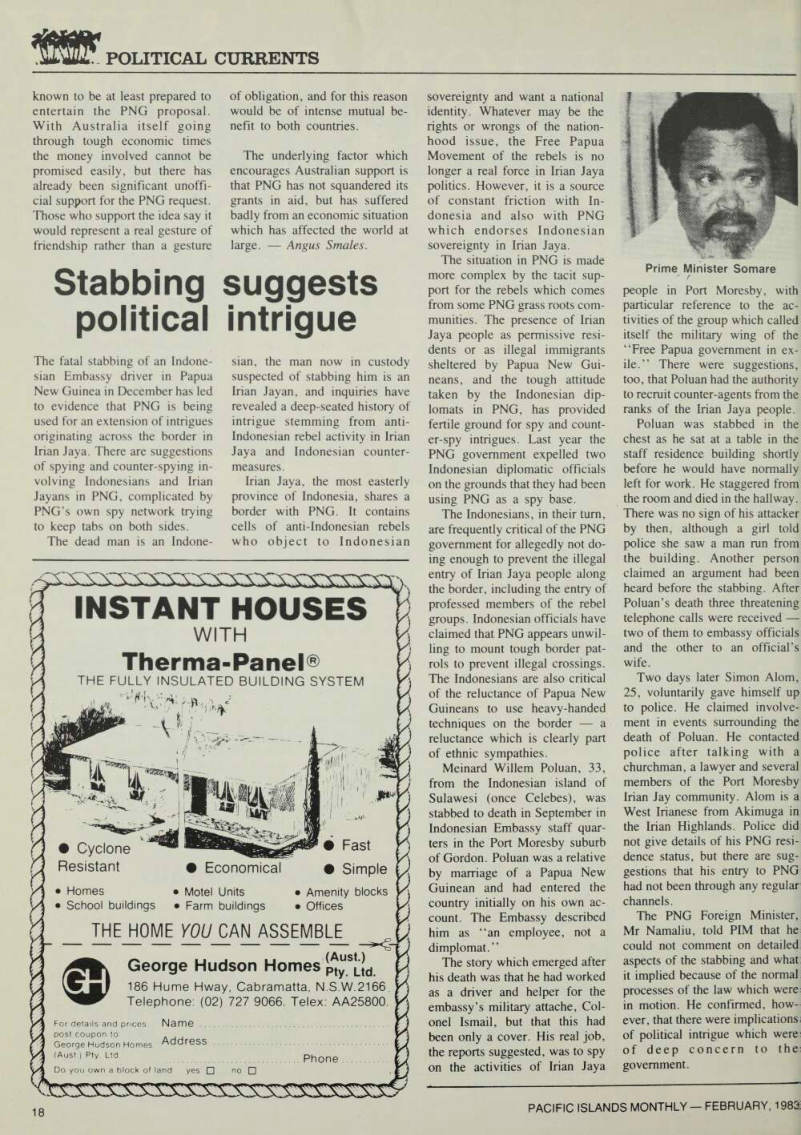
Prime Minister Somare