Troubled PNG asking Australia
pp. 17-18 · Read in the full issue
to increase its aid grant
Social problems, violence, un employment and crime have shown a marked increase in Papua New Guinea in the past 18 months. The situation is due in a large degree to an acute shortage of money, the depletion of re serves and a generally troubled economy. It is a far cry from the financial strength which marked PNG’s early years of independ ence in the mid 19705.
If any illustration is needed of the extent of the problems which PNG is facing, it is provided by the public service. The govern ment has retrenched about 10 percent of the public service. The numbers involved are nearly 3000 Papua New Guineans and about 300 contract outsiders in cluding Australians, New Zealanders, Britons and Filipinos.
It has long been claimed that the size of the PNG public ser vice was excessive, and repre sented an inheritance from Aust ralian administration in PNG.
Successive governments in PNG have conceded this, but have also claimed that a big public service was not out of place because of the opportunities it provided to phase Papua New Guineans into their new type of society.
The heavy retrenchments have not only brought increasing hard ship to the newly-emerged wage earning community, but have se verely cut the extent and scope of public works and services. This in turn has cut into private sector economic activity and employment.
An estimated 88 percent of Papua New Guineans still rely directly on their ancestral land for a subsistence-type economy.
But although they are outside the cash economy, they are not unaf fected by what has happened.
There is a widespread belief that countries like PNG can fall back on subsistence living in times of economic stress, but this is not practical. The result is that neith er the people of the new
Papua New Guinea, which gets nearly one-third of its national budget revenue from an annual Australian aid grant, has run into serious financial problems. At talks to be held in March PNG will ask Australia for an extra 12 percent on the agreed aid program to the end of 1986. Is an increase justified, and how will Australia react?
economy nor the people of the old economy can over-ride a de pression any better than can the people of developed countries.
Surveys by the World Bank and by Australian institutions have been critical to some extent of PNG’s national expenditure and spending patterns. PNG’s own central bank has issued a number of warnings, too. The suggestion is that PNG is partly to blame for its economic prob lems. This however is seen by many observers as extremely mild criticism against the back ground of PNG’s few short years of nationhood. In balance, PNG has shown a high degree of fi nancial responsibility particu larly in comparison with many other new nations, they believe.
The major cause of the present situation in PNG is a combina tion of world recessions and fal ling world markets. PNG’s great est single money earner is its copper and gold mining industry, but copper prices last year were at their lowest level for nearly 30 years and the tropical produce exported by PNG always a fickle money-earner also fell to low levels. Even copra, the
old standby which is never a glamorous money-earner but is usually more steady than other tropical crops, fell to an extreme low.
On top of reduced national incomes, PNG had its own ver sion of spiralling wage rates and it was further hit by the huge increases in the cost of petroleum fuels. Petroleum fuels create the biggest single drain on PNG foreign reserves, and PNG’s own expenditure estimates were re peatedly outstripped by the speed at which petroleum prices rose.
PNG cabinet ministers are well in the forefront of Pacific think ing in matters of alternative ener gy, but this is of little comfort to their country in its current heavy dependence on petroleum fuels.
One of the boasts of Michael Somare when he first became prime minister was that he did not want the Australian grant in aid to continue at a high level.
He believed that by tapering off the grant a stimulus would be provided to make PNG develop its self-reliance.
But circumstances have forced a change, and PNG has now made a formal approach to Aust
ralia for greater aid. The first tentative talks were held late last year when the Fraser government in Australia told the newly returned Somare government in PNG that it could not immediate ly accede to the request, but was prepared to bring forward the next round of scheduled talks to examine the PNG aid program.
These talks are now scheduled to be held in March.
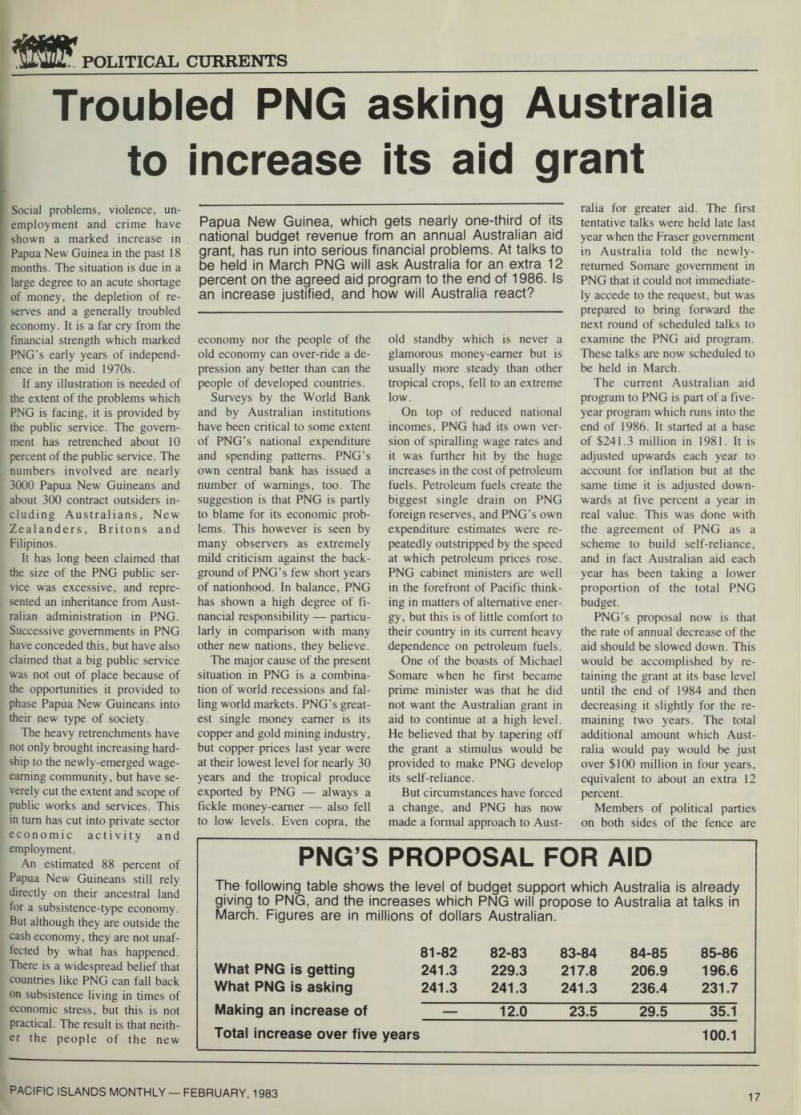
The current Australian aid program to PNG is part of a five year program which runs into the end of 1986. It started at a base of $241.3 million in 1981. It is adjusted upwards each year to account for inflation but at the same time it is adjusted down wards at five percent a year in real value. This was done with the agreement of PNG as a scheme to build self-reliance, and in fact Australian aid each year has been taking a lower proportion of the total PNG budget.
PNG’s proposal now is that the rate of annual decrease of the aid should be slowed down. This would be accomplished by re taining the grant at its base level until the end of 1984 and then decreasing it slightly for the re maining two years. The total additional amount which Aust ralia would pay would be just over $lOO million in four years, equivalent to about an extra 12 percent.
Members of political parties on both sides of the fence are
known to be at least prepared to entertain the PNG proposal.
With Australia itself going
through tough economic times
the money involved cannot be promised easily, but there has
already been significant unoffi
cial support for the PNG request.
Those who support the idea say it would represent a real gesture of friendship rather than a gesture
of obligation, and for this reason would be of intense mutual be nefit to both countries.
The underlying factor which encourages Australian support is that PNG has not squandered its grants in aid, but has suffered badly from an economic situation which has affected the world at
large.
Angus Smales.