budget debate
pp. 32-33 · Read in the full issue
Fact, fiction, and figuring in budget debate
All over the world the turn of the year is the time for searching analyses of the year just gone, and the hopeful unveiling of policies for the new. So it has been in French Polynesia in recent weeks, and the subject most hotly debated has been the economy of the territory or, to be more precise, the numerous social and human problems created by the over-rapid and enforced transfor mation of the traditional Polynesian subsistence economy into a Western-style cash economy.
Focal point of the discussion was the delayed presentation in the Territorial Assembly between Christmas and the New Year of the 1983 budget. The basic documents putting it in perspective were the annual bulletin of the Institute of Statistics (covering the year 1981), and a special report prepared by the head of the local credit institution, SOCREDO, Jean Vemaudon.
At first glance, some of the figures seem to belong to a new literary genre which might be called “statistical fiction”. For instance, how is it possible to believe that the 150,000 inhabitants of French Polynesia in one year consumed 463,000 tonnes of imported goods, worth CFP55,000 million? (The 1981 exchange rate between the CFP and the U.S. and the Australian dollar was roughly CFP 100 to one. It is now about CFP 120 to one.
These figures suggest a per capita expenditure of CFP366,667, a preposterous figure which serves as the basis for the apparently irrefutable claim that the French Polynesians have the highest standard of living of all the peoples in the Pacific, and perhaps even the world.
The breakdown of the figures is as follows; 165,965 tonnes of petroleum products required to run 100,000 motor vehicles and to produce 136 million kilowatts of electricity for 23,400 households and industrial establishments: CFP6B77 million; 133,668 tonnes of timber, cement, iron and other building materials: CFP4O94 million; 38,272 tonnes of industrial equipment, most of which was used for new electrification schemes in Tahiti; CFP15,513 million; 41,444 tonnes of household appliances, machinery and engines, including 3791 four-wheeled vehicles and 1793 two-wheeled: CFPI6,BOB million; 81,786 tonnes of food and beverages: CFP10,551 million.
The Department of Agriculture estimates that in 1981, as during the previous five or six years, no less than 85 per cent of food consumed in the territory was imported a disastrous comedown from the happy pre-bomb days when the territory was self sufficient in food (PIM Jun. ’B2, p 26).
The most amazing thing of all is the quantity of fish imported in 1981 CFP4B4 millions worth of fresh, canned, frozen or smoked fish, clams and crustaceans, brought in from more than a dozen different countries, including far-off places such as Iceland, Namibia and Bangladesh.
And all the time the waters of French Polynesia are teeming with tuna, bonito, mahimai, and other delicious types of fish. But these readily available creatures were hauled from the deep by Japanese, Korean and Taiwanese fishermen, and replaced on local menus by that massive array of imports.
Following the established trade pattern, almost half of the goods imported came from France, 10 per cent from other Common
Market countries, 21 per cent from the USA, 11 per cent from various Asian countries, 5.4 per cent from New Zealand, and 3.4 per cent from Australia. The last two countries supplied mainly meat, cereals and dairy products.
The magnitude of the territory’s imports is matched by the insignificance of its exports. Valued at only CFPIOI4 million, they consisted of a rather pathetic little list of only five items, headed by coconut oil (10,329 tonnes, valued at CFPSI9 million), and pearls (86 kilograms, valued at CFP4OS million).
How is it possible to maintain such a lop-sided relationship between imports and exports? The official line is that France supplies most of the money that permits the Polynesians to import all these goods, and lead a life of ease and luxury. The High Commissioner said it recently, in his speech opening the budget session of the assembly. He announced that the French contribu tion to the local economy in 1981 was CFP47,500 million or
CFP3IO,OOO per head for every one of us 150,000 inhabitants of the territory. This sounded and was obviously meant to sound as if France was some sort of Santa Claus, generously rewarding his Polynesian children for their good behavior. (Another metaphor often used is that of a Polynesian mistress set up in grand style by her generous French lover . . .).
The simple and easily ascertained truth is that France does in fact spend fabulous sums in Polynesia, but that the sums that actually percolate down to the islanders are very modest indeed., More than a third of the sum mentioned by the High Commission er, for example, goes on the nuclear testing program at Moruroa.
The rest of the CFP47,500 million “gift” is absorbed in its entirety by 15,000 civil servants and government employees a huge proportion of them expatriate Frenchmen or sundry wild, unproductive schemes.
The alleged CFP3IO,OOO per capita French “contribution” is, therefore, sad to relate, a completely meaningless figure, put out solely for propaganda purposes.
Another equally fictional figure that is constantly cropping up in official speeches is the alleged record high GNP which is basec on the false premise that the paperwork of the French civilian anc military bureaucrats is a “product” worth figuring in the annuaj economic balance sheet of the territory.
So those lop-sided import-export figures are explained by the massive regular purchases made by the French army and administ ration. In addition, the 15,000 individuals on the French Governi ment payroll buy for their own personal use huge quantities o:< goods such as cars, clothes, TV sets, video players, fine wines; liqueurs, and expensive foods. Remember that a top bureaucrai gets a monthly salary of from CFP4OO,OOO to 600,000 tax-free; and lower-echelon officials CFPIIS,OOO to 150,000. There is ye: another important category of French consumers now numben ing about 25,000 to be considered: these are the businessmen and tradesmen who have settled with their families in Tahiti sine* the bomb tests began, and who make a living selling goods ano
services to the army and administration, as well as to military personnel and government officials as individuals.
Some Polynesians undoubtedly manage to get a thin slice of the French cake by working for some of the above-mentioned public and private employers.
The most accurate figures suggest that 2340 Polynesian men work for the CEP-CEA organisation which has responsibility for the nuclear testing program, and 4975 for various construction companies.
We can also take it for granted that the 4475 registered housemaids and charwomen are Polynesians.
As for the 6000 or so Polynesians who are still classified in most documents as “independent farmers’’, they supposedly live off the land. It is doubtful, however, whether there will be enough land left for their children to go on surviving in the same frugal manner.
Last but not least there are probably about 20,000 poor devils who in practically any other country on earth would be classified as unemployed, but who in French Polynesia are statistically non existent because they have never cared to register at the unemploy ment office in Papeete, since there’s no dole to pick up. Among the worst hit are the numerous immigrants from the outer islands, and the school drop-outs, who number about 2000 every year.
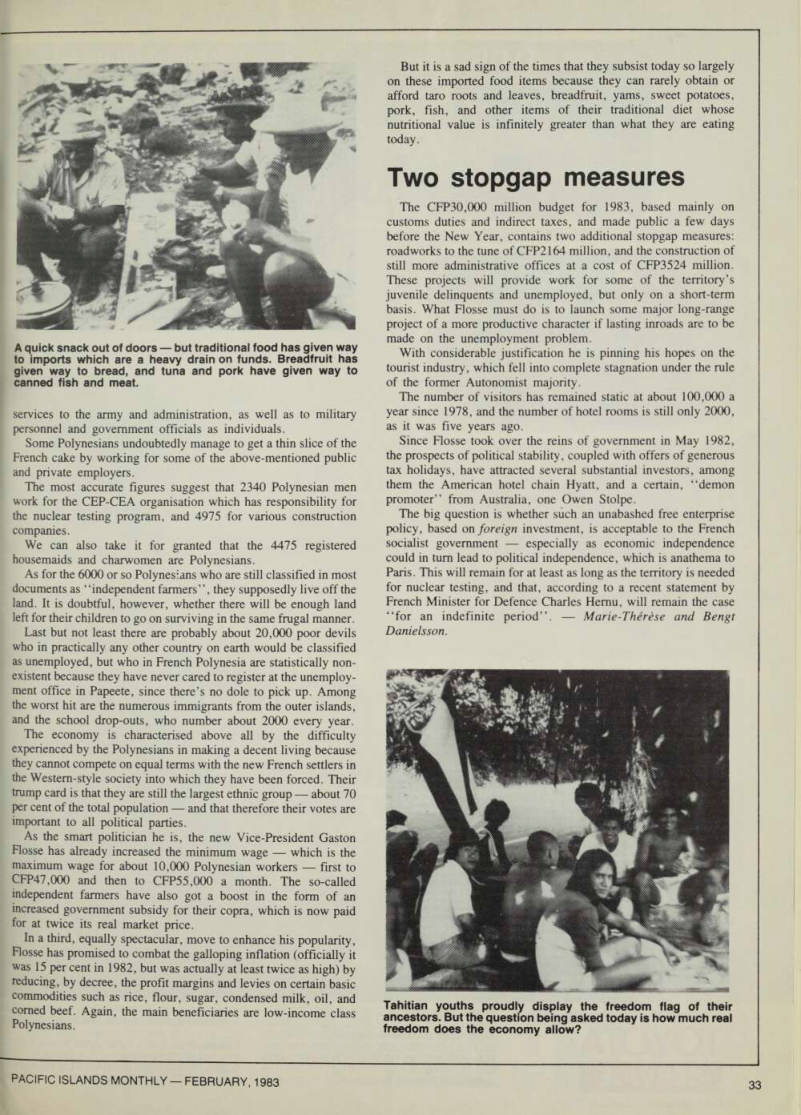
The economy is characterised above all by the difficulty experienced by the Polynesians in making a decent living because they cannot compete on equal terms with the new French settlers in the Western-style society into which they have been forced. Their trump card is that they are still the largest ethnic group about 70 per cent of the total population and that therefore their votes are important to all political parties.
As the smart politician he is, the new Vice-President Gaston Flosse has already increased the minimum wage which is the maximum wage for about 10,000 Polynesian workers first to CFP47,000 and then to CFP55,000 a month. The so-called independent farmers have also got a boost in the form of an increased government subsidy for their copra, which is now paid for at twice its real market price.
In a third, equally spectacular, move to enhance his popularity, Flosse has promised to combat the galloping inflation (officially it was 15 per cent in 1982, but was actually at least twice as high) by reducing, by decree, the profit margins and levies on certain basic commodities such as rice, flour, sugar, condensed milk, oil, and corned beef. Again, the main beneficiaries are low-income class Polynesians.
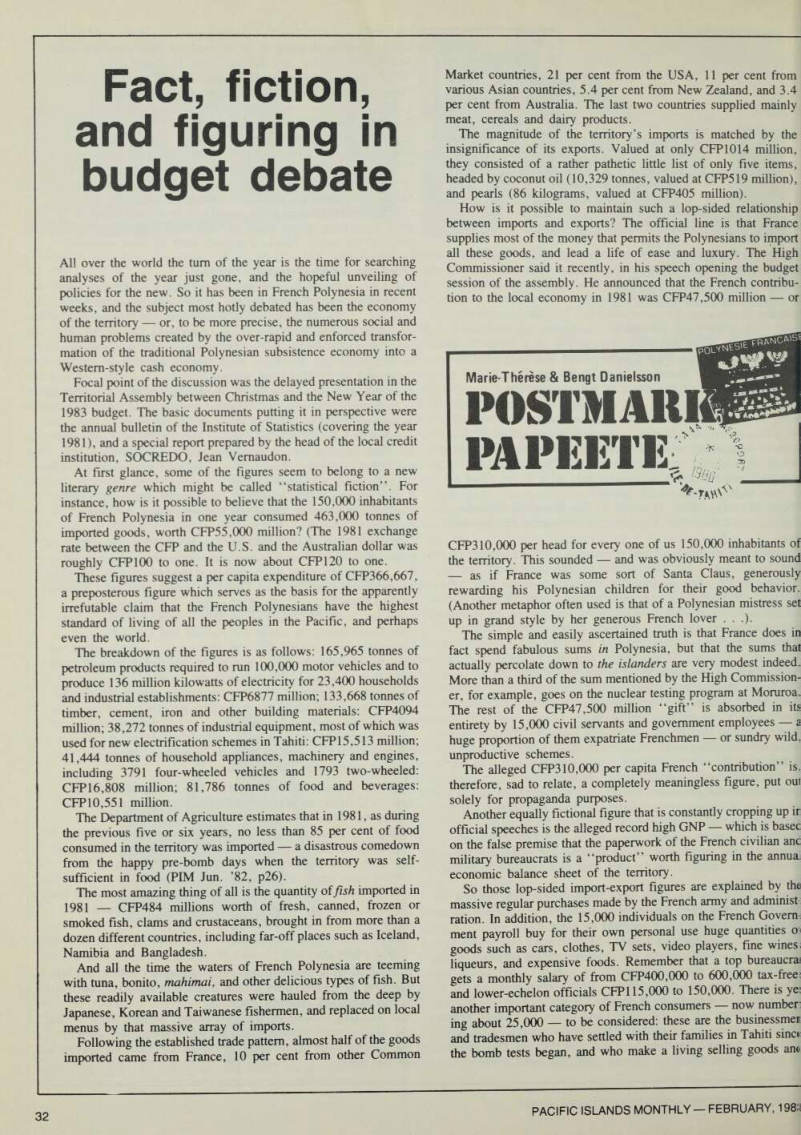
But it is a sad sign of the times that they subsist today so largely on these imported food items because they can rarely obtain or afford taro roots and leaves, breadfruit, yams, sweet potatoes, pork, fish, and other items of their traditional diet whose nutritional value is infinitely greater than what they are eating today.
Two stopgap measures
The CFP3O,OOO million budget for 1983, based mainly on customs duties and indirect taxes, and made public a few days before the New Year, contains two additional stopgap measures: roadworks to the tune of CFP2I64 million, and the construction of still more administrative offices at a cost of CFP3524 million.
These projects will provide work for some of the territory’s juvenile delinquents and unemployed, but only on a short-term basis. What Flosse must do is to launch some major long-range project of a more productive character if lasting inroads are to be made on the unemployment problem.
With considerable justification he is pinning his hopes on the tourist industry, which fell into complete stagnation under the rule of the former Autonomist majority.
The number of visitors has remained static at about 100,000 a year since 1978, and the number of hotel rooms is still only 2000, as it was five years ago.
Since Flosse took over the reins of government in May 1982, the prospects of political stability, coupled with offers of generous tax holidays, have attracted several substantial investors, among them the American hotel chain Hyatt, and a certain, “demon promoter’’ from Australia, one Owen Stolpe.
The big question is whether such an unabashed free enterprise policy, based on foreign investment, is acceptable to the French socialist government especially as economic independence could in turn lead to political independence, which is anathema to Paris. This will remain for at least as long as the territory is needed for nuclear testing, and that, according to a recent statement by French Minister for Defence Charles Hemu, will remain the case
“for an indefinite period’’.
Marie-Thérèse and Bengt
Daniels son.
A quick snack out of doors but traditional food has given way to imports which are a heavy drain on funds. Breadfruit has given way to bread, and tuna and pork have given way to canned fish and meat.
Tahitian youths proudly display the freedom flag of their ancestors. But the question being asked today is how much real freedom does the economy allow?