Trans-sexual prostitution in Polynesia
pp. 11-12 · Read in the full issue
Polynesia: A tradition defiled?
Deborah Macfar
LANE, writer of this arti cle, is a New Zealand medical student doing a Master of Public Health degree at the University of
Sydney, Australia.
The article is the result of three months research carried out late last year in Tahiti, Hawaii and San Francisco. It is based on part of Ms MacFarlane’s work for her MPH thesis.
For some years now, the larger Polynesian islands have seen the emergence of an intriguing type of character: young, flamboyant and predominantly of Polynesian origin, they frequent the bars and clubs, emerging from time to time to parade the streets and solicit male clients willing to pay them for their sexual services.
At first glance they could be mistaken for female prostitutes, and indeed some behave so con vincingly as women that even upon close examination no mas culine traits can be detected.
These individuals are, howev er, trans-sexual prostitutes, males who identify so closely with women that they adopt a feminine lifestyle, and support themselves through prostitution.
Indeed, trans-sexual prostitution has become so prevalent throughout Polynesia that one can readily indicate on a map of the Polynesian triangle the is lands where it can now be found.
Many historical references in dicate that transvestism and trans-sexualism were similarly prevalent in Polynesia hundreds of years ago. In an earlier PIM article, “Polynesia’s Third Sex”
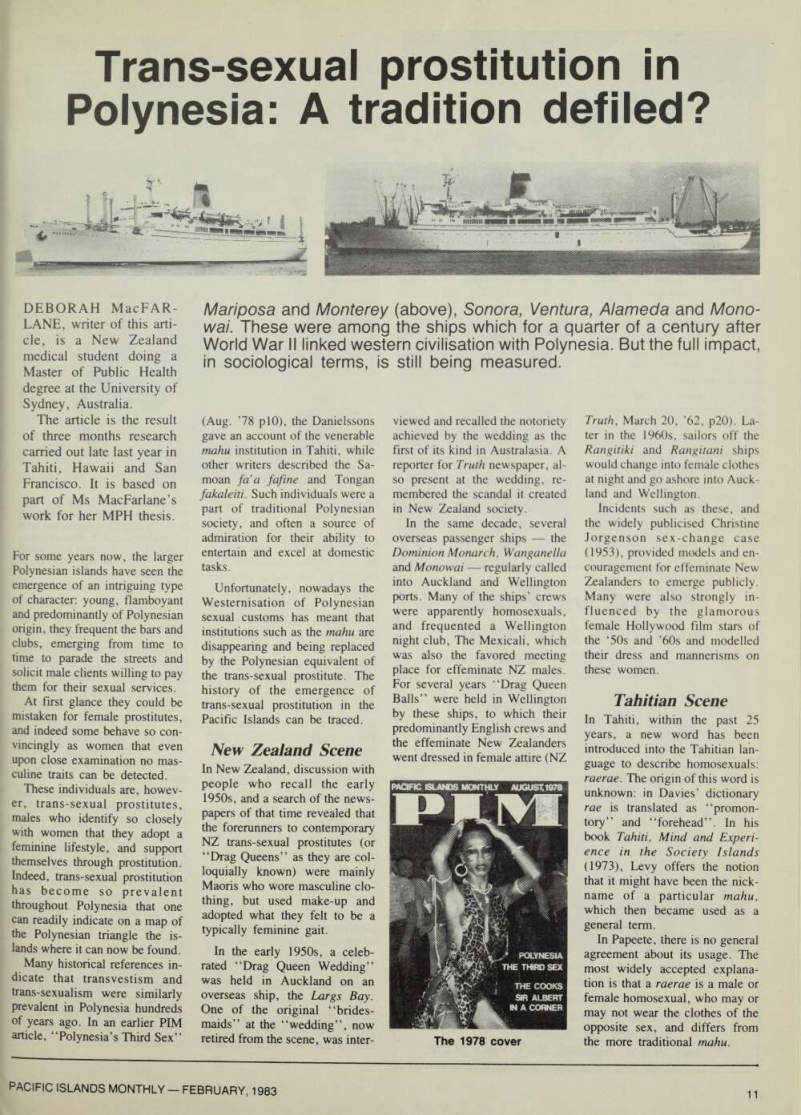
Mariposa and Monterey (above), Sonora, Ventura, Alameda and Mono wai. These were among the ships which for a quarter of a century after World War II linked western civilisation with Polynesia. But the full impact, in sociological terms, is still being measured.
(Aug. ’7B plO), the Danielssons gave an account of the venerable mahu institution in Tahiti, while other writers described the Sa moan fa a fafine and Tongan fakaleiti. Such individuals were a part of traditional Polynesian society, and often a source of admiration for their ability to entertain and excel at domestic tasks.
Unfortunately, nowadays the Westernisation of Polynesian sexual customs has meant that institutions such as the mahu are disappearing and being replaced by the Polynesian equivalent of the trans-sexual prostitute. The history of the emergence of trans-sexual prostitution in the Pacific Islands can be traced.
New Zealand Scene In New Zealand, discussion with people who recall the early 19505, and a search of the news papers of that time revealed that the forerunners to contemporary NZ trans-sexual prostitutes (or “Drag Queens” as they are col loquially known) were mainly Maoris who wore masculine clo thing, but used make-up and adopted what they felt to be a typically feminine gait.
In the early 19505, a celeb rated “Drag Queen Wedding” was held in Auckland on an overseas ship, the Largs Bay.
One of the original “brides maids” at the “wedding”, now retired from the scene, was inter
viewed and recalled the notoriety achieved by the wedding as the first of its kind in Australasia. A reporter for Truth newspaper, al so present at the wedding, re membered the scandal it created in New Zealand society.
In the same decade, several overseas passenger ships the Dominion Monarch, Wanganella and Monowai regularly called into Auckland and Wellington ports. Many of the ships’ crews were apparently homosexuals, and frequented a Wellington night club. The Mexicali, which was also the favored meeting place for effeminate NZ males.
For several years “Drag Queen Balls” were held in Wellington by these ships, to which their predominantly English crews and the effeminate New Zealanders went dressed in female attire (NZ
Truth , March 20, ’62, p2O). La ter in the 19605, sailors off the Rangitiki and Rangitani ships would change into female clothes at night and go ashore into Auck land and Wellington.
Incidents such as these, and the widely publicised Christine Jorgenson sex-change case (1953), provided models and en couragement for effeminate New Zealanders to emerge publicly.
Many were also strongly in fluenced by the glamorous female Hollywood film stars of the ‘sos and ’6os and modelled their dress and mannerisms on these women.
Tahitian Scene In Tahiti, within the past 25 years, a new word has been introduced into the Tahitian lan guage to describe homosexuals: raerae. The origin of this word is unknown: in Davies’ dictionary rae is translated as “promon tory” and “forehead”. In his book Tahiti, Mind and Experi ence in the Society Islands (1973), Levy offers the notion that it might have been the nick name of a particular mahu, which then became used as a general term.
In Papeete, there is no general agreement about its usage. The most widely accepted explana tion is that a raerae is a male or female homosexual, who may or may not wear the clothes of the opposite sex, and differs from the more traditional mahu.
The 1978 cover
Apparently raerae have exist ed in Papeete only since the mid -19505, corresponding roughly with the emergence of the term.
At this time, Matson liners would regularly call into Papeete, where their often homosexual crew, and undoub tedly also some of the passen gers, would consort with the loc al Tahitians. The first call in Papeete since World War II of a Matson liner was apparently by the Alameda on May 10, 1955, some 27 years ago. Other Mat son liners sailed around the Pacific, calling into New Zea land, Hawaiian and Tahitian ports. They included the Ventu
ra, Sonora, Sierra, Monterey, and Mariposa (PIM, July, 1955).
Before that time in Tahiti, the only homosexuals were mahu, and they were definitely not prostitutes.
Therefore a similar phenome non occurred in Papeete, Tahiti, as in Wellington, New Zealand; homosexual sailors from over seas liners paid the local Polyne sian homosexuals for their sexual services as “women”, and thus trans-sexual prostitution was es tablished. It must also be noted that on those Polynesian islands where overseas liners seldom, if ever, call, such as the Austral group, the Tuamotus, and Easter
Island, trans-sexual prostitution is not evident.
When Levy did his study in Tahiti (1962-1964), and even at the time of the Danielssons’ arti cle (1978), the mahu role was one of a limited number of cul tural forms which still persisted in Tahitian communities. In those years, the tradition that there was never more than one mahu to a community still held.
These days, that rule no longer applies, for in some communities such as Vaitape on the island of Bora Bora, several mahu now live in close proximity to each other.
When these elderly mahu die, no more will emerge to take their place. Instead they will be re placed by raerae. The extent to which this replacement occurs is therefore an indicator of the amount of acculturation that has occurred in Tahiti. From current observations, this is sadly quite significant.
In the cities, young Polyne sians are away from the influence of tribal land and leaders. Few services are available to them to establish links with past tradition and culture. In such an alien environment, there is an in creased opportunity for the adop tion of an alternative lifestyle such as trans-sexual prostitution.
In addition, due to lower stan dards of education and fewer employment opportunities than Europeans, many Polynesian trans-sexuals resort to prostitu tion, often the only available means of earning a living.
Nowadays most Polynesian trans-sexuals express a wish for sex-change operations. One can not help but wonder to what extent this wish is a reflection of Western values.
It is quite conceivable that were it not for European contact, the traditional forms of trans sexualism would still exist throughout Polynesia. These in dividuals would be a readily ac cepted part of Polynesian socie ty, have no need for prostitution, and definitely not express the media-promoted desire for sex change surgery.
The contemporary prevalence of trans-sexual prostitution through much of Polynesia can only be seen as a further example of the frequently destructive im pact of westernisation upon a traditional culture.
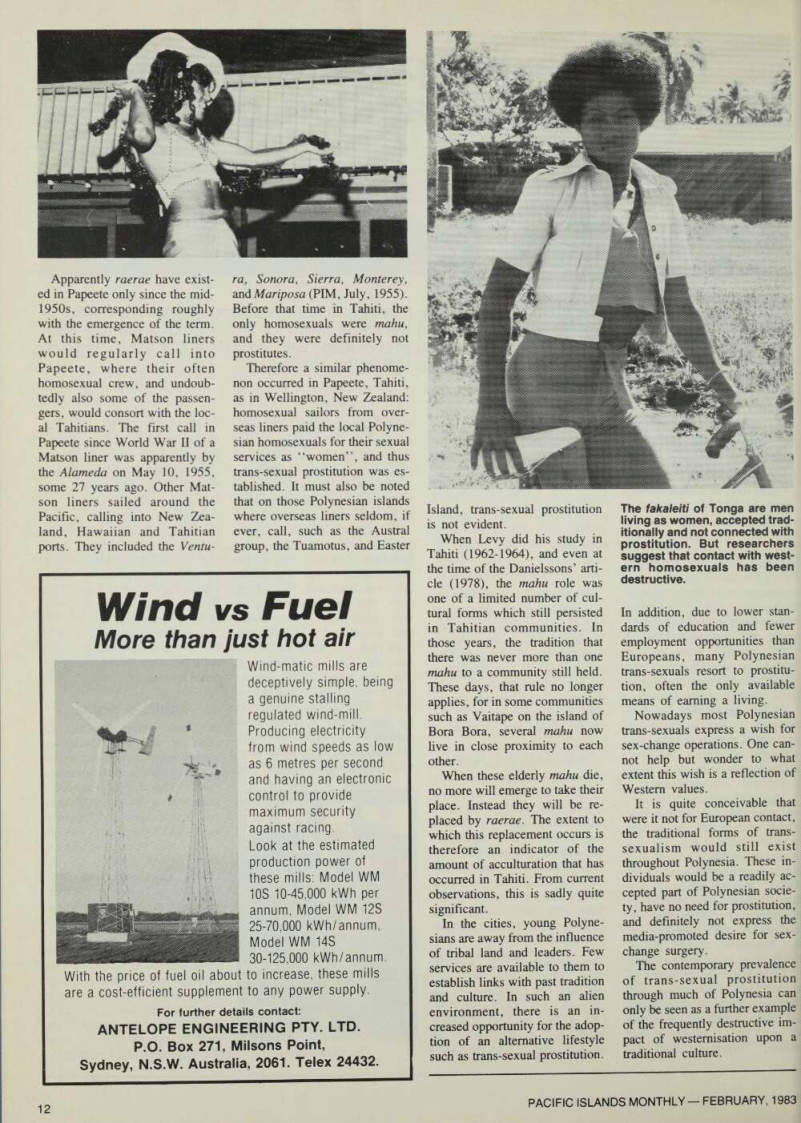
The fakaleiti of Tonga are men living as women, accepted trad itionally and not connected with prostitution. But researchers suggest that contact with west ern homosexuals has been destructive.