Airline, shipping issues in fall
pp. 13-15 · Read in the full issue

Political Currents
Airline, shipping issues in fall of Kiribati Government
BILLY SCHUTZ in Tarawa has talked to former Presi dent leremia Tabai and other chief actors in the drama which saw the fall of the government of Kiribati on December 10, 1982 (PIM Jan p 33). His report shows that there were is sues at stake quite apart from the formal one of an amendment to civil service
pay legislation.
The formal cause of the defeat of the Kiribati Government under President leremia Tabai was the rejection by 20 votes to 15 by the Maneaba ni Maungatabu (House of Assembly) of a government move to correct what it saw as an anomaly in civil service pay legislation. But a number of other issues lay beneath the surface.
The pay move would have legitimised salary rises of five per cent granted earlier in 1982 without the necessary backing in law to the holders of the six constitutional posts in the State set-up of Kiribati: the Speaker of the House, the chairman of the Public Service Commission, the Attorney-General, the Chief Jus tice, the Commissioner of Police, and the Director of Au dit. It would also have allowed them to receive rises in future, in line with civil service pay rates, without resort to constitutional amendments all the time.
The House had rejected the government’s bill on the issue on December 9. Former President Tabai told me in an interview: “I felt there was an issue of confi dence in that vote.” So, when the matter was reintroduced the next day, he included the issue of confidence. “It would not have been honorable to carry on with out doing so,” he said.
He said he was puzzled as to why the House had rejected the
bill. “The amount involved is only $1869. We were only trying to correct an oversight in existing legislation which had been point ed out by the Director of Audit. ”
But a spokesman for the newly formed opposition party Wiia I- Kiribati (Mouth of the Kiribati People) claimed the president had used the confidence issue to threaten members with the poss ible loss of their seats if they did not support his amendment. (The Kiribati Constitution provides that in the event of the defeat of a government, parliament must be dissolved and fresh elections held.) The spokesman admitted that his party had taken full advan tage of the confidence issue when it came up.
“The leremia government has been untruthful in the past,” he said.
His party’s main objections were to the losses incurred by Air Tungaru’s Boeing 727, and what he called the “continual sub sidy” to the Kiribati Shipping Corporation.
The spokesman claimed that expenditure figures on the Boe ing had never been made avail able to MPs. On the shipping corporation, he said that the gov ernment had allowed it to use money from the National Provi dent Fund, and had guaranteed it a bank loan to purchase a new ship.
On the issue of the salary rises for “the top six”, he said they were constitutional appointees and not civil servants. They should be treated the same as MPs and excluded from the civil service rises.
Responding to these opposi tion criticisms, former President Tabai said that opposition spokesmen should have raised the confidence issue “at a more appropriate time”. “This was not the time to discuss Air Tun garu and the shipping corpora tion,” he said.
The House had approved a Supplementary Appropriation Bill granting more money to Air Tungaru in May. “I can’t under stand how their opinions have changed so drastically in such a short time,” he said. The differ-
ence between chartering Air Nauru to do the Tarawa- Christmas Island-Honolulu run, and operating the Air Tungaru 727, was “nothing major”, he said. It was important to main tain the link with the Line Is lands, and the most practical means was by air. Mr Tabai added that details of expenditure on the Boeing were contained in a report by the Director of Audit, which had already been tabled in the House.
On the shipping corporation, the former president said for the provident fund or the national bank or any other financial in stitution to make a loan was “normal commercial practice”.
He did not regard such a loan as a subsidy. He said it was a sign of a country’s independence to buy a ship from local funds and not rely on aid. “Opposition mem bers should be proud of this rather than decrying it,” he said. (The ship concerned, the MB Nei Momi, a 300-tonne Japanese
built, cargo and passenger vessel costing $1.9 million, is already in operation.) On the issue of “the top six”, Mr Tabai said they held “con stitutional” posts only to main tain their independence of gov ernments, but, apart from this consideration, they were the same as other civil service posts.
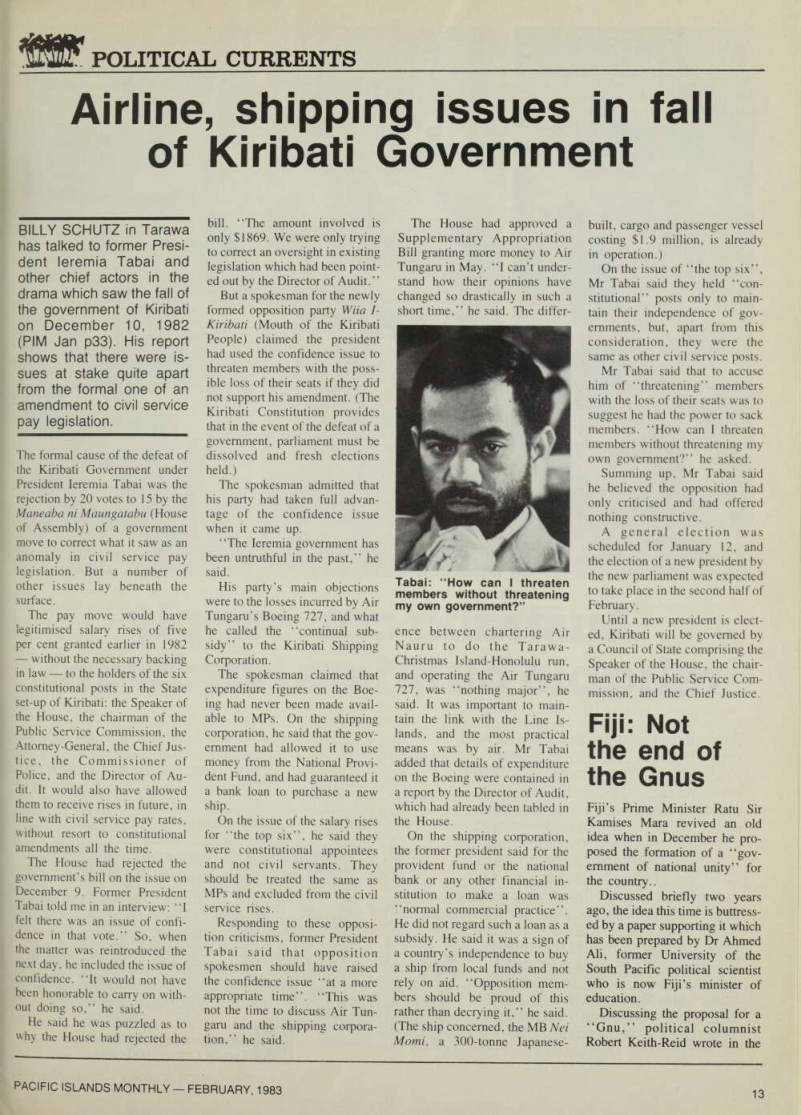
Mr Tabai said that to accuse him of “threatening” members with the loss of their seats was to suggest he had the power to sack members. “How can I threaten members without threatening my own government?” he asked.
Summing up, Mr Tabai said he believed the opposition had only criticised and had offered nothing constructive.
A general election was scheduled for January 12, and the election of a new president by the new parliament was expected to take place in the second half of February.
Until a new president is elect ed, Kiribati will be governed by a Council of State comprising the Speaker of the House, the chair man of the Public Service Com mission, and the Chief Justice.
Fiji: Not
the end of
the Gnus
Fiji’s Prime Minister Ratu Sir Kamises Mara revived an old idea when in December he pro posed the formation of a “gov ernment of national unity” for the country..
Discussed briefly two years ago, the idea this time is buttress ed by a paper supporting it which has been prepared by Dr Ahmed Ali, former University of the South Pacific political scientist who is now Fiji’s minister of education.
Discussing the proposal for a “Gnu,” political columnist Robert Keith-Reid wrote in the
Tabai: “How can I threaten members without threatening my own government?”
The Fiji Times of December 11: “On Tuesday a New Zealand High Court judge, Sir John White, is due to open his one man Royal Commission of In quiry into what really happened up to, and perhaps after, the election.
“Did the Alliance really try to fix the NFP with sinister outside help? Did the NFP really try to do the same to the Alliance? And so on, and so on.
“What surfaces in the White wash is bound to raise hackles and tempers again.
“It might be quite some time before the PM and Mr Reddy will be able to feel that they can get together to talk Gnu, if at all.
“In his Gnu talk so far the Prime Minister has seemed to imply that a goverment of nation al unity wouldn’t just be an ordi nary coalition government.
“Nor would it turn Fiji into a one-party state.
“Over the years since inde pendence came Fiji’s way he has said, more than once, that he’s become more and more convinc ed that the pure Westminster style of democracy, with a gov ernment side and an opposition side blustering away at each other across the floor of parlia ment, doesn’t work all that well in a multi-racial country such as Fiji, where stark divisions of race make a big and often dangerous difference in the way people think and react in response to things said and done by the other side.
“Mr Reddy’s first reaction has been to emphasise how very dif ficult it will be for Fiji’s political parties to get together in a state of Gnu-dom.
“A very delicate and complex business it will be, he said.
“And he was right.”
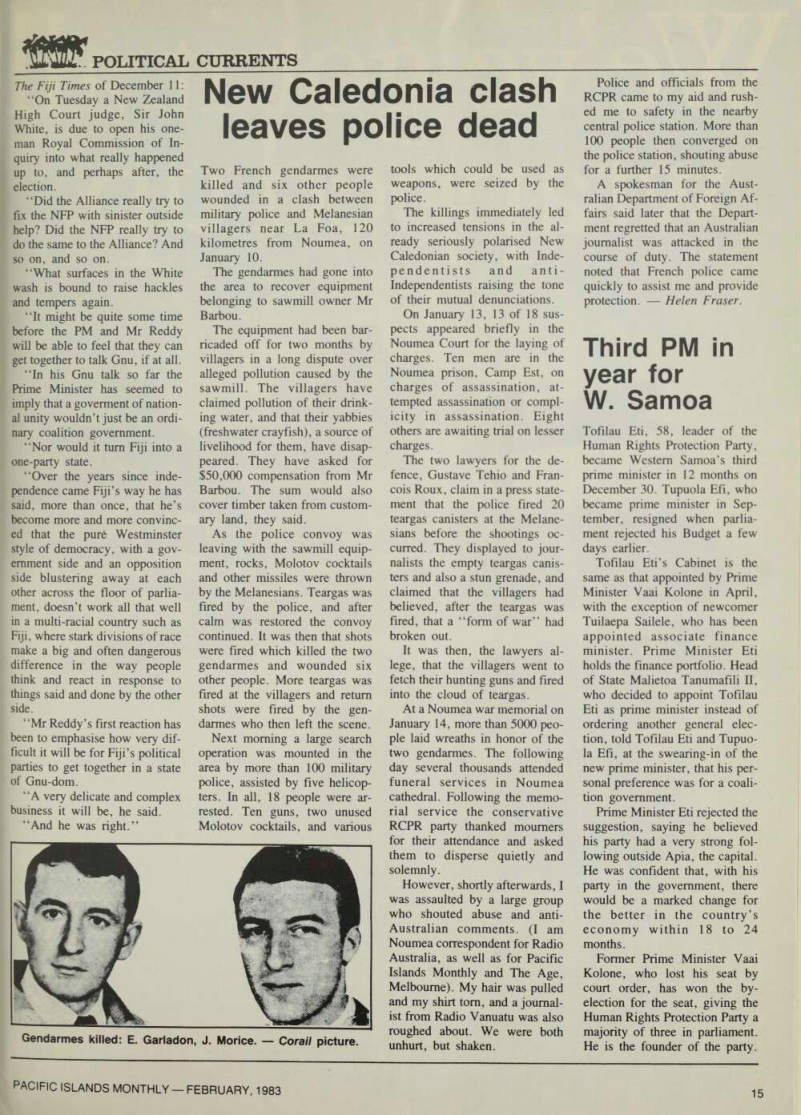
Gendarmes killed: E. Garladon, J. Morice. Corail picture.