Vanuatu (1)
pp. 7-10 · Read in the full issue

Letters
The land
issue in
Vanuatu (1)
The letter written to the Prime Minister of Vanuatu, Father Walter Hadye Lini, by Dr Alan Ward, La Trobe University, Melbourne (PIM Nov p 8), is most interesting in the subject it discusses, but warrants a few comments. I must say at the outset that I do not agree with him.
As far as the islanders are
concerned, the principal problem
raised by the presence of an “alienator” is this presence it self. They have been ready to accept, in many cases and I concur with them in principle that the representative of a family they have known for two to five generations be allowed to stay as a lessee, either on a large tract of land where he remains a produc er and perhaps an investor, or on small plots on which he keeps his house and lives from some out
side activity.
Many such “alienators” have only stayed on so as to get from the people an official and regis tered lease, which they hope to sell to a newcomer, so that they can retire with the proceeds to France, New Caledonia, Aust ralia or elsewhere. The villagers would accept helping a friend and neighbor to stay on, but do not relish the idea of opening the way to the coming of a new brand of settlers.
Thus we come to the idea that those alienators who decide to go should be paid for the improve ments they have made on the land. In fact, and this is part of the problem, there are no im provements to be seen which would warrant payment. Most of the coffee and cocoa plantations were abandoned long ago, and now there are cattle ranches either under coconut trees or the open sky. In the first case, the coconut trees may be over 90 years old or at least over 60, without any improvement what ever having been made. Putting cattle under coconut trees is not such an improvement that it should warrant payment.
In some rare cases there has
been some replanting done in the last 20 years. Unfortunately, in most cases the replanting was done on newly cleared areas.
This has been strongly contested by the people in the villages concerned: they are not in a mood to accept this as an im provement and have often as a result striven to get the “alienator” out (e.g. Tisman Bay on Malekula, and Lonorore plantation on Pentecost). Such cases are considered as solved by everyone concerned, and nothing should be done to reopen them.
I am personally against any payment for improvements, ex cept when it can be demonstrated that there have been real im provements. Putting up fences for cattle, in Vanuatu’s climate, and considering the value of the soil, is not an improvement. It means that so-called bush areas have been cleared and opened to over-grazing and erosion. The Europeans in Vanuatu have done little to conserve existing re-
sources, that is the physical and chemical elements, and the biological agents present in the soil.
I do not believe that there will be any positive, or negative, con sequences for New Caledonia.
What we need is a prosperous and orderly Vanuatu, where peo ple work their own land and find a market for their produce, not a fragile economy burdened by payments made to alienators who have never been invited to settle, who took land by force or guile, and mistreated the people for a century.
In New Caledonia we have made a political decision to buy the land from the settlers and hand it back to the Melanesian people. This decision does not
make economic sense, but has been made in an historical con text, that of conquest: European settlement in greater numbers than Vanuatu; and political expe diency, as much locally as vis d vis France itself. It does not need to be shrouded in the convenient but hypocritical and technically unjustified idea of payment for improvements made. Extensive cattle ranching is no improvement.
I must protest against the idea that in Vanuatu the people have neither the skills nor the capital to run a plantation or redevelop it. The plantation system is no more a model for economic de velopment. The areas alienated by Europeans will go back to family units, except, as in south eastern Santo, where there are insufficient people ready to settle again on their former lands a problem of numbers more than anything else. The State will have to play an important role here. The real problem is not capital. The land is there. Nor is it skills the people have them or can be helped to acquire them.
By this I mean useful skills, not those derived from theoretical ideas, but those needed for pro ducing for a market, according to the conditions set by market forces. There is no easy way out.
Europeans can have a place in the building of the economy, but only if they want to stay because they love the place and the peo ple, not because they want to get away as soon as possible with as much money as possible. The sons and daughters of former settlers can be useful, but only if they do not ask for financial privileges against the real privilege of living in Vanuatu.
(Professor)
Jean Guiart
Paris France
The land issue
in Vanuatu (2)
Dr Alan W. Ward is to be con gratulated on his courageous and far-sighted letter (PIM Nov p 8), and, most particularly, on his self-sacrificing action in resign ing from his post as Director of Rural Lands in Vanuatu.
Every French settler who is eager to enter into partnership
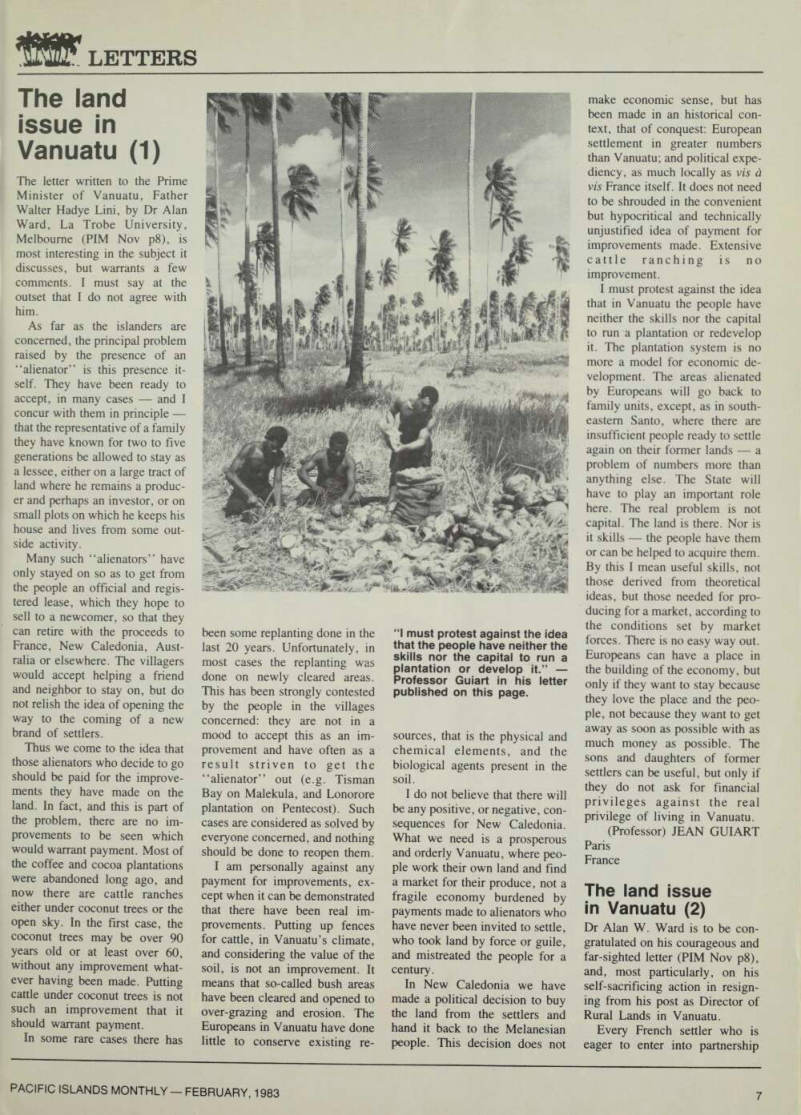
"I must protest against the idea that the people have neither the skills nor the capital to run a plantation or develop it."
Professor Guiart in his letter published on this page.
with Ni-Vanuatu to develop the land they live on should be grate ful to him, and to PIM for pub lishing his letter.
The land problem in Vanuatu since independence has been pre sented in a false light. How can one believe that the ancestors of the present-day Ni-Vanuatu shrewd, clever, hard bargainers as they were didn’t under stand what was happening when they sold or otherwise did a deal on land with white settlers?
I attach a copy of a 1912 document in which Hugh. Ale xander Robertson, a Presbyterian missionary on the islands of Er romanga, states on oath that he was witness to a formal transac tion in 1895 in which Gordon Macmillan Robertson purchased land for the sum of 20 pounds from a group of Ni-Vanuatu vendors.
Jean-Claude Rouleau
Port-Vila Vanuatu
“The Bounty
Experiment”
I am surprised that in the re cent discussions in PIM on films concerning the Bounty mutiny more attention has not been paid to a fine film made by Film Australia, The Bounty Experiment.
Not only is this 50-minute documentary, made on location on Pitcairn and Norfolk Islands, beautifully photographed and full of human interest, but its com mentary matches the quality of the images which is far from always being the case.
For the film’s makers, there were no “heroes” or “villains” in the Bounty mutiny, but merely Englishmen of the late 18th cen tury motivated by conflicting values of their times.
A sample: “In the late 18th
century, European explorers re turned from the Pacific with wonderful stories ... The Pacific was a new-found paradise, a paradise to be exploited. A sen suous place, and a place to be evangelised.
“While most sailors in those days had to be forced into ser vice, a voyage to the Pacific was like a magnet. The strongest and most able seamen could be cho sen. Beautiful women called men to dreams of wild romance, and to wild and headstrong actions.
The Pacific became a place of conflict as well as beauty.
“The mutiny on the Bounty had all the ingredients for epic movies. Clark Gable and Marlon Brando became Fletcher Chris tian. Charles Laughton and Trevor Howard became Captain Bligh.
“It’s a classic tale of conflict between two fundamental forces, between the sense of responsibil ity, of obligation, of commit ment to duty, and a contrary force, a yearning to drop the burdens, the drudgery of life as it really is and escape to something better.
“Those two forces in human nature came into collision 200 years ago on the Bounty. The collision caused the most famous mutiny in the whole history of the sea...”
The commentary returns to this opening theme in the closing moments of the film: the descendants of the mutineers lead a life they treasure.
“On Norfolk, the Pitcairners, as they still call themselves, manage to preserve their special identity in the face of pressures that erode it.
“The Pitcairners on Pitcairn see their isolation as a blessing, but the price they have to pay for it is rising.
“Being free or being respons
ible aren’t always the opposites that they seemed to be to Captain Bligh and Fletcher Christian.
“For the people of Pitcairn the two are very much bound together.
It’s a film that deserves much wider exposure, in Australia and elsewhere, than it has apparently had, and a credit to all those involved in its making John Shaw, who produced, directed, and filmed it, as well as writing the script; Howard Spry, sound technician, editor Richard Hind ley, and narrator Ed Howard.
This is not forgetting the peo ple on Pitcairn and Norfolk, who made a contribution of vibrant human warmth.
P. Warbeck
Sydney NSW Australia
Imperialist
Usa? (1)
Reader Urban Kapler’s claim (PIM Oct pi 3) that South Viet nam had a “functioning” gov ernment when the United States intervened in that country is spe cious, at the very least.
Historians and other observers generally recognise that, throughout most of the 1960 s and the early 19705, no South Viet namese government (read: dic tatorship) would have lasted more than a few weeks without the support, both political and military, of the United States.
Indeed, when the U.S. Govern ment did withdraw its support, Ngo Dinh Diem fell not to the Viet Cong or the North Vietnam ese, but to the people of South Vietnam in general.
Mr Kapler also confuses im perialism with colonialism. Im perialism does not involve the suppression of a country’s sovereignty as does colonial
ism but the exercise of power over a sovereign country’s deci sions regarding certain factors considered to be, for various “strategic” reasons, of paramount importance to the “security” of the imperial coun try. In that sense, a number of actions undertaken by the U.S. in Latin America, in Southern Afri ca, in the Pacific, and so on, can certainly be viewed as forming part of “imperialistic designs”, whether or not they are success ful. The same can be said about the actions of the Soviet Union in Eastern Europe, Afghanistan, Cuba, etc.
For a manifestation of modem colonialism, one has only to turn back a few pages in the same issue of PIM, where it is stated (p 5) that “the independence op tion (for the Marshall Islands Republic) has been rejected as unacceptable by U.S. negotiators”.
Michel Forand
Ottawa Canada
Imperialist
Usa? (2)
The letter from Urban Kapler (PIM Oct pi 3) requires rebuttal.
That U.S. policy in Vietnam was imperialist can be seen in NSC 5429-2 dated August 20, 1954 (see Department of Defense edi tion of the Pentagon Papers: United States-Vietnam Relations 1945-1967, House Committee on Armed Services Committee Print 92nd Congress Book 10, pp 736- 7, emphasis added).
“If requested by a legitimate local government which requires
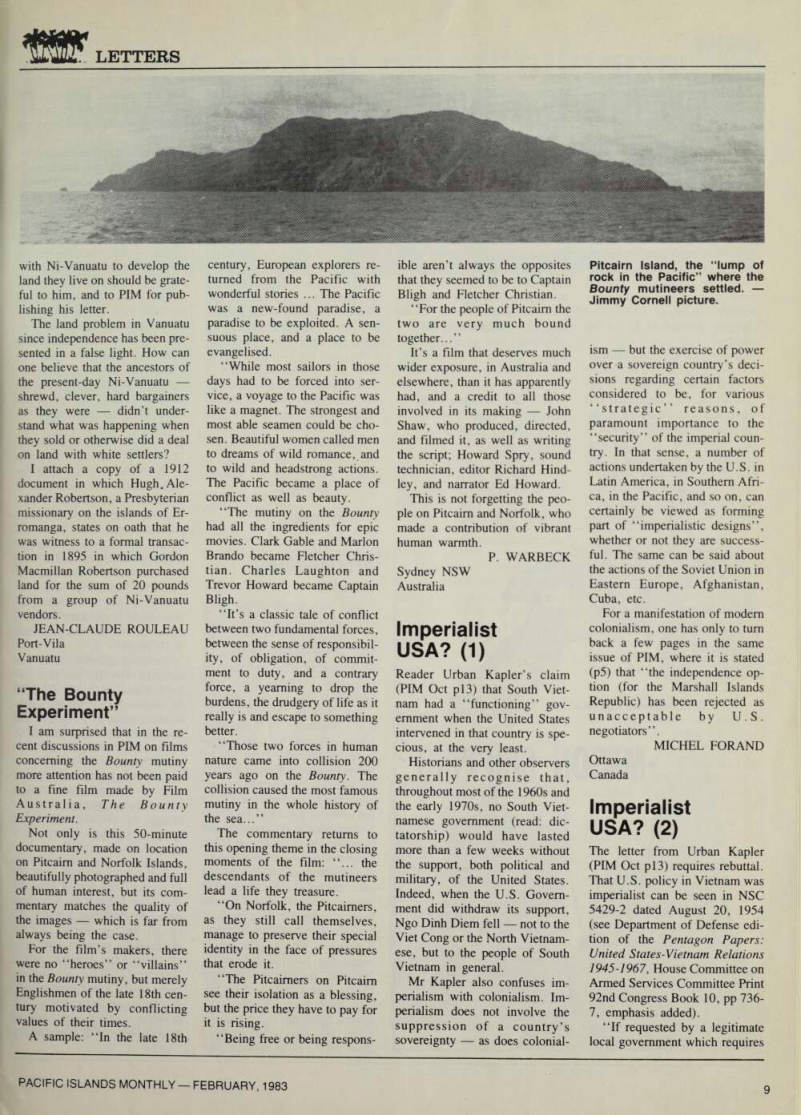
Pitcairn Island, the “lump of rock in the Pacific” where the Bounty mutineers settled.
Jimmy Cornell picture.
assistance to defeat local Com munist subversion or rebellion not consisting of armed attack, the U.S. should view such a situation so gravely that, in addi tion to giving all possible covert and overt support within Execu tive Branch authority, the Presi dent should at once consider Congressional authority to take appropriate action, which might if necessary and feasible include the use of U.S. military forces locally or against the external source of such subversion or re bellion (including Communist China if determined to be the source).”
In short, the U.S. will militari ly intervene as it sees fit against any group or government it de termines to be Communist and subverting a government it de clares as “legitimate”, even if the “subversion” is not an arm ed attack and would lead to war with China its legal obligation to the UN Charter notwithstand ing. And all of this is conceived within the context of the Geneva
Peace Accords of 1954 for French withdrawal from Vietnam.
Where Mr Kapler gets his fi gure of “5,000,000 people of Southeast Asia” murdered since the “liberation of South Viet nam” must also be questioned.
Perhaps like President Reagan he relies on the “authority” of The Reader’s Digest. After all, they were the first institution in the U.S. to publish the figure of 2,000,000 dead (now blossomed to 3,000,000 in some media re ports) as victims of the Pol Pot regime in Kampuchea. Their fi gure was based on an interview with an official of the Kampuc hean Government (who denies the interview occurred), publish ed in a Catholic family magazine from Rome which is so obscure that no library in the U.S. has a subscription to it.
That the U.S. had no imperial ist designs on the Pacific after World War II begs the facts. One has only to consider the history of U.S. relations with Mic-
ronesia and the Ryukyus. The Philippines were “given” their independence only after the U.S. assured to itself control over the economy of the islands. (And we must not forget the near genocid al U.S. policy in the early 20th century toward the Philippines.) As for the islands mentioned by Mr Kapler, he ignores the report of the House Committee on Nav al Affairs Study of Pacific Bases (Comm. Print, 79th Cong., 1945). They had designs not only on Micronesia, the Ryukyus, and the islands named by Mr Kapler, but many more including the Izus, Bonins, New Hebrides, Cebu, and the Gilberts. It was only the vigorous objections of its European colonial allies, and the tremendous financial burden required, that combined to force the U.S. to pull in its horns.
What I have noted above has been in the public domain for years. Where has Mr Kapler been all these years?
David Paul
Belmont, Mass.
Usa
Archaeology
weak?
I read PIM every month with interest but find that the reporting of anthropological and particu larly archaeological research in the islands is often inaccurate. I cite some examples from your September and October issues.
For instance Stephen Weins tein’s discussion of Kahoolawe Island in Hawaii includes a state ment that the island “is one of the few places in Hawaii that has not been explored (archaeologic ally) with a fine tooth comb”. In fact the opposite is true.
Kahoolawe is the only major Hawaiian island that has been intensively surveyed archaeolog ically, with over 500 sites having been recorded. Archaeological survey was undertaken by the navy in large part as a result of pressure from the Protect Kahoolawe Ghana. The whole island has been placed on the National Register of Historic Places in recognition of its his toric importance. Whether con tinued bombing is appropriate given this status is of course a moot point. Until massive ero
sion was caused, the island did have an agricultural economy, probably based on growing sweet potatoes.
Similarly the Danielssons’ ar ticle on Tikopia gets that island’s prehistory a bit wrong. There is no archaeological evidence of an earlier population being wiped out by a cyclone and much show ing a merging of cultures in later prehistory to produce the present “Polynesian” look to the is lands. I hope PIM will review Pat Kirch and Doug Yen’s excel lent new book on the prehistory and ecology of Tikopia, just pub lished by the Bishop Museum, so these misconceptions can be cleared up.
I have always found Robert Langdon’s (see his review of Feinberg’s Anuta ) and Erich von Daniken’s views of Pacific his tory to be equally invidious.
Thus Anuta’s culture is supposed to be a product of Europeandn dian influence (the same kind of argument as in Langdon’s Lost Caravel), and that of Kiribati a product of spacemen. When will Pacific prehistory and culture be properly credited to Pacific islan ders themselves rather than to “superior” outsiders! And when will PIM get a qualified ar chaeologist to check the accuracy of the reports that are published in its pages?
One final quibble. Anuta was already firmly on the an thropological map in 1973 with yet another Bishop Museum pub lication, edited by Doug Yen and Janet Gordon, called Anuta: A Polynesian Outlier in the Sol omon Islands.
Matthew Spriggs
(Assistant Professor) University of Hawaii at Manoa Honolulu Hawaii
Usa
PIM cannot pretend to be (or to employ) any sort of final au thority on subjects such as those raised by Professor Spriggs. Af ter all, anthropologists and ar chaeologists spend a great deal of their time arguing among themselves. What we do ap preciate are letters from readers like Professor Spriggs which ex press a spirited viewpoint on material appearing in our pages.