management service from KLM
pp. 53-55 · Read in the full issue
Air Niugini looks to contract management service from KLM
The long-established and widely
experienced European airline KLM-Royal Dutch Airlines is to provide contract management as sistance to Air Niugini, the dom estic and international airline owned by the Papua New Guinea government as its national carrier.
Negotiations on what form the management assistance will take, how it will be applied and what it will cost are now being held between the two airlines. The negotiations are expected to lead to the signing of a management assistance agreement early in the year.
A spokesman for Air Niugini said in Australia in December that it was too early to give details of how the new manage ment would be constituted. This would depend on the result of the negotiations now initiated.
The important aspect of the arrangement, he said, was that
Air Niugini’s ownership and
control were not being changed.
The airline would still control its own affairs and would still repre sent PNG airline policy. Howev er to make it operate more effi ciently within its chosen framework it would be “buy ing” management skills and air line expertise from an established operator. (Air Niugini has been operating for eight years, and KLM for more than 60 years).
Air Niugini moved quickly to counter widely-circulated rumors that it was being taken over by
Klm.
The new management arrange ment stems from a PNG govern ment decision last year to seek contract management aid be cause of a world-wide depression in the airline industry. The gov ernment decision was imple mented through the National Air line Commission which has
statutory responsibility for the operation of Air Niugini.
The commission is believed to have studied tentative proposals from two international airlines, KLM and Pan-American. The chairman, Mr Bart Philemon, an nounced late in November that KLM had been recommended subject to the success of negotia tions on the methods and costs involved. The negotiations were being held between management representatives of Air Niugini and KLM. The commission and the government would need to approve the final agreement.
In a later statement issued from Port Moresby the General Manager of Air Niugini, Mr J.
Tauvasa, said the airline would take full advantage of the man agement expertise which it was buying. As a result he believed that the airline would undergo a
strong period of growth in the next three years.
Mr Tauvasa said that 1979 and 1980 had been years of difficulty for the airline (the combined net loss for the two years was equi valent to more than SAS million) but the most recent return was showing a recovery.
There has been wide specula tion about the form of manage ment which will be adopted under the KLM contract. The indications are that the com
pany’s existing top management
and executive posts will not be affected, and that KLM nominees will fill a number of liaison positions. Other indica tions are that the bulk of KLM’s
expertise will be applied through
experts who will keep in touch with Air Niugini, rather than
through any large-scale infusion
of KLM personnel.
An important aspect of the deal from Air Niugini’s view point is that the program of de veloping local management, op erational and technical skills be maintained. One of the biggest handicaps which the airline has faced has been the shortage of higher skills among Papua New Guineans. This has saddled the
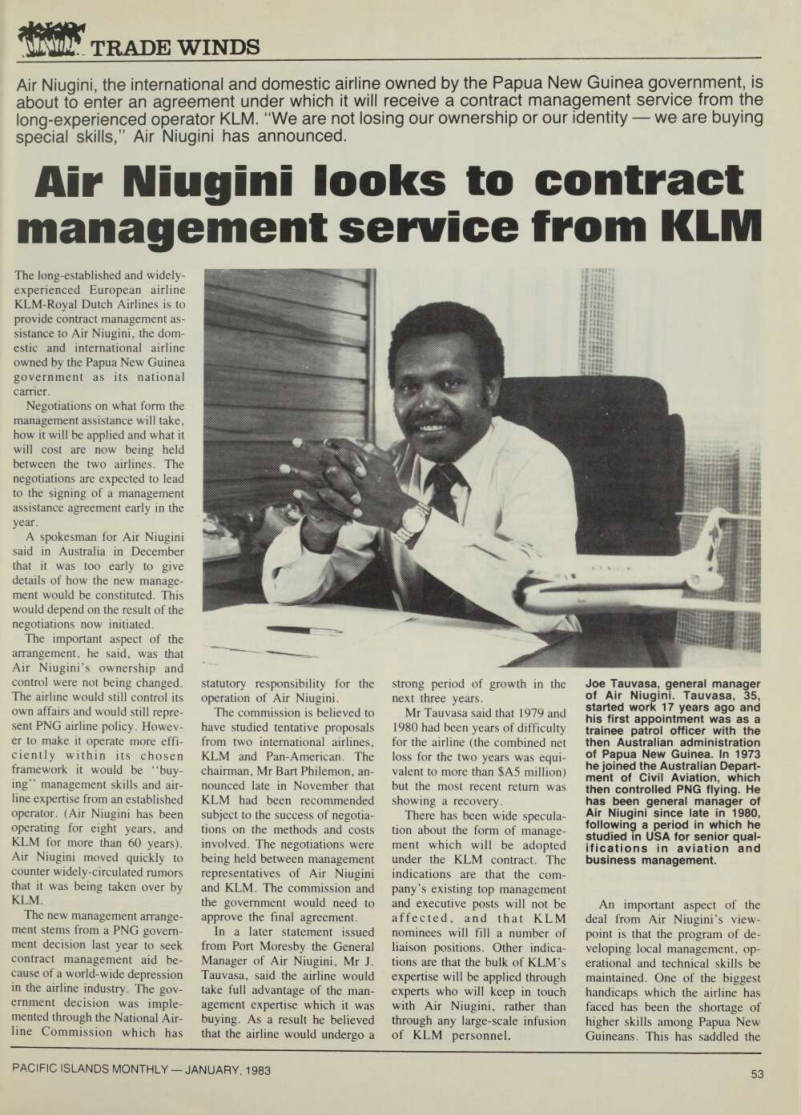
Joe Tauvasa, general manager of Air Niugini. Tauvasa, 35, started work 17 years ago and his first appointment was as a trainee patrol officer with the then Australian administration of Papua New Guinea. In 1973 he joined the Australian Depart ment of Civil Aviation, which then controlled PNG flying. He has been general manager of Air Niugini since late in 1980, following a period in which he studied in USA for senior qual ifications in aviation and business management.
airline with heavy wage burdens because of the need to import expensive skills. The PNG gov ernment is interested in more than training its own citizens to work for the airline it sees the airline as the sort of institution which can raise the technical level of the entire community,,
thus providing development of
the widest possible type. These factors, as well as the mere via bility of ihe airline, are all part of the deal which is being negotiated with KLM.
Air Niugini was established shortly before PNG became
politically independent, and it
took over routes and respon sibilities which had been filled until then by three Australian airlines, Qantas, Ansett and TAA. The three Australian operators were initially sharehol ders in Air Niugini, although the PNG government always had the majority interest. The govern ment has been the sole owner for the past 12 months.
IMF optimism
on Vanuatu
The International Monetary Fund
has predicted a promising
economic prospect for Vanuatu in 1983. An IMF consultation mission which was in the group made this assertion before leav ing Port-Vila in November. It spent two weeks holding discus sions with government ninisters and officials. The mission de scribed the visit as very fruitful.
Members said that progress made jointly by the Vanuatu authorities and the mission had laid the foundations for a further im provement in the line of informa tion-gathering. This information will be used in the analysis of economic trends and the formu lation of policy.
A press release from the Ministry of Finance, Commerce, Industry and Tourism says, given the political stability and the im proved economic climate, the IMF mission has forecast a furth er expansion of economic activi ty in 1983. Domestic interests were likely to decline gradually, reflecting the slowdown in the rate of inflation and declining interest rates abroad. The release adds that there was no reason to believe that inflation, which is low at present, would accelerate significantly in the near future.
The mission also expected both the current account and the overall balance of payments to remain in surplus, though the size of the surplus may decrease
as a result of the decreased level of copra exports and prices.
There is also expected to be an increase in imports and lower inflows of aid.
The mission described the economic prospects in 1983 as relatively promising.
Radio Vanuatu Service.
PNG interests
control Gollin
Three Papua New Guinea business groups in December completed the purchase of a 75 percent shareholding in the Aust ralia-based Gollin and Co, owner of coffee plantation operator Gollin and Co PNG Pty Ltd, which has the biggest coffee plantation in the southern hemis phere, the 6000-hectare Gumanch plantation in PNG’s Western Highlands.
The transaction, described as PNG’s biggest “all-national’’ private business deal and the first major investment in Australia by PNG companies, was monitored by the PNG Government which intervened to prevent the Gollin liquidators, Price Waterhouse, from offering the company to British coffee exporters S. & W.
Beresford.
The government was opposed to a foreign takeover. The PNG investment guidelines oppose the takeover of any PNG-based com pany if local shareholders are not involved.
The three business groups sharing the holding are Piplika
Development Corporation (Mount Hagen), Bomai Develop ment Corporation (Chimbu), and Lapusa Investments Pty Ltd (Goroka).
Emperor’s s4m
issue
Fiji’s Emperor Mines Ltd is to raise up to $4 million in a share issue early this year, the chair man, Jeffrey Reid, told sharehol ders at the company’s annual meeting in Melbourne.
“In order to maximise the potential of the mine, it is con sidered necessary to call on shareholders for additional capit al,’’ he said.
Mr Reid said later he could not give details of the issue as it depended on the price of gold.
Emperor last October raised $1.42 million through a place ment of 10 percent of the group’s issued captial.
Shareholders at the annual meeting approved the placement of another 10 percent of the present issued capital within the next 12 months.
Mr Reid said a placement was not imminent and the facility was a standby to supplement working capital.
Mr Reid said Emperor was negotiating with the Fiji Electric ity Authority to buy power from the new Monasavu hydro-electric scheme, but would be unable to begin drawing power until August.
Power expenses were 24 per
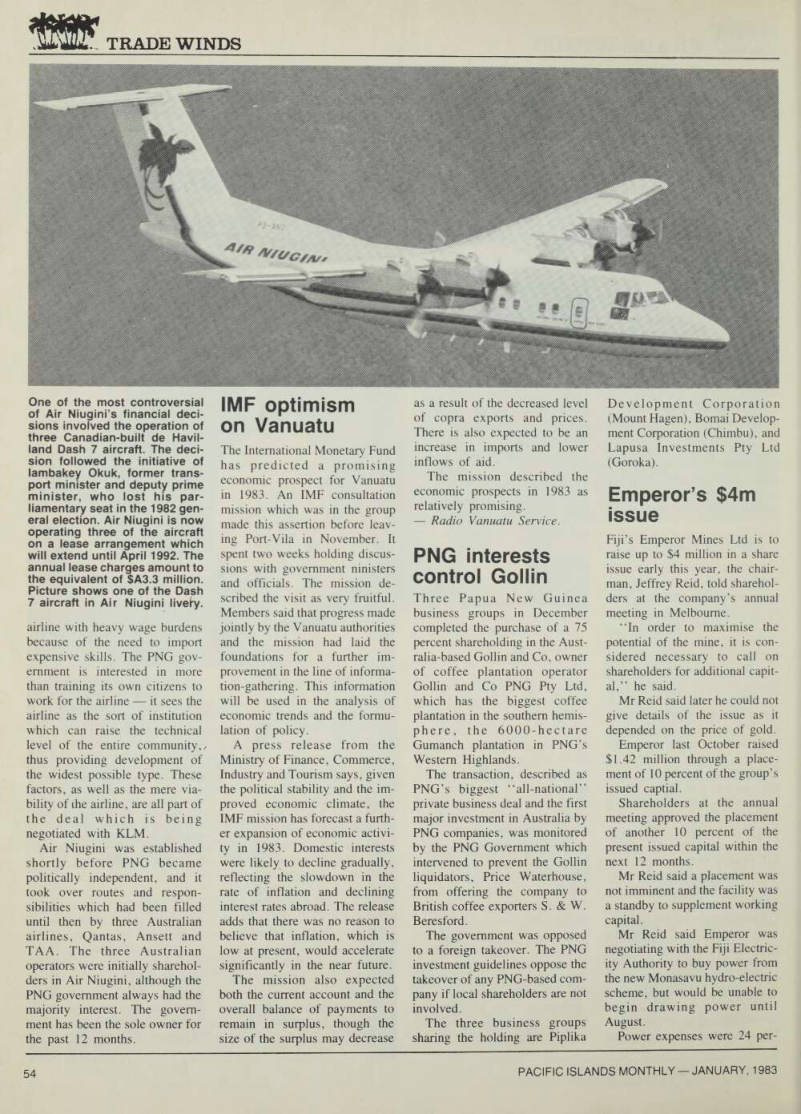
One of the most controversial of Air Niugini’s financial deci sions involved the operation of three Canadian-built de Havil land Dash 7 aircraft. The deci sion followed the initiative of lambakey Okuk, former trans port minister and deputy prime minister, who lost his par liamentary seat in the 1982 gen eral election. Air Niugini is now operating three of the aircraft on a lease arrangement which will extend until April 1992. The annual lease charges amount to the equivalent of $A3.3 million.
Picture shows one of the Dash 7 aircraft in Air Niugini livery.
cent of total group costs and the switch to hydro power was ex pected to result in a substantial saving, he said.
Mr Reid said the company had also benefited from the removal of a 1 percent gold turnover tax.
He said management was in vestigating recovery of gold and silver from Emperor’s tailings dams and had sent samples to Europe. The dams contained “some 330,000 ounces of gold and substantially more silver’’.
Nauru’s Guam
hotel project
ANA Enterprises Ltd, of Tokyo, has been awarded the contract to operate and manage Nauru’s new deluxe hotel on Guam’s Turnon Bay. The hotel scheduled to open late in 1984, will be Guam’s biggest, with 20 storeys, 450 large guest rooms, three restaur ants, a cocktail lounge, five function rooms and a ballroom convention centre.
Other facilities include a shop ping arcade, swimming pool, health club and tennis courts.
ANA Enterprises Ltd, a sub sidiary of All Nippon Airways (ANA), owns or manages hotels in Asia and the Pacific region.
ANA is Japan’s largest domestic carrier, operates international charters and has just opened a charter service to Guam. About three-quarters of Guam’s annual tourist intake is Japanese.
Kuwaiti loan
for W. Samoa?
The oil-rich Middle Eastern state of Kuwait may give aid worth SUSIO million to Western Samoa for electricity, harbor and timber projects at Asau, the har bor on the island of Savaii, but aid depends on results of a feasi bility study by engineers and specialists from Kuwait. The study, financed by Kuwait at a cost of $125,000 will concentrate on deepening and widening the harbor, establishing a generating plant using coconut husks and wood waste, developing timber resources, and improving roads and water supplies. Of the $lO million, $4 million will be a soft, long-term loan.
Bagasse to
newsprint
Bagasse, the sugarcane residue after milling, makes newsprint equal to that made from wood pulp, reports the Queensland Cane Growers’ Council’s Sugar News.
Two companies, the Peruvian Sociedad Paramonga, and Pro cess Evaluation and Develop ment Corporation (Peadco) of Mexico City, have combined in tests at the Peruvian company’s bagasse-to-newsprint mill near Trujillo and, reports Sugar News, the newsprint coming from the mill is of the same quality as that made from regular wood pulp, and costs consider ably less.
Peadco has just signed a con tract with the Indonesian Gov ernment to build a 300-tonnes-a -day bagasse newsprint plant scheduled to go into production in 1985.
Peadco’s executive vice president Eduardo J. Villavien cio believes there is a “great future for bagasse in newsprint making.’’ • • • Papua New Guinea’s breweries, South Pacific and San Miguel, have agreed to end their price cutting war and have returned to the July, 1981, gazetted price.
The recent budget increased the excise tax on beer.
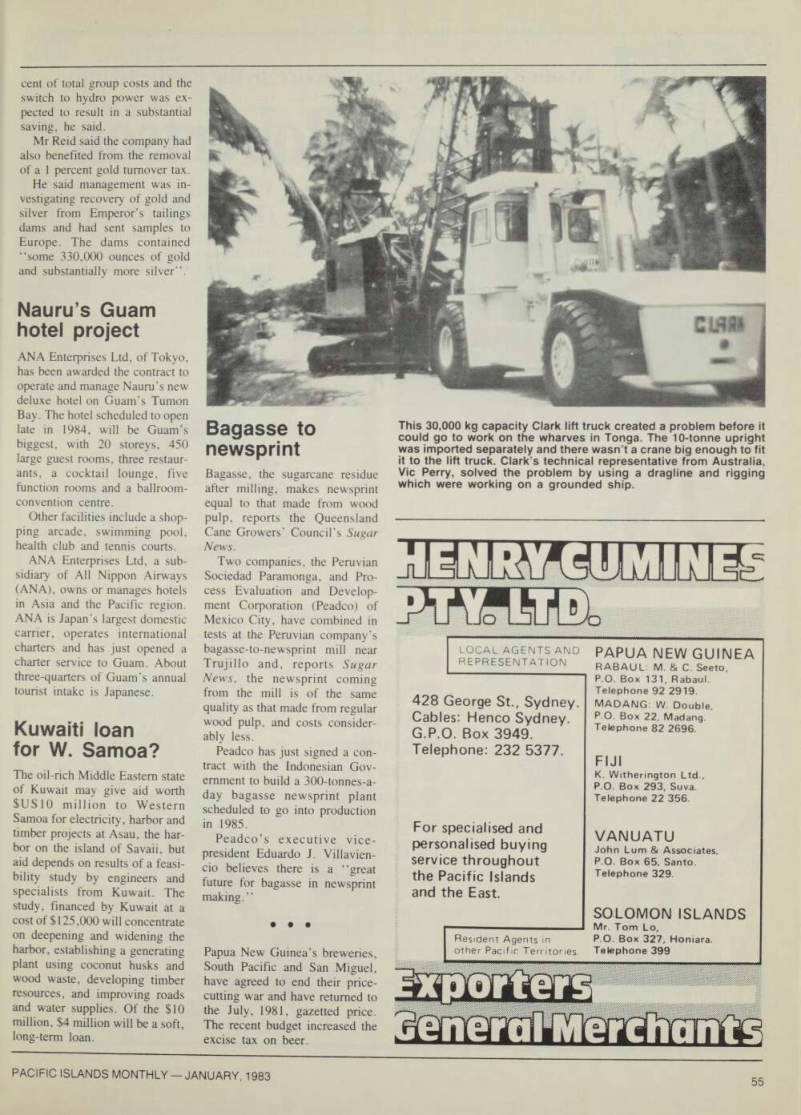
This 30,000 kg capacity Clark lift truck created a problem before it could go to work on the wharves in Tonga. The 10-tonne upright was imported separately and there wasn’t a crane big enough to fit it to the lift truck. Clark’s technical representative from Australia, Vic Perry, solved the problem by using a dragline and rigging which were working on a grounded ship.