Anglican Vicarage, Levuka
pp. 47-52 · Read in the full issue

Yesterday
Fiji 1931-34: The view from the Anglican Vicarage, Levuka
In April 1931 I left Sydney for Levuka on the RMS Aorangi. I was to proceed to Fiji as vicar of Levuka, Fiji. Like a huge Leviathan, sluggish and sleepy, the “strange diocese of Poly nesia’’, as an Archbishop of Canterbury described it, covers 11 million square miles of the South Pacific, and is generally described as “mostly wind and water’’. Levuka, the old capital of Fiji, 70 sea miles from Suva, was the foundation parish of the diocese of Polynesia.
Some bishops in the Anglican Communion are described as “Bishop//?” (not “of’) a specif ic diocese that is, where polit ical protocol makes it tactful.
Polynesia was one case. Many “Bishops in” are compelled to spend much of their time out of their diocese, proving that it is possible for bishops to be both
“in’’ and “out’’ at the same time.
Arriving at Suva, I presented myself at the new Bishop’s House for a briefing from the Archdeacon. The Bishop in
Polynesia, L.S. Kempthorne,
awaited me at Levuka. Under orders from the Archdeacon, who was just a trifle anxious to show a little authority, I attended him in Bishop’s house and re ceived a homily on worldliness and whisky, none of which had caught up on me, but were, it would seem, the pitfalls of pre lates. Apparently Government House was not included in this worldliness, for the phone rang soon afterwards and I was invited there to dinner. Sir Murchison Fletcher, Governor of Fiji, was an interesting figure, with a vis age moulded by some years in China in the diplomatic service.
PIM this month begins a series of extracts from the memoirs of one of the best-known clergy men to serve in the South Seas in this cen tury, the Anglican Arch deacon Emeritus of Polynesia, the Vener able Charles William Whonsbon-Aston, QBE.
Charles Whonsbon- Aston died in Sydney in June 1981, aged 82 (PIM Aug. ’Bl, p 73, Oct. ’Bl, p 36).
In 1980, he placed a three-part manuscript recounting his exper iences in Fiji, Papua and Western Samoa in the hands of Dr David Wetherell, of the School of Social Sciences at Deakin University, Vic toria, Australia.
Dr Wetherell has made these available to PIM, and the manuscript now appears in edited form.
a face that seldom revealed what was going on behind it. He was reputed to be the “Chinese offi cial’’ in Somerset Maugham’s The Painted Veil. Lady Fletcher spent little time in Fiji, but every garden in the country commemo rates her in the flowering shrub Pentas Carnea, well known loc ally as “Lady Fletcher’’. Every housewife blesses her foresight in introducing it.
We arrived in Levuka at mid day the next day. The heat was fierce. The Bishop and his young American wife, not long mar ried, were on the wharf to meet us and to escort us to the Royal Hotel, where we were to stay until our goods and chattels ar rived and had been unpacked in the Vicarage. The “Royal’’ was solidly built with great thick walls, much like a fortress, long colonial-style balconies fore and aft, a small square tower centred above, from which the mast-high Union Jack hung slack in the breeze. The only other hotel left was the somewhat dilapidated Polynesian, an old shabby wooden building. Both hotels were under the proprietorship of Mr “Ted’’ Houghton, though the ruling hand and genius was his wife. They fitted the scene ad mirably! He had been a steward
on the old Union Steamship Company’s island traders, and she a stewardess. The lady could assume a posture that could stifle any argument immediately, so much so that she was referred to as “Shrapnel Kate’’.
Levuka was as quaint a place as you could find anywhere in the Seven Seas, with a certain fascination that seems to catch and hold its people, binding them into a family, whatever their background may be Fijian, European, Chinese, Indian, Rotuman, Solomon Islander or ni-Vanuatu, Japanese, Tongan.
There were even a few Samoans.
They are all there and some of them have inter-marital links in all directions.
There was the picture show, where today the Technical Centre stands. It was under the aegis of the Patterson Bros, and showed silent pictures, with a girl sitting below the screen punching the very life out of a piano. Sometimes they showed Indian films. I went to one very interesting Indian film called Shiraz, the poignant story of the deep love the Shah Jehan had for his wife, whose early death gave him the inspiration to build the Taj Mahal in her memory. While the audience sat spellbound
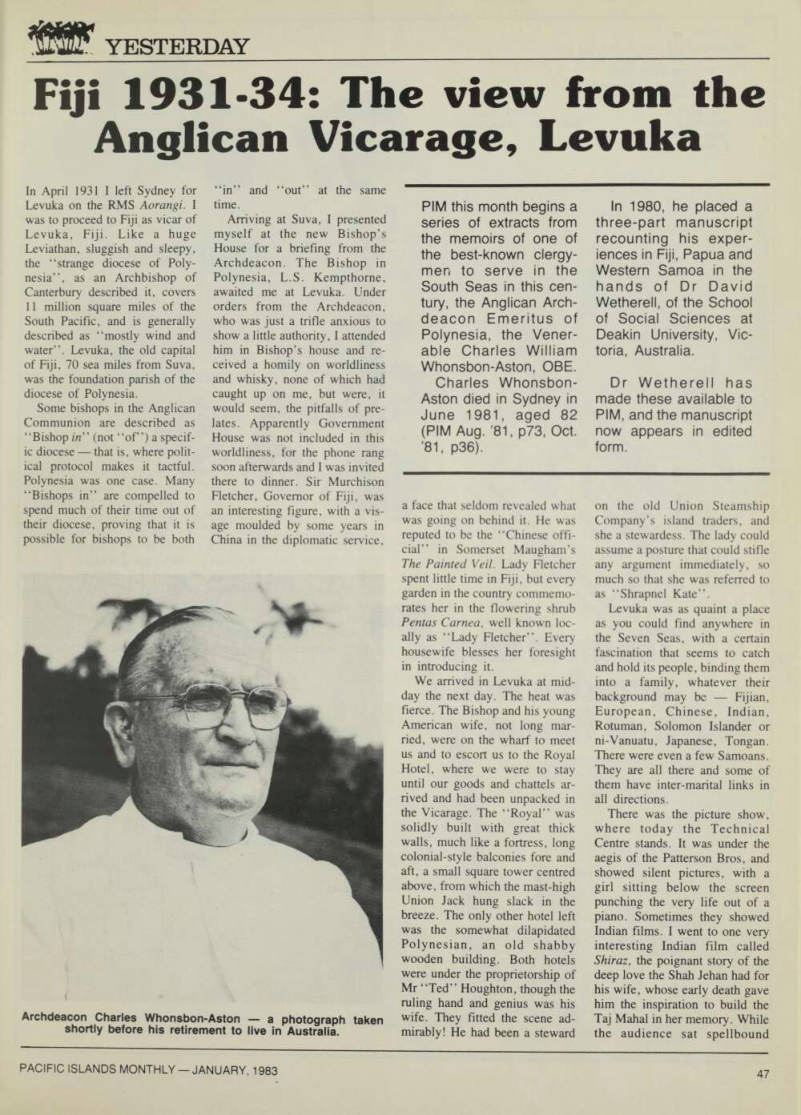
Archdeacon Charles Whonsbon-Aston - a photograph taken shortly before his retirement to live in Australia.
through the deeply emotional scene in which the hero sat be side the bed of his young wife who had just expired, the pianist dashed into ‘T’m dancing with tears in my eyes, for the girl in my arms isn’t you”. I found later she had been instructed to keep her eye on the film and play anything she thought appropriate.
It was for me now to try to assess Levuka’s position. It had recovered to some extent, and was living with the idea that it
was no longer the capital. The 1914-18 war had had a disturbing effect on its business life, much of which had been in German hands. They were good citizens, but were interned as the result of an incident in the Polynesia Hotel: one of them, Kienzle, baited at the bar, had struck at a picture of King George V. This is of interest, for his son, Herbert Kienzle, CBE, who had been bom and educated in Levuka, organised, trained and directed the famous “ Fuzzywuzzy” labor
force in the New Guinea cam paign in World War 11, without which the struggle there would have been prolonged and more costly in human life. The man responsible for the agitation in Levuka to intern German nation als told me later how much he had regretted his action, which had been motivated by the death of his son in France.
The departure in this way of some of the shrewdest business men and planters, in most cases never to return, gave the big
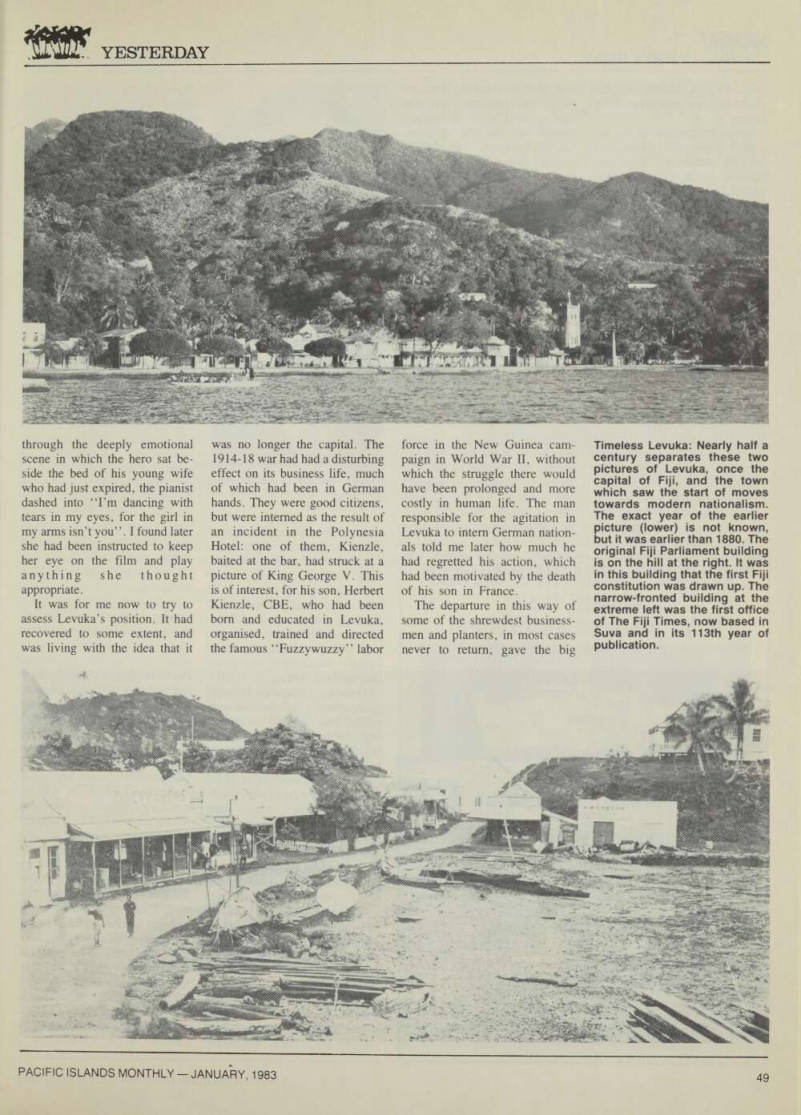
Timeless Levuka: Nearly half a century separates these two pictures of Levuka, once the capital of Fiji, and the town which saw the start of moves towards modern nationalism.
The exact year of the earlier picture (lower) is not known, but it was earlier than 1880. The
original Fiji Parliament building
is on the hill at the right. It was in this building that the first Fiji constitution was drawn up. The narrow-fronted building at the extreme left was the first office of The Fiji Times, now based in Suva and in its 113th year of
publication.
firms, BP’s and Hedstrom’s, the opportunity to consolidate their power.
Some descendants of the recruited Melanesian laborers of the 19th century still lived near Levuka. Many of those who worked in Fiji came from Solomon Islands (particularly Malaita), and Vanuatu (especially Tanna). After the end of the recruiting trade, the problem of repatriation became acute; no proper records existed for some, while others had simply been “blackbirded”. There was also a matrimonial mix-up, for there had been inter-marriage with Fijian women who had no desire to be taken away to Solomon Islands or elsewhere.
These formed the remnant of which the government apparently had “washed its hands”. The second Chief Justice of Fiji, discovering their state, called the attention of the Reverend William Floyd to them. The latter accepted the challenge, starting classes on Sundays for them first of all (in which the Chief Justice
took part) then settling them on his Onivero property. From that time on the Church of England moved into the role of semi official “protector” and of inter mediary between them and the government, the latter having no place for them in their cos mogony. They could not be in corporated into Fijian life, Floyd accepted the new re sponsibility with glee, for he had longed for some greater missio nary interest and here was his field. In 1882 Bishop John Sel wyn of Melanesia came over and inaugurated the mission, giving it status. Floyd settled the Melanesians in houses of their own building above his home and the Church of the Epiphany, just above the Bagadaci Park, where they were to give him many crises, but a great loyalty, When the property was sold and the Church of the Holy Redeem er built, they moved up the steep valley to Wailailai, to property administered by the Levuka Town Council. When the coun cil’s area was reduced, the head
man of the Solomoni, Brown Waqala, accepting Fijian cus tom, presented a tabua (whale’s tooth) to Melita, the Fijian lady who was head of the mataqali (the Fijian family tribal unit).
Holding a high opinion of the Solomoni, Melita gave them the right to settle on nearby, almost equally inaccessible, land, as long as they wished.
These represented the heritage handed down to me, through others. They were still a pathetic body, still stateless, still land less, many workless, their houses shanties, but nevertheless “homes” to them. Most inde pendent, they refused to be push ed or regimented. Many were victims, through a sort of invinc ible ignorance, of tuberculosis and leprosy. But they were not by any means miserable on the contrary, they could be de cidedly bright and happy.
Many of the “old hands” were still about when I entered the field. Among the ghosts of the past I can see in my memory there is Joe Quai of the rolling gait, his hat often on “three hairs”, copying the Australian colonial style of the days when he had been in Queensland: “O, yes, Ah bin S’tralia, bin Bund
’burg, Cai’ns, Bis’bun,” he would boast from his five feet stature. He was the bellringer for services.
Another of the “old brigade’’ was Joni, the turaga-ni-koro (head of the village) of Waitovi, a rather stocky, well-built dig nified chief. He annoyed me very much by dying while I was ab sent on Taveuni on one occasion.
I felt he had let me down by not waiting until I returned to talk matters over with me. I found that he had apparently become “fed up” with something, said casually “I die today”, went over, sat on a stone, and died. It was the waste of a good man, but I had discovered that such a thing
could happen.
Practically all the Melanesians had been collected from their seacoasts and were not farmers.
Their interest in planting was confined to the necessities of
living, supplementing their fish
ing. Some were taken up by Levuka’s commercial interests to become a cheap labor force, ex ploited to the full on the wharves and in the stores, on ships and in public works. They were a
strong, stocky hard-working
group.
In Suva in 1932 I put to a meeting of the Bishop, the Ar chdeacon and myself my vision of a settlement or settlements to
which they might be gathered
and where they could each have a few acres of land, their church, school and hospital, with some measure of personal government.
The government made 234 acres of Native Lease Land available where some streams met, about five miles from Suva, at Wailoku. (Wailoku, as a Fijian word, describes the gathering of water in the hand, letting it stream away between the fin gers). It was far from easy to persuade them to move, but they are now settled happily in bus distance to the City for those who work there.
South Seas communities such as Levuka were unlike towns elsewhere: they were and are collections of individuals, who have either been brought there for their particular skills or have drifted along and found a haven.
Many of the “strays” could be referred to as “characters”,
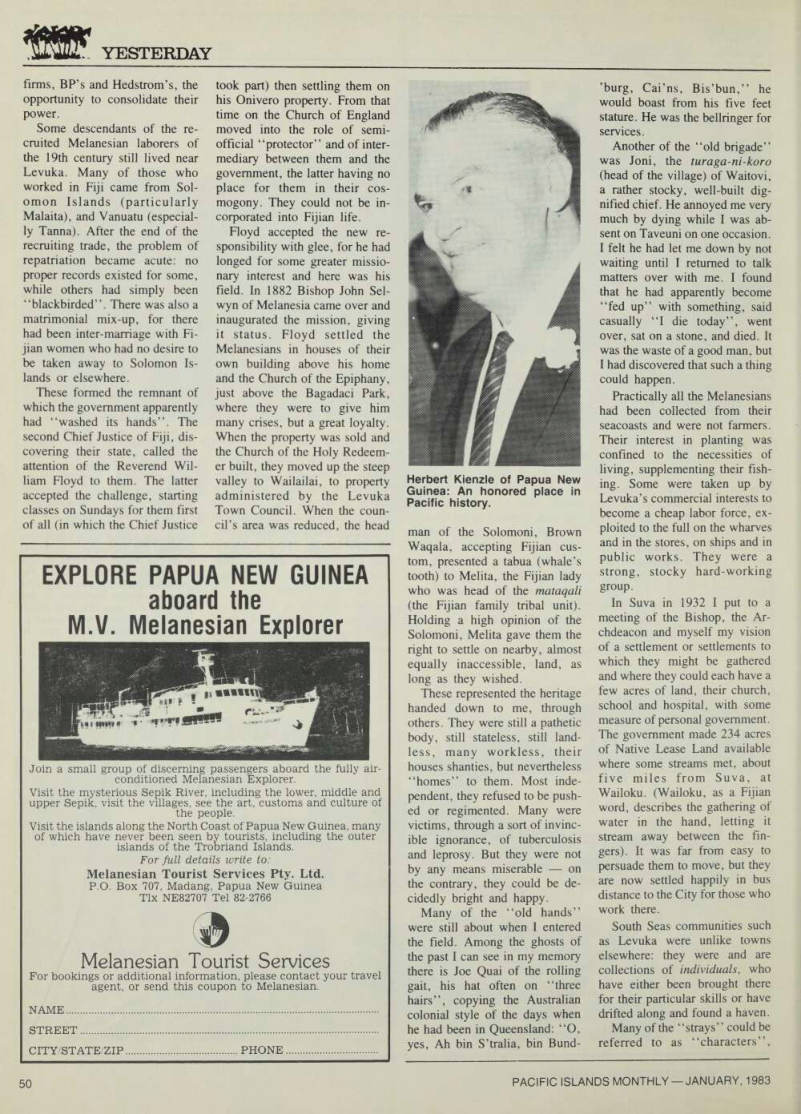
Herbert Kienzle of Papua New Guinea: An honored place in
Pacific history.
though I feel these days few could be so described. Levuka at one time could produce a Town Clerk bom in a British consulate in Russia, speaking perfect Rus sian; another, a remittance man, with his twin brother, were brothers of a baronet created by Queen Victoria; there was a ba ron connected with the royal house of Italy and there was Warbrooke, one of the drill offic ers recruited from Australia in 1868 to train Cakobau’s savage army. There were but two of them left when I arrived in Levu ka, Warbrooke and Georgius Wright, the father of the interna
tionally known photographer
Rob Wright.
In this, my new world, I saved myself from walking muddy miles by taking any lift I could get, using frail canoes, dinghies, yachts, cutters, ketches, small steamers and warships. I even took to the air, becoming the first of the cloth to fly across the 180th meridian. All this was in the space of those first three years.
There was something ex hilarating about facing out to sea in a ten-ton cutter into a stiffish southeast trade wind, with the country’s flag flying at the top
mast and a copper-hued, mop haired giant “thud, thud, thud ding” on the big lali (war drum) on the fore part of the vessel, the salt spray dashing from the prows that is, provided you are some sort of sailor. My par ish duties often called me to outlying islands such as Ngau (Gau) where there were white settlers near the village of Sawaieke. Our party on our first trip consisted of the doctor, who was taking his wife and family for a trip with him, and an Inspector of Native Schools, a New Zealander. We travelled on the Provincial cutter, the Mara ma-na-Yanuyanu, “the Lady of the Isles”.
We had to call first at the island of Mbatiki where we ar rived at the chiefs house in the evening. After the evening meal entertainment was put on for us in the big bare. The young ladies from a neighboring village, Naivukulani, gave, first of all an excellent meke. Kingsford Smith’s famous plane, the South ern Cross, had passed over their island on that first trans-Pacific flight only a few years earlier, and their hands and bodies moved with the chant to tell their reactions to this event.
(Above) This picture from the Fiji Government Archives shows the town of Levuka about 1885. (Below) Photographed about 20 years ago this picture shows the graceful decay which settled on many of the more imposing buildings of Levuka - this one the town hall.
Dance after dance ensued, with changing partners, the same tune soon becoming monoton ous. Faster and faster beat the drums, likewise the song and the dancing feet, hotter and hotter the closed bure became, with the heat and hiss of the benzine and the kerosene lights. There came the mingling odors of perspiring oily bodies, with the strong scent of the wa-na-kalou, the “string of the gods”, a vine that was the basis of the necklets, soaked in uci, the gaiety reaching its loud est, almost hysterical pitch. All this combined to force the sug gestion that the day was far spent, the dawn was at hand, and that we certainly needed rest. At that moment a vibrant young thing, who had been whirling about on her feet all the evening, approached me with a most fetching smile and cast her salusalu over my head and around my neck, a lovely ges ture, especially as the pungent odor of the garland had gathered to itself four hours of oily sweat.
I discovered it was an invitation
to an “aftermath”. But there are limits over which a parson must not step. In spite of my stars, I just had to decline.
We then went to Nairai Island.
We had no chance to get near the end of the reef where, in 1803, the brig Eliza had struck. The survivors had been landed at
Lawaki village nearby. Every
time I visited that way I used to wonder hopefully whether a
good Providence would guide
my feet to just the spot where some of the $34,000 taken ashore there had shyly hidden themselves . . .
Our stay was not very long and a favorable wind brought us home again to Levuka. The sea was much calmer and the rattle of the drum on the forepeak, as we entered the gap in the Levuka reef, was a warning to the saints who would have slept in their beds, that there would be no excuse for the next morning’s absence from church. It was
Saturday night . . .
Throughout Fiji one is never allowed to forget the great,
though divided, sense of relig ion, with cathedrals and churches, mosques and temples, Sikh and Hindu, with the religi ous processions, the fasts, the firewalking, and the rivalries and fisticuffs. From my hilltop home on one week of the year I could gaze out on Fairyland, spread around and below me, as the Feast of Diwali, the Festival of
Lights, gives praise to the God
dess of Light. I wonder will the day ever come when “the Light to lighten the Gentiles” will shine through it and enrich its meaning? It is a dream, but Christianity in Fiji, as exhibited in the average everyday adherent on the census paper, hardly gives room for optimism. • • • I must assert that all my time was not spent in gallivanting about the countryside. There was much to do in Levuka, with never a dull day. Any farewell, I have found, from any part of the South Seas has its great and emotional moments; leaving Levuka con formed to that pattern. The whole was made more poignant
because it would appear there would be no replacement for me there: the world depression made
staffing difficult.
The Solomon Islanders pre pared a special song of farewell in Fijian, led by their own string band. It had an attractive lilt and their voices blended so harmoni ously in singing (and I give the English translation of one part): “We will miss you, We will miss you. We have loved to see you stand up in church. We have loved the sight of you, Your face is like a beautiful white rose.”
If they had said “red rose” it might have been nearer the mark, but each day they would be arriv ing with farewell gifts, tapa cloth, mats, fans, shells, baskets and necklaces, while on the last evening the young men wanted to sit up in the Vicarage grounds all night. But I needed a good night’s rest, for I was to leave very early next morning by gov ernment tug for Suva, and thence to Australia. My next appoint ment, in 1934, was to be Muka wa, on the Papuan coast.
Next month: New Guinea Ahead.
Levuka town mellowed into a comfortable collection of buildings, held back from excessive expansion by the sea in front and the mountains at the back.