Tigilau, on world stage
p. 45 · Read in the full issue
Fables of Samoa: Sina, Tigilau, on world stage
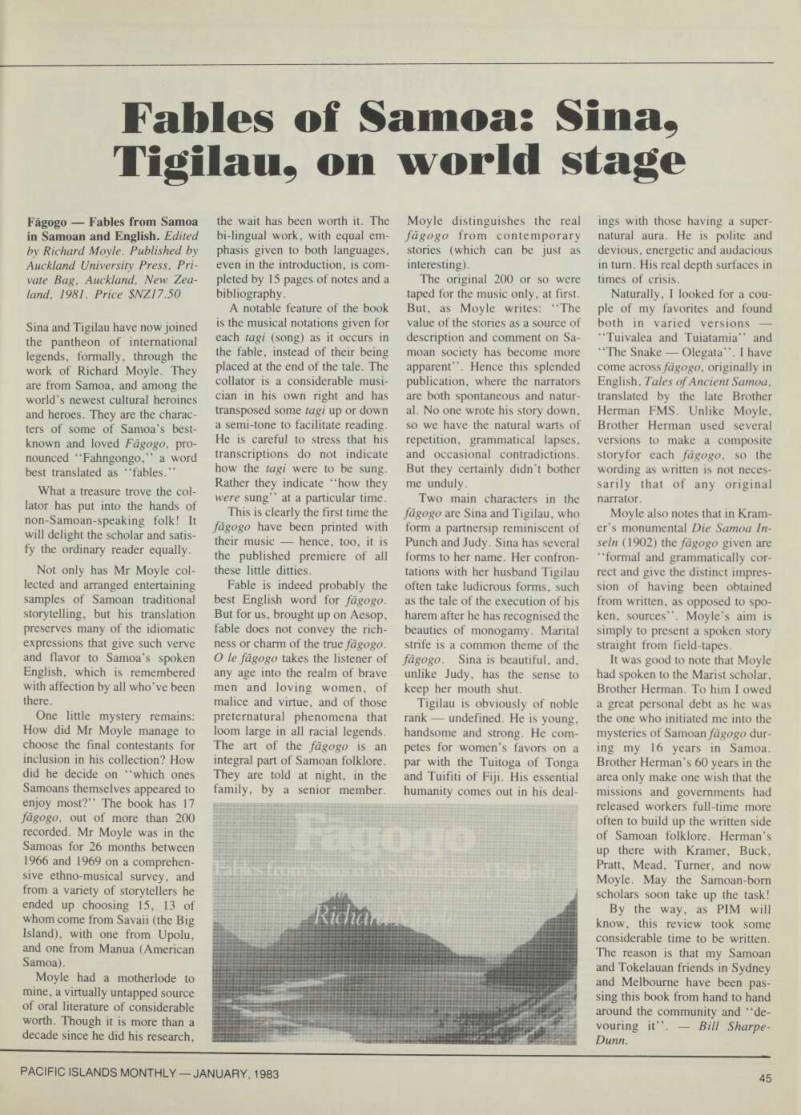
Fagogo Fables from Samoa in Samoan and English. Edited by Richard Moyle. Published by Auckland University Press, Pri vate Bag, Auckland, New Zea land, 1981. Price $NZ17.50 Sina and Tigilau have now joined the pantheon of international legends, formally, through the work of Richard Moyle. They are from Samoa, and among the world’s newest cultural heroines and heroes. They are the charac ters of some of Samoa’s best known and loved Fdgogo, pro nounced “Fahngongo,” a word best translated as “fables.”
What a treasure trove the col lator has put into the hands of non-Samoan-speaking folk! It will delight the scholar and satis fy the ordinary reader equally.
Not only has Mr Moyle col lected and arranged entertaining samples of Samoan traditional storytelling, but his translation preserves many of the idiomatic expressions that give such verve and flavor to Samoa’s spoken English, which is remembered with affection by all who’ve been there.
One little mystery remains: How did Mr Moyle manage to choose the final contestants for inclusion in his collection? How did he decide on “which ones Samoans themselves appeared to enjoy most?” The book has 17 fdgogo, out of more than 200 recorded. Mr Moyle was in the Samoas for 26 months between 1966 and 1969 on a comprehen sive ethno-musical survey, and from a variety of storytellers he ended up choosing 15, 13 of whom come from Savaii (the Big Island), with one from Upolu, and one from Manua (American Samoa).
Moyle had a motherlode to mine, a virtually untapped source of oral literature of considerable worth. Though it is more than a decade since he did his research,
the wait has been worth it. The bi-lingual work, with equal em phasis given to both languages, even in the introduction, is com pleted by 15 pages of notes and a
bibliography.
A notable feature of the book is the musical notations given for each tagi (song) as it occurs in the fable, instead of their being placed at the end of the tale. The collator is a considerable musi cian in his own right and has transposed some tagi up or down a semi-tone to facilitate reading.
He is careful to stress that his transcriptions do not indicate how the tagi were to be sung.
Rather they indicate “how they were sung” at a particular time.
This is clearly the first time the fdgogo have been printed with their music hence, too, it is the published premiere of all these little ditties.
Fable is indeed probably the best English word for fdgogo.
But for us, brought up on Aesop, fable does not convey the rich ness or charm of the tru c fdgogo.
O le fdgogo takes the listener of any age into the realm of brave men and loving women, of malice and virtue, and of those preternatural phenomena that loom large in all racial legends.
The art of the fdgogo is an integral part of Samoan folklore.
They are told at night, in the family, by a senior member.
Moyle distinguishes the real fdgogo from contemporary stories (which can be just as interesting).
The original 200 or so were taped for the music only, at first.
But, as Moyle writes: “The value of the stories as a source of description and comment on Sa moan society has become more apparent”. Hence this splended publication, where the narrators are both spontaneous and natur al. No one wrote his story down, so we have the natural warts of repetition, grammatical lapses, and occasional contradictions.
But they certainly didn’t bother me unduly.
Two main characters in the fdgogo are Sina and Tigilau, who form a partnersip reminiscent of Punch and Judy. Sina has several forms to her name. Her confron tations with her husband Tigilau often take ludicrous forms, such as the tale of the execution of his harem after he has recognised the beauties of monogamy. Marital strife is a common theme of the fdgogo. Sina is beautiful, and, unlike Judy, has the sense to keep her mouth shut.
Tigilau is obviously of noble rank undefined. He is young, handsome and strong. He com petes for women’s favors on a par with the Tuitoga of Tonga and Tuifiti of Fiji. His essential humanity comes out in his deal-
ings with those having a super natural aura. He is polite and devious, energetic and audacious in turn. His real depth surfaces in times of crisis.
Naturally, I looked for a cou ple of my favorites and found both in varied versions ‘Tuivalea and Tuiatamia” and “The Snake Olegata”. I have come across fdgogo, originally in English, Tales of Ancient Samoa, translated by the late Brother Herman FMS. Unlike Moyle, Brother Herman used several versions to make a composite storyfor each fdgogo, so the wording as written is not neces sarily that of any original narrator.
Moyle also notes that in Kram er’s monumental Die Samoa In seln (1902) the fdgogo given are “formal and grammatically cor rect and give the distinct impres sion of having been obtained from written, as opposed to spo ken, sources”. Moyle’s aim is simply to present a spoken story
straight from field-tapes.
It was good to note that Moyle had spoken to the Marist scholar, Brother Herman. To him I owed a great personal debt as he was the one who initiated me into the mysteries of Samoan fdgogo dur ing my 16 years in Samoa.
Brother Herman’s 60 years in the area only make one wish that the missions and governments had released workers full-time more often to build up the written side of Samoan folklore. Herman’s up there with Kramer, Buck, Pratt, Mead, Turner, and now Moyle. May the Samoan-bom scholars soon take up the task!
By the way, as PIM will know, this review took some considerable time to be written.
The reason is that my Samoan and Tokelauan friends in Sydney and Melbourne have been pas sing this book from hand to hand around the community and “de
vouring it”.
Bill Sharpe-
Dunn.