market” - and
pp. 43-44 · Read in the full issue
“To market, to market” - and the reasons why
Urban Food Marketing and Third World Rural Develop ment. By T. Scarlett Epstein.
Published by Groom Helm, Can berra, in association with Re search Centre for Southwest Pacific Studies, La Trobe Un iversity, Melbourne, 1982.
5A27.25. Isbn O 7099 0911 X.
Studies of market-place trade in developing economies have mainly been undertaken by economists such as Schumpeter, concerned with the “principle” of transactions; geographers in terested in export crops; and an thropologists looking at socio economic interactions. In Papua New Guinea, with its extreme decentralisation due to traditional socio-political organisation, “the isolation of individual mar kets from intra-country trade links probably reflects the tradi tional dispersion of small societies and their lack of contact with each other; the many diffe rent languages and dialects spo ken . . . (and) provides another indicator of socio-economic isolationism ... the absence of an intra-country system of food distribution . . . may throw into relief the serious problem of in
tegrating the many different trib al units into one political entity”.
At least, so Dr Scarlett Epstein observes in Urban Food Market ing and Third World Rural De velopment. She suggests that a study of PNG’s unconnected fresh food markets, in particular of the operations and motivations of individual buyers and sellers, may help the nation’s policy makers and planners to solve the long-standing problem of making available adequate, regular and fairly priced supplies of internal ly produced fresh food to the increasing populations of cities and towns.
Any solution would need to include (a) returns to producers which encourage them to supply more and more good quality food; (b) prices which the aver age householder, and preferably also people on very low incomes, can afford to pay; and (c) the phasing out, by legislation, if necessary, of competing imports.
The history of internal fresh food marketing in PNG is a chequered and mostly sad one.
Neither measures by local au thorities the Koki Market Trust, for example nor by the national government agricul
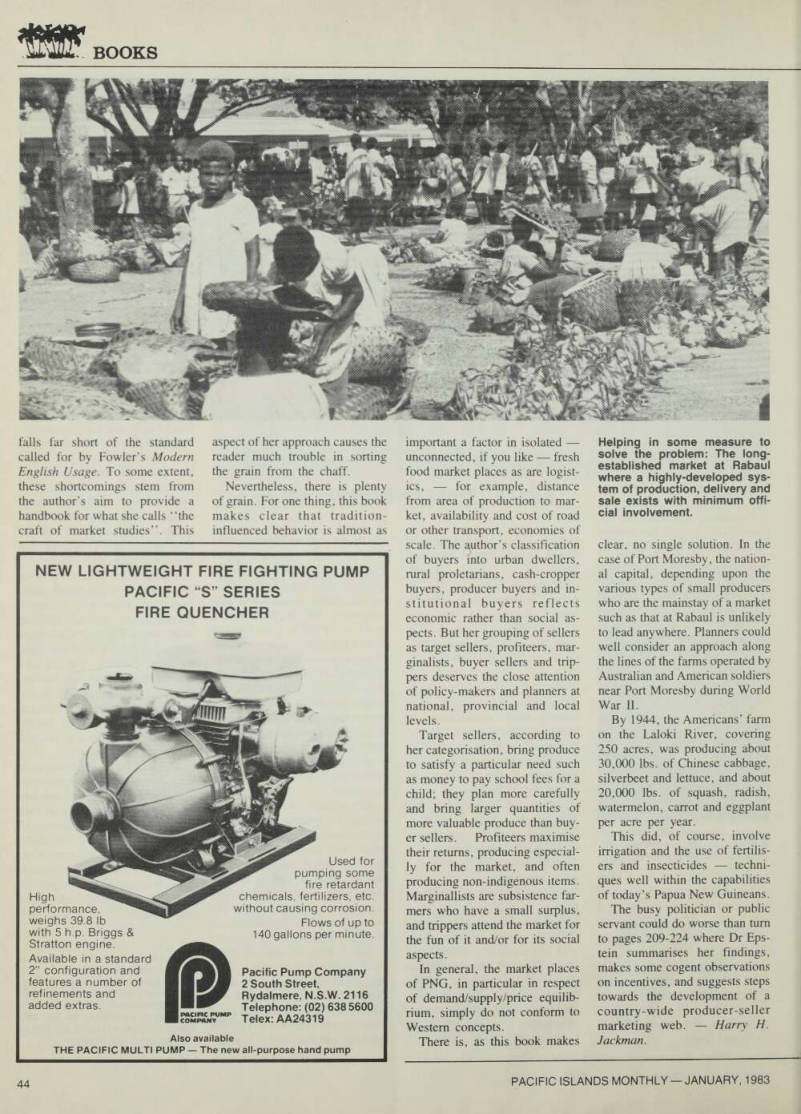
tural extension and the Fresh Food Marketing Corporation have had more than minimal suc cess. Indeed, the FFMC alone has squandered huge amounts of government money. On the other hand, a few local market places, notably the one at Rabaul which is close to deserving the descrip tion “traditional”, are helping to solve the problem.
This is a lengthy book, with 230 pages of close, small print, resulting from the author’s studies from 1967 to 1969 of what she calls the “hinterland rooted” markets at Vunapope, Kokopo, Rabaul, Goroka and Mount Hagen, and the “urban based” ones at Lae and Koki.
She had previously, between 1959 and 1961, done partly related research on the Gazelle Peninsula.
Much of this book is taken up with descriptions of the behavior and motives of buyers and sel lers, and with a number of case studies. There are 18 tables, 15 graphs, 12 charts and five maps.
The text is not easy to read.
There is a great deal of repeti tion, the material is poorly ar ranged, some tables and graphs are unhelpful, and the language
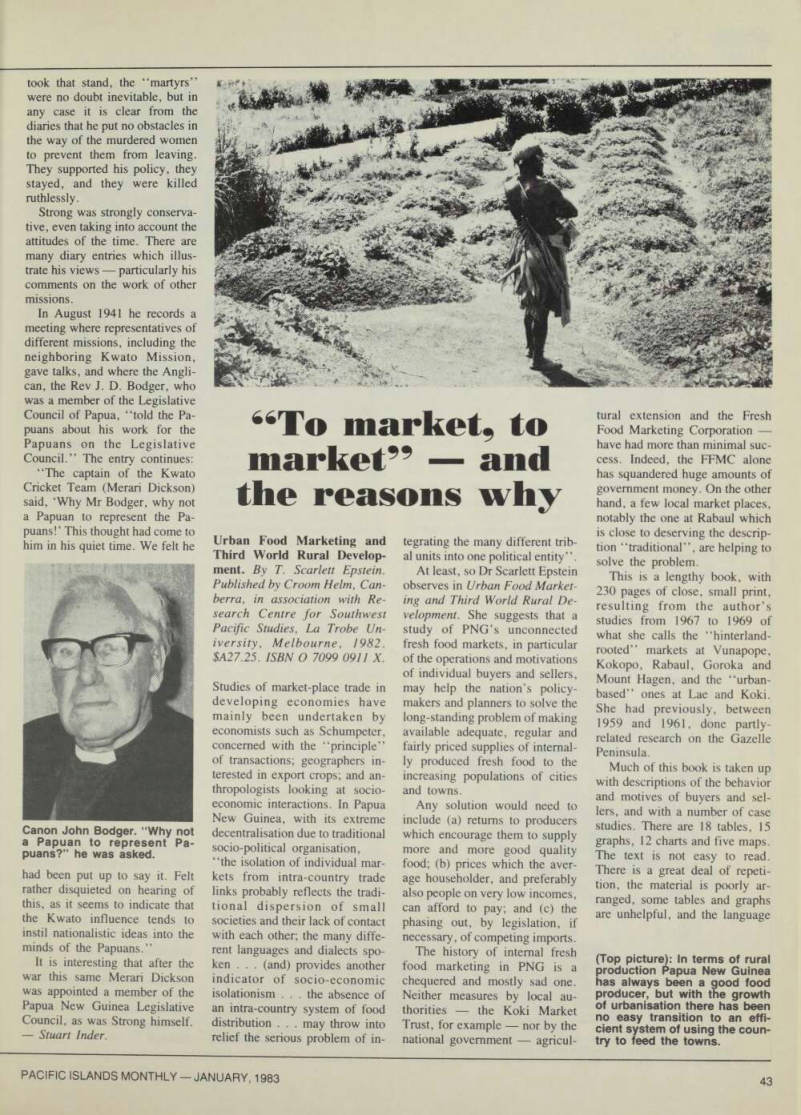
(Top picture): In terms of rural production Papua New Guinea has always been a good food producer, but with the growth of urbanisation there has been no easy transition to an effi cient system of using the coun try to feed the towns.
falls far short of the standard called for by Fowler’s Modern English Usage. To some extent, these shortcomings stem from the author’s aim to provide a handbook for what she calls “the craft of market studies’’. This
aspect of her approach causes the reader much trouble in sorting the grain from the chaff.
Nevertheless, there is plenty of grain. For one thing, this book makes clear that tradition influenced behavior is almost as
important a factor in isolated unconnected, if you like fresh food market places as are logist ics, for example, distance from area of production to mar ket, availability and cost of road or other transport, economies of scale. The author’s classification of buyers into urban dwellers, rural proletarians, cash-cropper buyers, producer buyers and in stitutional buyers reflects economic rather than social as pects. But her grouping of sellers as target sellers, profiteers, mar ginalists, buyer sellers and trip pers deserves the close attention of policy-makers and planners at national, provincial and local levels.
Target sellers, according to her categorisation, bring produce to satisfy a particular need such as money to pay school fees for a child; they plan more carefully and bring larger quantities of more valuable produce than buy er sellers. Profiteers maximise their returns, producing especial ly for the market, and often producing non-indigenous items.
Marginallists are subsistence far mers who have a small surplus, and trippers attend the market for the fun of it and/or for its social aspects.
In general, the market places of PNG, in particular in respect of demand/supply/price equilib rium, simply do not conform to Western concepts.
There is, as this book makes
clear, no single solution. In the case of Port Moresby, the nation al capital, depending upon the various types of small producers who are the mainstay of a market such as that at Rabaul is unlikely to lead anywhere. Planners could well consider an approach along the lines of the farms operated by Australian and American soldiers near Port Moresby during World War 11.
By 1944, the Americans’ farm on the Laloki River, covering 250 acres, was producing about 30.000 lbs. of Chinese cabbage, silverbeet and lettuce, and about 20.000 lbs. of squash, radish, watermelon, carrot and eggplant per acre per year.
This did, of course, involve irrigation and the use of fertilis ers and insecticides techni ques well within the capabilities of today’s Papua New Guineans.
The busy politician or public
servant could do worse than turn to pages 209-224 where Dr Eps tein summarises her findings, makes some cogent observations on incentives, and suggests steps towards the development of a
country-wide producer-seller
marketing web.
Harry H.
Jackman.
Helping in some measure to solve the problem: The long established market at Rabaul where a highly-developed sys tem of production, delivery and sale exists with minimum offi cial involvement.