Yachts
pp. 57-62 · Read in the full issue
PESI FONUA reports
from Nukualofa,
Tonga:
• HIC. The red and white Tongan flag has been flying in new places around the South Pacific on the Mon tevideo 43 sloop Hie, sailed by solo German yachtsman Detlef Martens.
Hie was registered in Tonga in June 1981 after being launched the pre vious year in Capetown, South Afri ca. The sloop is one of only three ocean cruising yachts to sail under the Tongan flag.
After the launching in South Afri ca, Detlef had intended sailing home to Germany to have the yacht regis tered there. But he turned westward into the Pacific through the Panama Canal instead of continuing north, and when he reached Tonga in mid -1981 he decided to have the yacht
registered there.
According to Detlef the Tongan registration differs in that it is cheap er and is paid as a small annual fee, whereas in Germany the fee is paid in a lump sum. Under German law there is a restriction on the type of elec tronic equipment he may use on board, but in Tonga there is no restriction.
Detlef once owned an electronic devices manufacturing business in Hamburg. He sold out and bought Hie, which is equipped with very modem electronic equipment. While at sea he is working on some elec tronic devices that he designed, ex perimenting with solar and wind energy.
When he returned to Nukualofa in November he was on the last stage of writing a sailing guide book for the Tuamotus. The book required a lot of research and charting which was made possible with his electronic
equipment. “Carrying the Tongan
flag while doing my research was fun,” explained Detlef. “A lot of people were asking about the flag and its origin. I explain where Tonga is. I feel that I am representing Tonga in some of these places, and I hope to
be a good representative.”
Detlef has been sailing since he was a boy. His parents have a yacht and the name Hie is shared by the family boats the letters taken from the first names of his father, mother and sister. He had been involved in yacht racing before and plans to race again in the near future, so who knows where else Hie will take the
Tongan flag.
Lan G. Menzies Re
ports from various
Papua New Guinea
ports:
The more adventurous cruising yach ties find the New Guinea Islands a real challenge, and revel in the un matched coastline scenery, deep an
chorages and friendly people that this
part of Papua New Guinea has to offer. A series of business trips al lowed your correspondent to catch up with a few of these adventurous types in some of the more remote locations of this country. But first, let’s report on home base Port Moresby. • KAMAVICK 111. Hailing from France in their 13m ketch Kamavick 111 are Marcel and Nellie Lecossois.
A soft-chine steel boat Kamavick 111
(which is Eskimo for “meeting
place”), was designed and built by
Marcel and Nellie in Tahiti over a
three-year period.
After cruising through New
Caledonia and Vanuatu, they headed for Solomon Islands. Unfortunately their visit was marred by a traumatic experience due to their desire to cruise and explore the outer islands before reporting to the nearest port of entry. . . There is a lesson here for all
cruising yachties.
Marcel and Nellie plan to cruise south to Caims and Brisbane, and then return to Vanuatu where they hope to set up a diving school using Kamavick 111 and Port-Vila as a base for their operations. • POLETTE. After some three weeks moored off the Rabaul Yacht Club in East New Britain, Basil and Nancy Campion (with their Siamese cat “Bandit”), set sail for Honiara in Solomon Islands.
Their 13m cutter Palette is a round bilge steel-hulled “tall ship” with a superbly laid solid teak deck and superstructure. Nancy and Basil bought the hull in New Zealand and then had Allan Mummery design a layout, with roomy aft cabin, for two people to cruise in comfort. Launch ed in early 1980, after three and a half years of hard work by the Camp ions Palette is a credit to their labors and ingenuity. The interior especially is a joy to behold. The soft sheen of mahogany is complemented by the subtlety of superb velvet fabrics it is all very traditional and yet so obviously functional. Basil’s en gineering background is evident in the many technical features that he has incorporated in the final design
no wonder, this is the second boat that he has completed.
The Campions originally circum
navigated in their 15m ketch Polack and have now decided to re-discover the Pacific in their new boat. After six months in Indonesian waters, they entered PNG via Vanimo on the far north coast. They were not par ticularly enthusiastic about Vanimo as a port of entry enough said!
Both Nancy and Basil were en thusiastic about the six months they have spent in PNG waters, cruising along the north coast via Wewak, Madang and across the Dampier Strait to New Britain. In particular, they were taken with the friendliness of the people in the more remote coastal villages. By carrying basic trade goods, such as rice, salt and twist tobacco, they were able to supplement their provisions with lots of fresh fruit and vegetables.
A highlight of their passage along the northern coast of New Britain was their visit to Garove Island in the Vitu Group, where they were able to sail into the crater of an extinct volcano. Basil and Nancy plan to see out the cyclone season in the Sol omons and then head for points east. • TURANA. Heading out from Rabaul on their very first cruising passage are Mo Mimnaugh and Ke vin McCue, with their two children
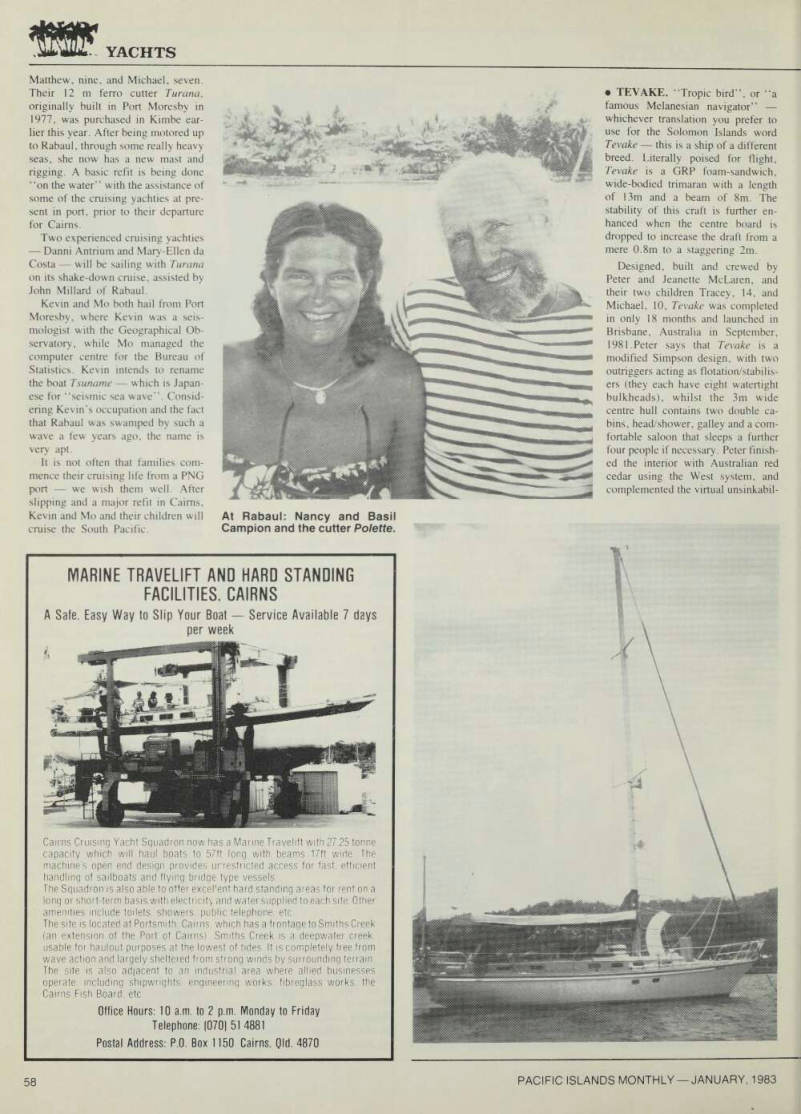
Detlef Martens: Yachtsman from West Germany, yacht from South Africa, flag from Tonga.
Martens set off to have his Mon tevideo 43 sloop Hie registered in Germany, but turned west into the Pacific and took out
Tongan registration. Pesi
Fonua picture.
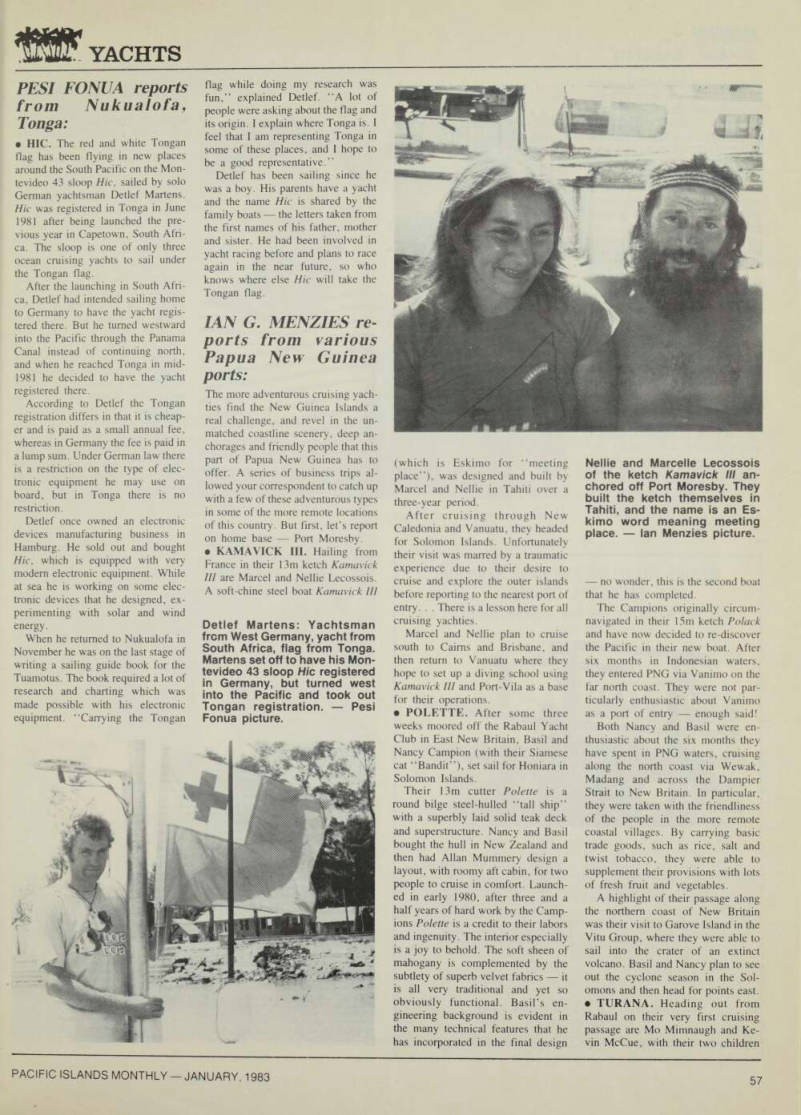
Nellie and Marcelle Lecossois of the ketch Kamavick III an chored off Port Moresby. They built the ketch themselves in Tahiti, and the name is an Es
kimo word meaning meeting
place. lan Menzies picture.
Matthew, nine, and Michael, seven.
Their 12 m ferro cutter Turana, originally built in Port Moresby in 1977, was purchased in Kimbe ear lier this year. After being motored up to Rabaul, through some really heavy seas, she now has a new mast and rigging. A basic refit is being done “on the water” with the assistance of some of the cruising yachties at pre sent in port, prior to their departure for Caims.
Two experienced cruising yachties
Danni Antrium and Mary-Ellen da Costa will be sailing with Turana on its shake-down cruise, assisted by John Millard of Rabaul.
Kevin and Mo both hail from Port Moresby, where Kevin was a seis mologist with the Geographical Ob servatory, while Mo managed the computer centre for the Bureau of Statistics. Kevin intends to rename the boat Tsuname which is Japan ese for "seismic sea wave”. Consid ering Kevin’s occupation and the fact that Rabaul was swamped by such a wave a few years ago, the name is very apt.
It is not often that families com mence their cruising life from a PNG port we wish them well. After slipping and a major refit in Caims, Kevin and Mo and their children will cruise the South Pacific.
• TEVAKE. "Tropic bird”, or “a famous Melanesian navigator” whichever translation you prefer to use for the Solomon Islands word Tevake this is a ship of a different breed. Literally poised for flight, Tevake is a GRP foam-sandwich, wide-bodied trimaran with a length of 13m and a beam of Bm. The stability of this craft is further en hanced when the centre board is dropped to increase the draft from a mere o.Bm to a staggering 2m.
Designed, built and crewed by Peter and Jeanette McLaren, and their two children Tracey, 14, and Michael, 10, Tevake was completed in only 18 months and launched in Brisbane, Australia in September, 1981. Peter says that Tevake is a modified Simpson design, with two outriggers acting as flotation/stabilis ers (they each have eight watertight bulkheads), whilst the 3m wide centre hull contains two double ca bins, head/shower, galley and a com fortable saloon that sleeps a further four people if necessary. Peter finish ed the interior with Australian red cedar using the West system, and complemented the virtual unsinkabil-
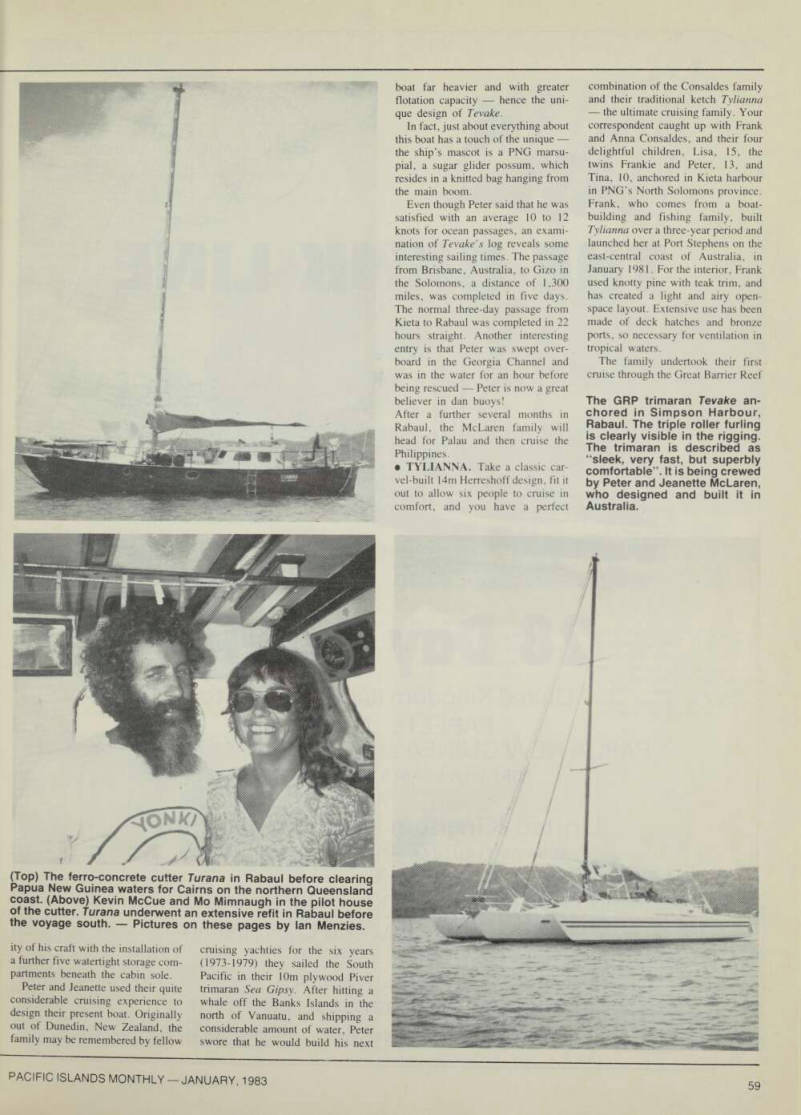
At Rabaul: Nancy and Basil Campion and the cutter Polette.
ity of his craft with the installation of a further five watertight storage compartments beneath the cabin sole.
Peter and Jeanette used their quite considerable cruising experience to design their present boat. Originally out of Dunedin, New Zealand, the family may be remembered by fellow
cruising yachties for the six years (1973-1979) they sailed the South Pacific in their 10m plywood Piver trimaran Sea Gipsy. After hitting a whale off the Banks Islands in the north of Vanuatu, and shipping a considerable amount of water, Peter swore that he would build his next
boat far heavier and with greater flotation capacity hence the uni que design of Tevake.
In fact, just about everything about this boat has a touch of the unique the ship’s mascot is a PNG marsu pial, a sugar glider possum, which resides in a knitted bag hanging from the main boom.
Even though Peter said that he was satisfied with an average 10 to 12 knots for ocean passages, an exami nation of Tevake’s log reveals some interesting sailing times. The passage from Brisbane, Australia, to Gizo in the Solomons, a distance of 1,300 miles, was completed in five days.
The normal three-day passage from Kieta to Rabaul was completed in 22 hours straight. Another interesting entry is that Peter was swept over board in the Georgia Channel and was in the water for an hour before being rescued Peter is now a great believer in dan buoys!
After a further several months in Rabaul, the McLaren family will head for Palau and then cruise the
Philippines.
• TYLIANNA. Take a classic car vel-built 14m Herreshoff design, fit it out to allow six people to cruise in comfort, and you have a perfect
combination of the Consaldes family and their traditional ketch Tylianna the ultimate cruising family. Your correspondent caught up with Frank and Anna Consaldes, and their four delightful children, Lisa, 15, the twins Frankie and Peter, 13, and Tina, 10, anchored in Kieta harbour in PNG’s North Solomons province.
Frank, who comes from a boat building and fishing family, built Tylianna over a three-year period and launched her at Port Stephens on the east-central coast of Australia, in January 1981. For the interior, Frank used knotty pine with teak trim, and has created a light and airy open space layout. Extensive use has been made of deck hatches and bronze ports, so necessary for ventilation in tropical waters.
The family undertook their first cruise through the Great Barrier Reef
(Top) The ferro-concrete cutter Turana In Rabaul before clearing Papua New Guinea waters for Cairns on the northern Queensland coast. (Above) Kevin McCue and Mo Mimnaugh in the pilot house of the cutter. Turana underwent an extensive refit in Rabaul before the voyage south. - Pictures on these pages by lan Menzies.
The GRP trimaran Tevake an chored in Simpson Harbour, Rabaul. The triple roller furling is clearly visible in the rigging.
The trimaran is described as “sleek, very fast, but superbly comfortable”. It is being crewed by Peter and Jeanette McLaren, who designed and built it in Australia.
for 12 months. They wanted to get to know their boat and themselves as a family before they ventured further afield. It obviously worked.
Six months ago they entered PNG waters via Samarai and then worked their way along the coastline through Lae to Madang. There they acquired their ship’s cat Kar Kar, named after an island off the coast in the area.
From Madang they sailed inside the main reef right up the north coast of New Britain to Rabaul. In their own words, it was an unforgettable ex perience, even though Frank spent long hours at the masthead guiding the yacht through the many inner reefs. Many of the villagers had never before seen a yacht, leave aside four fair-headed children and the sounds of disco music.
At Umboi Island they were feted at a “singsing” (a traditional feast and dance). While off Cape Gloucester they witnessed the eruption of the volcano, Mt Talawe. With stick to bacco, soap and rice they traded for fresh fruit and vegetables along the way. (A tip fish hooks, and basic tackle and line, are also very much in demand by the coastal villagers.) The family were enthusiastic about cruising in PNG waters and said they
found plenty of deep, protected an
chorages, fairly predictable weather,
made good passages and met friend ly, helpful people along the route.
From Kieta they were to head south to Honiara in Solomon Islands. • GLORIA MARIS. Probably one of the best-known “yachts” and cruising couples in the Pacific, are Joyce and Delmer Stone and their 15m Chinese junk Gloria Maris.
Spent a pleasant hour with this fas cinating couple after they had been dredging for miniature (and micros copic) shells a hobby about which
they are very enthusiastic and re nowned for their expertise and dis coveries of new species.
Joyce is also known to many cruis ing amateur radio operators for the mobile marine network that she ran in Solomon Islands for a period of four years under the call sign Hotel 44 Kilowatt Radio.
From Kieta, Joyce and Delmer were to head south through the Louisiades to Cairns in northern Australia, where they hope to investi gate the possibility of constructing a new cruising catamaran.
Don Travers Re
ports from Tubuai ,
Austral Islands,
French Polynesia:
• KARACHI. A 9 m Yorktown fib reglass centre cockpit sloop, with owners Gene and Shirlee Bishopp and crew Shannon Speier (all USA) on board, called recently at Tubuai.
Gene is a retired mining engineer cruising the Pacific with his wife and occasional crew. Shannon joined up in Tahiti.
Karachi wintered in Hawaiian wa ters after leaving her homeport of San Diego in October 1981. She arrived in Papeete in July ’B2. They cruised the Society Islands before
Cruising in Papua New Guinea waters: (Top) Gloria Maris, famous for its hull pat tern; (below left) Jeanette and Peter McLaren in the trimaran Tevake ; (below) Tylianna at Kieta, Bouganville Island. lan Menzies pictures.
coming to Tubuai. From here they left for Raivavae and returned to Tahiti with plans to cruise the Tuamotus. They have no definite plans after that.
Karachi’s ham call sign is
Ka6Roe.
• GUSTY 11. A French yacht with Captain Roger Dorin of Paris and crew on board arrived in October.
Gusty II was cruising the Austral Islands of Raivavae, Tubuai and Rurutu before returning to Tahiti.
Gusty II was sailed from France.
I have no further information on the yacht, its itinerary or its crew members. They left before I had a chance to meet them.
Peter Mcquarrie
reports from Funafuti,
Tuvalu:
• ERENA RAOI. A 13 m catama ran designed, built and sailed by John Thurston arrived at Funafuti from
Pago Pago, American Samoa.
Erena Raoi was en route for Tarawa, Kiribati, where the yacht was built.
After a short stay in Kiribati, where the yacht was built. After a short stay in Kiribati, she is expected to sail for Papua New Guinea to take up charter work there. • DINK’S SONG. A 13 m Jim Brown-designed Sea Runner trima ran, Dink’s Song was built by Jeff Allen and sailed by Jeff and crew Lilian Ramljak. After a stay of one year in Vanuatu, Dink’s Song was headed for Tahiti via Fiji, Tuvalu, the Samoas and the Cooks. • RIBONO. An 8 m catamaran de
signed for lagoon sailing and short
inter-island crossings between atolls in Kiribati, Ribono stopped for two days at Funafuti for rudder repairs while on her delivery voyage from Lautoka, Fiji, to Tarawa.
Meet the Consaldes family from Australia - ail six of them photographed here in their Her reshoff ketch Tylianna off Kieta in Bougainville, PNG. With Frank and Anna Consaldes are twins Frankie and Peter, Tina and Lisa.