The wonder lakes
pp. 21-23 · Read in the full issue

Tropicalities
The wonder lakes of Palau
Australia’s Great Barrier Reef in its profusion of animal and plant life. Nearly two kilometres wide in places, it presents one of the richest marine environments in Oceania. At least 300 species of coral have been found here, more than four times the number the Caribbean has to offer. In its nooks and crannies swim masses of rare fish, such as the two metre long parrot fish in its neon blue suit, billyfish, gobies, asci dians, appagonas, and giant groupers.
On these limestone islands are a number of marine lakes, which offer a unique opportunity for controlled study of the ocean and its inhabitants. It was this ready made laboratory that attracted Dr Bruce Robison and his party to Palau. Dr Robison is a marine biologist associated with the Un iversity of California, Santa Bar bara, Marine Scientist Institute.
“There is no location in the world better suited for the micro-
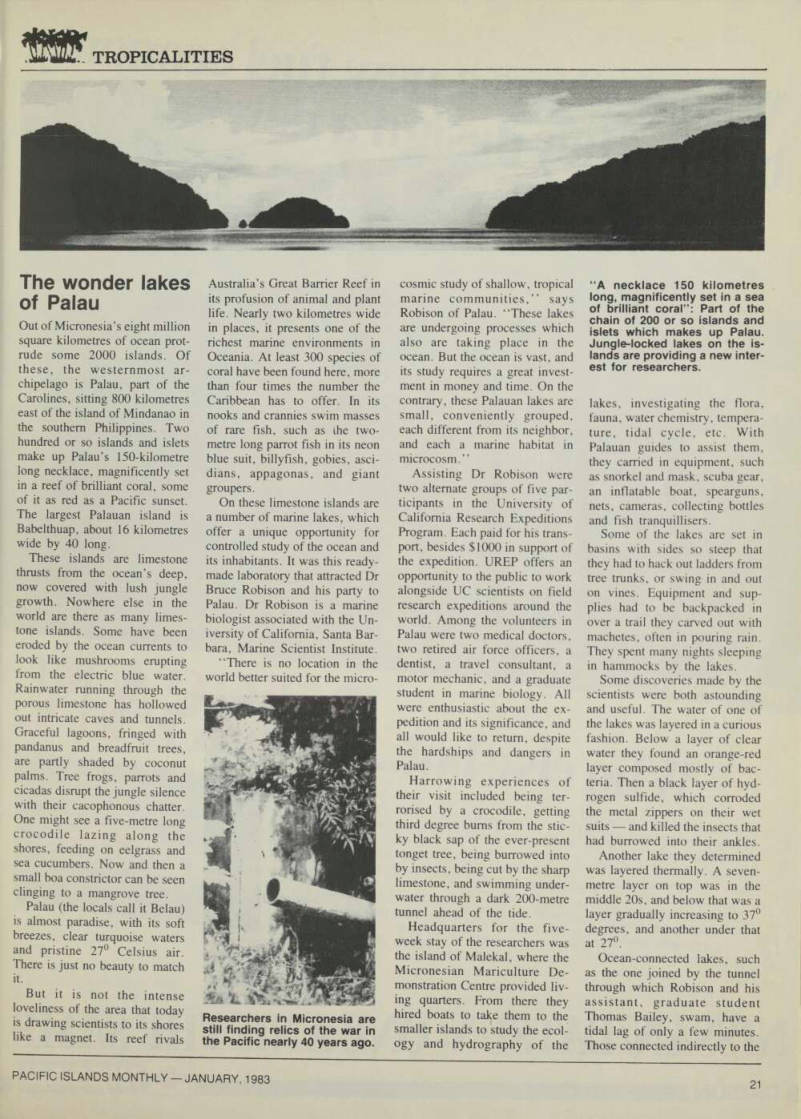
Out of Micronesia’s eight million square kilometres of ocean prot rude some 2000 islands. Of these, the westernmost ar chipelago is Palau, part of the Carolines, sitting 800 kilometres east of the island of Mindanao in the southern Philippines. Two hundred or so islands and islets make up Palau’s 150-kilometre long necklace, magnificently set in a reef of brilliant coral, some of it as red as a Pacific sunset.
The largest Palauan island is Babelthuap, about 16 kilometres wide by 40 long.
These islands are limestone thrusts from the ocean’s deep, now covered with lush jungle growth. Nowhere else in the world are there as many limes tone islands. Some have been eroded by the ocean currents to look like mushrooms erupting from the electric blue water.
Rainwater running through the porous limestone has hollowed out intricate caves and tunnels.
Graceful lagoons, fringed with pandanus and breadfruit trees, are partly shaded by coconut palms. Tree frogs, parrots and cicadas disrupt the jungle silence with their cacophonous chatter.
One might see a five-metre long crocodile lazing along the shores, feeding on eelgrass and sea cucumbers. Now and then a small boa constrictor can be seen clinging to a mangrove tree.
Palau (the locals call it Belau) is almost paradise, with its soft breezes, clear turquoise waters and pristine 27° Celsius air.
There is just no beauty to match it.
But it is not the intense loveliness of the area that today is drawing scientists to its shores like a magnet. Its reef rivals
cosmic study of shallow, tropical marine communities,” says Robison of Palau. “These lakes are undergoing processes which also are taking place in the ocean. But the ocean is vast, and its study requires a great invest ment in money and time. On the contrary, these Palauan lakes are small, conveniently grouped, each different from its neighbor, and each a marine habitat in microcosm.”
Assisting Dr Robison were two alternate groups of five par ticipants in the University of California Research Expeditions Program. Each paid for his trans port, besides $lOOO in support of the expedition. UREP offers an opportunity to the public to work alongside UC scientists on field research expeditions around the world. Among the volunteers in Palau were two medical doctors, two retired air force officers, a dentist, a travel consultant, a motor mechanic, and a graduate student in marine biology. All were enthusiastic about the ex pedition and its significance, and all would like to return, despite the hardships and dangers in Palau.
Harrowing experiences of their visit included being ter rorised by a crocodile, getting third degree bums from the stic ky black sap of the ever-present tonget tree, being burrowed into by insects, being cut by the sharp limestone, and swimming under water through a dark 200-metre tunnel ahead of the tide.
Headquarters for the five week stay of the researchers was the island of Malekal, where the Micronesian Mariculture De monstration Centre provided liv ing quarters. From there they hired boats to take them to the smaller islands to study the ecol ogy and hydrography of the
lakes, investigating the flora, fauna, water chemistry, tempera ture, tidal cycle, etc. With Palauan guides to assist them, they carried in equipment, such as snorkel and mask, scuba gear, an inflatable boat, spearguns, nets, cameras, collecting bottles and fish tranquillisers.
Some of the lakes are set in basins with sides so steep that they had to hack out ladders from tree trunks, or swing in and out on vines. Equipment and sup plies had to be backpacked in over a trail they carved out with machetes, often in pouring rain.
They spent many nights sleeping in hammocks by the lakes.
Some discoveries made by the scientists were both astounding and useful. The water of one of the lakes was layered in a curious fashion. Below a layer of clear water they found an orange-red layer composed mostly of bac teria. Then a black layer of hyd rogen sulfide, which corroded the metal zippers on their wet suits and killed the insects that had burrowed into their ankles.
Another lake they determined was layered thermally. A seven metre layer on top was in the middle 20s, and below that was a layer gradually increasing to 37° degrees, and another under that at 27°.
Ocean-connected lakes, such as the one joined by the tunnel through which Robison and his assistant, graduate student Thomas Bailey, swam, have a tidal lag of only a few minutes.
Those connected indirectly to the
Researchers in Micronesia are still finding relics of the war in the Pacific nearly 40 years ago.
“A necklace 150 kilometres long, magnificently set in a sea of brilliant coral”: Part of the chain of 200 or so islands and islets which makes up Palau.
Jungle-locked lakes on the is lands are providing a new inter est for researchers.
ocean, perhaps by percolation from an adjacent lake, might be out of phase by as much as several hours.
The fish populations are less diversified in the more isolated lakes, and they are more stable and smaller in both size and number. With less mixing of the water by fresh tidal surges, the lakes are more likely to be ther mally stratified, with fish re stricting themselves to particular heat zones. The one puzzling exception was the “all temperature gobie”. The scien tists observed that this little fish thrived in all heat zones and crossed from one to the other with no apparent ill effects from the different temperatures and levels of salinity and oxygen.
Robison and Bailey brought back a number of gobies, as well as other species, for study in their UCSB lab.
The lakes that are more direct ly connected to the ocean have a plentiful and diversified fish population, including such large fish as groupers and bat rays.
Some lakes contain as many as
60 different species, in contrast to the more isolated lakes, where as few as three or four can be found. In Jellyfish Lake on the Island of Koror the surface layer was completely filled with grapefruit-sized non-stinging jel lyfish. These animals generate their food from sunlight by incor porating phytoplankton into their bodies. They have a curious habit of migrating en masse from one end of the lake to the other in response to some unknown prompting. This is difficult to understand, since jellyfish have no eyes.
“We found that some lakes have distinctly different fish communities at night than during the day because of tidal cycles which allow the fish to enter and leave these lakes,” Robison said. “And fishes which are common on reefs outside the lakes often exhibit strikingly dif ferent feeding and behavior pat terns when they are living in the lakes.”
Kibakku Lake has a tunnel leading to the sea through which reef fish travel between lake and
lagoon. It was in Spooky Lake, so named because of the forebod ing shade cast on its murky water by the jungle trees, that a crocodile dropped into the water from a mangrove root beside Bailey, who was snorkelling. He speedily swam ashore, shouting a warning to Robison, who was stranded on a rock, with the dilemma of swimming to shore or walking through the jungle barefoot and without a machete.
Not fancying spending the night there, he decided to swim for it. To his horror, the crocodile did too. From the cor ner of his eye he saw the flat headed croc overtake and pass him, then peel off and disappear in the murky depths. Meanwhile the two Palauan guides had seized spearguns and jumped in to the lake to escort Robison to shore.
The Palau Islands were the scene of bitter fighting when the United States took the islands from the Japanese during World War n. Members of this marine lakes expedition found a number of war relics in the jungle: a
machinegun pillbox, helmets, canteens, and saki bottles in caves, searchlights, cannon and lookout towers, overgrown with vines, a crashed Zero fighter plane in a shallow tidal flat, and sunken landing craft among the coral reefs. They found that one machinegun nest made a very fine barbecue and used it to cook many of their meals.
Although the bitter battles of the ’4o’s left Palau’s sands stained with blood, the clear wa ters of the Pacific have long since cleansed it and men can get down to the more rewarding task of unlocking the ocean’s secrets.
That’s what Palau is all about
today.
Jean Ayres Hartley in
Sacramento, California
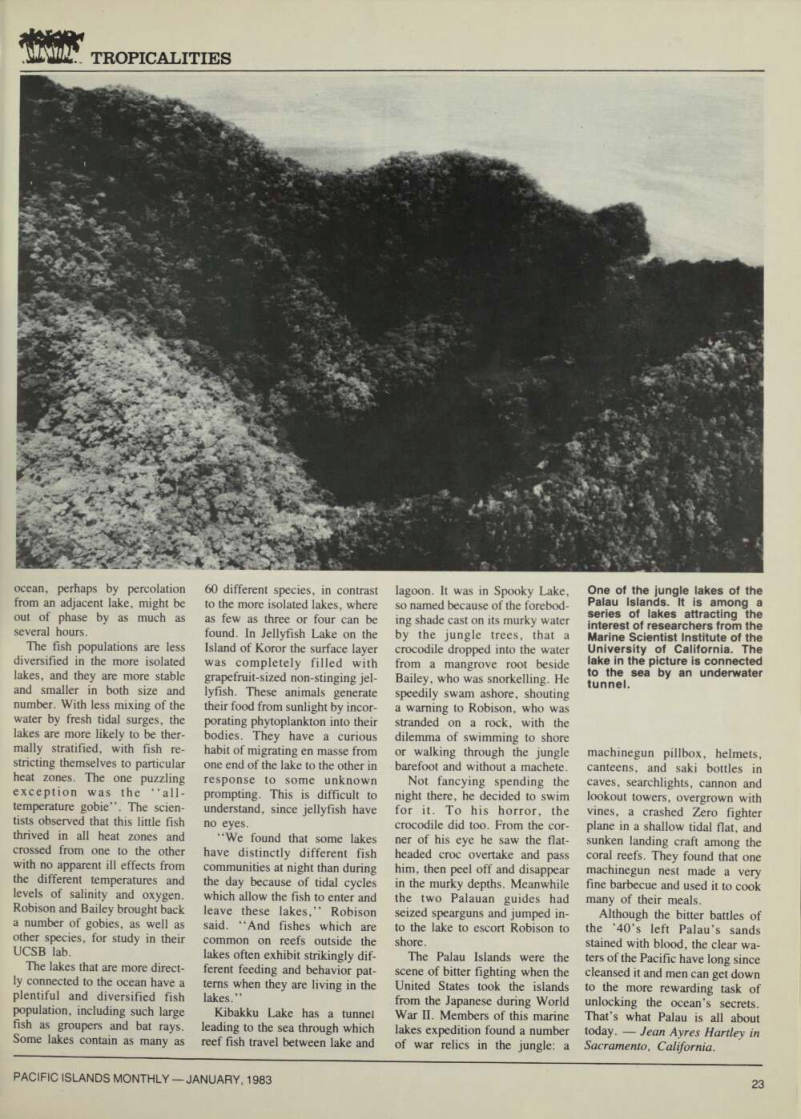
One of the jungle lakes of the Palau Islands. It is among a series of lakes attracting the interest of researchers from the Marine Scientist Institute of the University of California. The lake in the picture is connected to the sea by an underwater tunnel.