Big Apple
pp. 17-19 · Read in the full issue
Tropicalities
Coconuts sprout in the Big Apple
Programs concerning the Pacific region continued to be scheduled throughout autumn 1982 at New York’s Metropolitan Museum of Art, Asia Society and Natural History Museum.
“Ceremonies and Spirits,” an exhibition of art from Africa, the Pacific Islands and the Americas selected from the Metropolitan’s Michael C. Rockefeller Wing, toured New York’s five boroughs.
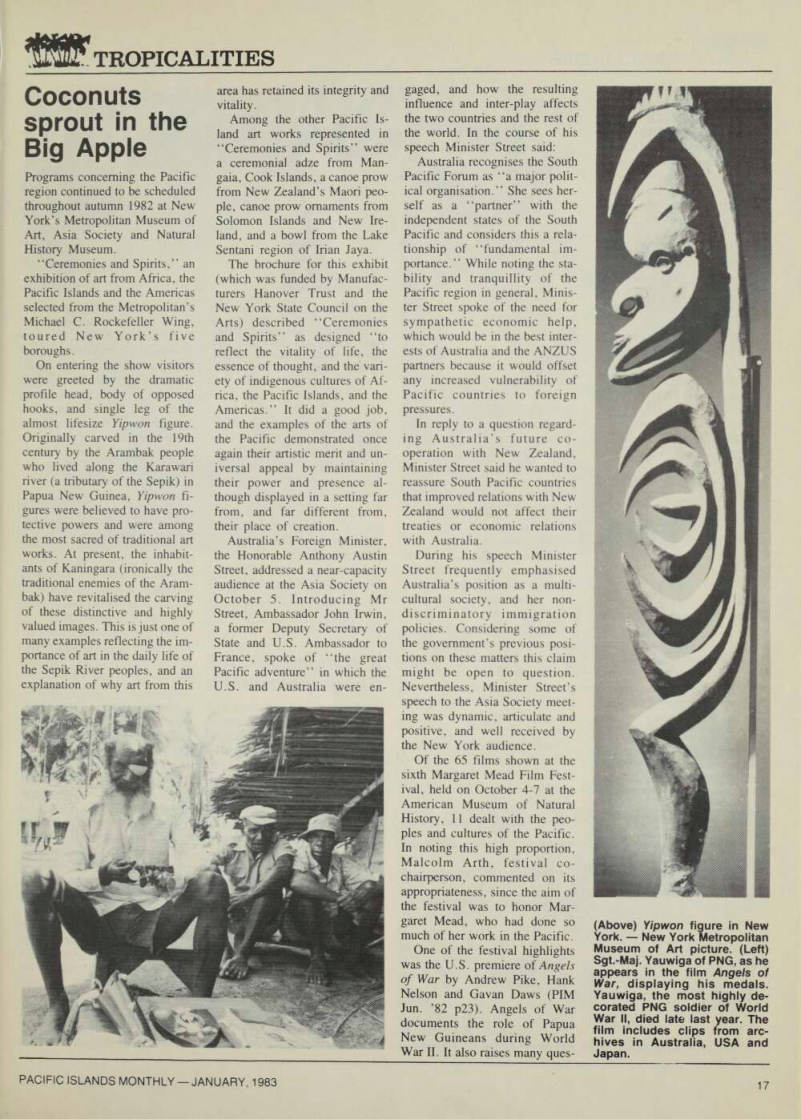
On entering the show visitors were greeted by the dramatic profile head, body of opposed hooks, and single leg of the almost lifesize Yipwon figure.
Originally carved in the 19th century by the Arambak people who lived along the Karawari river (a tributary of the Sepik) in Papua New Guinea, Yipwon fi gures were believed to have pro tective powers and were among the most sacred of traditional art works. At present, the inhabit ants of Kaningara (ironically the traditional enemies of the Aram bak) have revitalised the carving of these distinctive and highly valued images. This is just one of many examples reflecting the im portance of art in the daily life of the Sepik River peoples, and an explanation of why art from this
area has retained its integrity and
vitality.
Among the other Pacific Is land art works represented in “Ceremonies and Spirits” were a ceremonial adze from Man gaia, Cook Islands, a canoe prow from New Zealand’s Maori peo ple, canoe prow ornaments from Solomon Islands and New Ire land, and a bowl from the Lake Sentani region of Irian Jaya.
The brochure for this exhibit (which was funded by Manufac turers Hanover Trust and the New York State Council on the Arts) described “Ceremonies and Spirits” as designed “to reflect the vitality of life, the essence of thought, and the vari ety of indigenous cultures of Af rica, the Pacific Islands, and the Americas.” It did a good job, and the examples of the arts of the Pacific demonstrated once again their artistic merit and un
iversal appeal by maintaining
their power and presence al though displayed in a setting far from, and far different from, their place of creation.
Australia’s Foreign Minister, the Honorable Anthony Austin Street, addressed a near-capacity audience at the Asia Society on October 5. Introducing Mr Street, Ambassador John Irwin, a former Deputy Secretary of State and U.S. Ambassador to France, spoke of “the great Pacific adventure” in which the U.S. and Australia were en-
gaged, and how the resulting influence and inter-play affects the two countries and the rest of the world. In the course of his speech Minister Street said: Australia recognises the South Pacific Forum as “a major polit ical organisation.” She sees her self as a “partner” with the independent states of the South Pacific and considers this a rela tionship of “fundamental im portance.” While noting the sta bility and tranquillity of the Pacific region in general. Minis ter Street spoke of the need for sympathetic economic help, which would be in the best inter ests of Australia and the ANZUS partners because it would offset any increased vulnerability of Pacific countries to foreign pressures.
In reply to a question regard
ing Australia’s future co operation with New Zealand, Minister Street said he wanted to reassure South Pacific countries that improved relations with New Zealand would not affect their treaties or economic relations with Australia.
During his speech Minister
Street frequently emphasised
Australia’s position as a multi cultural society, and her non
discriminatory immigration
policies. Considering some of
the government’s previous posi
tions on these matters this claim might be open to question.
Nevertheless, Minister Street’s speech to the Asia Society meet ing was dynamic, articulate and positive, and well received by the New York audience.
Of the 65 films shown at the sixth Margaret Mead Film Fest ival, held on October 4-7 at the American Museum of Natural History, 11 dealt with the peo ples and cultures of the Pacific.
In noting this high proportion,
Malcolm Arth, festival co chairperson, commented on its appropriateness, since the aim of the festival was to honor Mar garet Mead, who had done so much of her work in the Pacific.
One of the festival highlights was the U.S. premiere of Angels of War by Andrew Pike, Hank Nelson and Gavan Daws (PIM Jun. ’B2 p 23). Angels of War documents the role of Papua New Guineans during World War 11. It also raises many ques-
(Above) Yipwon figure in New
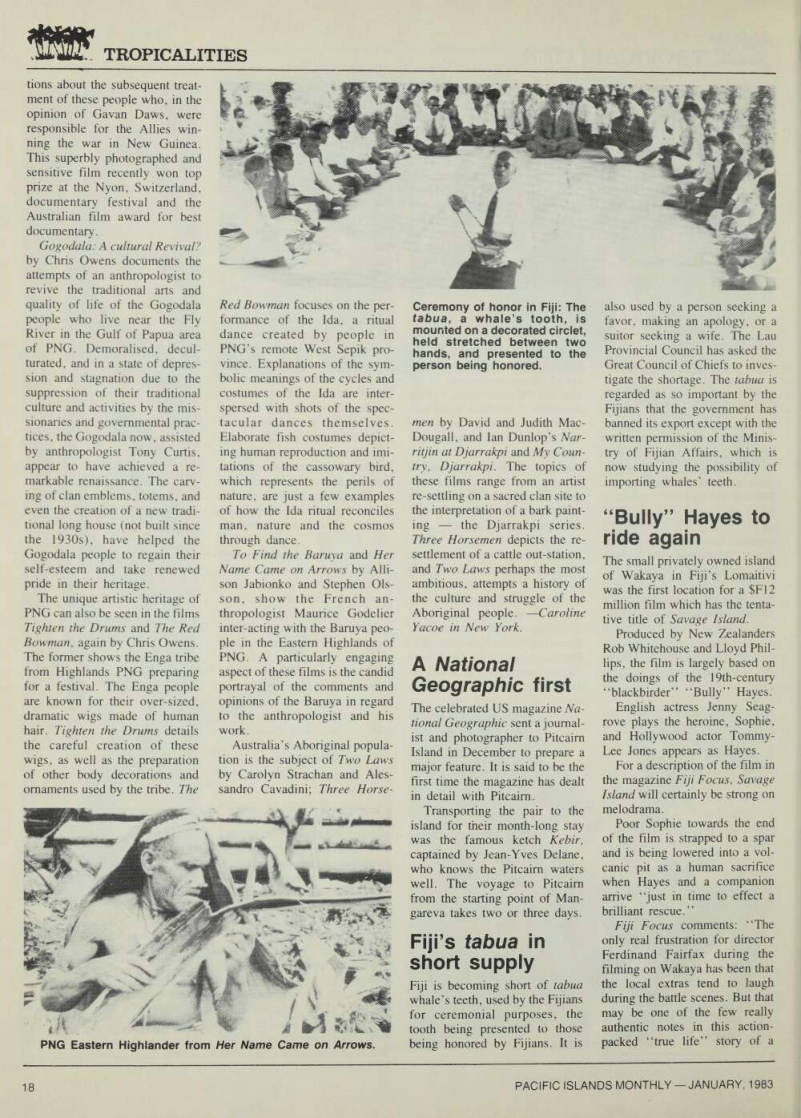
York. New York Metropolitan Museum of Art picture. (Left) Sgt.-Maj. Yauwiga of PNG, as he appears in the film Angels of War, displaying his medals.
Yauwiga, the most highly de corated PNG soldier of World War II, died late last year. The film includes clips from arc hives in Australia, USA and Japan.
tions about the subsequent treat ment of these people who, in the opinion of Gavan Daws, were responsible for the Allies win ning the war in New Guinea.
This superbly photographed and sensitive film recently won top prize at the Nyon, Switzerland, documentary festival and the Australian film award for best documentary.
Gogodala: A cultural Revival? by Chris Owens documents the attempts of an anthropologist to revive the traditional arts and quality of life of the Gogodala people who live near the Fly River in the Gulf of Papua area of PNG. Demoralised, decul turated, and in a state of depres sion and stagnation due to the suppression of their traditional culture and activities by the mis sionaries and governmental prac tices, the Gogodala now, assisted by anthropologist Tony Curtis, appear to have achieved a re markable renaissance. The carv ing of clan emblems, totems, and even the creation of a new tradi tional long house (not built since the 19305), have helped the Gogodala people to regain their self-esteem and take renewed pride in their heritage.
The unique artistic heritage of PNG can also be seen in the films Tighten the Drums and The Red Bowman, again by Chris Owens.
The former shows the Enga tribe from Highlands PNG preparing for a festival. The Enga people are known for their over-sized, dramatic wigs made of human hair. Tighten the Drums details the careful creation of these wigs, as well as the preparation of other body decorations and ornaments used by the tribe. The
Red Bowman focuses on the per formance of the Ida, a ritual dance created by people in PNG’s remote West Sepik pro vince. Explanations of the sym bolic meanings of the cycles and costumes of the Ida are inter spersed with shots of the spec tacular dances themselves.
Elaborate fish costumes depict ing human reproduction and imi tations of the cassowary bird, which represents the perils of nature, are just a few examples of how the Ida ritual reconciles man, nature and the cosmos
through dance.
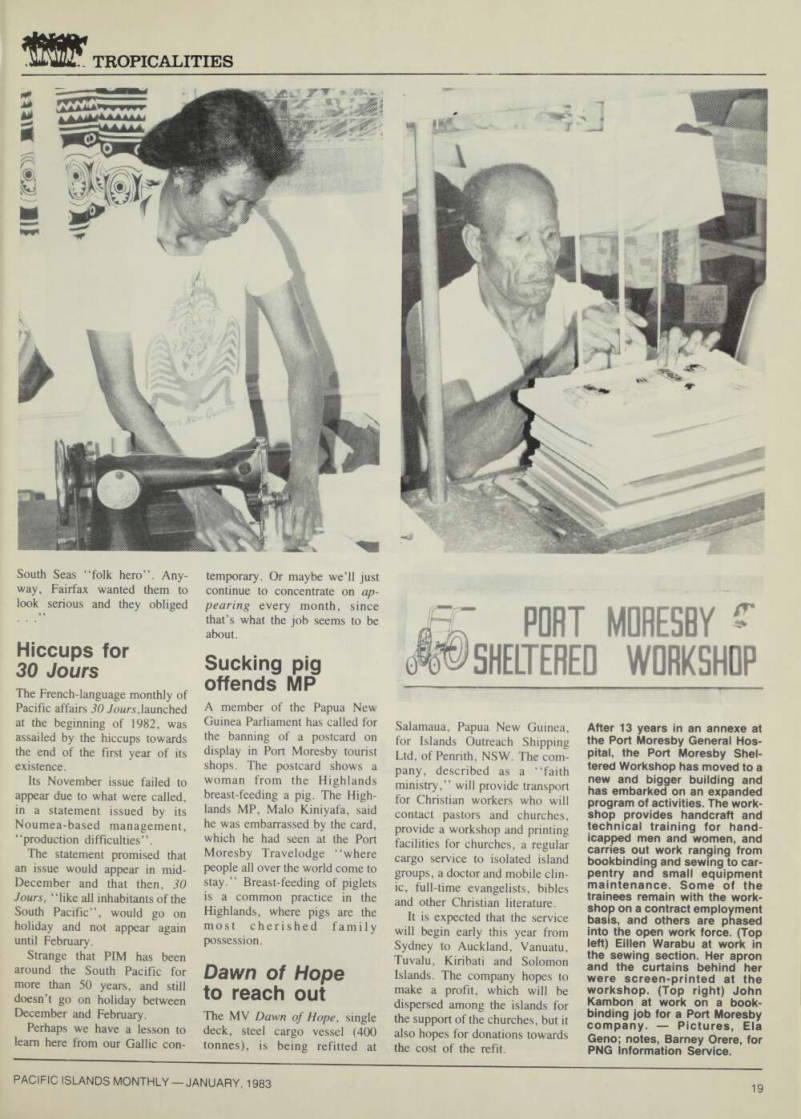
To Find the Baruya and Her Name Came on Arrows by Alli son Jabionko and Stephen Ols son, show the French an thropologist Maurice Godelier inter-acting with the Baruya peo ple in the Eastern Highlands of PNG. A particularly engaging aspect of these films is the candid portrayal of the comments and opinions of the Baruya in regard to the anthropologist and his work.
Australia’s Aboriginal popula tion is the subject of Two Laws by Carolyn Strachan and Ales sandro Cavadini; Three Horse-
men by David and Judith Mac- Dougall, and lan Dunlop’s Nar ritjin at Djarrakpi and My Coun try, Djarrakpi. The topics of these films range from an artist re-settling on a sacred clan site to the interpretation of a bark paint
ing the Djarrakpi series.
Three Horsemen depicts the re settlement of a cattle out-station, and Two Laws perhaps the most ambitious, attempts a history of the culture and struggle of the
Aboriginal people.
Caroline
Yacoe in New York.
A National
Geographic first
The celebrated US magazine Na tional Geographic sent a journal ist and photographer to Pitcairn Island in December to prepare a major feature. It is said to be the first time the magazine has dealt in detail with Pitcairn.
Transporting the pair to the island for their month-long stay was the famous ketch Kebir,
captained by Jean-Yves Delane,
who knows the Pitcairn waters well. The voyage to Pitcairn from the starting point of Man gam va takes two or three days.
Fiji’s tabua in
short supply
Fiji is becoming short of tabua whale’s teeth, used by the Fijians for ceremonial purposes, the tooth being presented to those being honored by Fijians. It is
also used by a person seeking a favor, making an apology, or a suitor seeking a wife. The Lau Provincial Council has asked the Great Council of Chiefs to inves tigate the shortage. The tabua is regarded as so important by the Fijians that the government has banned its export except with the written permission of the Minis try of Fijian Affairs, which is now studying the possibility of importing whales’ teeth.
“Bully” Hayes to
ride again
The small privately owned island of Wakaya in Fiji’s Lomaitivi was the first location for a SFI2 million film which has the tenta tive title of Savage Island.
Produced by New Zealanders Rob Whitehouse and Lloyd Phil lips, the film is largely based on the doings of the 19th-century “blackbirder” “Bully” Hayes.
English actress Jenny Seag
rove plays the heroine, Sophie, and Hollywood actor Tommy- Lee Jones appears as Hayes.
For a description of the film in the magazine Fiji Focus, Savage Island will certainly be strong on melodrama.
Poor Sophie towards the end of the film is strapped to a spar and is being lowered into a vol canic pit as a human sacrifice when Hayes and a companion arrive “just in time to effect a brilliant rescue.”
Fiji Focus comments; “The only real frustration for director Ferdinand Fairfax during the filming on Wakaya has been that the local extras tend to laugh during the battle scenes. But that may be one of the few really authentic notes in this action packed “true life” story of a
PNG Eastern Highlander from Her Name Came on Arrows.
Ceremony of honor in Fiji: The tabua, a whale’s tooth, is mounted on a decorated circlet, held stretched between two hands, and presented to the person being honored.
South Seas “folk hero”. Any way, Fairfax wanted them to look serious and they obliged y y
Hiccups for
30 Jours
The French-language monthly of Pacific affairs 30 Jours, launched at the beginning of 1982, was assailed by the hiccups towards the end of the first year of its existence.
Its November issue failed to appear due to what were called, in a statement issued by its Noumea-based management, production difficulties ’’.
The statement promised that an issue would appear in mid- December and that then, 30 Jours, “like all inhabitants of the South Pacific’’, would go on holiday and not appear again
until February.
Strange that PIM has been around the South Pacific for more than 50 years, and still doesn’t go on holiday between December and February.
Perhaps we have a lesson to learn here from our Gallic con
temporary. Or maybe we’ll just continue to concentrate on ap pearing every month, since that’s what the job seems to be about.
Sucking pig
offends MR
A member of the Papua New Guinea Parliament has called for the banning of a postcard on display in Port Moresby tourist shops. The postcard shows a woman from the Highlands breast-feeding a pig. The High lands MP, Malo Kiniyafa, said he was embarrassed by the card, which he had seen at the Port Moresby Travelodge “where people all over the world come to stay.’’ Breast-feeding of piglets is a common practice in the Highlands, where pigs are the most cherished family possession.
Dawn of Hope
to reach out
The MV Dawn of Hope, single deck, steel cargo vessel (400 tonnes), is being refitted at
Salamaua, Papua New Guinea, for Islands Outreach Shipping Ltd, of Penrith, NSW. The company, described as a “faith ministry,” will provide transport tor Christian workers who will contact pastors and churches, provide a workshop and printing facilities for churches a regular laciiities tor churches, a regular cargo service to isolated island groups, a doctor and mobile dinic, full-time evangelists, bibles and other Christian literati,rp ana other Christian literature.
It is expected that the service will begin early this year from Sydney to Auckland, Vanuatu Tuvalu, Kiribati and Solomon Islands. The company hopes to make a profit, which will be dispersed among the islands for the support of the churches, but i, also hopes for donations towards the cost of the refit.
After 13 years in an annexe at the Port Moresby General Hos pital, the Port Moresby Shel tered Workshop has moved to a new and bigger building and has embarked on an expanded program of activities. The work shop provides handcraft and technical training for hand icapped men and women, and carries out work ranging from bookbinding and sewing to car pentry and small equipment maintenance. Some of the trainees remain with the work shop on a contract employment basis, and others are phased into the open work force. (Top left) Eillen Warabu at work in the sewing section. Her apron and the curtains behind her were screen-printed at the
workshop. (Top right) John
Kambon at work on a book
binding job for a Port Moresby
company. - Pictures, Ela
Geno; notes, Barney Orere, for PNG Information Service.