Miracle men
pp. 24-25 · Read in the full issue
at work in Tahiti
To what extent can we count on God to help us, and to relieve our sufferings?
Two self-styled saviors appearing in public in French Polynesia towards the end of 1982 have come up with quite different answers to this perennial question. Both believe firmly in divine interven tion in human affairs, but when it comes to defining the area in which this intervention is most likely to occur, they have worked it out each in his own way; one is solely concerned with individual salvation and physical healing, while the other strives for a total transformation of society, beginning with its political system.
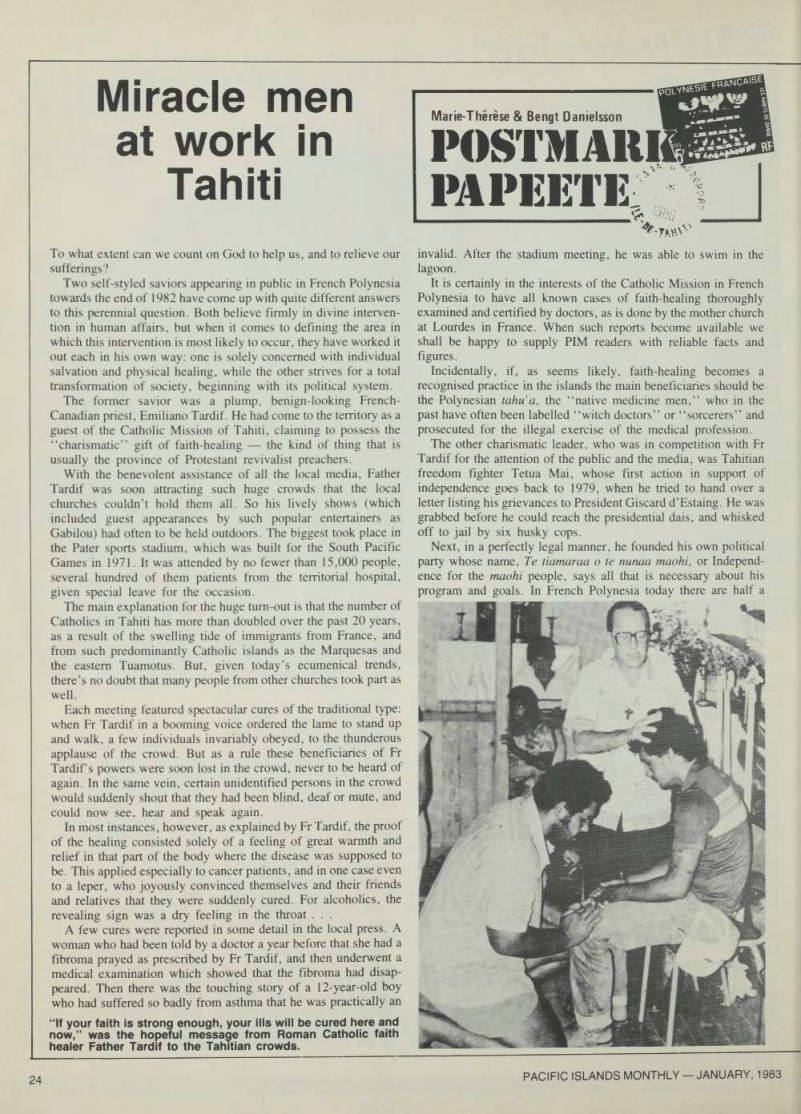
The former savior was a plump, benign-looking French- Canadian priest, Emiliano Tardif. He had come to the territory as a guest of the Catholic Mission of Tahiti, claiming to possess the “charismatic” gift of faith-healing the kind of thing that is usually the province of Protestant revivalist preachers.
With the benevolent assistance of all the local media, Father Tardif was soon attracting such huge crowds that the local churches couldn’t hold them all. So his lively shows (which included guest appearances by such popular entertainers as Gabilou) had often to be held outdoors. The biggest took place in the Pater sports stadium, which was built for the South Pacific Games in 1971. It was attended by no fewer than 15,000 people, several hundred of them patients from the territorial hospital, given special leave for the occasion.
The main explanation for the huge tum-out is that the number of Catholics in Tahiti has more than doubled over the past 20 years, as a result of the swelling tide of immigrants from France, and from such predominantly Catholic islands as the Marquesas and the eastern Tuamotus. But, given today’s ecumenical trends, there’s no doubt that many people from other churches took part as well.
Each meeting featured spectacular cures of the traditional type: when Fr Tardif in a booming voice ordered the lame to stand up and walk, a few individuals invariably obeyed, to the thunderous applause of the crowd. But as a rule these beneficiaries of Fr Tardif s powers were soon lost in the crowd, never to be heard of again. In the same vein, certain unidentified persons in the crowd would suddenly shout that they had been blind, deaf or mute, and could now see, hear and speak again.
In most instances, however, as explained by Fr Tardif, the proof of the healing consisted solely of a feeling of great warmth and relief in that part of the body where the disease was supposed to be. This applied especially to cancer patients, and in one case even to a leper, who joyously convinced themselves and their friends and relatives that they were suddenly cured. For alcoholics, the revealing sign was a dry feeling in the throat . . .
A few cures were reported in some detail in the local press. A woman who had been told by a doctor a year before that she had a fibroma prayed as prescribed by Fr Tardif, and then underwent a medical examination which showed that the fibroma had disap peared. Then there was the touching story of a 12-year-old boy who had suffered so badly from asthma that he was practically an
invalid. After the stadium meeting, he was able to swim in the
lagoon.
It is certainly in the interests of the Catholic Mission in French Polynesia to have all known cases of faith-healing thoroughly examined and certified by doctors, as is done by the mother church at Lourdes in France. When such reports become available we shall be happy to supply PIM readers with reliable facts and
figures.
Incidentally, if, as seems likely, faith-healing becomes a recognised practice in the islands the main beneficiaries should be the Polynesian tahu’a, the “native medicine men,” who in the past have often been labelled “witch doctors” or “sorcerers” and prosecuted for the illegal exercise of the medical profession.
The other charismatic leader, who was in competition with Fr Tardif for the attention of the public and the media, was Tahitian freedom fighter Tetua Mai, whose first action in support of independence goes back to 1979, when he tried to hand over a letter listing his grievances to President Giscard d’Estaing. He was grabbed before he could reach the presidential dais, and whisked off to jail by six husky cops.
Next, in a perfectly legal manner, he founded his own political party whose name, Te tiamaraa o te nunaa maohi, or Independ ence for the maohi people, says all that is necessary about his program and goals. In French Polynesia today there are half a
“If your faith is strong enough, your ills will be cured here and now,” was the hopeful message from Roman Catholic faith healer Father Tardif to the Tahitian crowds.
dozen parties, representing 20 percent of the electorate, advocat ing complete independence. The overwhelming majority of their supporters are Polynesians, who are still deeply religious and regularly seek solace and guidance by reading the Bible. So when Tetua Mai declared that God had enjoined him to found a party to lead his people to freedom, it did not sound nearly as ludicrous to his Polynesian compatriots as it did to most Europeans, Confident that he was the chosen prophet, Tetua Mai, in April 1982, went a step further and set up a Provisional Government of Tahiti, consisting of 11 ministers. He also formed a militia, or honor guard, dressed in smart uniforms, instituted a Polynesian marriage ceremony, and began issuing passports and drawing up a register of Polynesian supporters of independence.
For a while, the French authorities were disposed to dismiss him as a harmless crank, and his poor showing in the May territorial elections 416 votes seemed to confirm this opinion of him.
But their attitude soon changed when they discovered that Tetua Mai believed as firmly in the United Nations as in the heavenly powers, and was travelling around the Pacific rallying support for an appeal to the UN Committee on Decolonisation in favor of independence for the French colonies of New Caledonia and French Polynesia.
It was no less a figure than Henri Emmanuelli, minister for French Overseas Departments and Territories, who decided during his visit to Tahiti last August that the time had come to crush Tetua.
With the obvious aim of provoking an “incident,” two French gendarmes suddenly discovered that Tetua Mai’s “police escort,” who had been roaming all over Tahiti for months on their motor bikes, were wearing “unauthorised” uniforms! They stopped five of them and tore off their epaulettes. Tetua went to the gendar merie to recover his property, a scuffle ensued, and eventually it was the two gendarmes who were arrested by Tetua’s police.
Although Tetua quickly realised he had fallen into a trap, ordered the gendarmes released, and told the French procureur that he took full responsibility for what had happened, the gendarmes were not letting go of the wonderful pretext they now had for raiding the headquarters of the Provisional Government and smashing the movement altogether.
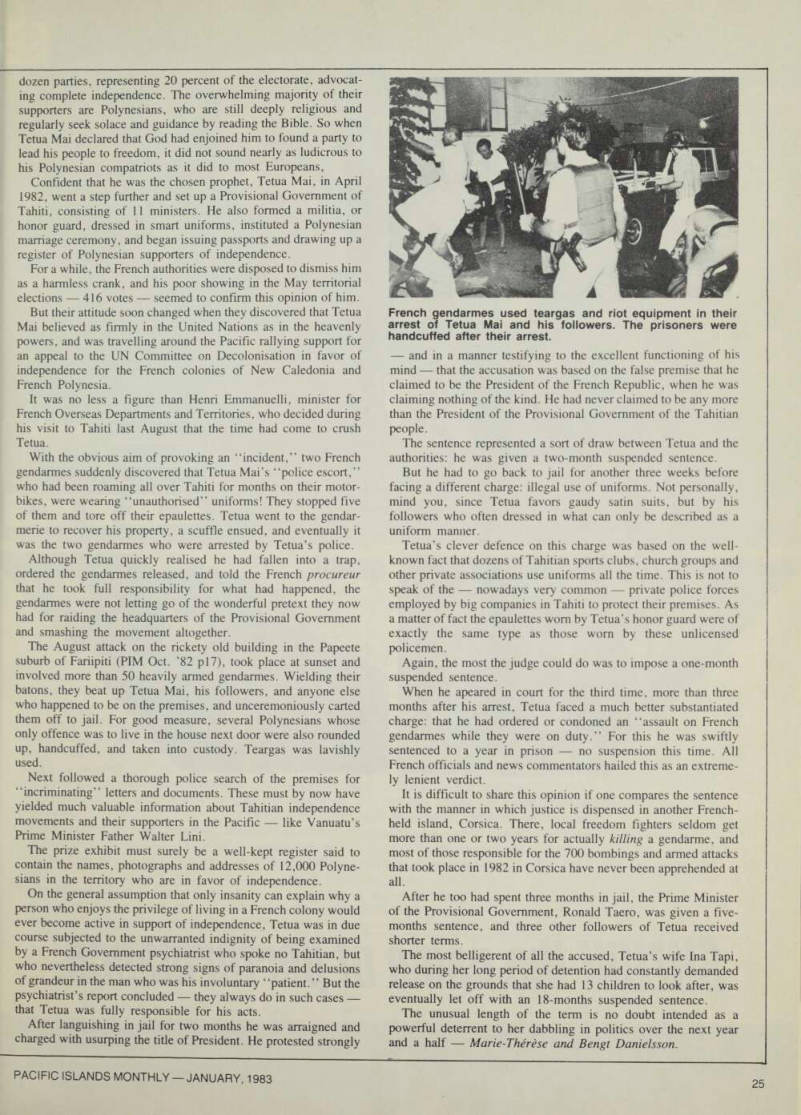
The August attack on the rickety old building in the Papeete suburb of Fariipiti (PIM Oct. ’B2 pi 7), took place at sunset and involved more than 50 heavily armed gendarmes. Wielding their batons, they beat up Tetua Mai, his followers, and anyone else who happened to be on the premises, and unceremoniously carted them off to jail. For good measure, several Polynesians whose only offence was to live in the house next door were also rounded up, handcuffed, and taken into custody. Teargas was lavishly used.
Next followed a thorough police search of the premises for “incriminating” letters and documents. These must by now have yielded much valuable information about Tahitian independence movements and their supporters in the Pacific like Vanuatu’s Prime Minister Father Walter Lini.
The prize exhibit must surely be a well-kept register said to contain the names, photographs and addresses of 12,000 Polyne sians in the territory who are in favor of independence.
On the general assumption that only insanity can explain why a person who enjoys the privilege of living in a French colony would ever become active in support of independence, Tetua was in due course subjected to the unwarranted indignity of being examined by a French Government psychiatrist who spoke no Tahitian, but who nevertheless detected strong signs of paranoia and delusions of grandeur in the man who was his involuntary “patient. ” But the psychiatrist’s report concluded they always do in such cases that Tetua was fully responsible for his acts.
After languishing in jail for two months he was arraigned and charged with usurping the title of President. He protested strongly
and in a manner testifying to the excellent functioning of his mind that the accusation was based on the false premise that he claimed to be the President of the French Republic, when he was claiming nothing of the kind. He had never claimed to be any more than the President of the Provisional Government of the Tahitian people.
The sentence represented a sort of draw between Tetua and the authorities: he was given a two-month suspended sentence.
But he had to go back to jail for another three weeks before facing a different charge: illegal use of uniforms. Not personally, mind you, since Tetua favors gaudy satin suits, but by his followers who often dressed in what can only be described as a uniform manner.
Tetua’s clever defence on this charge was based on the well known fact that dozens of Tahitian sports clubs, church groups and other private associations use uniforms all the time. This is not to speak of the nowadays very common private police forces employed by big companies in Tahiti to protect their premises. As a matter of fact the epaulettes worn by Tetua’s honor guard were of exactly the same type as those worn by these unlicensed policemen.
Again, the most the judge could do was to impose a one-month suspended sentence.
When he apeared in court for the third time, more than three months after his arrest, Tetua faced a much better substantiated charge: that he had ordered or condoned an “assault on French gendarmes while they were on duty.” For this he was swiftly sentenced to a year in prison no suspension this time. All French officials and news commentators hailed this as an extreme ly lenient verdict.
It is difficult to share this opinion if one compares the sentence with the manner in which justice is dispensed in another French held island, Corsica. There, local freedom fighters seldom get more than one or two years for actually killing a gendarme, and most of those responsible for the 700 bombings and armed attacks that took place in 1982 in Corsica have never been apprehended at all.
After he too had spent three months in jail, the Prime Minister of the Provisional Government, Ronald Taero, was given a five months sentence, and three other followers of Tetua received shorter terms.
The most belligerent of all the accused, Tetua’s wife Ina Tapi, who during her long period of detention had constantly demanded release on the grounds that she had 13 children to look after, was eventually let off with an 18-months suspended sentence.
The unusual length of the term is no doubt intended as a powerful deterrent to her dabbling in politics over the next year and a half Marie-Therese and Bengt Danielsson.
French gendarmes used teargas and riot equipment in their arrest of Tetua Mai and his followers. The prisoners were handcuffed after their arrest.