merry-go-round
pp. 48-49 · Read in the full issue

Tale of a Tahitian merry-go-round
The key figure in the new parliamentary majority emerging from the May 23 elections to French Polynesia’s Territorial Assembly was obviously Gaston Flosse, the astute leader of the pro-French Tahoeraa Fluiraatira party, which is affiliated with the metropoli tan-French Gaullist RPR party of Jacques Chirac (PIM Jul. p 22).
From his new position of strength, Flosse promptly undertook to steer a straight course towards a better life for all which most people who’d voted for him took to mean more money, more jobs, more welfare, more cars, more TV sets and more booze. (Incidentally, this also was the basic program of the former majority under Francis Sanford which was booted out because it failed to deliver the goods . . .) But instead, to the amusement or dismay of the people of French Polynesia, what has happened in the four months since Flosse and his team of able young technocrats took over the reins of government is a kind of political merry-go-round, in which those astride the wooden horses have bickered with and pushed and shoved each other, to the accompaniment of howls of abuse and shrill denunciations. And when the merry-go-round finally ground to a halt, everybody was back precisely where they started The key element in these farcical proceedings is the simple fact that Flosse’s party had won only 13 seats in the 30-member assembly. To obtain a working majority, the 13 Tahoeraa Huiraatira assemblymen had therefore to ally themselves with another group holding at least three seats.
The logical choice for the role of ally had seemed to be the new Aia api party, with its three seats in the assembly. The party had been formed shortly before the elections as a breakaway from Francis Sanford’s Ea api party. Foremost of the three turncoats was the young mayor of Mahina, Emile Vemaudon, who is nicknamed “the Sheriff’ because of his predilection for American police methods and uniforms (PIM Aug. p 24).
Mathematically speaking the thing seemed perfect, since it provided a 16-14 majority and catapulted Flosse into the position of vice-president of the assembly. (The president is still the French High Commissioner, who is appointed by the government in Paris.) But Flosse had overlooked the human factor in particular, the ebullience, whimsy and outright megalomania of “the Sheriff”.
He certainly must have had his aprehensions, since he sought at the outset to neutralise his coalition partner by appointing him to the largely ceremonial office of speaker of the assembly. But he overlooked the fact that this post also provided Vemaudon with ample opportunity for meddling and scheming behind his back.
Flosse’s accession to the vice-presidency meant that he had to resign his seat as deputy to the National Assembly in Paris, a position he’d held since 1978. For unfathomable reasons the constitutional set-up is so arranged as to prevent Flosse’s electoral proxy, Tutaha Salmon, from automatically filling the vacated seat.
So a by-election had to be held for the Eastern constituency. The event was made all the more pointless by the fact that the electorate had been especially rigged-up in ’7B to ensure Flosse’s victory, and his proxy was equally sure to win it. That is, until
Flosse’s new-found coalition partner Vemaudon himself decided to contest the seat. In the event, he did not seriously threaten Salmon, who got twice as many votes as his unwelcome runner up. But what was worse than this act of defiance, in Flosse’s eyes, was the venomous smear campaign waged against the Tahoeraa Huiraatira candidate by Vemaudon and his cohorts, especially the
appropriately-named Napoleon Spitz.
Vemaudon’s impudence can only be explained by his apparent ly firm belief that Flosse desperately needed his support to stay in power, and that no other possible coalition partner was available to him. On the face of things, this did indeed seem to be the case: the two other parties represented in the assembly by six members in one case, three in the other appeared to be at the opposite end of the political spectrum from Flosse. The larger group, John Teariki’s Pupu here aia (Polynesian Patriots), has an essentially rural, Polynesian and Protestant base, while Flosse’s party appeals primarily to French and part-European businessmen, and Polyne sian Catholics. The three-member la mana te nunaa, for its part, stands for what Flosse and his associates dread most; an indepen dent state run by Polynesians on socialist lines, and developing close co-operation with other Pacific nations.
There was general amazement, therefore, when at the end of September Flosse announced (a) that he had broken with Ver naudon, and (b) that he was going to form a new majority with Teariki.
Most people regarded the proposed alliance as tantamount to an act against nature. But, as we have related in these columns before, for several years now these two political adversaries have had an identical line on two important issues.
The first concerns internal self-government. In March, 1980, Flosse suddenly did a political U-tum in which he came out so strongly for full local autonomy that Teariki and Sanford, leaders of the Autonomist majority of the day, accused him of having cold-bloodedly stolen their program (PIM May, ’BO, p 27).
The second issue is nuclear testing. Flosse, in December, 1981, went a step further and introduced an anti-bomb resolution in the Territorial Assembly: it called for an immediate halt to nuclear testing and the establishment of an independent committee of inquiry (composed not only of civilian French radio-biologists, but of similarly qualified scientists from New Zealand, Australia and
Japan) into the health hazards resulting from the explosion of more than 90 bombs in the islands. Once again, Teariki accused Flosse of blatant opportunism.
But whatever Flosse’s motives, the fact was that the two parties now had common goals on two crucial issues in the political life of the territory.
This time again, however, the human factor prevailed over fine tuned parliamentary arithmetic. As things turned out, the followers of Flosse and Teariki, who for a full 25 years had been bitterly at loggerheads, simply could not shake off their mutual distrust, and refused to endorse the deal.
After three weeks of negotiations, it was announced in some what sad but extremely polite terms that talks had been broken off
between the two sides because they could not agree on the method of allocation of the seven seats on the Government Council Vemaudon’s party comrades in the assembly immediately jumped into the breach with an ingenious but quite unscrupulous prescription for setting the merry-go-round in motion again: they declared themselves ready to dump their own party and stick with Flosse. Three other assemblymen, elected as independents, joined them, thus offering Flosse an 18-12 majority which he, of course, was delighted to accept.
Vemaudon sought to hit back by expelling the defectors from his party a totally ineffectual gesture, since they had already left it of their own free will. He then claimed it was in his power to expel them from the assembly, announcing darkly that he had in his possession letters of regisignation from the assembly which he had had them sign, as a precautionary measure, before they were ever elected to it.
However, with the majestic Napoleon in the van, the two defectors refused to acknowledge the smallest whiff of a Waterloo, and in fact displayed such fighting spirit when they turned up in the assembly that they traded insults with hecklers in the public gallery, and almost got into fist fights with some of them.
For some reason Vemaudon has never been able to produce his “guillotine” letters. Instead, he took the extraordinary step of flying off to Paris to ask President Mitterrand to dissolve the assembly and organise new elections.
Considering that he alone of the 30 members wants the assembly dissolved, and considering also that in his campaign speeches he has never ceased to vilify everything that Mitterrand and the Socialist Party stand for, his chances of success seemed slim indeed.
The most that can be said for his antics is that they show he at least understands one basic fact of the political life of the territory: that the real power of decision over the destiny of the people of French Polynesia still lies in the hands of politicians in far-off Paris. Marie-Therese and Bengt Danielsson.
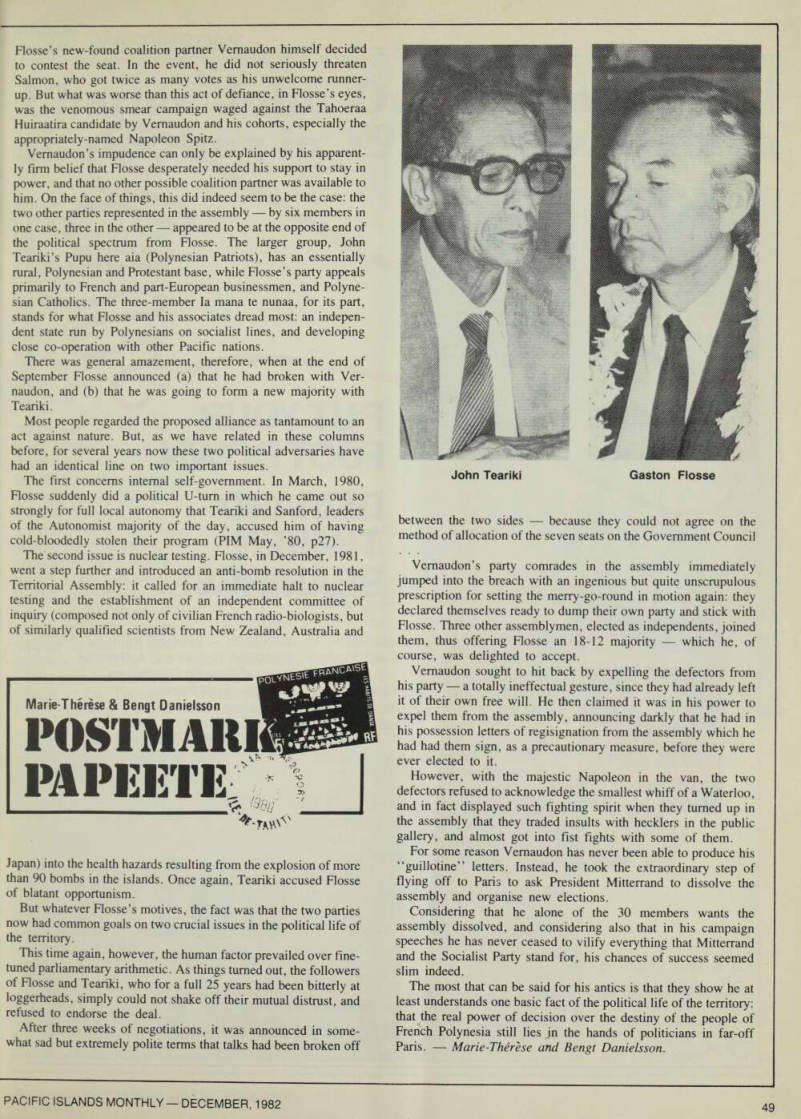
Gaston Flosse
John Teariki