shutterbug in 1930s New Guinea
pp. 51-54 · Read in the full issue
Yesterday
Charles John Orr, engineer and shutterbug in 1930s New Guinea
Reader JOHN C. ORR is proud of the photo graphic skills of his late father, the Australian
Charles John Orr,
who worked as an elec trical engineer in the New Guinea goldfields in the 19305. The exam ples of Orr Senior’s work reproduced in these pages seem to justify this pride.
Orr Junior writes: “Dad did not caption many of his photos that’s where the difficulty lies. But, for the first two years anyway, there are clues.
“The photos that he sent to his fiancee Flor ence Mae Webb (‘Myra’ to her family in Forbes, in the central-west of New South Wales) mostly had brief expla nations written on the backs.
“He took hundreds of photos in the Territory.
The emphasis as one
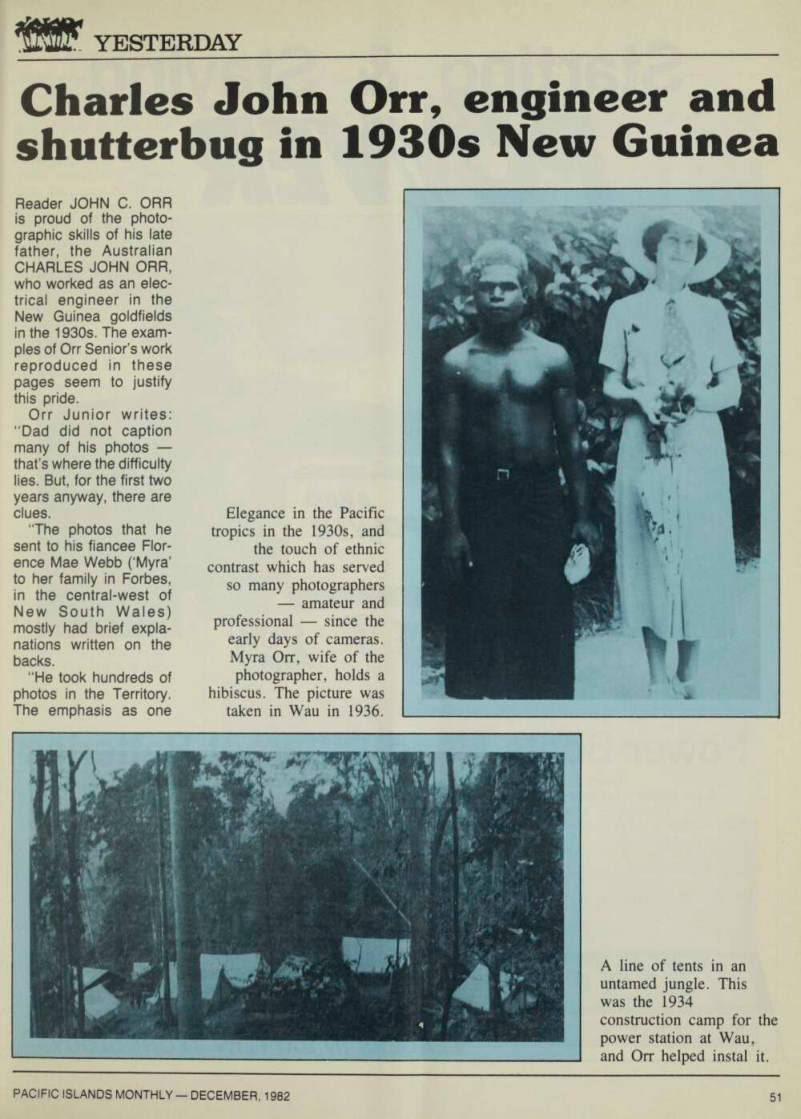
Elegance in the Pacific tropics in the 19305, and the touch of ethnic contrast which has served so many photographers - amateur and
professional - since the
early days of cameras.
Myra Orr, wife of the photographer, holds a hibiscus. The picture was taken in Wau in 1936.
A line of tents in an untamed jungle. This was the 1934 construction camp for the power station at Wau, and Orr helped instal it.
might expect, is on the electrical plant and its operations. But there are photos of Duk Duk dancers, tennis matches, and a score of other aspects of life in the Territory in those days, aspects of both a local and an introduced character.
“The incidence of air craft in the photographs as much as the mountains, cloud and jungle in the back grounds proclaim ‘New Guinea gold coun try, 19305’.
“The camera Dad used was a German Ag fa, which he bought in Sydney, after signing on with New Guinea Gold fields Ltd, which had its office at 67 York Street, Sydney.
“I think PIM readers will agree, from the photos seen here, that my father had an instinct for photography: that quality which is more than a sense of compos ition, but the ability, by instinct, to register an image. We have a pic
ture then, and not a flat copy of what, after the click, returns to itself.
“Dad never regarded his photography as ‘work’, although I’m sure he loved it. He did it in ‘offs’ and ‘ons’, with the ‘offs’ most of the time longer than the ‘ons’. It was a hobby of his.
“But let the pictures speak for themselves.”
This remarkable picture was taken after the Rabaul volcanic eruption of 1937. The shadow of a ship which appears to be cast on flat land is actually on the waters of Simpson Harbour, covered with floating pumice.
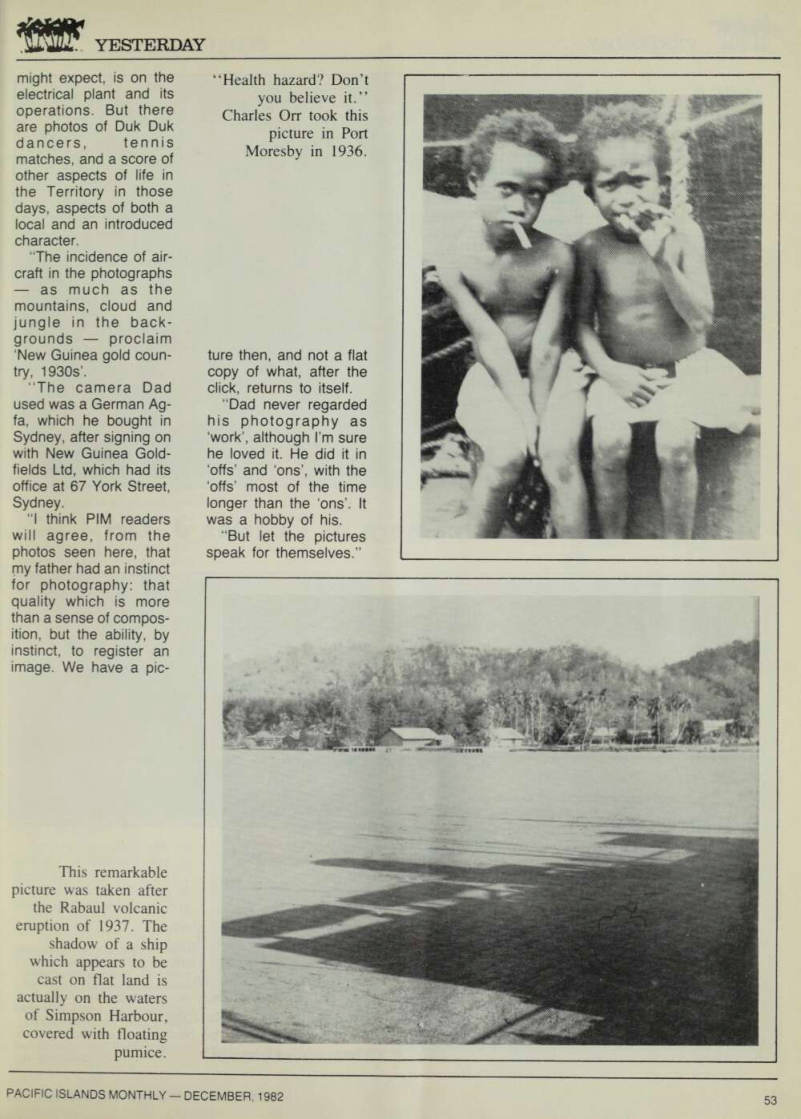
“Health hazard? Don’t you believe it.”
Charles Orr took this picture in Port Moresby in 1936.
The historical camera of Charles J. Orr
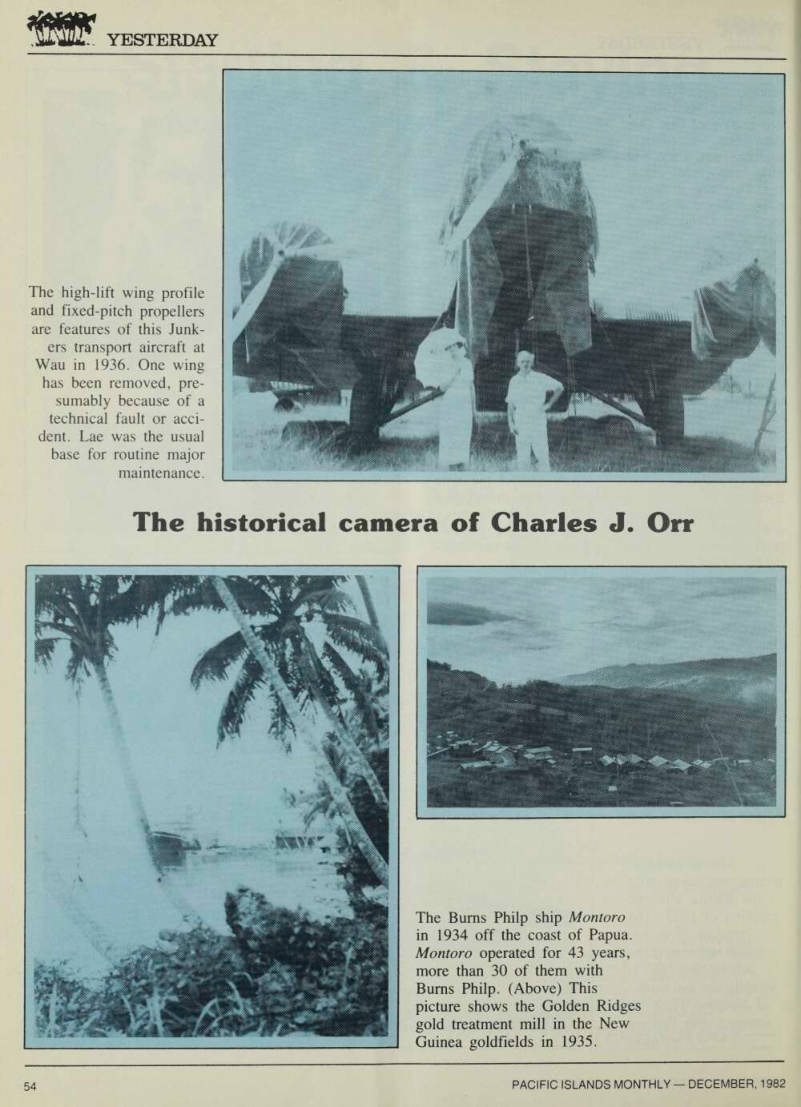
The high-lift wing profile
and fixed-pitch propellers are features of this Junk ers transport aircraft at Wau in 1936. One wing has been removed, pre sumably because of a technical fault or acci dent. Lae was the usual base for routine major maintenance.
The Bums Philp ship Montoro in 1934 off the coast of Popua.
Montoro operated for 43 years, more than 30 of them with Bums Philp. (Above) This picture shows the Golden Ridges gold treatment mill in the New Guinea goldfields in 1935.