The continuing
pp. 45-47 · Read in the full issue
Decentralisation: The continuing dilemma
Decentralisation: Options and Issues A Manual for Policy makers. By Edward P. Wolfers, Diana Conyers, Peter Larmour, and Yash P. Ghai. Published by the Commonwealth Secretariat, London, 1982. 6 pounds Sterling.
Politics is about power over peo ple and resources. In democ racies, this power, commonly called government, is in the hands of popularly elected men and women. In some nations such as Sweden and France, gov ernment is centralised; in others, particularly where there is a fed eral system such as in the USA and Australia, government is ex ercised at several levels. Tiers of government that is, sharing power is always characterised by competition between the tiers.
In India, this competition, main ly from religious, tribal and ling uistic divergences, led to a divi sion into three nations; in Nigeria, it caused a bitter civil war. Most of the nations which have emerged during the past 30 or so years contain within their
boundaries a number of linguistic and culturally distinct groups which have insisted upon (and usually succeeded in winning) some form of distribution of the power of government.
In our part of the world, the people of Solomon Islands and Papua New Guinea have gone to some lengths, by means of their new nations’ constitutions, to transfer some of the powers exer cised by the colonial overlord from the national to regional and local levels. This transfer, often referred to as decentralisation, has, among other things, resulted in 19 provincial governments in PNG, each with a premier, depu ty premier and other ministers, with a concomitant burden upon provincial revenue; provincial public services in far from fric tion-free relationships with the national public service; confu sion in dealings with foreign en terprises; and frequent failure to make the best of national and local resources.
There are three main forms of decentralisation: political, in volving the power to pass laws and make policy decisions; ad ministrative, primarily concern ed with the control of public services and other public sector organisations; and geographical, relocating the headquarters of a ministry of department and/or posting staff from headquarters to the regions. In Decentralisa tion: Options and Issues, it is rightly pointed out that “whatev er the size of a country, there will almost always be pressures for decentralisation ... to increase local participation, to improve access to government, and to
make government more effective and responsive to local needs ... But decentralisation does not by itself generate additional resources. In practice, the decen tralisation of powers may often necessitate the subsequent provi sion of extra resources, but addi tional resources do not necessari ly follow ...”
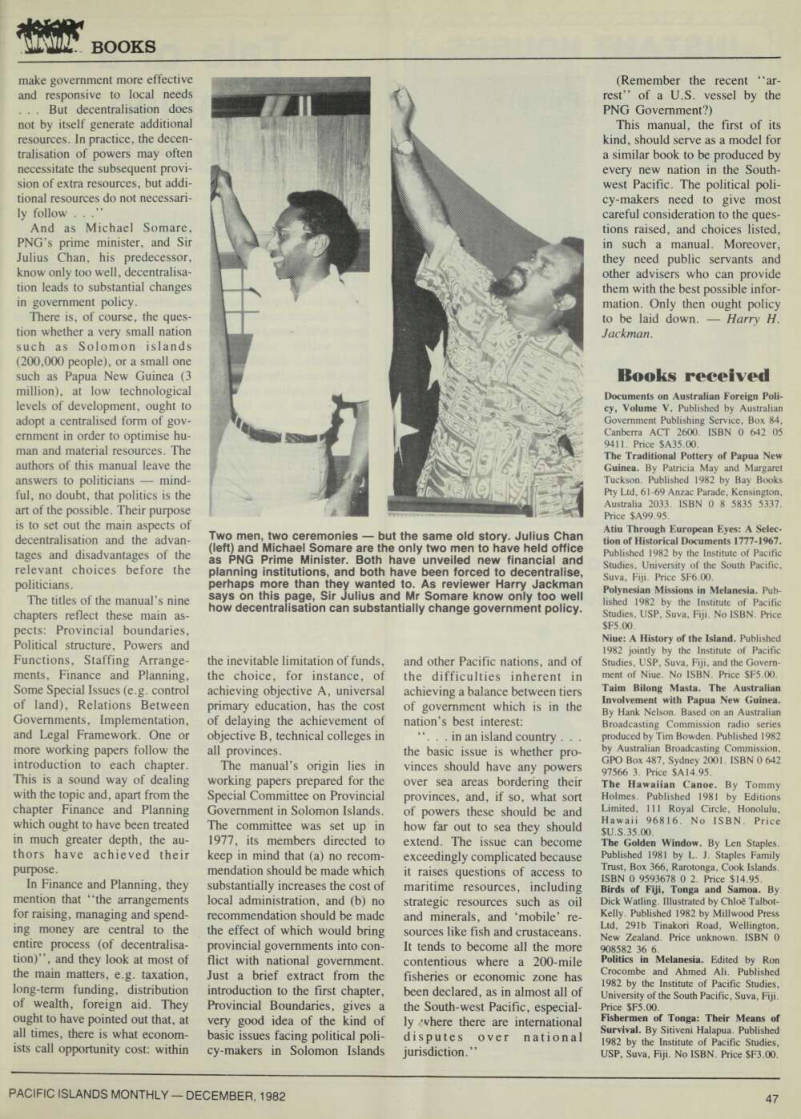
And as Michael Somare, PNG’s prime minister, and Sir Julius Chan, his predecessor, know only too well, decentralisa tion leads to substantial changes in government policy.
There is, of course, the ques tion whether a very small nation such as Solomon islands (200,000 people), or a small one such as Papua New Guinea (3 million), at low technological levels of development, ought to adopt a centralised form of gov ernment in order to optimise hu man and material resources. The authors of this manual leave the answers to politicians mind ful, no doubt, that politics is the art of the possible. Their purpose is to set out the main aspects of decentralisation and the advan tages and disadvantages of the relevant choices before the politicians.
The titles of the manual’s nine chapters reflect these main as pects: Provincial boundaries, Political structure, Powers and Functions, Staffing Arrange ments, Finance and Planning, Some Special Issues (e.g. control of land), Relations Between Governments, Implementation, and Legal Framework. One or more working papers follow the introduction to each chapter.
This is a sound way of dealing with the topic and, apart from the chapter Finance and Planning which ought to have been treated in much greater depth, the au thors have achieved their purpose.
In Finance and Planning, they mention that “the arrangements for raising, managing and spend ing money are central to the entire process (of decentralisa tion)”, and they look at most of the main matters, e.g. taxation, long-term funding, distribution of wealth, foreign aid. They ought to have pointed out that, at all times, there is what econom ists call opportunity cost: within
the inevitable limitation of funds, the choice, for instance, of achieving objective A, universal primary education, has the cost of delaying the achievement of objective B, technical colleges in all provinces.
The manual’s origin lies in working papers prepared for the Special Committee on Provincial Government in Solomon Islands.
The committee was set up in 1977, its members directed to keep in mind that (a) no recom mendation should be made which substantially increases the cost of local administration, and (b) no recommendation should be made the effect of which would bring provincial governments into con flict with national government.
Just a brief extract from the introduction to the first chapter, Provincial Boundaries, gives a very good idea of the kind of basic issues facing political poli cy-makers in Solomon Islands
and other Pacific nations, and of the difficulties inherent in achieving a balance between tiers of government which is in the nation’s best interest: “. . . in an island country . . . the basic issue is whether pro vinces should have any powers over sea areas bordering their provinces, and, if so, what sort of powers these should be and how far out to sea they should extend. The issue can become exceedingly complicated because it raises questions of access to maritime resources, including strategic resources such as oil and minerals, and ‘mobile’ re sources like fish and crustaceans.
It tends to become all the more contentious where a 200-mile fisheries or economic zone has been declared, as in almost all of the South-west Pacific, especial ly -where there are international disputes over national jurisdiction.”
(Remember the recent “ar rest” of a U.S. vessel by the PNG Government?) This manual, the first of its kind, should serve as a model for a similar book to be produced by every new nation in the South west Pacific. The political poli cy-makers need to give most careful consideration to the ques tions raised, and choices listed, in such a manual. Moreover, they need public servants and other advisers who can provide them with the best possible infor mation. Only then ought policy
to be laid down.
Harry H.
Jackman.
Books received
Documents on Australian Foreign Poli cy, Volume V. Published by Australian Government Publishing Service, Box 84, Canberra ACT 2600. ISBN 0 642 05 9411. Price $A35.00.
The Traditional Pottery of Papua New Guinea. By Patricia May and Margaret Tuckson. Published 1982 by Bay Books Pty Ltd, 61-69 Anzac Parade, Kensington, Australia 2033. ISBN 0 8 5835 5337.
Price 5A99.95.
Atiu Through European Eyes: A Selec tion of Historical Documents 1777-1967.
Published 1982 by the Institute of Pacific Studies, University of the South Pacific, Suva, Fiji. Price $F6.00.
Polynesian Missions in Melanesia. Pub lished 1982 by the Institute of Pacific Studies, USP, Suva, Fiji. No ISBN. Price $F5.00.
Niue: A History of the Island. Published 1982 jointly by the Institute of Pacific Studies, USP, Suva, Fiji, and the Govern ment of Niue. No ISBN. Price $F5.00.
Taim Bilong Masta. The Australian Involvement with Papua New Guinea.
By Hank Nelson. Based on an Australian Broadcasting Commission radio series produced by Tim Bowden. Published 1982 by Australian Broadcasting Commission, GPO Box 487, Sydney 2001. ISBN 0 642 97566 3. Price $A 14.95.
The Hawaiian Canoe. By Tommy Holmes. Published 1981 by Editions Limited, 111 Royal Circle, Honolulu, Hawaii 96816. No ISBN. Price $U.5.35.00.
The Golden Window. By Len Staples.
Published 1981 by L. J. Staples Family Trust, Box 366, Rarotonga, Cook Islands.
ISBN 0 9593678 0 2. Price $14.95.
Birds of Fiji, Tonga and Samoa. By Dick Watling. Illustrated by Chlo£ Talbot- Kelly. Published 1982 by Millwood Press Ltd, 291 b Tinakori Road, Wellington, New Zealand. Price unknown. ISBN 0 908582 36 6.
Politics in Melanesia. Edited by Ron Crocombe and Ahmed Ali. Published 1982 by the Institute of Pacific Studies, University of the South Pacific, Suva, Fiji.
Price $F5.00.
Fishermen of Tonga: Their Means of Survival. By Sitiveni Halapua. Published 1982 by the Institute of Pacific Studies, USP, Suva, Fiji. No ISBN. Price $F3.00.
Two men, two ceremonies but the same old story. Julius Chan (left) and Michael Somare are the only two men to have held office as PNG Prime Minister. Both have unveiled new financial and planning institutions, and both have been forced to decentralise, perhaps more than they wanted to. As reviewer Harry Jackman says on this page, Sir Julius and Mr Somare know only too well how decentralisation can substantially change government policy.