Dillingham:
pp. 43-45 · Read in the full issue
How a dynasty was born
Millstones and Milestones: The Career of B. F. Dillingham. By Paul T. Yardley. Published for the B. F. Dillingham Company, Ltd, by the University Press of Hawaii, Honolulu. ISBN 0 8248
0761 8. Su.S. 17.50.
The name Dillingham has been one to conjure with in Hawaii for at least a century.
Paul Yardley gives us in this authorised biography the best in troduction yet published to the history of that family. It is a useful, though not strongly crit ical, contribution to the scanty literature on Hawaii’s economic history, based mainly on business records and family documents held in the Bishop Museum in Honolulu.
Benjamin Franklin Dilling ham, the subject of this study, was an able young ship’s officer in 1865, when an accident which occurred while he was ashore in Honolulu forced him to remain there to convalesce. During that period he formed attachments, both business and romantic, which led him to make the island capital his home. What makes his story remarkable is the way in which his hard-driving, basically clean-living, personality, com bined with associations among Hawaii’s missionary-descended elite, led him to fortune and the founding of a business dynasty.
Young Dillingham, known to family and friends as “Frank”, married the daughter of Lowell Smith, one of the leading Protes
tant ministers of Honolulu.
Through the rest of his life he continued an association with the mission churches, teaching Sun day school classes, singing in the choir, and sharing with his wife in many church activities and charities. What may strike to day’s reader is the manner in which this strong, strict, moral outlook could blend with the ability to drive a hard bargain, inflate the value of railroad or plantation stock, influence gov ernment bodies to his own profit, and spend lavishly on his family lifestyle.
Some of the business practices Mr Yardley describes raised eyebrows even in the business world ofß. F. Dillingham’s day.
Yet Dillingham would certainly have resented and dismissed as unfounded any charges of dis honesty levelled against him. His intentions were good, and he seems always to have believed that the works he brought into being railroads, docks, or plantations were truly for the good of the community. Yet the tensions involved in his constant promotions and constant inde btedness were such as to bring him major nervous collapses at least twice in his career, and to lesser illnesses many times.
Through all the vagaries of his many business enterprises Dillin gham profited from the close associations which his marriage into the missionary elite had brought him. Time and again he was bailed out of rash promo tions, first by Samuel Northrup Castle, later by Charles Bishop or by Samuel Damon, among others, where another man would have been forced into bankruptcy.
Special influence was however by no means the sole source of Dillingham’s success. He was able to secure financial support in San Francisco, New York, and even London. His charm, open ness, unbounded self confidence, and obvious ac-
quaintance with good living helped him secure financial backing in major financial centres when cautious provin cialism in Honolulu withheld support.
Yardley’s story does not em phasise the tight, oligarchic con trol of Hawaii’s economy in the late 19th and early 20th cen turies, but it illustrates it dramat ically. “Frank” Dillingham was a promoter, a “boomer”, and his restless, imaginative ways put him at odds with nearly every one of the major factoring con cerns that controlled the sources of financing, transportation, pur chasing of supplies, and, above all, access to good agricultural land throughout the Hawaiian group. Yet in the long run it seemed nearly always possible to arrange a new loan or delay payment on an old one with men who did not want to see one of their own circle go under.
Few Hawaiians enter this story and virtually no Orientals, though they made up the majori ty of Hawaii’s population. This account is concerned with the doings among the Caucasian (ha ole) elite, and the others appear only as servants or as faceless laborers. Only once does Mr Yardley permit us a glimpse of Dillingham’s relations with the Hawaiian working people, in a passage which speaks of the re spect and affection which his generosity, friendliness, and free-spending personal ways had brought him among the Hawaiians in his younger days.
Similarly, there is in Yardley’s account little indication of wide spread small-investor involve ment in Dillingham’s enter prises. If there were those who benefited or lost from the wild fluctuations in value, the delayed dividends, or the steady growth of the Oahu Railroad or Olaa plantation, we have no clear picture of their consequences to laborers, small investors, or creditors. Only a few incidents of personal beneficence to the pro moter’s acquaintances whom he knew to have suffered are men tioned here.
By the beginning of the 20th century the bulk of B.F. Dilling ham’s most productive work had been achieved. From that point
on he was engaged in a constant struggle to maintain a semblance of solvency and control in spite of bad investments, overcapital isation, and bankers’ jitters. The Dillingham sons, Walter and Harold in particular, took in creasing amounts of the load off their father’s mind, but they could not stop him from plung ing, as of old, into a few more dubious ventures. Appeals to his vanity, his generosity, or to old associations often swayed the senior’s mind in which sound, prudent business judgment had never been the strongest feature.
But the results of his efforts can be seen today in the powerful Dillingham Corporation and its affiliates. There is the vast area of leeward Oahu, which Dilling ham’s railroad opened up to ag ricultural development. There are parts of the island of Hawaii where his vision pioneered trans portation and plantation growth, now long since passed into other hands. There are vast improve ments to Honolulu and Hilo har bors, carried out or promoted by Dillingham. And finally there are charitable religious, and other social institutions which survive today at least partly as a result of his beneficence.
At his death in 1918 Benjamin Franklin Dillingham was a weal thy man, honored by a devoted family and a respectful commun ity. Certainly many felt that what he had contributed to Hawaii’s economic growth more than jus tified the wealth he had ac
cumulated.
Donald D.
Johnson.
Essays In
Solomons
biography
Ti-Evarane: People of Courage from the Solomon Islands. By George G. Carter. Published by Unichurch Publishing, Rabaul and Auckland. 1981. No price, ISBN provided.
Very little has been produced in the way of Solomon Islands biography. George Carter’s book thus breaks important new ground in making some amends
for this great deficiency. While he does not attempt full-scale biographies, he has woven to gether 32 descriptive accounts of some of the outstanding Melane sian leaders and personalities in the Western Solomons of this century.
Drawing on his deep personal knowledge and experience of the area, using to the full archival and other unpublished material (including the diaries of local people), enriching his material
with painstakingly gathered oral
history, he provides something
which is rather remarkable in Pacific history. His work gives insights into the lives of men and women who were caught up in the great events which have radi cally altered life in the Western Solomons: from the coming of the labor traffic, traders, plant ers, missionaries and colonial government to the Japanese, the Americans, and then
independence.
But the uniqueness of the book lies in the way in which these outside influences are perceived through the eyes and actions of the local people. The focus of the book is on the way in which the Solomon Islanders responded, from their own culture and tradi tion, to the new ideas and values with which they were forced to
grapple.
As the sub-title, “People of
Courage,” suggests, these biog
raphical glimpses are given with
in a positive and sympathetic framework. They are also seen in the context of the work of the Methodist Mission in the West ern Solomons, and provide new and valuable insights into the impact of Christianity and the leadership of people like J.F.
Goldie and J.R. Metcalfe.
But these stories are told from the point of view of the local people themselves and show something of the acceptance of
Christianity by Solomon Islands
people on their own terms. This is seen in such things as the way in which they promoted peace and maintained the work of the Church during the war.
In concentrating on the courageous and even heroic as pects of the lives of the people described in the book, little criti cal insight into these individuals or the work of the Church and government has been given. But to look for such things is really to ask the author to give something which does not fall within his purpose. What he has given are stories which have their own intrinsic interest because of the personality and local color which each provides. A very worth while foundation has also been established for more extensive historical and biographical re search and writing with respect to the people of the Western Solomons. Allan Davidson.
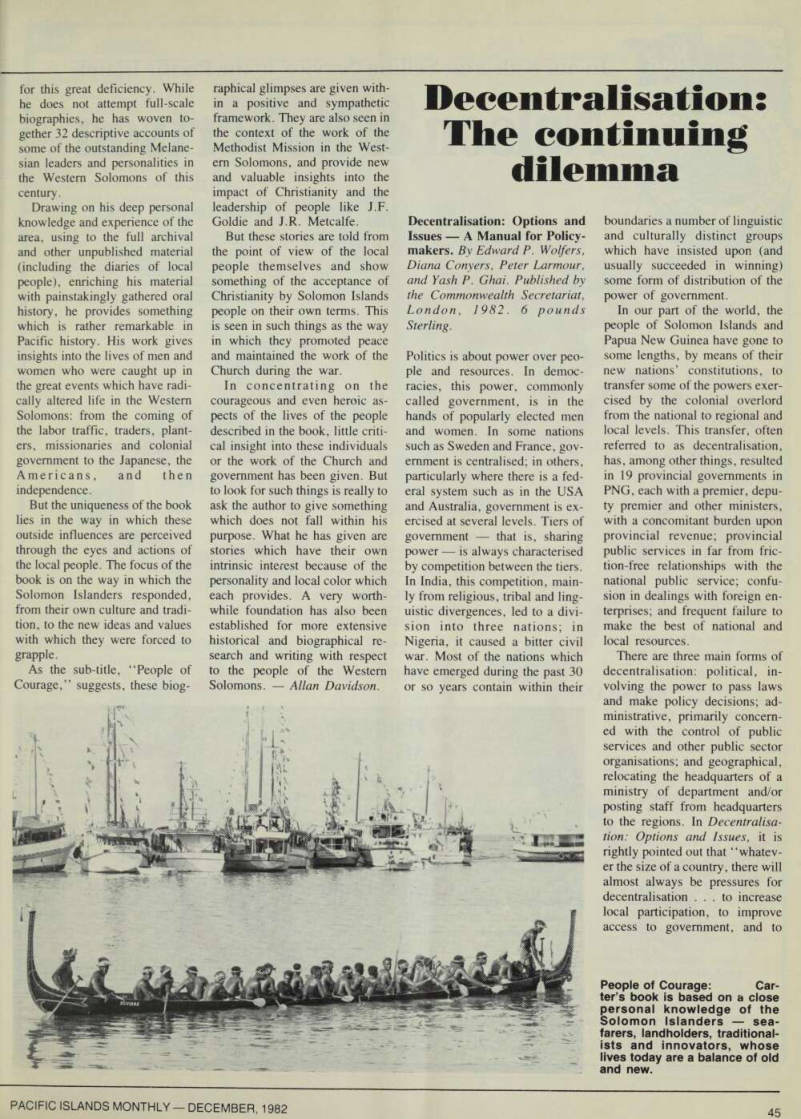
People of Courage: Car ter’s book is based on a close personal knowledge of the Solomon Islanders sea farers, landholders, traditional ists and innovators, whose lives today are a balance of old and new.