Concluding the
pp. 41-43 · Read in the full issue

Books
Concluding the story of German New Guinea
German New Guinea: The Draft Annual Report for 1913- 14. Edited and translated by Pe ter Sack and Dymphna Clark.
Published by the Department of Law Research, School of Social Sciences, Australian National University, Canberra, 1980. PP
Vi, 170. Isbn 909596 45 X.
$A5.95.
This book presents the final re port on the German administra tion of her German New Guinea (Melanesian) colonies for fiscal year 1914 (1 April 1913-31 March 1914).
The various reports translated here were not polished and re vised for final publication, but they still read as easily as the rest of the reports presented in the authors’ previous book, German New Guinea: The Annual Re ports (reviewed in PIM, Sep ’Bl, p 53).
Following the translators’ in
troduction, there are a general report, seven reports prepared by district officers in the seven ad ministrative centres (Kaewieng, Namatanai, Manus, Kieta, Fried rich Wilhelmshafen, Eitape and Morobe), five reports prepared by the five mission societies ac tive there (Methodist, Marist, Rhenish, Divine Word, and Neuendettelsau), and, finally, seven special reports and sets of statistics (the most notable being the report on the two government schools in Rabaul).
The translators’ main hope is to have readers “appreciate vari ous ‘games’ which went on at various levels as the result of various tensions” between dis trict or mission officials and the headquarters staffs (introduction, vi). But this is in fact only brought out in marginal com ments added in this edition as a handful of footnotes to district and mission reports. More inter esting are the details of colonial
and mission activity in the field, and the general patterns of Ger man colonial behaviour into which they fit.
It is clear from the general and district office reports that Morobe and Friedrich Wilhelmshafen were centres for the spread of colonial rule inland to encompass hill tribes, which required a good deal of pacifica tion at first because of inter-tribal feuding brought on by guides serving German officials. We see Rabaul growing up in a period of rather rapid urban development, and we watch as Australians flock into the German Solomon Islands to take advantage of the freehold land tenure permitted by the Germans, as well as of the labor and the favorable commer cial laws.
Medical tultul, where they could be found, were appointed to lead the way to improved public health and personal hygiene.
Gold was being sought in the Friedrich Wilhelmshafen and Morobe districts, although labor recruiting had seriously depleted the numbers of coastal young men in Morobe district.
The missions were all increas ing their staffs and calling for official actions to assist their
efforts. The Methodists had Sa moans and Fijians working for them, and ran over 200 Sunday schools. The mission was pleased with its progress along the Rai coast but wanted the government to ban “unregulated relationships’’ among the islan ders so as to stabilise marriages.
The greatest mission efforts were those of the Neuendettelsau mis sion, which had arrived in New Guinea in 1886 at the start of German administration. It was based in Finschhafen, where it grew copra (50 tonnes in calen dar 1913). It also ran a sawmill near Butaueng, and was building a medical centre at Butaueng to treat serious illnesses under the
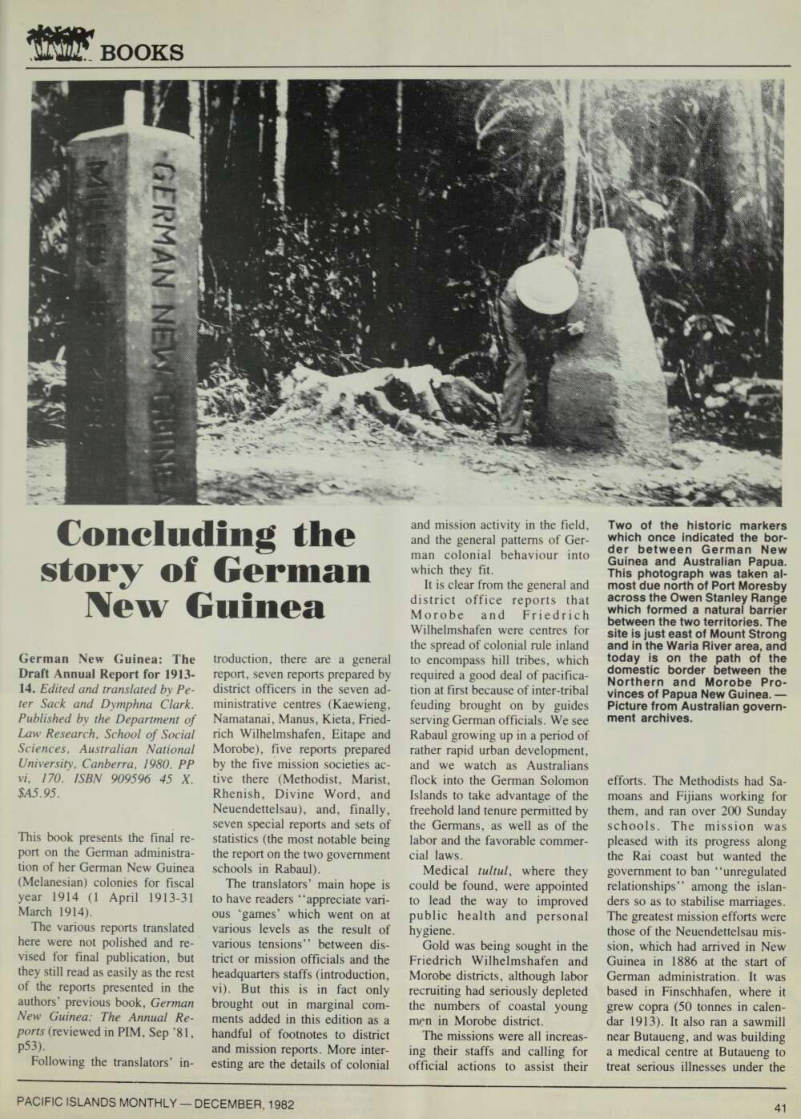
Two of the historic markers which once indicated the bor der between German New Guinea and Australian Papua.
This photograph was taken al most due north of Port Moresby across the Owen Stanley Range which formed a natural barrier between the two territories. The site is just east of Mount Strong and in the Waria River area, and today is on the path of the domestic border between the Northern and Morobe Pro vinces of Papua New Guinea.
Picture from Australian govern ment archives.
direction of Stressel. It ran 34 schools and called on the govern ment to restrict labor recruitment of teenagers to allow them to complete their educations and undergo confirmation. In what hindsight would call an unrealist
ic, possibly xenophobic, mo
ment, the mission urged the ad ministration to suppress the spread of Pidgin English so as to foster the spread of German.
On the practical level, there were two government schools in Rabaul, one for Europeans (which had only 13 students in fiscal 1914) and one for islan ders, which had 120 pupils (37 from Friedrich Wilhelmshafen, 26 from New Britain, 22 from elsewhere in German New Guinea, 15 from the Admiralties, 10 from New Ireland, six from the Solomons, and four others).
For some reason, all 12 pupils from Morobe spent long spells in the hospital. Students were given vocational training in book
binding, carpentry, joinery, met
al work and printing, although Barschdorff, the schoolmaster, considered the main function of the school to be a full six-year German language program for islanders.
Through all these details run the recurrent themes of increas
ing commercial emphasis (aided
by the explorations of trained
specialists), extensive public
works in district centres, com pulsory labor for those public works, and a keen awareness of the racial composition of the loc al populations all of which
factors played a corresponding role throughout the German colo nial empire before World War I.
The editors have done a ser vice in presenting all the annual reports in English and have ren dered the German into English with only occasional syntactical irregularities. Continuing the policy of their previous volume, despite ample space in which to overcome it, the editors have omitted about a dozen parag raphs dealing with German Mic ronesia (Nauru, the Marshalls, Carolines and Marianas, except the American-held Guam). This is regrettable since information on these islands, referred to as the Island Territory (Inselgebiet) in this book, is virtually non existent in such usually reliable sources as the Deutsches Kolonialblatt, an official organ and the Deutsche Kolonial zeitung, organ of the Deutsche Kolonialgesellschaft. Further more, there is other information on these islands left in the trans lation. It is hoped the editors will feel an urge to completeness and provide a translation of these and similar passages from the earlier annual reports.
This Draft Annual Report for 1913-14, though the last of the series of annual reports, would make a good introduction to this field of history, to be kept on hand as readers go through the first volume and chart the succes ses and failures of German colo nial achievement in Melanesia
before August 1914.
M. L.
Berg.
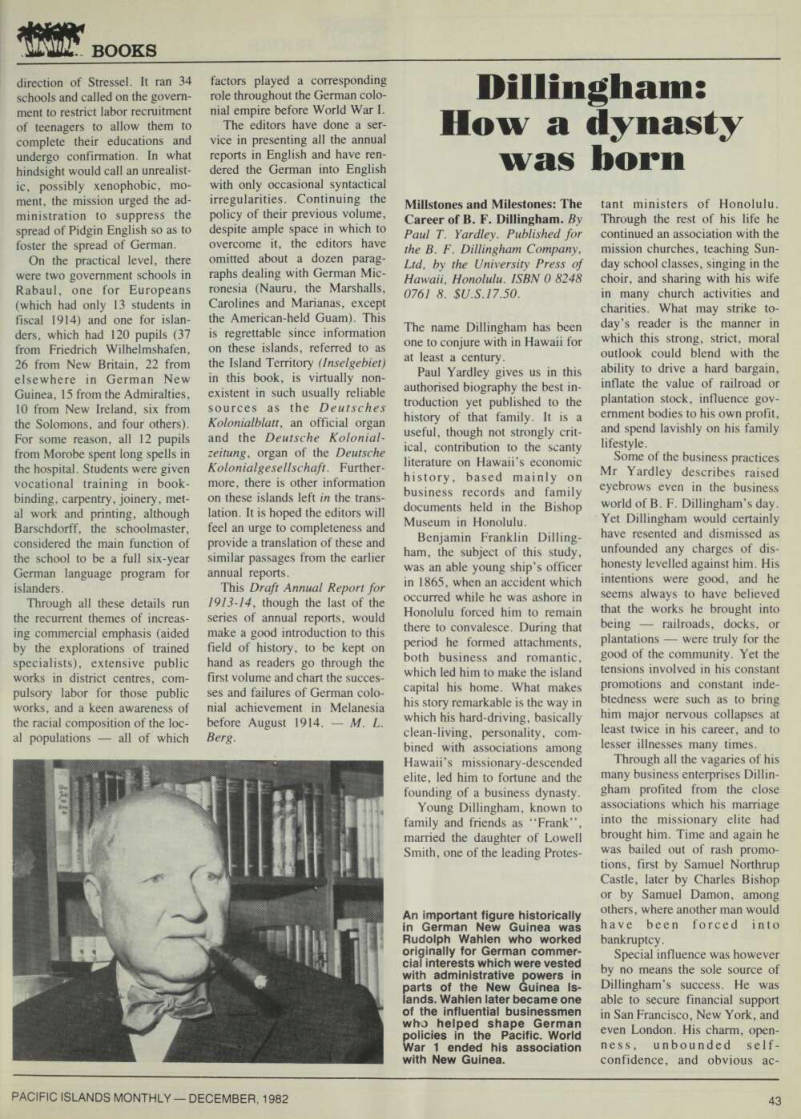
An important figure historically in German New Guinea was Rudolph Wahlen who worked originally for German commer cial interests which were vested with administrative powers in parts of the New Guinea Is lands. Wahlen later became one of the influential businessmen who helped shape German policies in the Pacific. World War 1 ended his association with New Guinea.