CHOGRM decisions
p. 25 · Read in the full issue
The formal agenda at the Suva CHOGRM was split into three main headings: World and regional political trends, interna tional economic issues, and regional functional and economic co-operation.
Much of the discussion had a specific Pacific orientation, and Islands leaders secured prominent inclusion in the final communique which made reference to decolonisation, nuc lear weapons testing, a zone free of nuclear weapons and the Law of the Sea Convention.
The communique which was put out by the leaders at the end of the talks was remarkable for what it didn’t touch on, rather than for its stated contents. Hidden among many of the international issues were matters which perhaps most worry the Forum states.
Major items touched on by the communique were the Middle East situation, international disarmament, South Afri ca, Namibia, Kampuchea, Afghanistan, great power rivalries, trade barriers, and the world economy in general.
One of the clauses from the communique was “Heads of Government agreed that the South Pacific was an area of great economic and strategic importance, and they endorsed the concern expressed for the security of the area.
“They agreed that an intrusion of great power rivalry in the South Pacific would introduce a new and undesirable ele ment of instability.”
The communique also stated that all peoples of the South Pacific were entitled to independence, and it welcomed reforms being introduced in New Caledonia by France. The communique said it was hoped these reforms would “assist the Kanaks of New Caledonia in their efforts towards a smooth and speedy transition to independence”.
The communique condemned French nuclear tests in the Pacific, and called on all countries in the zone not to store or dump nuclear wastes.
The communique also contained an effective reprimand for the United States over failure to sign the Law of the Sea Convention. The communique said the convention was of special significance to the countries of the region, and the U.S. attitude was deeply deplored. It was felt that the convention was worthless unless all countries supported it, and the communique urged all countries to give their signed support and to proceed without delay to the ratification process.
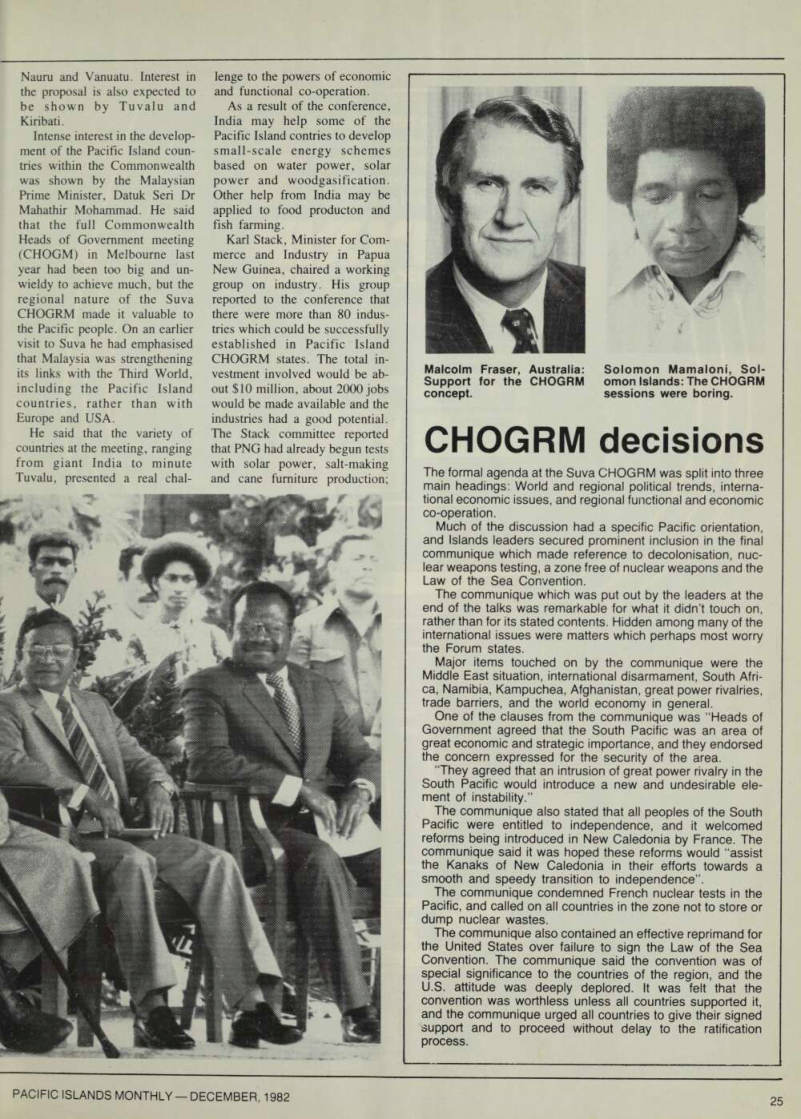
Solomon Mamaloni, Sol omon Islands: The CHOGRM sessions were borin`g.
Malcolm Fraser, Australia; Support for the CHOGRM concept.