from regional Commonwealth
pp. 24-27 · Read in the full issue
Political Currents
Special deal for Island members from regional Commonwealth
Heads of government from Commonwealth countries in the Pacific and Indian Oceans held their regional confer ence (CHOGRM) in Fiji in October. ROBERT KEITH REID writes from Suva that some differences of opinion were apparent about the value of the talks. But he adds there was no doubt that general agreement existed to give special recognition to the Pacific Island countries of the Commonwealth.
This year’s Commonwealth Heads of Government Regional Meeting (CHOGRM) was held in Fiji where the New Zealand Prime Minister, Robert Mul doon, questioned the value of the occasion. CHOGRM cost an es timated $BOO,OOO and Mr Mul doon wasted no time in making an assessment of value for money. “There’s just not enough to talk about’’ he huffed, al though for his own part he appa rently found plenty to talk about
mainly concerning the worse
ning world economy and how the trend could be reversed.
Solomon Mamaloni, Prime Minister of Solomon Islands, al so projected a dim view of the
proceedings. They were boring,
he said, and were not likely to produce anything of value. But despite these attitudes Australia and some of the Asian nations expressed confidence in the role of CHOGRM and attached im portance to what was discussed.
A big part of CHOGRM’s time was spent on matters con cerning the Island countries of the Pacific. The outcome could mean a broadening range of be nefits for the Island countries involved in the talks. In particu lar this could mean closer rela tionships and more fruitful deal ings between Commonwealth Pacific Island countries on the one hand and Commonwealth Southeast Asia countries on the other.
The meeting ended with a pro mise of $1.5 million from Aust ralia and $50,000 from Fiji to establish a fund which will aid research into energy, trade, ag riculture and industry in the Is land countries. Following a deci sion at the Suva CHOGRM, the
Commonwealth Secretary-
General Shridath Ramphal will co-opt an advisory committee to examine the resources in the 200mile economic zones being de clared off the shores of many of the countries. There are 17 coun tries in the CHOGRM group, and
the move will be to assist their utilisation of the fisheries, miner als and other resources in the economic zones.
The Australian Prime Minis ter, Malcolm Fraser, said that Australia strongly supported the CHOGRM concept because of the major role that the Island countries had to play. This was in the overall interest of the entire region, he said. Mr Fraser was speaking at the opening ceremony in the grounds of Gov ernment House where the visit ing leaders were welcomed by Fijian chiefs and traditional ceremony.
The Fijian government al located $425,000 for the confer ence and received a further $300,000 from Australia in spe cial aid. The government took over two adjoining hotels for the occasion, and sealed them off from the city. They were the Travelodge where the delegates stayed, and the Grand Pacific
where the conference was held.
Security was boosted by a special adviser from the Victoria Police in Melbourne and by an Aust ralian anti-bomb squad.
At a concluding press confer
ence the Fiji Prime Minister, Ratu Sir Kamisese Mara, said the conference had been valuable be cause of the new links which it had established between the Pacific Island leaders and their Asian counterparts. It had also put into motion planning for the development of energy schemes, agriculture, trade and industry.
Australia confirmed an earlier offer to finance the establishment of a small nations joint diplomat ic mission in New York so that small countries could afford to be represented at United Nations meetings. Among Pacific Island countries the offer was accepted in principle by Solomon Islands,
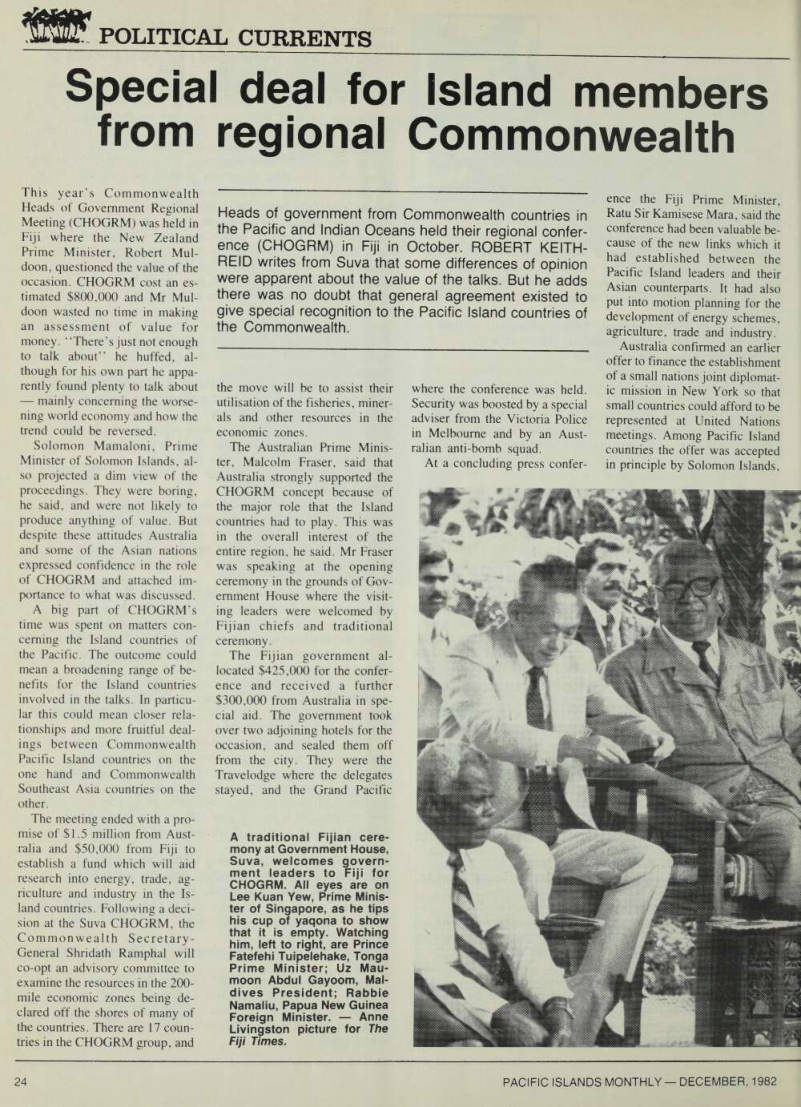
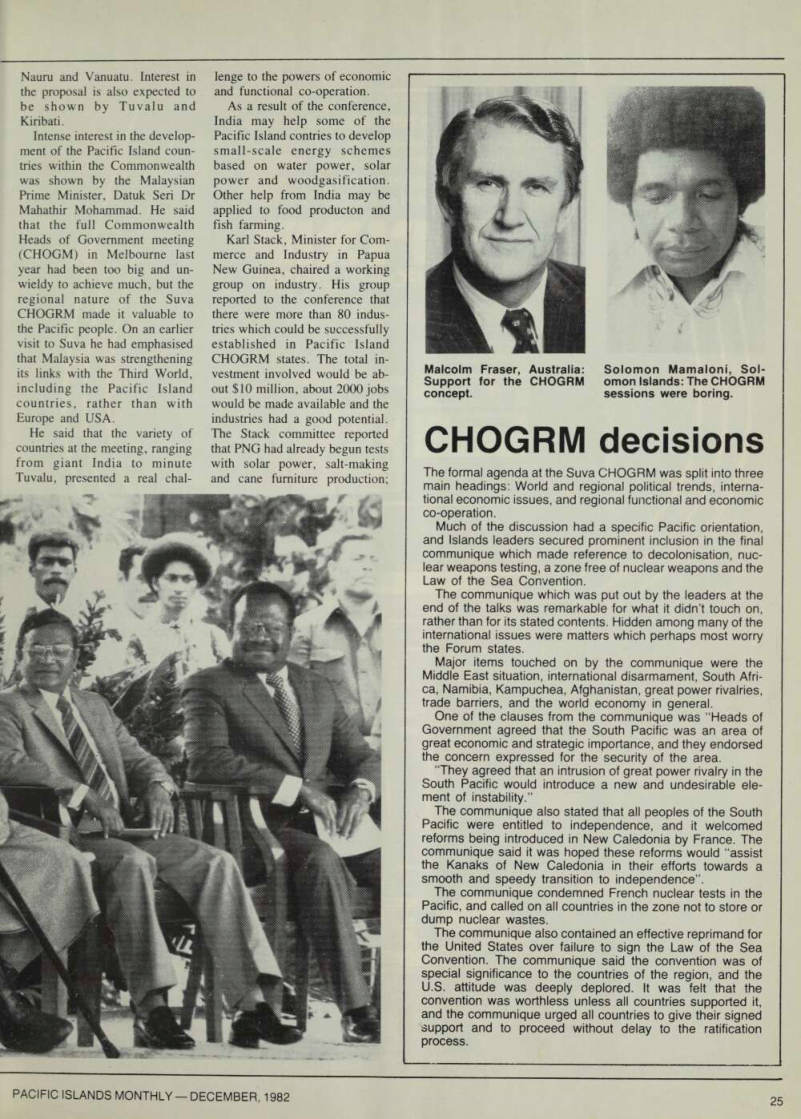
A traditional Fijian cere mony at Government House, Suva, welcomes govern ment leaders to Fiji for CHOGRM. All eyes are on Lee Kuan Yew, Prime Minis ter of Singapore, as he tips his cup of yaqona to show that it is empty. Watching him, left to right, are Prince Fatefehi Tuipelehake, Tonga Prime Minister; Uz Mau moon Abdul Gayoom, Mal dives President; Rabbie Namaliu, Papua New Guinea Foreign Minister. Anne Livingston picture for The Fiji Times.
Nauru and Vanuatu. Interest in the proposal is also expected to be shown by Tuvalu and Kiribati.
Intense interest in the develop ment of the Pacific Island coun tries within the Commonwealth was shown by the Malaysian Prime Minister, Datuk Seri Dr Mahathir Mohammad. He said that the full Commonwealth Heads of Government meeting (CHOGM) in Melbourne last year had been too big and un wieldy to achieve much, but the regional nature of the Suva CHOGRM made it valuable to the Pacific people. On an earlier visit to Suva he had emphasised that Malaysia was strengthening its links with the Third World, including the Pacific Island countries, rather than with Europe and USA.
He said that the variety of countries at the meeting, ranging from giant India to minute Tuvalu, presented a real chal
lenge to the powers of economic and functional co-operation.
As a result of the conference, India may help some of the Pacific Island contries to develop small-scale energy schemes based on water power, solar power and woodgasification.
Other help from India may be applied to food producton and
fish farming.
Karl Stack, Minister for Com merce and Industry in Papua New Guinea, chaired a working group on industry. His group reported to the conference that there were more than 80 indus tries which could be successfully established in Pacific Island CHOGRM states. The total in vestment involved would be ab out $lO million, about 2000 jobs would be made available and the industries had a good potential.
The Stack committee reported that PNG had already begun tests with solar power, salt-making and cane furniture production;
Vanuatu was considering open ing a tannery a sawmill and a coconut oil expressing mill, Kiribati was considering the pro duction of coconut oil, soap and excercise books, and the fabrica tion of sheet metal products; and Western Samoa was considering the establishment of a tannery.
Mr Stack said that one of the practical advantages in the new industrial movement was the op portunity for economic and technical co-operation between the developing countries of the region. They were reaching out together at a time when each could help the others, he said.
Under instructions from the conference, the Stack committee will continue with its inquiries and practical recommendations.
It may also consider schemes for publishing investment brochures on behalf of specific countries, for transfers of technology bet ween countries, for promoting standards of packaging and qual ity control, and co-operation with United Nations to promote investment in industry.
Eight prominent industrialists and bankers accompanied the Malaysian delegation at the talks, and they carried out a survey of Fiji’s potential for at tracting investment. The leader of the Malaysian commercial group, Mohammed Hashim Shamsudin, who is director of the Bank of Bhumpiputra, said that possibilities for a number of joint ventures had been found.
The Malaysian interests are ex amining proposals involving the production of ginger, melons, orchids, and palm oil, and also the possibilities of the hotel in dustry, agricultural estates and prawn and lobster culture.
The situation of the Soviet Union in relation to Pacific af fairs was raised by newsmen at the conference with some of the leaders. Earlier the Fiji Prime Minister, Ratu Sir Kamisese Ma ra, had claimed that there had been Soviet influences in the July general election in Fiji.
At a CHOGRM press confer ence the Australian Prime Minis ter, Malcolm Fraser, was asked if, in view of Ratu Mara’s claims, he considered the Soviet Union was a threat to Pacific security. Mr Fraser said it was
apparent there was “ner vousness” about what the Soviet Union might do. He said that some African countries had ac cepted Soviet aid, but because of the strings attached they had sub sequently wished they could re linquish the arrangement.
He said that most countries wanted aid without strings which was how Australia and New Zealand aid was given and he believed that this was a far more satisfactory arrangement.
Subsequently the Fiji Foreign Minister, Mosese Qionibaravi, told the local press that he be lieved the Soviet was “a real threat to the Pacific”. He be lieved the Soviet Union was anx ious to establish a Pacific base to match existing America involve ment. The effects of this thinking were a very real in the Pacific, he said.
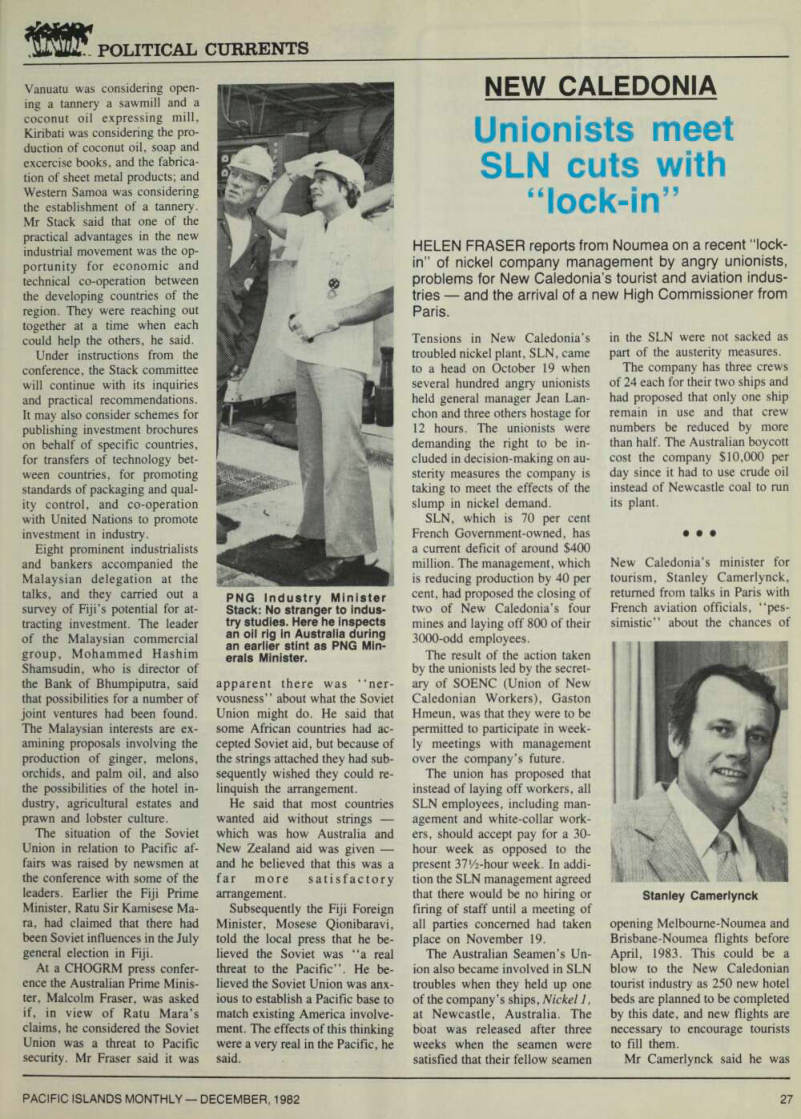
PNG Industry Minister Stack; No stranger to indus try studies. Here he inspects an oil rig in Australia during an earlier stint as PNG Min erals Minister.