Unionists meet
pp. 27-33 · Read in the full issue

New Caledonia
Unionists meet SLN cuts with “lock-in”
HELEN FRASER reports from Noumea on a recent “lock in” of nickel company management by angry unionists, problems for New Caledonia’s tourist and aviation indus tries and the arrival of a new High Commissioner from Paris.
Tensions in New Caledonia’s troubled nickel plant, SLN, came to a head on October 19 when several hundred angry unionists held general manager Jean Lan chon and three others hostage for 12 hours. The unionists were demanding the right to be in cluded in decision-making on au sterity measures the company is taking to meet the effects of the slump in nickel demand.
SLN, which is 70 per cent French Government-owned, has a current deficit of around $4OO million. The management, which is reducing production by 40 per cent, had proposed the closing of two of New Caledonia’s four mines and laying off 800 of their 3000-odd employees.
The result of the action taken by the unionists led by the secret ary of SOENC (Union of New Caledonian Workers), Gaston Hmeun, was that they were to be permitted to participate in week ly meetings with management over the company’s future.
The union has proposed that instead of laying off workers, all SLN employees, including man agement and white-collar work ers, should accept pay for a 30hour week as opposed to the present 37'/2-hour week. In addi tion the SLN management agreed that there would be no hiring or firing of staff until a meeting of all parties concerned had taken place on November 19, The Australian Seamen’s Un ion also became involved in SLN troubles when they held up one of the company’s ships, Nickel 1, at Newcastle, Australia. The boat was released after three weeks when the seamen were satisfied that their fellow seamen
in the SLN were not sacked as part of the austerity measures.
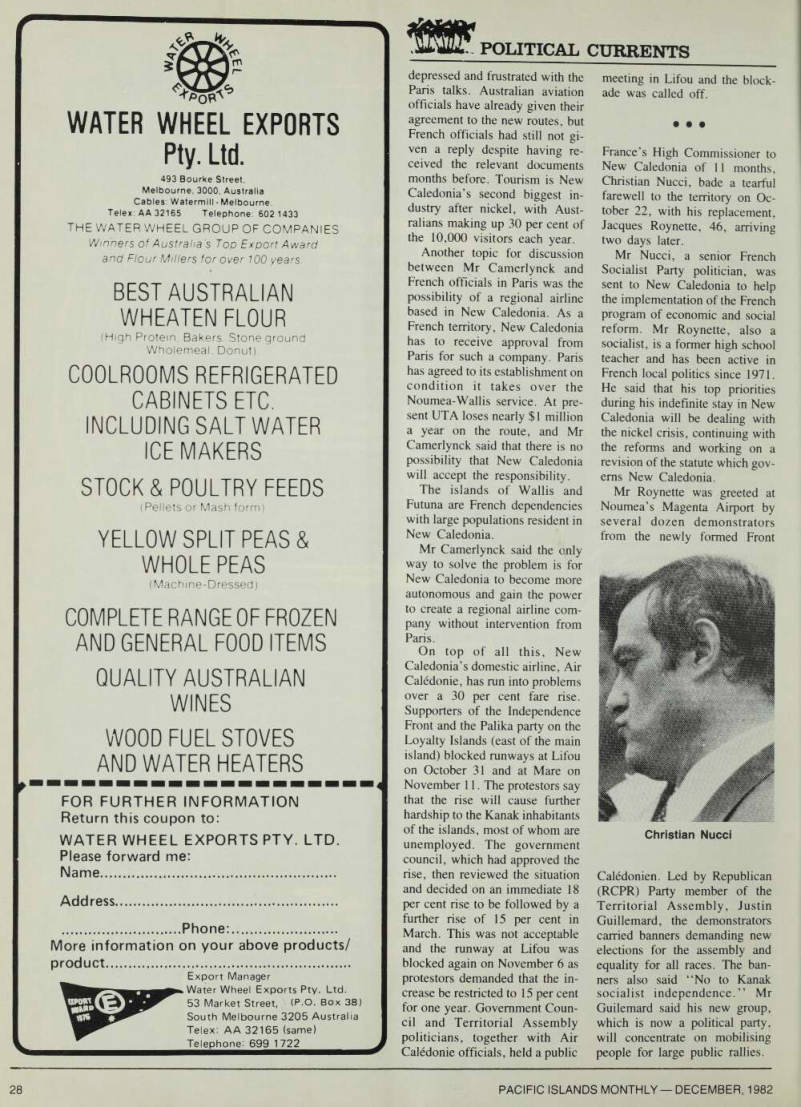
The company has three crews of 24 each for their two ships and had proposed that only one ship remain in use and that crew numbers be reduced by more than half. The Australian boycott cost the company $lO,OOO per day since it had to use crude oil instead of Newcastle coal to run its plant. • • • New Caledonia’s minister for tourism, Stanley Camerlynck, returned from talks in Paris with French aviation officials, “pes simistic” about the chances of
opening Melboume-Noumea and Brisbane-Noumea flights before April, 1983. This could be a blow to the New Caledonian tourist industry as 250 new hotel beds are planned to be completed by this date, and new flights are necessary to encourage tourists to fill them.
Mr Camerlynck said he was
Stanley Camerlynck
depressed and frustrated with the Paris talks. Australian aviation officials have already given their agreement to the new routes, but French officials had still not gi ven a reply despite having re ceived the relevant documents months before. Tourism is New Caledonia’s second biggest in dustry after nickel, with Aust ralians making up 30 per cent of the 10,000 visitors each year.
Another topic for discussion between Mr Camerlynck and French officials in Paris was the possibility of a regional airline based in New Caledonia. As a French territory, New Caledonia has to receive approval from Paris for such a company. Paris has agreed to its establishment on condition it takes over the Noumea-Wallis service. At pre sent UTA loses nearly $1 million a year on the route, and Mr Camerlynck said that there is no possibility that New Caledonia will accept the responsibility.
The islands of Wallis and Futuna are French dependencies with large populations resident in New Caledonia.
Mr Camerlynck said the only way to solve the problem is for New Caledonia to become more autonomous and gain the power to create a regional airline com pany without intervention from Paris.
On top of all this, New Caledonia’s domestic airline, Air Caledonie, has run into problems over a 30 per cent fare rise.
Supporters of the Independence Front and the Palika party on the Loyalty Islands (east of the main island) blocked runways at Lifou on October 31 and at Mare on November 11. The protestors say that the rise will cause further hardship to the Kanak inhabitants of the islands, most of whom are unemployed. The government council, which had approved the rise, then reviewed the situation and decided on an immediate 18 per cent rise to be followed by a further rise of 15 per cent in March. This was not acceptable and the runway at Lifou was blocked again on November 6 as protestors demanded that the in crease be restricted to 15 per cent for one year. Government Coun cil and Territorial Assembly politicians, together with Air Caledonie officials, held a public
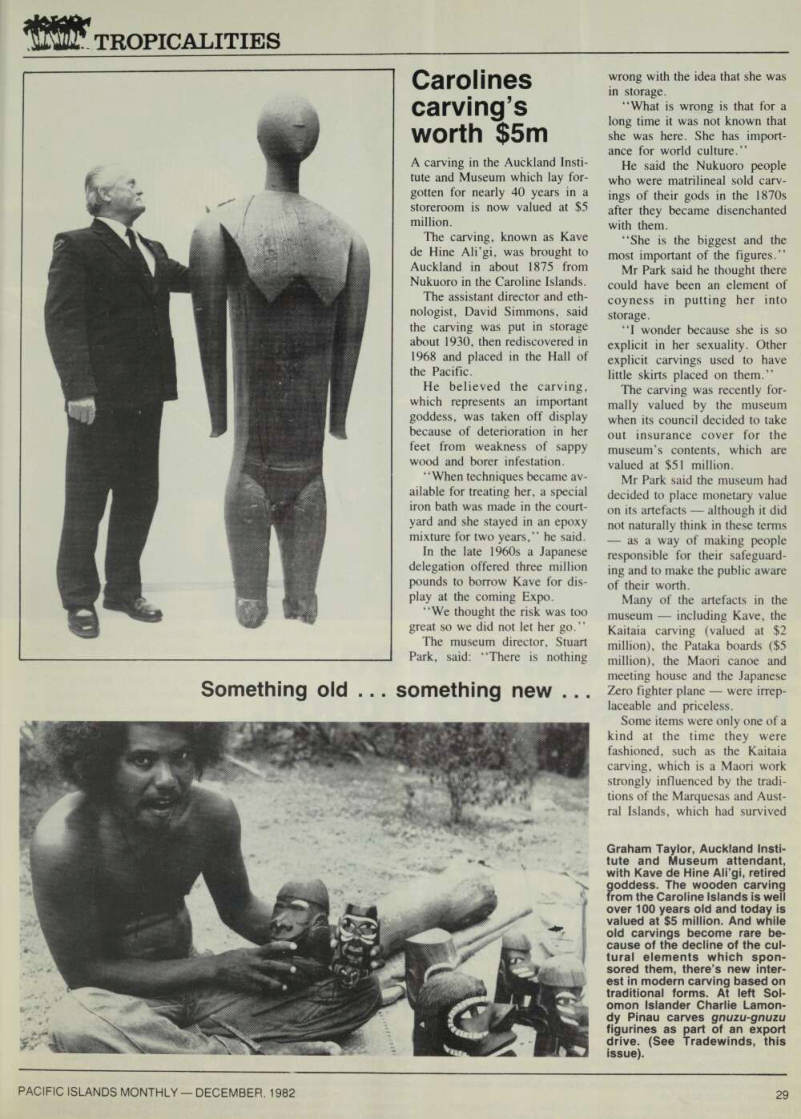
meeting in Lifou and the block ade was called off. • • • France’s High Commissioner to New Caledonia of 11 months, Christian Nucci, bade a tearful farewell to the territory on Oc tober 22, with his replacement, Jacques Roynette, 46, arriving two days later.
Mr Nucci, a senior French Socialist Party politician, was sent to New Caledonia to help the implementation of the French program of economic and social reform. Mr Roynette, also a socialist, is a former high school teacher and has been active in French local politics since 1971.
He said that his top priorities during his indefinite stay in New Caledonia will be dealing with the nickel crisis, continuing with the reforms and working on a revision of the statute which gov erns New Caledonia.
Mr Roynette was greeted at Noumea’s Magenta Airport by several dozen demonstrators from the newly formed Front
Caledonien. Led by Republican
(RCPR) Party member of the Territorial Assembly, Justin Guillemard, the demonstrators carried banners demanding new elections for the assembly and equality for all races. The ban ners also said “No to Kanak socialist independence.” Mr Guilemard said his new group, which is now a political party, will concentrate on mobilising people for large public rallies.
Christian Nucci
Something old ... something new ...
Carolines
carving’s
worth $5m
A carving in the Auckland Insti tute and Museum which lay for gotten for nearly 40 years in a storeroom is now valued at $5 million.
The carving, known as Kave de Hine Ali’gi, was brought to Auckland in about 1875 from Nukuoro in the Caroline Islands.
The assistant director and eth nologist, David Simmons, said the carving was put in storage about 1930, then rediscovered in 1968 and placed in the Hall of the Pacific.
He believed the carving, which represents an important goddess, was taken off display because of deterioration in her feet from weakness of sappy wood and borer infestation.
“When techniques became av ailable for treating her, a special iron bath was made in the court yard and she stayed in an epoxy mixture for two years,” he said.
In the late 1960s a Japanese delegation offered three million pounds to borrow Kave for dis play at the coming Expo.
“We thought the risk was too great so we did not let her go.”
The museum director, Stuart Park, said: “There is nothing
wrong with the idea that she was in storage.
“What is wrong is that for a long time it was not known that she was here. She has import ance for world culture.”
He said the Nukuoro people who were matrilineal sold carv ings of their gods in the 1870 s after they became disenchanted with them.
“She is the biggest and the most important of the figures.”
Mr Park said he thought there could have been an element of coyness in putting her into storage.
“I wonder because she is so explicit in her sexuality. Other explicit carvings used to have little skirts placed on them.”
The carving was recently for mally valued by the museum when its council decided to take out insurance cover for the museum’s contents, which are valued at $5l million.
Mr Park said the museum had decided to place monetary value on its artefacts although it did not naturally think in these terms as a way of making people responsible for their safeguard ing and to make the public aware of their worth.
Many of the artefacts in the museum including Kave, the Kaitaia carving (valued at $2 million), the Pataka boards ($5 million), the Maori canoe and meeting house and the Japanese Zero fighter plane were irrep laceable and priceless.
Some items were only one of a kind at the time they were fashioned, such as the Kaitaia carving, which is a Maori work strongly influenced by the tradi tions of the Marquesas and Aust ral Islands, which had survived
Graham Taylor, Auckland Insti tute and Museum attendant, with Kave de Mine Ali’gi, retired
goddess. The wooden carving
from the Caroline Islands is well over 100 years old and today is valued at $5 million. And while old carvings become rare be cause of the decline of the cul tural elements which spon sored them, there’s new inter est in modern carving based on traditional forms. At left Sol omon Islander Charlie Lamon dy Pinau carves gnuzu-gnuzu figurines as part of an export drive. (See Tradewinds, this issue).
intact while similar items had not, like the Zero.
Although it was ironic the museum should be required to place a monetary value on unique artefacts there was a need for a way of gauging the level of risk when collections went on loan.
Insurance was more valuable as a means of providing for re pair or restoration.
“People tend to think in monetary terms, but the value of these things is a cultural one scientific, historic and aesthet ic,” Mr Simmonds said.
“Since they are not for sale
they do not, strictly speaking,
have a monetary value unless someone pinches them. For that reason the museum has allocated an extra $20,000 this year to
upgrade security.” New Zea
land Herald.
TAFEA’s big
’B2 show
DAVID KOUKARI of Tanna, Vanuatu, reports on what is becoming one of the biggest events in the life of the island the annual TAFEA Agricul tural Show.
After weeks of rain, brilliant sunshine drew a large crowd to Lenakel, Tanna, in southern Vanuatu, for the 15th annual Agricultural Show of TAFEA the five southern islands of Tan na, Anatom, Futuna, Erroman go, and Aniwa. Among the spe cial guests were the Prime Minis ter, Father Walter Lini, and Mrs Lini, High Chief Willie Bong matur, the Australian High Com missioner and other dignitaries.
Each year since 1967 the TAFEA Show has been held in August, the month for harvest ing. The first show was or ganised by local British and French agricultural officers. It must be admitted that at the start it really meant nothing to TAFEA’s subsistence farmers.
The 1967 TAFEA Show was largely unnoticed. But the or ganisers persisted, and each year more and more farmers began to see its value. Gradually, increas ing numbers of subsistence far mers began to grow different kinds of vegetables and crops to sell, and began to pay more
attention to the quality of their livestock. Today, the Agricultur al Show is an important date in the people’s calendar. It is a time when proud farmers can display the fruits of their labor, and perhaps win the $3O first prize for the best English cabbage, or the best yam, onion or lettuce.
For the first time, the show this year was held over two days, a reflection of the attempts by man-TAFEA to make their new country economically independent.
More than ever, the islands’ farmers understand the need to produce good crops and veget ables, and to develop their land wisely. Now it is more than earn ing a living. Now it is a case of feeding ni-Vanuatu in places like Port-Vila, and of gaining export earnings for our young country.
The 1982 TAFEA Show was more, however, than just an ag ricultural show. There were im pressive displays of art and craft work from French-speaking and English-speaking schools. This was to show the people of TAFEA how the standard of edu cation in our islands has im proved, and to encourage people to send their children to school.
There were carvings from the islands’ skilled craftsmen, intri cately woven mats and baskets,
shell jewellery and traditional and modem dresses. There was a traditional custom dance and a
modem string-band competition.
And there were floats, encourag ing both the old and the young to pay more attention to their own culture and environment, en couraging the people of TAFEA to use their own skills to help develop their country.
If the first day of the show was a contest between yams and cab bages, the second was a contest
between politicians.
The day began on a festive note, with the string-band com petition and a female tug-of-war.
Then, at mid-moming, a proces sion of cars and trucks carrying excited Vanuaaku Pati supporters
wound its way through the show crowds. On the first truck was a smiling Barak Sope, secretary general of the Vanuaaku Pati, fresh from his by-election win in Vila the day before.
From the back of an open truck in the centre of the show grounds, speaker after speaker used a noisy, and at times cran ky, loudspeaker to turn the show into a political rally for the Tanna by-election which was only a week away.
Barak Sope was repeatedly in terrupted by applause as he out lined the achievements of the Vanuaaku Pati Government. His reference to new development projects for Tanna, and more access to the New Zealand mar ket, drew a warm response. But it was his statement that the government would honor its 1979 election promise to provide a system of free education before the end of 1983 that gained the warmest applause.
Only metres away, a hastily organised opposition rally com peted with loudspeakers for the crowd’s attention. Tempers flared as speakers tried to oublast their opponents and the “Moder ate” candidate shouted that the Vanuaaku Pati had turned the Agricultural Show into a political sideshow.
Given the reasons for the by election (the fatal shooting in June 1980 of an opposition M.P.) the confrontation might have become serious. But the parting gesture of the candidates, as they shook hands, displayed the underlying co-operative spirit of the TAPE A Show.
The TAFEA Agricultural show is each year attracting more tourists, not least because it is held on an island which boasts the famous “Yasur” Volcano, wild horses, white beaches, blue sea and brilliant sunshine. Come and see for yourself. I think you will have more pleasure on TAFEA island than on any other island in the Pacific. David Koukari.
Not spooky, just
a heart attack ...
The head of Suva’s Colonial War Memorial Hospital, Dr Ken Lai, has quashed speculation that a
The Papua New Guinea bird of paradise has been given yet another role. This time it is on a newly-designed beer label in connection with an export drive to sell beer brewed in Port Moresby to a number of Pacific countries. South Pacific Brew ery has already launched the beer in Hawaii, and more re cently in Australia. A bird of paradise emblem was used for many years on a brand of to bacco sold in PNG, the bird appears on the PNG flag and national emblem, and it is also the emblem of the PNG national airline, Air Niugini.
man who died while taking part in a spear dance for the Queen at Bau island late in October was a sacrifice (madrali) for the recent resiting of the chiefly burial ground on the island.
He said the post-mortem on the man clearly showed that he died of a heart attack and not of any supernatural cause, as rumored.
The dead man, Livai Dcarokodo, a farmer of Navatu in Cakaudrove, collapsed while performing the dance for the Queen on October 31.
He was rushed by helicopter to Bau landing and taken from there to the hospital in an ambulance but was dead on arrival.
“Spear dancing is a strenuous exercise and at the age of 62, taking part in such activity could be dangerous,” Dr Lai said.
Remains of old Bau chiefs were moved to a new burial place when renovations were made be cause of the Queen’s visit and a subsequent meeting of the Great Council of Chiefs.
Towards the ’B4
arts festival
The Council of Pacific Arts meeting, held at South Pacific Commission headquarters, Noumea, from September 15 to 17, was officially opened by the vice-president of the Governing Council of New Caledonia, M Jean-Marie Tjibaou. M Rock Wamytan of New Caledonia chaired the meeting, and the Ver erable Archdeacon Kingi Ihaka of New Zealand was vice chairman.
First item on the agenda was the proposed draft constitution for the council. There were no changes effected to the status of the council, although the basic draft constitution, together with appropriate comments, will be circulated to member countries by the SPC Secretariat. The mat ter will be discussed further at the next meeting of the council.
For all future festivals, the host country will be responsible for producing an anthem for that particular festival. In the case of the 1984 festival the organising committee will consider anthems submitted by Fiji, French Poly nesia, Marshall Islands, Palau
and Papua New Guinea, along with any anthem which they may produce themselves. The host country, New Caledonia, will also decide who is to produce the official film of the 1984 Festival.
After the report by the organis ing committee of the Fourth Fes tival of Pacific Arts had been discussed and highly commend ed, proposals for the organisation of the festival were examined by the meeting. The suggested sub title of the Fourth Festival was altered from “Pacific My New Home” to “Our Pacific Home,” and six areas for discussion pro posed by the committee were outlined: (1) The festival is focused on the cultures of the natives of this region. (2) The festival fits in with to day’s reality and therefore we must examine the cultural prob lems we are faced with in our society today. (3) New data. (4) The dominating place of our knowledge and traditional values. (5) The heart of the festival; our artistic tradition. (6) The theme of the festival, “Pacific 2000.”
The council considered a re quest from the South Pacific Peo ple’s Foundation of Canada (SPPFC), for the Vancouver and Charlotte Islands’ Indians to par ticipate in the Fourth Festival.
After lengthy discussion, the re quest was turned down and it was agreed that participation in the festival would be restricted to member countries of the council only.
The Council of Pacific Arts will not meet in 1983 unless the organising committee feels that a meeting is necessary for the or ganisation of the Fourth Festival.
The Fourth Festival of Pacific Arts is scheduled to be held in New Caledonia in 1984.
230,000 in maths
competition
Anne Kreag, a young American student at the Tonga High School, was among the 18 Wales medallists who gained top marks in the 1982 Australian Mathematics Competition.
Apart from one New Zealan
der, the rest of the medals went to Australian students.
The competition, which is sponsored by the Canberra Col lege of Advanced Education, the Bank of New South Wales and the Canberra Mathematical As sociation, attracted 230,000 en tries from more than 2100 secon dary schools in Australia, New Zealand, Papua New Guinea and the Pacific region.
Of other prizes to non- Australians, awarded in junior, intermediate and senior divi sions, New Zealand won a total of 46, Fiji 19, French Polynesia 13, Papua New Guinea nine, Western Samoa seven, Tonga five, Vanuatu two, and Solomon Islands, New Caledonia, Kiribati and Tokelau one each.
40th anniversary
of Guinea Gold
November 19, 1982, marked the 40th anniversary of the founding of Guinea Gold, the Allied fight ing man’s newspaper in the Southwest Pacific in World War 11.
Writing in the Australian newspaper The Weekend Aust ralian on the occasion, the last editor of Guinea Gold, Horace Chisholm, recalled the problems and satisfactions of working on the four-page paper.
Produced in Australian and American editions, Guinea Gold, when it ceased appearing on June 30, 1946, had a record of 1320 days of unbroken publication.
Mr Chisholm describes the origins of the paper in the mind of Melbourne Herald war corres pondent R. B. Leonard, who was “appalled at the news starvation of the troops in the southwest Pacific all they could depend on were a few radio sets.”
Mr Leonard put his idea for a newspaper to General Sir Thomas Blarney of the Aust ralian army, who replied: “If you think it can be done, you had better do it yourself.”
But Blarney immediately elevated Leonard to the rank of major, solely responsible to him, and gave the new-born paper tiansport priority after ammuni tion but equal with rations. He also named the paper Guinea
Gold, a polite echo of the term “GG”, or “Good Guts’’, a slang expression for “the truth’’, or “accurate information’’ among the troops.
Chisholm ends his account of the three-and-half-year life of Guinea Gold with these words: “At its peak it had been read by 800,000 men: by Australians, Americans and New Zealanders.
It had been read by white men, black men, brown men, red men and yellow men.
“Sir Thomas Blarney had been asked for a final message. It began; The ending of the career of Guinea Gold is, to me, some thing like the passing out of a very favorite pet’.’’
ESCAP acts on
pesticide perils
The United Nations’ Economic and Social Commission for Asia and the Pacific has announced that a special training program is being organised for the South Pacific region in relation to the safe handling and efficient use of agro-pesticides.
An initial planning workshop was held in Fiji from 31 May-11 June, 1982, in which a training program was developed and prospective instructors trained who in turn will train various kinds of end-users in safety as pects of these potentially hazard ous yet indispensible chemicals.
S.A.N.S. Kibria, Executive Sec retary of ESCAP: Fisheries, pest control, agriculture and energy are getting special at tention he has told member countries.