from politics and business
pp. 17-67 · Read in the full issue
22Nd South Pacific Conference
Pago hosts a meeting of “heavies” from politics and business
The opening of the 22nd South Pacific Conference in Pago Pago on October 23 was almost like old times. Established names from the golden years of the South Pacific Commission Ratu Sir Kamisese Mara, Ham mer Deßoburt and Robert Rex
were again present. Tonga’s
King Taufa’ahau Tupou IV and Western Samoa’s Head of State Malietoa Tanumafili made spe cial appearances to add further lustre to the occasion. And for mer Secretaries-General Fred Betham and Macu Salato were in attendance to reaffirm the con tinuity of the SPC. It was all an impressive display of confidence in the SPC. Or was it?
There are other explanations that could be offered. The illus
trious turnout might have been the “21st” celebrations which the conference did not have last year. It may have been just an act of respect for an ageing institu tion. It is even possible that the opening had nothing to do with the SPC directly but was wholly a gesture of goodwill towards host American Samoa’s Gover nor, Peter Tali Coleman.
Whatever their intentions in attending (and informal conver sation during the conference sug gested that the show of support was not accidental), the momen tum created by the large number of regional leaders continued into the work of the conference pro per. By conference end, the vote of confidence in the SPC was unmistakable.
Indeed, concrete evidence of support for the conference was clear even before the opening gavel. While many of the senior leaders left shortly after the offi cial opening, a number remained for the working sessions. These included Sir Thomas Davis, Robert Rex and New Zealand’s Deputy PM Duncan Maclntyre.
In all, approximately two-thirds of the 25 delegations present were headed by leaders of
ministerial rank or above. More overt expressions of support were not long in coming.
Lord Belstead, leading the British delegation, asked for the floor within the first hour to make a special statement. His remarks included references to the value of the SPC as a vehicle for regional co-operation, to the importance of regionalism to the UK, and to the usefulness of the SPC in providing his government
with access to the region. The theme of the SPC’s contribution to regional co-operation was sec onded from the small islands perspective immediately after wards by Prime Minister Davis of the Cooks.
The issue of the role of the SPC, if any, in South Pacific regionalism has overhung the or ganisation like the sword of Damocles for a full decade now.
The pendulum, however, ap-
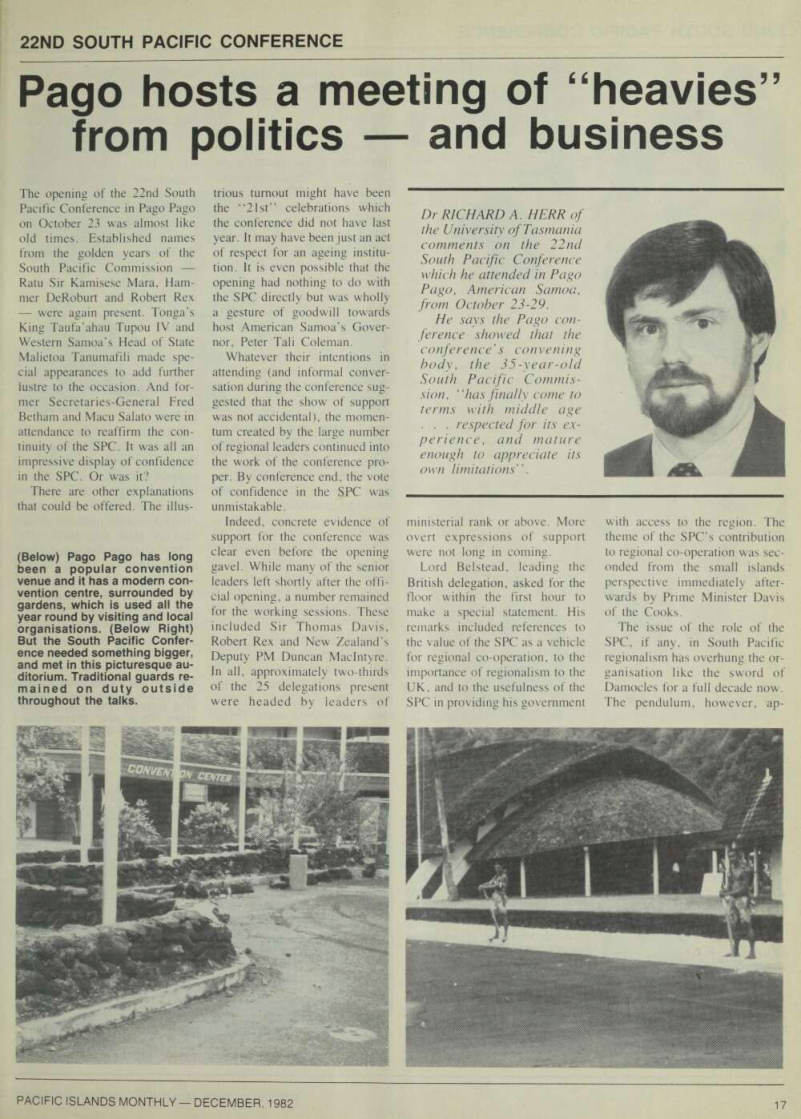
(Below) Pago Pago has long been a popular convention venue and it has a modern con vention centre, surrounded by gardens, which is used all the year round by visiting and local organisations. (Below Right) But the South Pacific Confer ence needed something bigger, and met in this picturesque au ditorium. Traditional guards re mained on duty outside throughout the talks.
Dr Richard A. Herr Of
the University of Tasmania comments on the 22nd South Pacific Conference which he attended in Pago Pago, American Samoa, from October 23-29.
He says the Pago con ference showed that the conference’s convening body, the 35-year-old South Pacific Commis sion, "has finally come to terms with middle age . . . respected for its ex perience, and mature enough to appreciate its own limitations".
peared to be swinging back in the SPC’s favor at Pago Pago. The dogged pursuit of a “single reg ional organisation” (SRO) by Paulias Matane, Papua New Guinea’s secretary for foreign affairs and trade, attracted little enthusiasm. Even the Solomons and Vanuatu appeared willing to accept the Rotorua Forum’s deci sion in August this year that the time was not yet right to attempt to secure a merger of the SPC and the Forum’s secretariat, the South Pacific Bureau for Economic Co-operation (SPEC).
A major reason for the declin ing support for an SRO stems from the failure of a series of inquiries to produce evidence of substantial duplication between the SPC and SPEC. This could
be seen in the rejection of calls for further inquiries into the question of duplication. Most ag reed with the new Secretary- General, Francis Bugotu, when he said the facts were available and new studies would not add to resolving the issue of an SPC SPEC merger.
Nevertheless, Bugotu’s pro posal to conduct an in-house re view of what the SPC might do unilaterally to ensure the avoi dance of costly duplication struck a responsive chord among the delegates. The review is not
another fact-finding expedition but rather a practical attempt to address the long-running complaint.
Politically, the proposal by the secretary-general was timed to perfection. It was raised in the Committee of Representatives of
Participating Governments
which immediately preceded the conference. The unexpected in itiative had the effect of under cutting some of the objections of the Solomons and Vanuatu. Thus PNG stood virtually alone during the conference on the issue of an SRO or an SPC-SPEC merger.
This isolation was keenly felt by Matane but he was not to be dissuaded from carrying out his objective. He announced that PNG would not grant increases in its contributions to the SPC budget for the next three years.
Matane also asserted that his Government was completely serious about “reviewing” its membership of the SPC if no progress on the SRO were forth
coming immediately. Both
threats, however, have a hollow
ring.
An attempt to restrict the SPC budget along similar lines was tried at the 1978 conference without marked success. And at that time PNG had the backing of
Fiji.
Unilateral withdrawal from the SPC would be such a drastic step that its implications would at once extend to the South Pacific Forum. Thus, during the confer ence, comments were being made about PNG as the “big
brother” in the region. To force its views on the other states in this way would only heighten such suspicions of PNG’s inten tions in the region. Related to this is the continuing concern over Melanesian “sub regionalism”. (All three states more or less openly supporting the SRO concept at the confer ence PNG, Solomons and Vanuatu are Melanesian.) Tuvalu’s energetic High Com missioner in Suva, Kamuta Latasi, hinted broadly at these fears during his comments on regional institutional arrange ments. Latasi argued that an SRO would be preoccupied by the problems and desires of the larger states. Who, he asked, would listen to the wishes of the smaller countries if the SPC were lost?
Latasi also questioned the wis dom of an SPC-SPEC merger.
He pointed to the unhappy ex perience of the Gilbert and Ellice Islands “merger”. Forced mar riages end in divorce, he claimed, and the fallout is worse than any short term gains.
The address contained ele ments of dejd vu. Another Tuva luan, former Prime Minister Toaripi Lauti, offered similar ar guments in defence of the SPC during the 1976 Review Com mittee meeting on Nauru. That
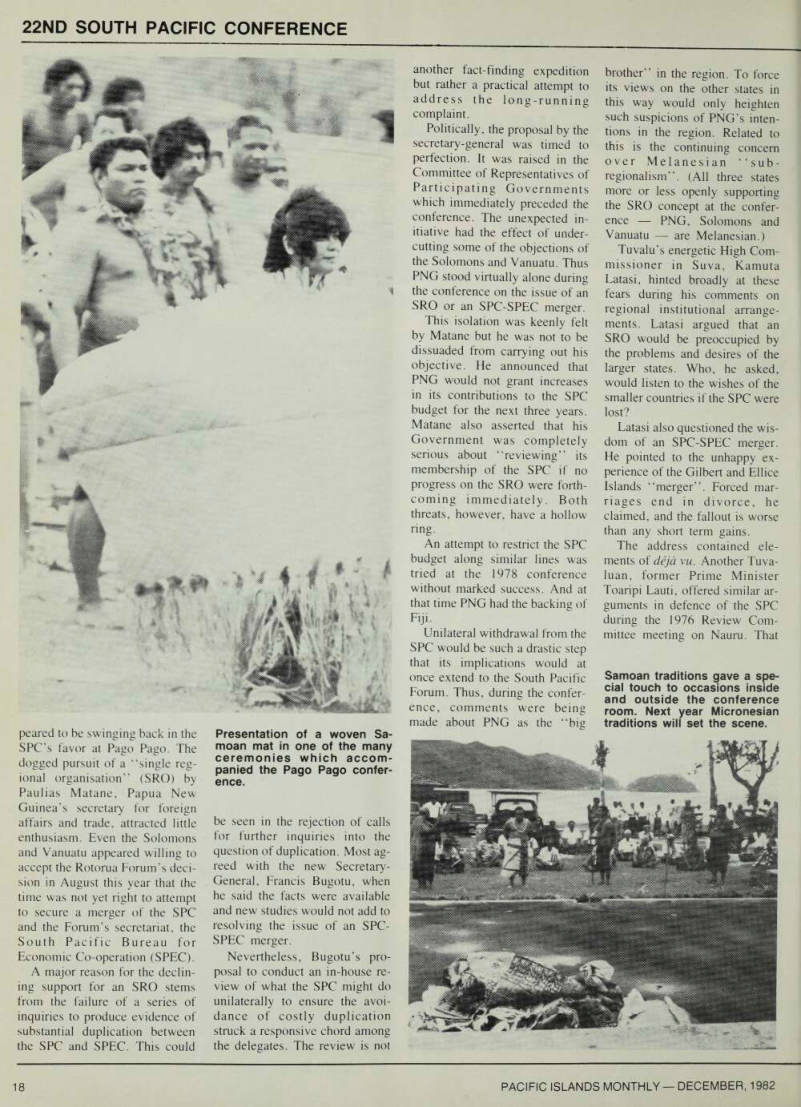
Presentation of a woven Sa moan mat in one of the many ceremonies which accom
panied the Pago Pago confer
ence.
Samoan traditions gave a spe cial touch to occasions inside and outside the conference room. Next year Micronesian traditions will set the scene.
speech did much to turn the course of the 1976 inquiry away from abolishing the SPC.
If the issue of SPC-SPEC rela tions lived up to the advance billing, the subject of nuclear wastes did not. This had been tipped as a topic likely to pro
duce sparks, especially between
France and the U.S. and those Island states that take a hard line on all nuclear issues. The anti cipated confrontation did not emerge, however.
The Northern Marianas’ dele gate, George Chan, asserted forcefully that the South Pacific Regional Environment Prog ram’s (SPREP) support for the London Dumping Convention ought to be rejected. Chan said this convention tended to legitimise the dumping of nuc lear wastes at sea and this was
patently unsafe.
Many other Island countries agreed with the Northern Marianas in principle but were not prepared to reject SPREP’s advice. Overall the feeling seemed to be that some controls were better than none. There was scarcely a murmur therefore when the American State Depart ment representative, Bob Brand, asked the conference to reconsid er a resolution which would have called upon all SPC members to end studies into marine dumping of nuclear wastes.
One of the more novel ques tions to arise during the confer ence was the use of sponsorship.
The idea of raising money by
inviting commercial enterprises
to help “sponsor” the confer ence was initiated by the Ameri can Samoan Government for sev eral reasons. Not only did the quarter of a million dollars raised assist it in upholding a high standard for hospitality, the con cept of co-operation between in dustry and government evidently appealed strongly to Governor Coleman.
The experiment was fraught
with risks. There is no in stitutionalised role for industry to participate in the conference.
The implicit support for “free enterprise” would have been po tentially contentious even if some of the early publicity had not stated openly that a free enterprise system was needed to maintain stability in the region.
After all, it was not that long ago that a pre-independence Euro pean MP from Fiji had to be
repudiated during a conference
for his attack on indigenous co operatives on the grounds that co-operatives were against the
spirit of free enterprise.
Nevertheless, the 1982 experi ment was generally well re ceived. The presentations by the sponsors (selected by their fel
lows to address the conference) were pertinent. The ensuing questions from delegates showed genuine interest. And the hosts for the 1983 Conference, the Northern Marianas, have indi cated that they intend to continue with the idea of sponsorship.
Certainly there are advantages to be had in obtaining financial support for the conferences, which have not been held at the Noumea headquarters of the SPC since 1978. The real doubts on the concept of sponsorship rest with the role these industries are to play in the conference, if any.
The SPC is, after all, an inter governmental body, and there fore a parallel trade fair might be a more appropriate mechanism for commercial participation.
Should a regular pattern of indus try involvement develop, as Governor Coleman would wish, then consideration may also have to be given as to how the money paid by sponsors can be used
directly by the SPC to defray
conference costs.
The character of the “met
ropolitan” governments’ partici
pation in the conference also
provided some interesting revela
tions. (The term “metropolitan” has been officially abandoned but no new term has been de vised to replace it.) The British Government clearly wished to continue to be involved in South Pacific regionalism. There are
historical reasons for this, of course, and the UK is still a major aid donor in the area.
Nevertheless, there may have been added grounds for British interest this year.
Argentina apparently made overtures to be admitted as an observer. This was rejected by the Islands without the need for any “metropolitan” interven tion. The motive for Argentina’s approach, however, seems to have had less to do with the Falklands war than with some islands in the Beagle Channel.
These are claimed by Chile but Argentinian possession would give that country a window on the Pacific.
Chile, by the way, has been cultivating the South Pacific for the past five years. The catalyst was a mutual interest in 200-mile maritime zones. This year the Chilean representative. Ambas sador Jorge Valdovinos, gave $lO,OOO to the SPC and indicated his Government’s wish to do this annually. Peru, represented in Pago Pago by its Canberra Am bassador Jose Torres-Muga, has
• Continued on Page 67
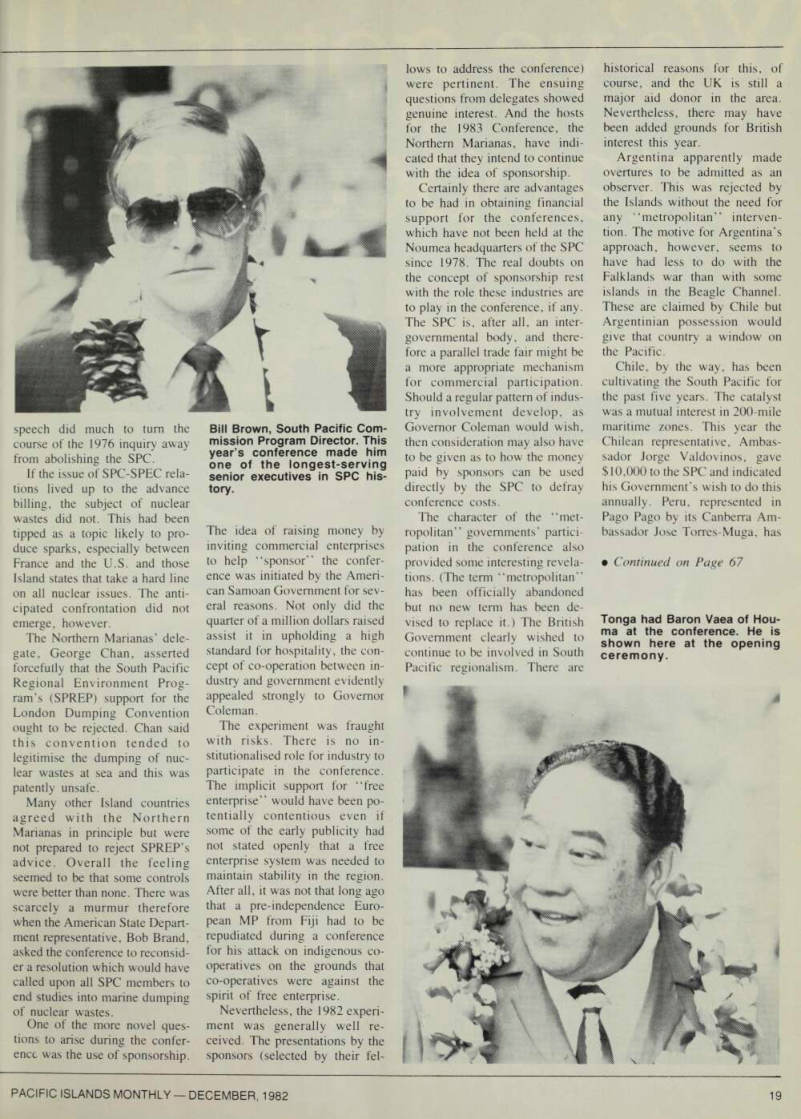
Bill Brown, South Pacific Com mission Program Director. This year’s conference made him one of the longest-serving senior executives in SPC his tory.
Tonga had Baron Vaea of Hou ma at the conference. He is shown here at the opening ceremony.
also been active in the SPC in recent years.
The American delegation was perhaps at the highest level for any South Pacific Conference.
The reason was evidently a show of support for American Samoa — although some wires did ap pear to be crossed between Pago and Washington. Governor Col eman referred several times dur ing the conference to American Samoa’s internal political re sponsibility. At odds with these assertions, however, was the fact that the American delegation was headed by Interior Department Assistant Secretary, Pedro San- Juan, who is responsible for the
U.S. dependencies.
It was somewhat surprising that the element of dependency should have been emphasised. In recent years, the U.S. ambas sador to Suva has led the U.S. delegation. It was rumored that the present incumbent, Fred Eck ert, would have been available but Washington decided other wise. Since Eckert was appoint ed to Suva as a friend of the president, the decision seemed
doubly curious.
President Ronald Reagan made a video appearance at the Conference to welcome dele gates to Pago Pago. His address received more than polite atten tion as most felt it gave the conference greater visibility in the ,U.S.
The Australian delegation was headed by the Minister for De fence Support, Ian Viner.
Perhaps because alphabetical or der dictated that it was called upon first when “metropolitan” interventions were sought, Aust ralia tended to take a more cauti ous line than some of the others.
It may be, however, that Aust ralia now has so much invested in its relations with the Islands that Canberra is becoming rather too careful about rocking any regional boats. This was particu larly evident on SPC-SPEC rela tions where Australia’s com ments could have been taken for either side.
Finally, the success of the con
ference depended substantially
on the work of the secretariat.
The new secretary-general and his staff carried out their duties without a single false step. In deed, Bugotu had some notable successes to his credit. He managed to get a rise in the budget. The work program was adopted without serious modifi cation. His proposal to conduct an in-house review greatly
strengthened the SPC’s position
during the debate on SPC-SPEC relations. And he spoke with authority in defence of the SPC and its work in the region. In all, it was a very polished perform ance for his first conference.
Having attended South Pacific Conferences for the past 11 years, I would have to conclude that this was the most “normal”
Conference since Rarotonga in 1974. The SPC is now 35 years old and it seems thpt the organ isation has finally come to terms with middle age. It is respected for its experience, and mature enough to appreciate its own limitations.
The scene in Pago Pago at the official opening of the 22nd South Pacific Conference. Governor Coleman is greeting delegates as they arrive by car for the ceremony.