The community
pp. 13-15 · Read in the full issue
22Nd South Pacific Conference
PIM Associate Editor MALCOLM SALMON was in Pago Pago for the 22nd South Pacific Conference in the last week of October. He writes here of his impressions of Pago and of conference doings, onstage and off. His comments are followed by a summary of the work of the conference by Dr RICHARD A. HERR, of the University of Tasmania.
The hand of
nature ...
Speaking at the opening cere mony of the 22nd South Pacific Conference in Pago Pago in Oc tober, Secretary-General Francis Bugotu of the South Pacific Commission remarked on the fact that Pago had hosted three such conferences, more than any other centre apart from Noumea (a special case because it is the site of SPC headquarters).
He said the record was a tri bute to the people of a communi ty as small as Pago, and to their interest in regional affairs.
I think there is another reason: nature has cunningly designed Pago from the start to serve as what our American cousins call a “convention center’’.
No pictures, no written de scriptions, adequately prepare one for the beauty of the island of Tutuila. Thickly wooded moun tains rearing steeply behind the narrow coastal strip at Pago are a constant source of visual delight and of relief for eyes tired of poring over the flood of docu ments inevitably produced by a bureaucratic bash such as the South Pacific Conference. I grew particularly fond of the coconut palms which, here and there, cling defiantly to the precipitous flanks of the mountains, at al titudes greater surely than is real ly good for their health.
Nor has nature forgotten the air-conditioning: Pago’s tropical warmth and high humidity are almost constantly tempered by fresh breezes off the harbor, making a seaside stroll a ready means of cooling-off, as well as of relaxing after the day’s work.
The community
of Pago Pago
There is yet another reason why Pago is a superb venue for events of this kind. The smallness of the Pago community referred to by Mr Bugotu means that the local people can be mobilised and schooled in how to welcome overseas guests with a thorough ness that would be out of the question in a larger centre. Gov ernor Peter Tali Coleman and his aides performed minor miracles in going about this task.
The Governor himself set the example by assuming an abso
lutely crushing workload
throughout the conference and its many and varied accompanying social occasions, and carrying it all off with unfailing dignity and
aplomb.
Members of his family were not far behind him. His well-
favored daughter, Amata Cole man, came especially from Washington to work on the or ganisation of the conference. Her American husband was in charge of a small and effective group responsible for the technical pre parations. As well as Amata, half a dozen of her brothers were also there and at work, having zeroed in on Pago from points as far flung as Baltimdre, San Fran cisco and Alaska.
But it wasn’t only a Coleman family affair. Others with names to conjure with in Samoa, such as Millie Nelson, worked just as hard.
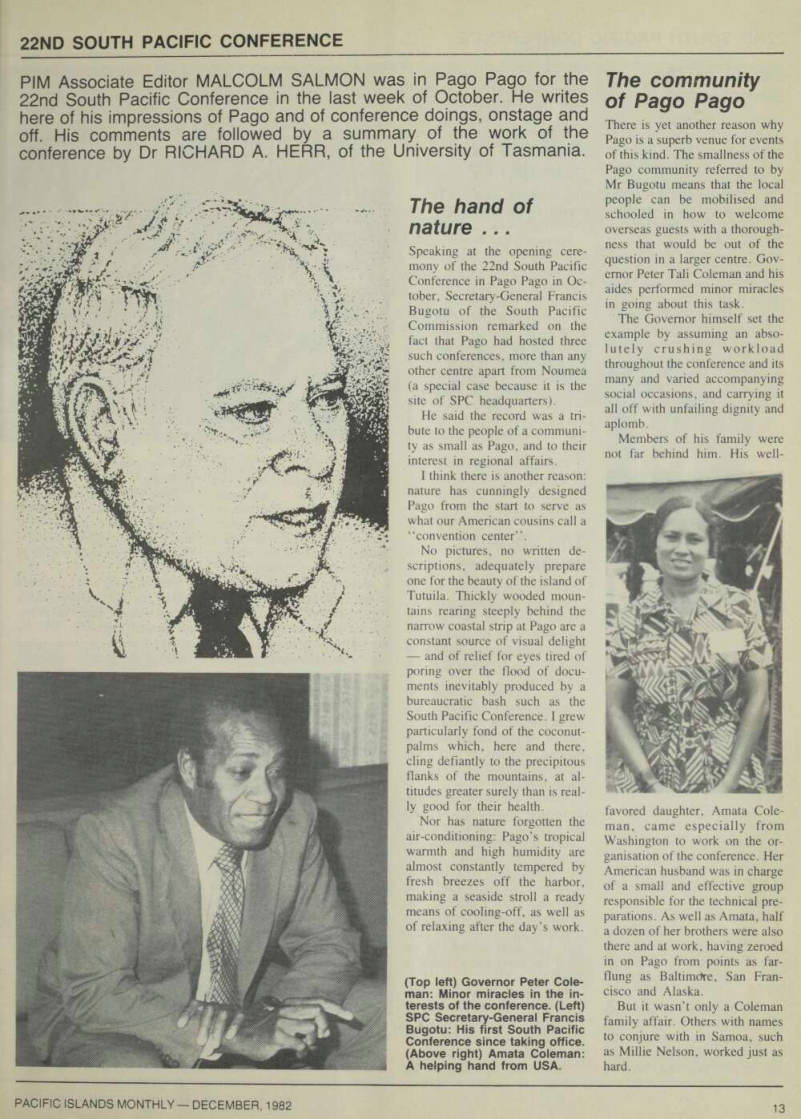
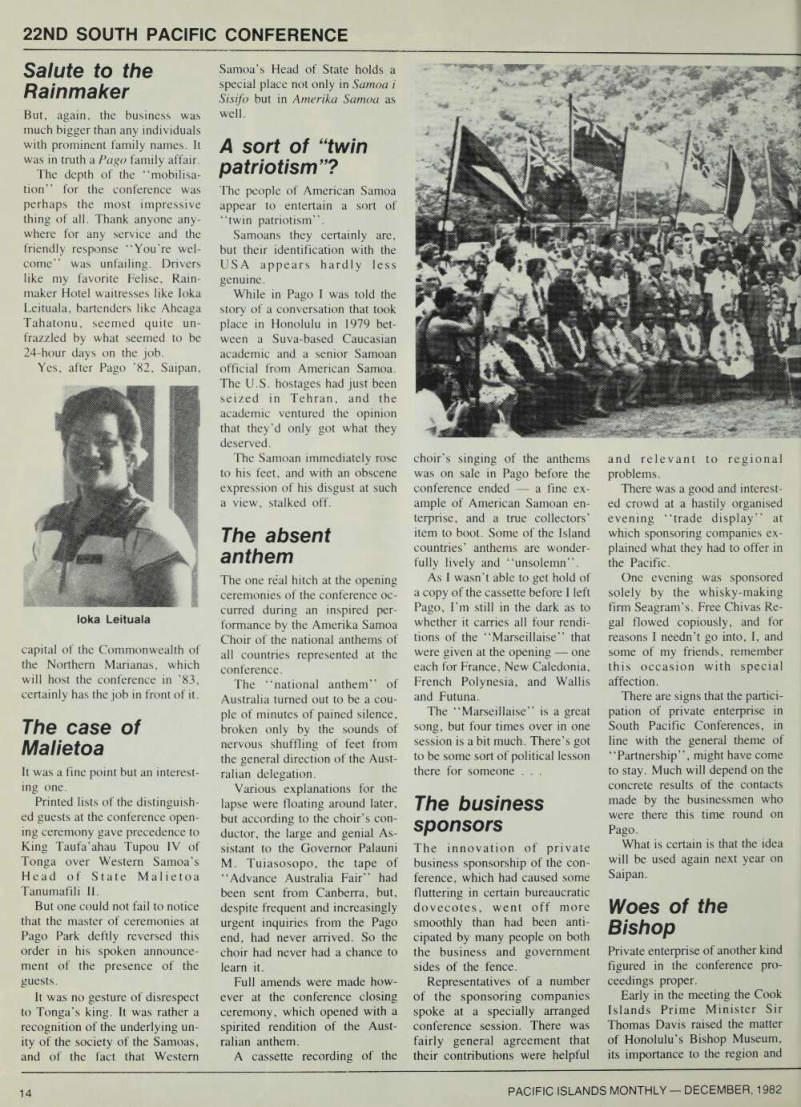
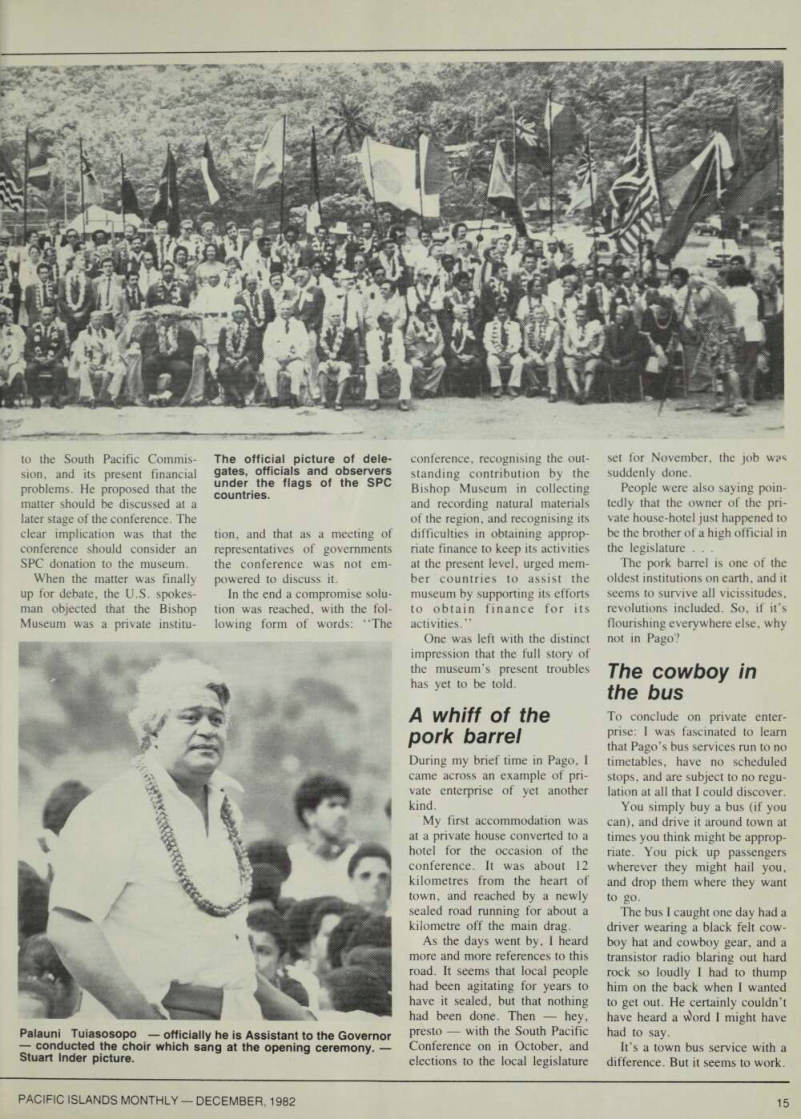
(Top left) Governor Peter Cole man: Minor miracles in the in terests of the conference. (Left) SPC Secretary-General Francis Bugotu: His first South Pacific Conference since taking office. (Above right) Amata Coleman: A helping hand from USA.
Salute to the
Rainmaker
But, again, the business was much bigger than any individuals with prominent family names. It was in truth a Pago family affair.
The depth of the “mobilisa tion” for the conference was perhaps the most impressive thing of all. Thank anyone any where for any service and the friendly response “You’re wel come” was unfailing. Drivers like my favorite Felise, Rain maker Hotel waitresses like loka Leituala, bartenders like Aheaga Tahatonu, seemed quite un frazzled by what seemed to be 24-hour days on the job.
Yes, after Pago ’B2, Saipan,
capital of the Commonwealth of the Northern Marianas, which will host the conference in ’B3, certainly has the job in front of it.
The case of
Malietoa
It was a fine point but an interest
ing one.
Printed lists of the distinguish ed guests at the conference open ing ceremony gave precedence to King Taufa’ahau Tupou IV of Tonga over Western Samoa’s Head of State Malietoa Tanumafili 11.
But one could not fail to notice that the master of ceremonies at Pago Park deftly reversed this order in his spoken announce ment of the presence of the guests.
It was no gesture of disrespect to Tonga’s king. It was rather a recognition of the underlying un ity of the society of the Samoas, and of the fact that Western
Samoa’s Head of State holds a special place not only in Samoa i Sisifo but in Amerika Samoa as well.
A sort of “twin
patriotism”?
The people of American Samoa appear to entertain a sort of “twin patriotism”.
Samoans they certainly are, but their identification with the USA appears hardly less
genuine.
While in Pago I was told the story of a conversation that took place in Honolulu in 1979 bet ween a Suva-based Caucasian academic and a senior Samoan official from American Samoa.
The U.S. hostages had just been seized in Tehran, and the academic ventured the opinion
that they’d only got what they
deserved.
The Samoan immediately rose to his feet, and with an obscene expression of his disgust at such a view, stalked off.
The absent
anthem
The one real hitch at the opening ceremonies of the conference oc curred during an inspired per formance by the Amerika Samoa Choir of the national anthems of all countries represented at the conference.
The “national anthem” of Australia turned out to be a cou ple of minutes of pained silence, broken only by the sounds of nervous shuffling of feet from the general direction of the Aust
ralian delegation.
Various explanations for the lapse were floating around later, but according to the choir’s con ductor, the large and genial As sistant to the Governor Palauni M. Tuiasosopo, the tape of “Advance Australia Fair” had been sent from Canberra, but,
despite frequent and increasingly
urgent inquiries from the Pago end, had never arrived. So the choir had never had a chance to ieam it.
Full amends were made how ever at the conference closing ceremony, which opened with a spirited rendition of the Aust ralian anthem.
A cassette recording of the
choir’s singing of the anthems was on sale in Pago before the conference ended a fine ex ample of American Samoan en terprise, and a true collectors’ item to boot. Some of the Island countries’ anthems are wonder
fully lively and “unsolemn”.
As I wasn’t able to get hold of a copy of the cassette before I left Pago, I’m still in the dark as to whether it carries all four rendi tions of the “Marseillaise” that were given at the opening one each for France, New Caledonia, French Polynesia, and Wallis and Futuna.
The “Marseillaise” is a great song, but four times over in one session is a bit much. There’s got to be some sort of political lesson there for someone . . .
The business
sponsors
The innovation of private business sponsorship of the con ference, which had caused some fluttering in certain bureaucratic dovecotes, went off more smoothly than had been anti
cipated by many people on both
the business and government sides of the fence.
Representatives of a number
of the sponsoring companies
spoke at a specially arranged
conference session. There was
fairly general agreement that
their contributions were helpful
and relevant to regional
problems.
There was a good and interest ed crowd at a hastily organised evening “trade display” at
which sponsoring companies ex
plained what they had to offer in the Pacific.
One evening was sponsored
solely by the whisky-making
firm Seagram’s. Free Chivas Re gal flowed copiously, and for reasons I needn’t go into, I, and some of my friends, remember this occasion with special affection.
There are signs that the partici
pation of private enterprise in
South Pacific Conferences, in line with the general theme of
“Partnership”, might have come
to stay. Much will depend on the concrete results of the contacts made by the businessmen who were there this time round on
Pago.
What is certain is that the idea will be used again next year on Saipan.
Woes of the
Bishop
Private enterprise of another kind figured in the conference pro ceedings proper.
Early in the meeting the Cook Islands Prime Minister Sir Thomas Davis raised the matter of Honolulu’s Bishop Museum, its importance to the region and
loka Leituala
to the South Pacific Commis sion, and its present financial problems. He proposed that the matter should be discussed at a later stage of the conference. The clear implication was that the conference should consider an SPC donation to the museum.
When the matter was finally up for debate, the U.S. spokes man objected that the Bishop Museum was a private institu
tion, and that as a meeting of representatives of governments the conference was not em powered to discuss it.
In the end a compromise solu tion was reached, with the fol lowing form of words; “The
conference, recognising the out
standing contribution by the
Bishop Museum in collecting
and recording natural materials of the region, and recognising its difficulties in obtaining approp riate finance to keep its activities at the present level, urged mem ber countries to assist the museum by supporting its efforts to obtain finance for its activities.”
One was left with the distinct impression that the full story of the museum’s present troubles has yet to be told.
A whiff of the
pork barrel
During my brief time in Pago, I came across an example of pri vate enterprise of yet another kind.
My first accommodation was at a private house converted to a hotel for the occasion of the conference. It was about 12 kilometres from the heart of town, and reached by a newly sealed road running for about a kilometre off the main drag.
As the days went by, I heard more and more references to this road. It seems that local people had been agitating for years to have it sealed, but that nothing had been done. Then hey, presto with the South Pacific Conference on in October, and elections to the local legislature
set for November, the job was suddenly done.
People were also saying poin
tedly that the owner of the pri vate house-hotel just happened to be the brother of a high official in
the legislature . . .
The pork barrel is one of the oldest institutions on earth, and it seems to survive all vicissitudes, revolutions included. So, if it’s
flourishing everywhere else, why
not in Pago?
The cowboy in
the bus
To conclude on private enter prise: I was fascinated to learn that Pago’s bus services run to no timetables, have no scheduled stops, and are subject to no regu lation at all that I could discover.
You simply buy a bus (if you can), and drive it around town at times you think might be approp riate. You pick up passengers wherever they might hail you, and drop them where they want to go.
The bus I caught one day had a driver wearing a black felt cow boy hat and cowboy gear, and a transistor radio blaring out hard rock so loudly I had to thump him on the back when I wanted to get out. He certainly couldn’t have heard a I might have had to say.
It’s a town bus service with a difference. But it seems to work.
Palauni Tuiasosopo —officially he is Assistant to the Governor - conducted the choir which sang at the opening ceremony.
Stuart Inder picture.
The official picture of dele gates, officials and observers under the flags of the SPC countries.