Queen gets warm welcome, but
pp. 21-22 · Read in the full issue
Visiting Royalty
Queen gets warm welcome, but PNG looks at its royal link
Wherever the Queen went there was warmth, affection, color and ceremony. But there were also developments which showed the changing nature of the Pacific scene, and which pointed to a new chapter in links between the old world and the new Pacific.
Papua New Guinea in particu lar illustrated the changing scene. The government there was embarrassed when a leaked re port revealed recommendations that the Queen should no longer be formal head of state. But Prime Minister Michael Somare reflected the feeling of his people when he asked Queen Elizabeth to return shortly to open a new
national parliament building
and she accepted.
Solomon Islands has already debated a similar report in parlia ment, suggesting that a local
president should replace the
Queen as head of state. So far Solomon Islands has not adopted any formal recommendation, and in Papua New Guinea the parlia ment has yet to debate certain aspects of a report from the PNG General Constitutional Commission.
Neither country is likely to make any early constitutional change, but the existence of the reports and the evidence which led to them is symptomatic of the changing politics of the Pacific.
PNG was also in the news during the Queen’s Pacific visit when a newspaper published there carried an article highly critical of the Royal Family. The article led to a clash between the owner and some of his staff, and the sale of the newspaper several
days later.
Fiji’s welcome to the Queen was warm and spontaneous, and perhaps the only note of criticism was because it was too formal.
An editorial in the Fiji Times described Queen Elizabeth as the people’s queen, but said that the stiff formality which had sur rounded her visit had given her little chance to meet the people, and little chance for them to meet her.
Queen Elizabeth of England who is also the constitutional head of state of seven Pacific countries visited the Pacific in October. She went to six Island countries: Papua New Guinea, Fiji, Nauru, Solomon Islands, Kiribati and Tuvalu.
One of the highlights of her Fiji tour was to visit the little island of Bau where Fiji chiefs paid homage to her as a chief in her own right. She opened a meeting of the Great Council of Chiefs, and during the cere monies there she presented the award of the Royal Victorian Chain to the Governor-General, Ratu Sir George Cakobau. It is a rare award today, confined to royalty or senior national leaders.
The Deputy Prime Minister, Ratu Sir Penaia Ganilau, was made a Knight Commander of the Royal Victorian Order at a ceremony on board the Royal Yacht Britannia. The award was made by the Queen in recogni tion of the Deputy Prime Minis ter’s part in establishing what was called a special relationship between Fiji and the throne.
Historically, the Queen’s visit to Tuvalu was one of the high lights of her Pacific tour. Tuvalu has the distinction of being the smallest country of which she is Queen. It is 90 years since the country has been associated with the British Grown and there have been several visits by members of the Royal Family, but the Queen was the first reigning monarch to make a visit.
More than 20 traditional canoes escorted the Queen and the Duke of Edinburgh when they came ashore to a colorful
welcoming ceremony. They
walked from the landing area on a carpet of woven mats. Children sang songs and showered the Queen with flowers.
In the Solomon Islands the Queen withstood the famous “nerve test” where men carrying spears attempt to frighten away visitors, and where the measure of the visitor’s stature is to stand fast without flinching. Conch
shells were used like trumpets to welcome the Queen.
The island of Tarawa in Kiribati and the island country of Nauru had the biggest crowds to gather for many years when the Queen visited them. On Nauru white paint was used to brighten up roadside tree trunks in honor of the Queen’s visit.
In Papua New Guinea the Queen’s visit to the Highlands town of Mount Hagen coincided with a savage hailstorm which smashed windows and wind screens, but did not cause any injuries.
Wrapping up the Queen’s four-week tour of the Islands, the English journalist Grania Forbes wrote; “It is true that at times she must have felt the strain as she battled not only against the sear ing heat and oppressive humidi ty, but also against language and cultural barriers.
“Contrary to her image as a reserved and somewhat dignified figure, she has taken the oddest of situations in her stride and with her marvellous good humor she has enjoyed every twist of this magical mystery tour around the Pacific.’’
Newspaper starts
a royal row Ray Thurecht is a difficult man to typify. He exudes a sort of restrained ostentation, bolstered by a history of real achievement which is his ultimate strength.
Like many who have turned a basic skill or technical ability into solid commercial success, he tends to be not quite identifi able with any particular camp.
And like them, too, he may not realise this himself. It’s one of the penalties of a certain type of success.
Thurecht, who is just into his fifties, went from Brisbane in the Australian state of Queensland to Port Moresby in Papua New Guinea nearly 30 years ago. He went there as a Linotype techni cian (a fast-dying trade with the onset of new technology) for the South Pacific Post newspaper, now the PNG Post-Courier. He formed his own job-printing business, PNG Printing, in the 1960 s and he hasn’t looked back.
He leamt to fly (his business runs an aircraft today), he became top man in the PNG chambers of commerce movement, and he kept abreast of new technology in the printing and graphic arts industries. From printing it was a natural step into publishing, and
he eventually amalgamated a
number of news sheets into a five-day-a-week paper Niugini Nius. Niugini Nius got into top gear just under three years ago, published in Lae and simultane ously printed in Lae and Port Moresby. Thurecht used his air craft to freight page negatives over the mountains from Lae to Port Moresby every evening.
Like many publishers he had early editor troubles, but he eventually secured Charles
Cepulis, a capable journalist who
had first come from Australia to PNG to work in the Post- Courier. Cepulis had been a sub editor and news editor on the Post-Courier, he had acted as a editor on a number of occasions,
and immediately before taking
up the Thurecht appointment he had worked in Suva with The Fiji Times.
The third man in the story was Andy Walker, a Scot who had migrated to Australia, who had worked as a journalist in Mel bourne, and who had joined Niugini Nius in Lae.
Walker wrote an article which
disparaged the 'British Royal
Family and its relationship to PNG and which drew attention to the apparent incongruity of roy alty on the other side of the world being a constitutional part of PNG. The article was published
on the eve of Queen Elizabeth’s recent visit to PNG and was critical of the whole structure of British royalty. It referred to the Duke of Edinburgh once Prince Philip of Greece as “Phil the Greek”, it criticised the earnings and situation of the Queen and of the heir to the throne, the Prince of Wales, and it criticised the morals of the Queen’s sister, Princess
Margaret.
From a political and sociolog ical point of view one of the most interesting aspects of the exercise was Walker’s miscalculation of public feeling towards the British Royal Family and its constitu tional position in PNG. He tend ed to reflect an attitude which is
probably more acceptable today
in sections of the old Common wealth than in new nations which
have deliberately sought mem
bership of the Commonwealth.
In any event, neither Walker nor Cepulis had much opportunity to assess reader reaction. A hor rified Thurecht took one look at what his newspaper had publish ed and ordered the destruction of the entire print run after only a small proportion of the run had been sold.
“He probably saw an honor from the Queen going out the window” was one uncharitable comment. In fairness to Thurecht it would seem that his assessment of general PNG attitudes towards the link with the British Crown was much closer to the mark than that of his newspaper.
Walker and Cepulis walked off the job in protest at their owner’s action, but the paper’s continuity was saved when Thurecht's aircraft flew from Port Moresby to Lae bringing two journalists from the Port Moresby paper The Times. Any suggestion that the two were strike-breaking evaporated when it was revealed that the company they worked for. Word Publish ing. had bought Niugini Nius.
Word Publishing grew out of an ecumenical grouping of churches, and has entered the publishing business with no small success. It has put a Papua New Guinean journalist, Sinclair Solomon, into the editor’s chair at Niugini Nius, Cepulis and Walker have left PNG, and Thurecht has ended his flirtation
with the newspaper industry. The price of the sale was not disclosed.
PNG report calls
for a president
Only six days before the Queen was due to visit Papua New Guinea the government was em barrassed by the leaking of a report which recommends, among other things, that the Queen should cease to be the formal head of state and should
be replaced by a Papua New
Guinean president.
In this respect the contents of the report were similar to recom mendations which have been made in Solomon Islands over the past ten months.
The PNG report came from the General Constitutional Commis sion and was meant to have its first airing in parliament. The chairman of the commission, Mr Mahuru Rarau Rarau, was as embarrassed as the government at the disclosure of parts of the
report. The mere fact that the embarrassment was obvious tends to suggest that the senti ments of the report are not or not yet, anyway entrenched.
The report, which circulated in a number of quarters and which also received newspaper publici ty, claimed that many Papua New Guineans wanted a break from their colonial past and a more efficient and appropriate method of recognising a head of state. The report said there was no suggestion that PNG should relinquish its membership of the Commonwealth.
Under PNG’s present constitu tional structure the Queen as head of state is represented by a Papua New Guinean Governor- General, but the degree of real power which rests with parlia ment and the Prime Minister is considerable. However, the con cept is being increasingly ques tioned, according to the constitu tional commission’s report.
The report said “We accept the British Monarch as head of
the Commonwealth of which we are, and will continue to be, a member. We will continue to show Queen Elizabeth our re spect and affection, and will wel come her and her family with our traditional hospitality. But that is a different thing from actually vesting the executive power in the Queen as our head of state.”
The commission’s recommen dation for a president provides for greater effective power than that which is at present vested in the Governor-General. The ap pointment should be made by parliament, the report says. The recommendation also suggests the establishment of a PNG sys tem of honors to replace the present Imperial system. Parlia ment has yet to debate the report.
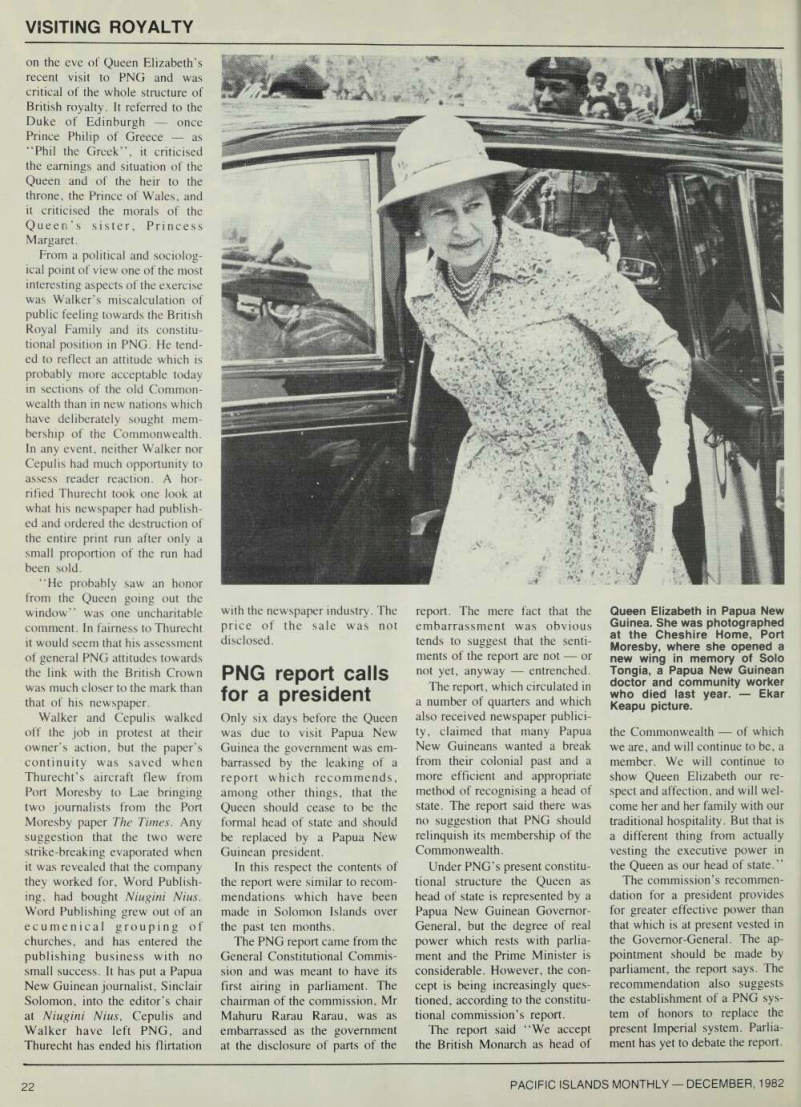
Queen Elizabeth in Papua New Guinea. She was photographed at the Cheshire Home, Port Moresby, where she opened a new wing in memory of Solo Tongia, a Papua New Guinean doctor and community worker who died last year. Ekar
Keapu picture.