the rainbow's end?
pp. 61-62 · Read in the full issue
Books
Ok Tedi: What lies at the rainbow's end?
Ok Tedi: The Pot of Gold. By Richard Jackson. Published by the University of Papua New Guinea, 1982. 199 pp. Thirty color photographs, nine maps, index. Distributed by Word Pub lishing, Box 1982, Boroko,
Ncd, Png. K 6.95.
Ok Tedi: The Pot of Gold is a real gem. The reader will find it worth its weight in gold. Richard Jackson, professor of geography at the University of Papua New Guinea (UPNG), now on second ment to the Institute of Applied Social and Economic Research (lASER) as their director, has been extensively involved over the past six years as a consultant on the impact of Ok Tedi. Since 1976 he has walked around the villages of Kiunga and Telefo min Districts, and has written a number of reports on the area for the Department of Minerals and Energy. He has also served as a member of the Ok Tedi Manage ment Committee. The UPNG has sponsored his research.
What we have here is a story well told the story of a quest, the perennial seeking of men and women for riches and adventure.
Jackson tells his tale as if it were a detective story. Indeed, the search for the earth’s resources, their ownership, division of the spoils, and who wins and who loses, all have the makings of a good mystery.
In this case the target is Mount Fubilan (“a steep and slippery place” in the local dialect), a mountain more than 2000 metres high in a remote comer of PNG the Star Mountains, near the Indonesian border of Irian Jaya.
This mountain of gold, copper and silver was first discovered in 1968. So far there have been many losers and a few winners.
The losers have been Kennecott, the American company that in the early ’7os was up against it in
Chile. Kennecott thought they
were into a marginal copper mine they didn’t know they were exploring what is first and fore most a gold mine. They were
interested in possible tax losses on the millions they’d already invested. They lost in the negoti ations with the Papua New Gui nean team, and pulled out. This is a long and involved part of the history of Ok Tedi, and Jackson tells it with zest.
Another set of losers have been the people who have given their lives to the exploration and development of the mine. The first was Dave Binnie, a helicop ter pilot who was killed in an accident in 1968. Many more may die in the process of remov ing Mt. Fubilan over the next 30 years.
The flora and fauna of the area will be losers too. But, as Jack son points out, proper environ mental impact studies, carried out over many years, have never been done, so authorities have been forced to make projections based on minimal information.
There is even a plant unique to the area named Fubilanensis. At tempts to transplant it elswhere have failed.
Again, little is known about the capacity of the river system to absorb and distribute waste.
We do know that the denudation rates are among the highest in the world. The rate of natural ero sion, landslides on the Hinden burg Wall, are all absorbed by the Ok Tedi River system. The extremely high rainfall in the area facilitates this process natur
ally. But we also know that a drought in 1972 dried up the Fly to shipping at Kiunga. What will happen when mining and slides and high denudation rates all combine with a drought?
Still, compared to the ecolog ical disasters on Bougainville caused by the copper mine there, Jackson feels the impact of re moving Mount Fubilan will be negligible at least on the wildlife.
The impact on the Min people is another question. In some re spects they have already been losers. Their lives, especially for those who live near the mine, have forever been altered. While Jackson discusses various scenarios in relation to other ef fects of the mine, he does not
fully explore the possible im
pacts on the Min people. He quotes David Hyndman: “The
Wopkaimin will be practising
their subsistence system for many years to come, regardless of the boom or bust consequ ences of mining in the area.”
Already Ok Tedi has drawn out men for the labor force, and the men and women left at home in many places are depending more on remittances, or, as in parts of Oksapmin and Telefomin, have started producing food for the mine (already three tonnes a week goes by air from
Oksapmin).
Even distant peoples will have
their lives changed irreversibly by the mine. (Jackson has covered these issues in more de tail in his report to Minerals and
Energy.)
Another set of losers will be the Evangelical and Catholic missionaries the only people who have shown any consistent interest in the Min peoples until preparations for the mine began in earnest in 1981. A project of this scale with investments of nearly SUSI billion is bound to eclipse the missions.
Jackson is concerned to ex plore the possible benefits of the mine. The “winners” could possibly be many too. Though the profits from the “pot of gold” won’t begin to be realised until 1985 or 1986, it is es timated that SUSIO billion will eventually be shared out. People have been making money from Ok Tedi since it was started by Kennecott in 1968. In fact Ken necott did so well by the people at Tabubil they found it hard to believe the stories of Kennecott’s
reputation elsewhere.
Jackson traces with keen inter est the story from Kennecott’s withdrawal, the PNG Govern ment’s “going it alone” from March, 1975, to the agreement with “the Big Australian,” Bro ken Hill Proprietary (BHP), in March, 1976, to the final agree ment in February, 1981.
The new consortium is with BHP of Australia, Amoco of America, and Kupferex plorationsgesellschaft of Ger many. The launching of Ok Tedi Mining Company Ltd (the 10 directors include two Papua New Guineans) is treated with great irony by Jackson. He is quick to point out that no Wopkaimin were present. Jackson, who dedi cated his book to the people of the Western Province, writes of the marriage of partners and the
wedding cake;
“The whole cake rests on a table that is the Western Province and surrounding areas. That pro portion of the table on which the mine actually stands belongs to the Wopkaimin. All the owners of the table are concerned not only to obtain a slice of cake for themselves, but to ensure that their guests in their stampede for
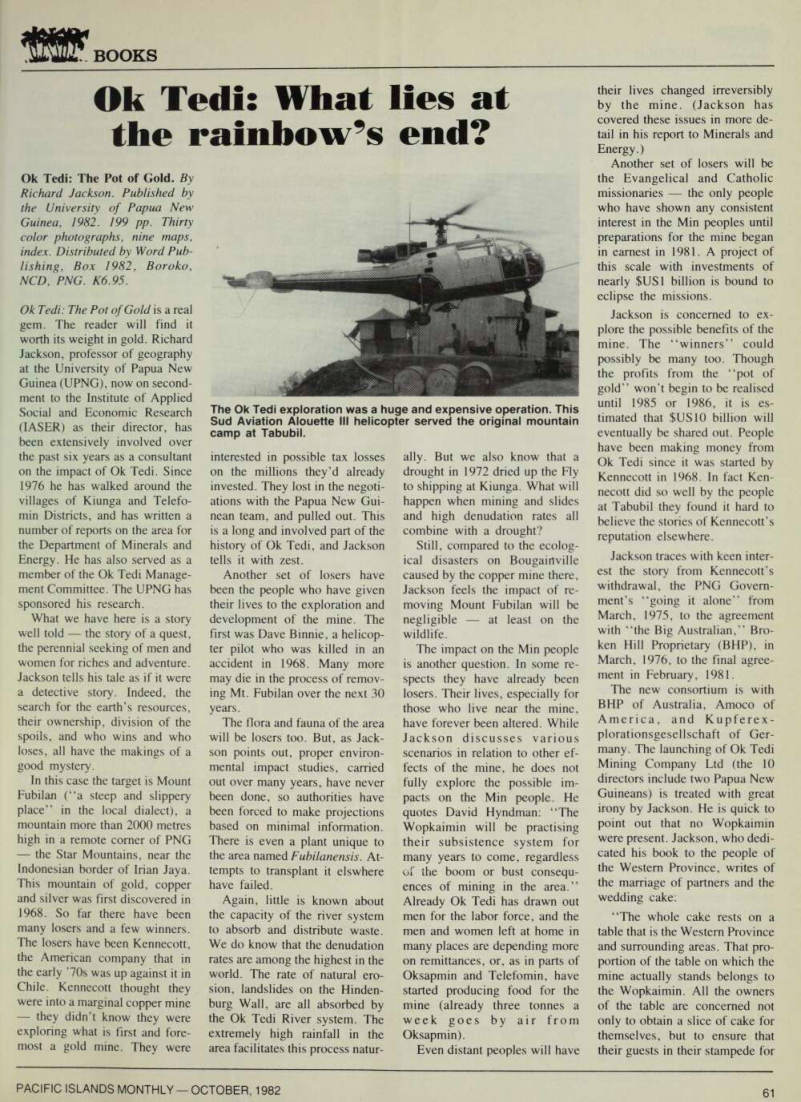
The Ok Tedi exploration was a huge and expensive operation. This Sud Aviation Alouette III helicopter served the original mountain camp at Tabubil.
their own slices do not wreck their table.”
Tremendous profits are to be raked off throughout the con struction phase. Since Jackson finished his book in March, 1981, there have been a number of examples of this, like Talair’s contract for over K 1 million to fly between Port Moresby and Kiunga and Tabubil for OTMCL (Ok Tedi Mining Company Ltd), or contracts for the building of the road between Kiunga and Tabubil, and houses for the workers.
In describing the course of events between Kennecott’s leaving in 1975 and the final agreement in 1981, Jackson does not fully explore one scenario that the foreign companies favored an enclave mining development such as they have in the mountains of central Irian Jaya (which is even fenced off against rebels). An enclave de velopment is much simpler for foreign companies, as all prob lems of dealing with local people and suppliers are avoided. All labor is foreign, all equipment, materials, food and supplies are imported, and the ore is exported the companies get their pro fits, and the government its taxes.
But such an approach has al ways been unacceptable to PNG.
Yet in 1982 there is tremendous conflict already as the companies tend to import from Australia or the USA things they could buy (with more effort, and often at higher cost) in PNG. How firm the PNG Government will be in circumventing this tendency to an enclave pattern of mining re mains to be seen.
To PNG the benefits from the mine (and other such projects) have always been seen in terms of revenue to support “real de velopment”. PNG remains de pendent on untied aid from Aust ralia of about K2OO million a year. It is unlikely that any other country in the world receives such generous aid.
But PNG is also committed to trying to reduce this dependency over the years through the estab lishment of major projects like Ok Tedi. The surplus generated is ideally seen as going to help
pay for the social services and infrastructure the country is mis sing (only 13 percent of the relevant age group are in high school, roads, bridges, health centres all need to be built, and
employment generated PNG
has all the problems of any
underdeveloped nation).
Recent developments in PNG during the Chan government have made many people wonder who will really benefit from Ok Tedi.
Jackson quotes another Jack son report, that of Dudley Jack son in February, 1981, who wrote as a consultant to the Na tional Planning Office: “There is a danger that over the next few decades the mineral wealth will
simply be squandered, leaving
bleak prospects and bare pick
ings for future generations”
Richard Jackson comments; “Perhaps the Pot of Gold will have been spent even before it is dug out of the ground.”
Jackson goes on to point out that in many isolated areas of PNG mining may be the only type of development the people can expect. “The fundamental problem remains the way in which government spends its re venues. Mining must be en couraged to tie into the local economy, or there will be no local economy and there will be no development, judged by gov ernment’s past performance.”
The need for OTMCL to pay attention to the recruitment,
training, and purchasing prog
rams so that they benefit local people is recognised by Jackson.
He goes on to say;
“Unless things change local
people will have very valid reasons for believing that whilst the company and the two govern ments have arranged things very nicely for themselves they have left nothing but crumbs and a wrecked table for the people of the area.”
Jackson explores the Min identity and has their cause at heart. A recent development not mentioned in the book is the creation of the North Fly De velopment Area. This amounts to a form of de-decentralisation, with the North Fly Development Area being administered from Port Moresby by a Kiap, Des Fitzer, who mounted the first government patrol in the area in January, 1963. This recentralisa tion is meant to be in the interest of the Min peoples. Tabubil will have its first Kiap, and Kiunga its own senior officers (like a superintendent of education) as in other provinces.
The move is also in line with the importance of the develop ment of the area to PNG.
Similar overtures are being made in Telefomin District. If and when both the North Fly and Telefomin are free from the in difference of the provincial ad ministrations they now endure over 300 kilometres away in Dam and Vanimo they hope that the districts may “go ahead”.
Could it also be the start of a Min Province?
For all those interested in the
problems of “development” in
the Pacific this is a book worth
reading and owning.
Sheldon
G. Weeks.
* Sheldon G. Weeks is director of the Education Research Unit, UPNG, Port Moresby.
Books Received
South Pacific Handbook.
Second Edition. By David Stanley.
Edited by Bill Dalton. Published by Moon Publications, P.O. Box 1696-
Sf, Chico Ca 95927 U.S.A. Isbn
0-9603322-3-5. Price U 5514.25.
Pub 1982-3.
The Chinese In Papua New
GUINEA: 1880-1980. By David Y.H. Wu. Published by The Chinese University Press, The Chinese Un
iversity of Hong Kong, Shatin, N.T., Hongkong. ISBN 962-201-255-1.
Price U 5517.50. Pub. 1982.
FAGOGO. Fables from Samoa in Samoan and English. Collected, ar ranged and translated by Richard Moyle. Published by Auckland Un iversity Press and Oxford University Press. Price NZ517.50. Pub. 1981.
Retreat From Kokoda. By
Raymond Pauli. Published by Heinemann Publishers Australia Pty.
Ltd. P.O. Box 133, Richmond, 3121. ISBN 0-85561-049-2. Price $9.95. Reissue 1982.
BIKMAUS. Vol 111, No. 1. Edited by Andrew Strathem, Rex Okona, Kathy Kituai, John Kolia. March
1982 edition. Subscription charge
$20.00 per annum.
ORAL HISTORY. Part Two. Vol IX, Number 1. Collected by Mary Mennis. Published by The Institute of PNG Studies. ISBN 0210-2556.
Edited by Pamela Swadling, National Museum and Art Gallery. Price each issue K 51.50.
Land And Politics In New
CALEDONIA. By Alan. W. Ward.
Published by Department of Political and Social Change, Research School of Pacific Studies, The Australian National University. ISBN 86784- 077-3. Pub. 1982.
Road Belong Develop
Ment. Cargo Cults, Com
Munity Groups And Self
Help Movements In Papua
NEW GUINEA. By Rolf Gerritsen, R.J. May and Michael A.H.B. Wal ter. Published by Australian National University. ISBN 0-86784-044-7.
No price available.
National-Provincial Gov
Ernment Relations In
Papua New Guinea. By R.J.
May. Published by Australian Na tional University. ISBN 0-86784- 031.5. No price available.
A Voyage To New Hol
LAND. By William Dampier. Edited by James Spencer. Published by Alan Sutton Publishing Limited 17a Brunswick Road, Gloucester GLI
Ihg. Isbn 0-904387-75-5. Dis
tributed by Angus & Robertson.
Price $19.95. Pub. 1981.
An Account Of The
Mutiny Of Hms Bounty. By
Lieutenant William Bligh. Edited by Robert Bowman. Published by Alan Sutton Publishing Limited, 17a Brunswick Road, Gloucester GLI IHG. Distributed by Angus & Robertson. ISBN 0-904387 47X.
Price $19.95. Pub. 1981.
TI-E VARANE. By George G. Car ter on behalf of Unichurch Publishing P.O. Box 90, Rabaul ENBP PNG.
Pub. 1981.
New Guinea Images In
Australian Literature.
Edited by Nigel Krauth. Published by University of Queensland Press, P.O. Box 42, St Lucia, Qld., 4067.
Price $19.95 (cloth) $9.95 (paper).
Pub. 1982.
Confronting The Nuc
LEAR AGE. By John Hinchcliff.
Published by Pacific Peacemaker, P.O. Box 311, Bondi Junction. ISBN 0-9593609-0-5. Price $4. Pub. 1982.
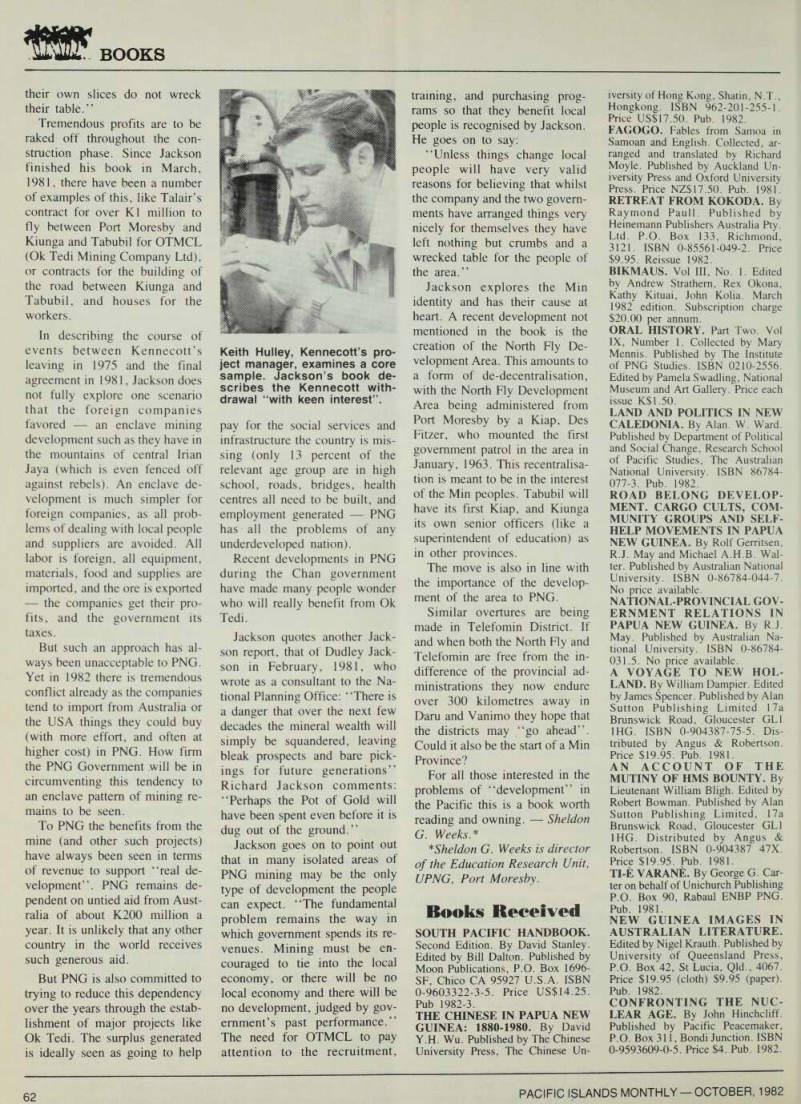
Keith Hulley, Kennecott’s pro ject manager, examines a core sample. Jackson’s book de scribes the Kennecott with drawal “with keen interest".