Islands churches: Problems,
p. 59 · Read in the full issue
Books
Islands churches: Problems, hopes for the '80s
Tides of Change Pacific Christians Review Their Prob lems and Hopes. Published by the Commission for World Mis sion of the Uniting Church in Australia, in co-operation with the Joint Board of Christian Edu cation of Australia and New Zea land, Melbourne, 1981. Edited by Vaughan Hinton. 127 pp.
Price SAS. ISBN 0 85819 326 4.
This is a book that was crying out to be written. It’s a first-class work in every way. Sub-titled ‘‘Pacific Christians Review Their Problems and Hopes”, Tides of Change offers 30 topical essays on issues affecting the younger churches of the South Pacific Island nations. Ten poems and commentaries, inters persed throughout among the es says, reflect another side of the developing literature on the gen eral subject. Three pages of stat istics give details of 14 Island states in a compact form. A reading list, notes on con tributors, and Francis Bugotu’s “This Man” complete the book.
Not all Christian denomina tions in the Pacific are represent ed, nor are all the writers indi genous. But these are not much more than nitpicker’s points in relation to a publication so long overdue and so much needed.
Culture, tradition, power, “new theology”, and ecumen ism are given full treatment.
The compiler, Vaughan Hin
ton, has divided the contributions into six sections; “The Way Things Were”, “Culture and Identity”, “Powers in Parad ise”, ‘‘New Theology and Friendships”, “Stresses and
Struggles”, and “Searching for
New Relationships”.
It’s obvious that the issues
considered important by the
Oceanian churches will differ from those perceived as impor tant in Australia, and even in other developing nations.
Back in 1970 I ventured the expression “Fourth World” to describe the South Pacific coun
tries, with their vast ocean dis tances, small populations, and their total dependence on agricul ture and the sea.
In 1982 I see no reason to abandon the term, because the South Pacific is a unique area, with problems and strengths all its own. The essays reflect this different world, this unique part of the globe.
The essay “Islanders Have Long Been Missionaries” by Dr David Wetherell will surprise many: “. . . most village peo ple in the South Pacific first heard the Gospel stories as they reclined on mats or squatted on the sand with other Pacific Islan ders.” Over 1100 names of such Islander missionaries are on the roll of honor of the Pacific Theological College, and the list is not complete.
Other essays tell, for the first time in English apparently, of lesser known aspects of Oceanic Christian life. “French-Speaking Christians Say Bonjour ”, and “Breakthrough from Isolation in French Polynesia” remind us
that French-language people
don’t have to be either Catholics or atheists. Apart from Wallis- Futuna, the majority of French speaking Pacificans are Protes tant Christians.
“Do Indian People Fit Into
Fiji?” by Fiji-bom Daniel Mas
tapha made me sit up, by noting that Fiji Indians are the largest single group of people in the South Pacific. In view of recent reports on the political scene in Fiji, the author, though very in formative, is possibly over optimistic about future relation ships between the country’s two main races.
Though I found the whole book a delight, for me some of the contributions stood out; “Tonga Feudal Anachronism or Christian Community?”, “The Role of Prayer in Nation building”, “Towards a Melane sian Style of Christian Life”, “ A Missionary in Politics”, “The Christian Presence Plus and
Minus”, “The Growing Wo men’s Movement”, “Australia’s Economic Presence in the Pacif ic”, “Tourism Yes Please, No Thank You”, and “New Caledonians Seek Their Inde pendence.” Not all of these, of course, will appeal equally to all readers.
In a book for dipping into (as this one certainly is), subject matter is often more important than mere authorship. Yet Mr Hinton has done the Commission for World Mission proud with a wide selection of contributing writers. The locals include the Rev Dr Sione Latukefu (Tonga), Bishop Gasika Gasika (Papua New Guinea), Amelia Rokotuivuna (Fiji), Bishop Les lie Boseto (Solomon Islands), Lorine Tevi (Fiji), the Rev Wal ter Lini (Vanuatu), the Rev S.
Amanaki Havea (Tonga/Fiji), Bernard Mulla Narakobi (PNG), the Rt Rev Harry Tevi (Vanuatu), and the Rev B.
Nabitari (Kiribati).
Of the non-essays, I found Francis Bugotu’s dramatic poem “This Man” extremely moving.
Tang Wai-lin’s offbeat “The English and Their Cup of Tea” had me puzzled, unless it’s a tribute to early English mis sionaries and their intrepid ways.
As a “handbook for people seeking to understand the changes sweeping the Pacific and as a reference on Australian- Pacific relations” it is invalu able. It should be in the library of anyone interested in this Pacific “Fourth World” and not only those engaged in religious ac tivities either.
If there’s a sequel to this book and it’s to be hoped sequels come in a steady stream may I suggest that the following topics should also be covered: “Form ing of Conscience”, “Urban Apostolate”, “Hindu and Chris tian Relationships”, “The Gay Communities of Polynesia and Christian Witness”, “The Melanesian Brotherhood and Other Religions” and “Grace Builds on Nature in Polynesian/Melanesian/Micro
nesian Customs”.
Bill
Sharpe-Dunn.
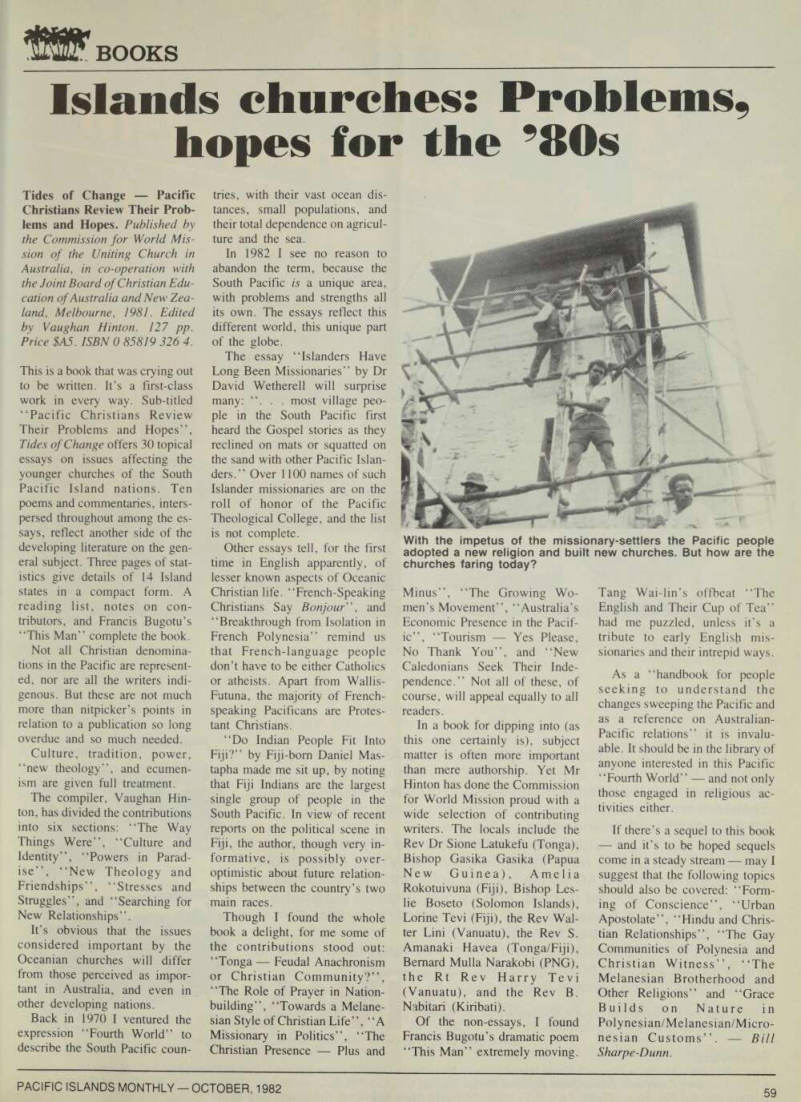
With the impetus of the missionary-settlers the Pacific people adopted a new religion and built new churches. But how are the churches faring today?