W. Samoans see sell-out of rights
p. 51 · Read in the full issue
Political Currents
W. Samoans see sell-out of rights in citizenship accord with NZ
A wave of protest swept Western Samoa’s capital Apia in August- September as the significance of the Va’ai Kolone government’s citizenship agreement with New Zealand sank into the public mind.
The agreement effectively in validates the Privy Council rul ing that all Western Samoans bom between 1928 and 1949, or their children, are New Zealand citizens with full rights Zealand (PIM Sep p 6).
Under the agreement, worked out by Va’ai Kolone and New Zealand Prime Minister Mul doon, all Samoans now living in New Zealand an estimated 50.000 will acquire citizen ship. This includes an estimated 30.000 “overstayers”, Samoans living on in New Zealand after their residence permits have run out.
But for the rest the regular annual quota of 1100 Samoan immigrants to New Zealand each year will be maintained.
There is particular resentment in Western Samoa that the deal was concluded without the sligh test attempt at consultation with those affected possibly as many as 100,000 people.
Seven thousand people turned out for a protest meeting in Apia on August 30, and further meet ings were planned.
Former Prime Minister and present opposition leader Tupuo la Efi accused New Zealand of having “conned” his country’s government into the agreement.
“Thinking people will wake up and realise they have been conned,” he said “It will not be forgotten. ’ ’
Tupuloa said the government had abrogated its duty to its people by sanctioning the agreement.
“It is a basic tenet of the Anglo-Saxon legal heritage that the right to legal citizenship can only be surrended by personal choice,” he said. The values and heritage that New Zealand and
Western Samoa shared had been sacrificed to regulate the flow of Samoans into New Zealand.
Tupuola summoned New Zea land journalists who were visit ing Apia to his house to make his comments.
He also offered a statement on the issue to the state-controlled radio station. He told the journal ists that the station had demand ed $lB to broadcast it, but had not told him when it would go to air.
Tupuola’s indignation was shared by members of the West ern Samoa Law Society, and by the country’s two main newspapers.
The Law Society described the agreement as “abhorrent”, and summoned a special general meeting to discuss it. They said the government had “no legal basis” for its decision to sanction
an agreement that curtailed Sa moans’ right of citizenship in New Zealand.
For the daily newspaper The Observer, there was bitter irony in the fact that a party styling itself the Human Rights Protec tion Party should have “sac rificed the human rights of more than 100,000 Samoans at the whim of New Zealand’s Prime Minister, Robert Muldoon, with out those Samoans knowing any thing about it”.
Referring to the fact that for mally the agreement is a protocol to the existing treaty of friend ship between the two countries, The Observer wrote; “For the first time that useless treaty of friendship was taken out of the locker where it had been eaten into by termites. It had not been touched by the New Zea land Government when it began
its harassment of overstayers.
Why now? Because now, it suits the New Zealand’s Govern ment’s purpose to do so.
“It means that there is no guarantee that the harassment of overstayers in New Zealand would now stop. The New Zea land legislation will not spell out that if you see a Samoan New Zealand citizen in the street, smile friendly to him, stop and chat. The stigma has been imprinted. A Samoan in New Zealand will always look a Sa moan whether he is armed with a New Zealand citizenship or not.
He will always be referred to as ‘that brown coconut’.”
According to a September re port Tupuola Efi planned a visit to New Zealand to discuss the agreement with Mr Muldoon. He also planned to present Muldoon
with a petition signed by Western
Samoans who are opposed to it.
Within a few days of launching, the petition had attracted 15,000 signatures.
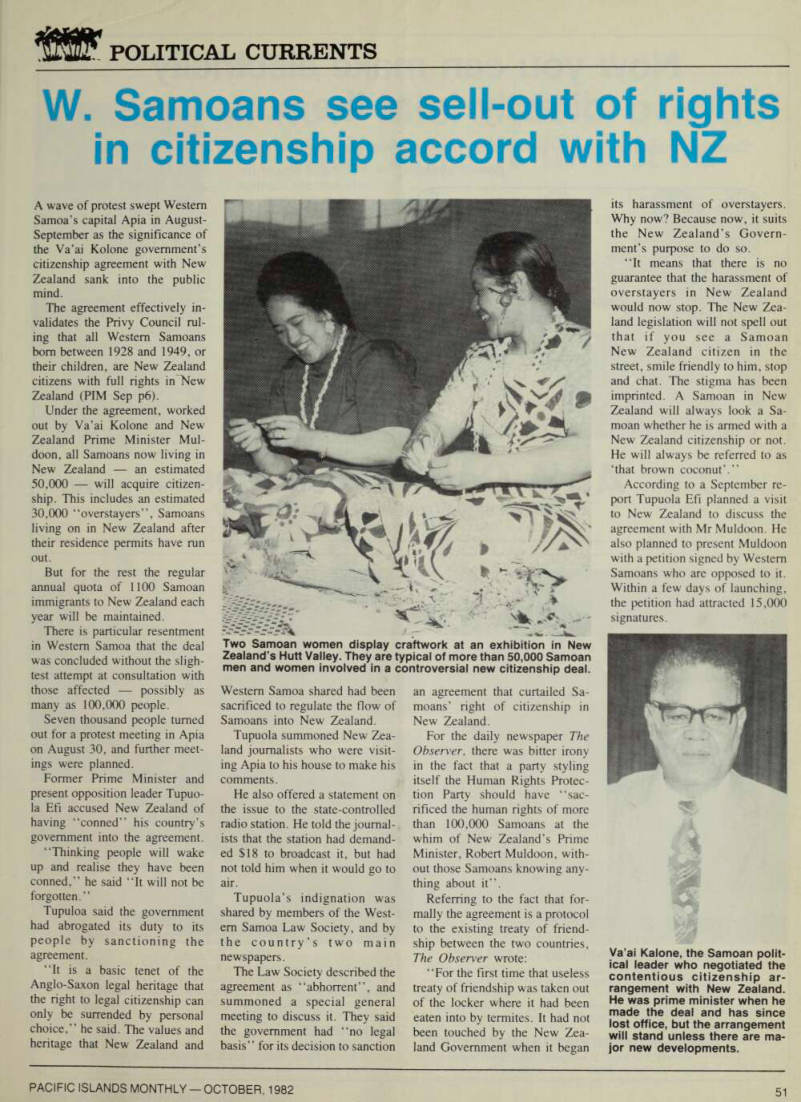
Two Samoan women display craftwork at an exhibition in New Zealand’s Hutt Valley. They are typical of more than 50,000 Samoan men and women involved in a controversial new citizenship deal.
Va’ai Kalone, the Samoan polit ical leader who negotiated the contentious citizenship ar rangement with New Zealand.
He was prime minister when he made the deal and has since lost office, but the arrangement will stand unless there are ma jor new developments.