13th South Pacific Forum meeting:
pp. 44-49 · Read in the full issue

What they did in Rotorua
STUART INDER reports below on the work of the 13th South Pacific Forum meeting in Rotorua, New Zealand, in August.
Thirteen Pacific Island leaders at the 13th South Pacific Forum in Rotorua in August surveyed French plans for decolonising New Caledonia and refrained
from publicly criticising them.
In effect the 13 independent or self-governing states of the Pacific Islands told France: “You seem to be doing an honest job. We support it. We’ll take another look 12 months from now to see how it’s going.”
Nobody would have believed 12 months ago at the 12th Forum in Port-Vila that such a com munique would have been issued from Rotorua, but as Prime Minister Ratu Sir Kamisese Mara told his colleagues: “I feel
reasonably satisfied that impor
tant changes are taking place in
New Caledonia far beyond what any one of us envisaged when we were at Vila last year. These changes are designed to meet the aspirations of the Kanak people.
“What is most important is
that the changes are taking place
under the full responsibility of the French Government. We should continue to encourage the process in a most constructive way in order to achieve the ob jectives of decolonisation with the least possible bloodshed and disturbance.”
France has Ratu Mara to thank for the final satisfactory (to France) consensus communique from the Forum. It was Ratu Mara who led the delegation
from the Forum countries to Paris earlier this year, and it was Ratu Mara’s report, and the man ner in which he introduced it and
shepherded it through the
Rotorua meeting that has resulted in France being given room in which to move.
The views expressed by Ratu Mara in his report were in the end the views expressed in the Forum’s final communique, which said that the Forum: Reaffirms its belief that the principles of self-determination and independence apply to non
self-go veming Pacific countries;
Acknowledges and accepts the report of the Forum mission to France and expresses its appreci ation to the President of the
French Republic for having re ceived the delegation under the leadership of the Prime Minister of Fiji; Takes note of recent develop ments within New Caledonia, including the Independence Front’s participation in the Coun cil of Government, and expresses concern at the violent acts of groups opposed to reforms in the territory; Acknowledges the efforts of the Kanak people towards the attainment of self-determination and independence of New Caledonia by peaceful means; Welcomes the French Govern ment’s program of reforms in New Caledonia, and expresses the hope that it will continue the
reform process and give priority to declaring its intentions on the territory’s future political status; Urges the French Government to work closely with the Kanak people of New Caledonia in for mulating a political program for a peaceful transition to independence; Declares its continuing inter est in the progress in New Caledonia and encourages the French Government to maintain dialogue with the Forum; Decides to forward this resolu tion to the French President; Decides to review develop ments further at the 14th meeting of the Forum.
This final communique did not represent opinions expressed at
the Forum so much as what leaders were prepared to put their names to. For some, such as Vanuatu, Papua New Guinea and Solomon Islands but especial ly for Vanuatu the communi que wasn’t strong enough.
Father Walter Lini fought hard but in vain to get his colleagues to agree to the three points of Independence Front spokesman Yann Uregei that were made in Ratu Mara’s report, and which Uregei himself pressed during lobbying sessions in Rotorua.
These were (a) to have New Caledonia listed at the United Nations as a colonial territory so that France would be put under pressure, (b) to get Paris to set a firm time table for independence,
and (c) to have Paris recognise the Independence Front as the sole representative of the people of New Caledonia.
Recognition of the Independ ence Front as representing the people was rejected by almost the entire Forum as interference with domestic New Caledonian politics. But there was sympathy in varying degrees for the other two points.
New Zealand was opposed to all three points and Prime Minis ter Muldoon felt the whole issue was something of a waste of time, with more important mat ters to be debated. (Neither he nor Foreign Minister Warren Cooper would see Yann Uregei when he was in New Zealand.) Father Lini’s persuasive view was that white minorities should not be allowed to dictate the future of New Caledonia, and that despite Ratu Mara’s hopes to the contrary, France’s new initia tives were too late to have any worthwhile effect. New Caledonia needed to work to an early time table for independence.
The distance between Lini’s views and those of the Forum
chairman (Mr Muldoon) became public on a couple of occasions when he and Mr Muldoon held press conferences for no other reason, apparently, than to score off each other. At the close of the conference, Father Lini made the point that Vanuatu was not bound by any rules of the Forum to stand by and watch the French mishandle the New Caledonian situation over the next 12 months, and that it would unila terally press the UN to intervene and Paris to name a timetable.
Economic rather than political issues dominated the remainder of the two-day conference. In most cases there was also a fair degree of agreement. The one exception was the debate on civil aviation, which at least ended with a decision for the prepa ration of yet another report. This one will be a full-scale survey of all aspects of regional air trans port in the Pacific Islands, in cluding tourism, air freight and internal passenger traffic, so the governments can have facts on which to plan effectively. The South Pacific Bureau for Economic Co-operation (SPEC) will have this chore.
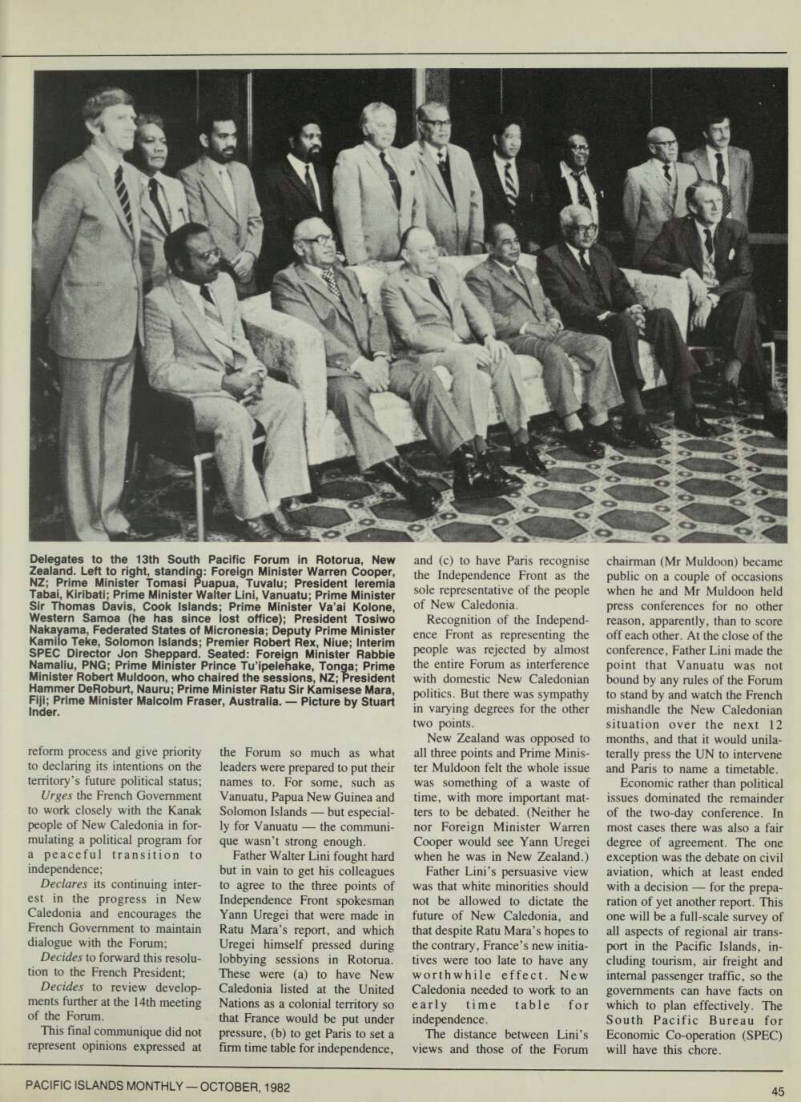
Delegates to the 13th South Pacific Forum in Rotorua, New Zealand. Left to right, standing: Foreign Minister Warren Cooper, NZ; Prime Minister Tomasi Puapua, Tuvalu; President leremia Tabai, Kiribati; Prime Minister Walter Lini, Vanuatu; Prime Minister Sir Thomas Davis, Cook Islands; Prime Minister Va’ai Kolone, Western Samoa (he has since lost office); President Tosiwo Nakayama, Federated States of Micronesia; Deputy Prime Minister Kamilo Teke, Solomon Islands; Premier Robert Rex, Niue; Interim SPEC Director Jon Sheppard. Seated: Foreign Minister Rabbie Namaliu, PNG; Prime Minister Prince Tu’ipelehake, Tonga; Prime Minister Robert Muldoon, who chaired the sessions, NZ; President Hammer DeRoburt, Nauru; Prime Minister Ratu Sir Kamisese Mara, Fiji; Prime Minister Malcolm Fraser, Australia. Picture by Stuart Inder.
On one aspect of aviation’s future in the region there was general agreement nobody wants a Flying Forum Line. But there have to be ways in which the regional airlines can co operate in aircraft use, spare parts, services, bookings, fuel, schedules, etc. and the survey is aimed at providing a basis on which sensible decisions can be made.
Mr Muldoon made it clear that New Zealand wanted nothing to do with the Australian airline Ansett, which New Zealand is convinced is attempting to force its way into the lucrative Tasman services. Other critics, including Nauru, had things to say about Ansett’s widening interests in airlines in the region, which Nauru naturally enough sees as competition with Air Nauru. The debate finally developed at cross purposes. Some delegations, in cluding New Zealand’s, were in terested in the regional overview, with others taking a bilateral ap proach. On bilateral matters, there were useful negotiations done outside the conference in hotel rooms.
There was no problem at all about achieving Forum unity when it came to criticising the United States for its refusal to sign the Law of the Sea Conven tion later this year, or condemn ing the U.S. for its failure to recognise the sovereign rights of Pacific countries over all fish, including highly migratory species, found within their fish ing zones.
The Forum stressed “the vital importance of fisheries compris ing highly migratory species” to the Forum countries, and “af firmed the commitment of the Forum members and observer countries to develop their fisheries resources to the benefit of their people. ’ ’ In short, it gave a strong warning to the U.S. that it was required to change its policy because the Island states had no intention of changing theirs.
The “observer countries” are Palau, the Marshall Islands, and the Federated States of Mic ronesia, all administered by the U.S. But the Federated States are now full members of the Forum Fisheries Agency as a result of the Rotorua meeting.
Without naming them, the Forum also hit out at the Japan ese, when it resolved that “dis tant water fishing nations should not link aid to fisheries access agreements,” and “deplored the recent tendency” of nations to make such a link. Kiribati has been the most vocal on this issue, having last year refused to re negotiate a fishing agreement with Japan when it found that its aid package from Japan depend ed on the extent of its fishing concession.
It regarded this as standover tactics, and said so, in the direct way that the smaller Pacific na tions have.
The fisheries decisions were an example of true regionalism in action. In the long term they could well turn out to be the most important and far-ranging deci sions yet made by the Forum.
They were drawn up by the Forum Fisheries Agency, and the finer points thrashed out earlier at ministerial level, thus allowing the leaders to endorse the ap proach with the minimum of debate.
Strangely, one of the older Forum nations, Fiji, later expre ssed misgivings on this ap proach, arguing that the Forum should avoid being used as a rubber stamp on decisions made elsewhere.
Some of the younger Forum members see this as commend able so long as the preparation gets done, and the big complaint last year was that not enough of the decisions had been taken at ministerial level, thus wasting the time of the leaders around the kava bowl. That problem was largely overcome this year, but it is likely that the right mix of efficient informality is not going to be easy to achieve. There is probably no likelihood of the South Pacific Forum ever return ing to the atmosphere of that first meeting in Wellington, 1971.
The debate, such as it was, on whether the Pacific is ready for a single regional organisation (SRO) to replace the South Pacif ic Commission (SPC) and the Forum’s technical secretariat, SPEC, did show the value of preparation.
This is a dialogue that both the Forum and the SPC have been having for years, with no result.
Finally last year the Forum called for a report on just what an SRO meant, and hundreds of man hours have since gone into find ing out.
PNG came up with a set of answers, SPEC with another, and a committee earlier this year put it all together so the Forum could make a final decision at Rotorua.
What it boiled down to was, could you make SPC and SPEC into one body, make the Forum superior to it, find a headquarters, site satisfactory to everybody, organise the funds to run it, and find a place in it for the U.S., France and the United Kingdom, who are not members of the Forum?
From the administrative point of view the committee con sidered that an SRO would be more cost-effective, and would function more effectively, bring ing about better use of available regional resources, and that therefore there could be “advan tages” in establishing it.
But when it looked at the political implications it virtually
threw up its hands in horror. It could make no recommendation on that score other than to say that the “political implications would need to be carefully weighed”.
Here was the political minefield as the committee saw it: “The committee considered that the authority of the Forum must remain paramount. The problem is that any explicit as sertion of Forum authority over a single regional organisation would raise serious doubts about the continued participation of France, the United States and the United Kingdom . . .
“It also recognised that, while a centralised secretariat would be more efficient and economic to operate, the French attitude to a decision to locate all elements of a single regional organisation away from the present SPC head quarters at Noumea would re quire further exploration.
“The committee foresaw the need to explore further the legal and constitutional implications which would be involved should
a single regional organisation be brought into being, and that in certain countries constitutional factors could be linked to finan cial considerations.
“The committee recognised that a political decision to pro ceed with the formation of a single regional organisation in volved the risk that France, the United States and the United Kingdom could cease to be in volved as partners in a regional organisation.”
The Forum never has really been enthusiastic about this ques tion of an SRO, and the thorough
investigation into the implica
tions of a change finally gave members the opportunity to put it away in the too-hard basket.
There are those who feel that Australia and New Zealand, through the purse strings, exert too great an influence on the Pacific through the SPC, and would like to see the SPC cur tailed. But others feel that getting rid of SPC would create more problems than it solved, and that
eventually the thing might well
resolve itself.
It is unlikely that the SRO will appear on next year’s agenda. It didn’t even rate a mention in this year’s final communique.
On other business: • The SPARTECA trade ag reement was not an issue at Rotorua. The meeting did little more than acknowledge that with Nauru’s accession to the agree ment on August 8, all Forum Island countries were now mem bers of the agreement. • There was an easy passage for an inquiry by the U.S. Gov ernment as to whether the Forum countries would be interested, in principle, in having a piece of a communications satellite it was planning to put over the Pacific in 1983. It would cost $U.5.650,000 for South Pacific use but another $5 million if it was to be equipped to cover the Pacific as far north as the North ern Marianas plus, in all cases, the cost of ground sta tions. As the U.S. was interested at this stage only in finding out whether there were likely to be any takers, and the Forum had nothing to lose by saying yes and
awaiting detailed costings, it said yes. • The question of establishing a Pacific Islands Fund for loans to Island nations was put aside for a further report next year.
The smaller islands, who would probably make best use of it, were concerned about cost con trols, and sought more information. • Mahe Tupouniua was ap pointed new director of SPEC in place of Dr Gabriel Gris, of PNG, who died in office in March. There was no debate; the Forum rubber-stamped a deci sion made at the informal meet ing of leaders on the Sunday, and thus set off some rumblings that are likely to be heard for some time.
Mahe is the competent found ing director of SPEC, who went back to his post as Finance Minister of Tonga in 1980 after seven years as director. Recently he resigned as Finance Minister, but he had not made application for the SPEC post, nor had Ton ga officially put his name for ward (it felt it wouldn’t be right
to do so, since he had already had a long term as director).
But, as Ratu Mara said later, his name “popped up”, and Ratu Mara certainly was one who pressed for his appointment, on the ground that he was efficient and had the required stature to enable him to deal with governments.
In all other circumstances that might well have been the end of it a timely and satisfactory choice. But there was in fact a formal applicant, and formally sponsored by Kiribati Babera Kirata, Kiribati’s Minister for Natural Resources.
Kirata’s last-minute by passing left a nasty taste in some mouths, notably of those who felt that Melanesia and Polynesia had had an unbroken record in winning top posts in the SPC and SPEC, and that when the oppor tunity had come, at last, for a competent Micronesian to take his turn, he had been rejected.
Here was a case when more conference formality and less ka va-bowl politics might have pro duced a more acceptable result.