A new Micronesia booklet
pp. 53-55 · Read in the full issue
that tells it like it is
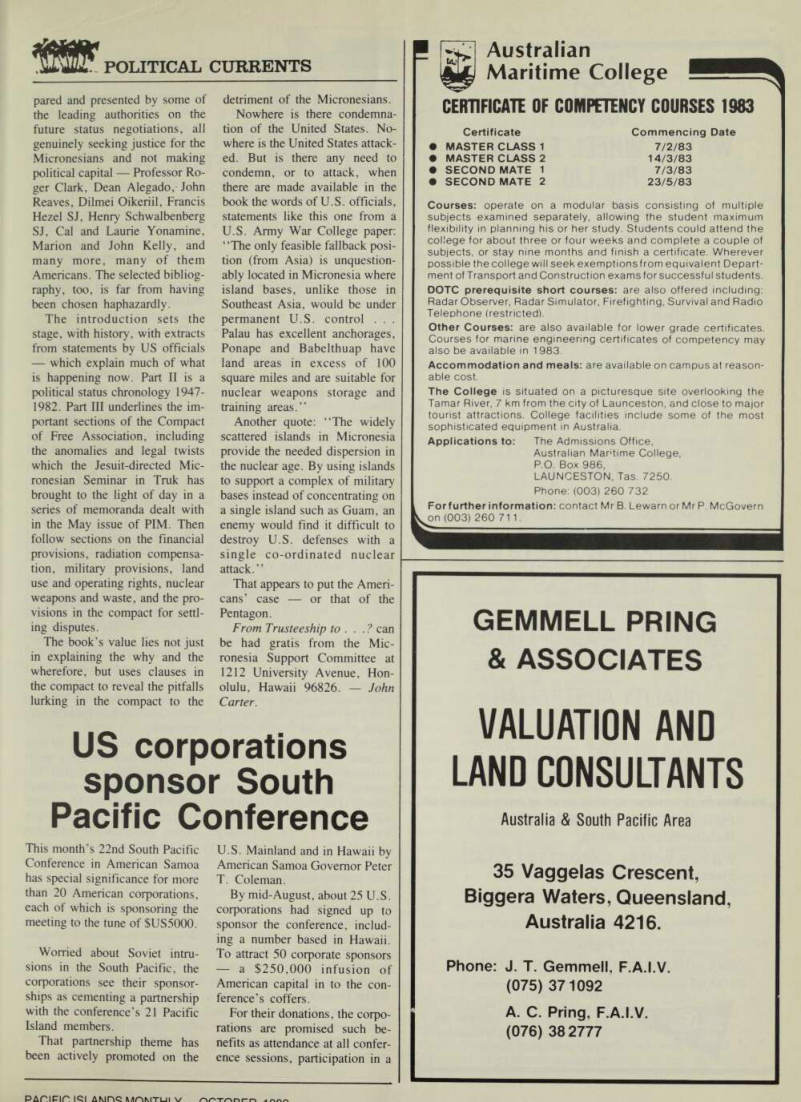
On the inside back cover of a yellow-backed booklet which ar rived at PlM’s office recently, there’s a drawing not unlike the traditional story boards of Mic ronesia. It shows a man in a sail
rigged outrigger canoe, obvious
ly nonplussed, because there’s a
big question mark ballooning
above his head. Three islands lie ahead the island of Free As-
sociation, the island of Common wealth, and the island of
Independence.
Which explains in a nutshell what the book is all about, and the dilemma facing the people of Micronesia. What do they want as their political future? What will the Americans let them have? There are no answers in this book From Trusteeship to . . . ? Micronesia and its Future, a joint publication of the Mic ronesia Support Committee and Pacific Concerns Resource Cent er, both of Honolulu.
But it’s a mine of information on the relationship between the United States, as Trustee of the Trust Territory of the Pacific Islands, which is Micronesia, and the Micronesians.
A few months ago, it looked as if the road-end was just around the comer, but that was before the Americans put Ronald Reagan into the White House, to undo much that had been done; to some it seemed for the sake of proving that he could do it. May be, it has something to do with missing out on a star part in a film. Maybe, but more likely, as with his actions over the Law of the Sea Convention, because he listened to some powerful voices
Big Business lobbying over the Law of the Sea and the ocean’s wealth; the Pentagon breathing heavily in his ear over the strategic importance of those 2000-plus islands of Micronesia.
Strategic importance is, most probably, the nub of the thing.
As the book points out, in 1947, the United Nations designated Micronesia as the world’s only “strategic” Trust Territory, granting the United States power to use the islands for military activities. The Japanese used them as a launching pad in their attack on the United States. After American blood had been shed in winning them back from the Japanese, Americans said that never again would those islands be used as an anti-American base. That explains much of what has transpired in the negoti ations between the United States and the Micronesians.
Several years ago, in a radio hook-up discussion with Roger Gale, then at Berkeley Universi ty, and Gaven Dawes, of the University of Hawaii, over Mic ronesia, I suggested in a mild sort of defence of the U.S., that its attitude to its trusteeship was schizophrenic the Pentagon wanted military considerations to be paramount in the United States’ dealings with the Mic ronesians, while the State De partment, like all good Ameri cans, wanted them treated in all sorts of generous ways. The Pen tagon seems to have won most of the arguments behind the brass knobs and handles of the White House.
You can’t blame the Ameri cans altogether. Had it not been for that UN designation things might have been different.
The Kwajalein landowners might not now be invading their own land, and the Americans might not have adopted the tough attitude they have at the moment.
But, read it for yourself. It’s all there in this book, at least the case for the Micronesians, pre-
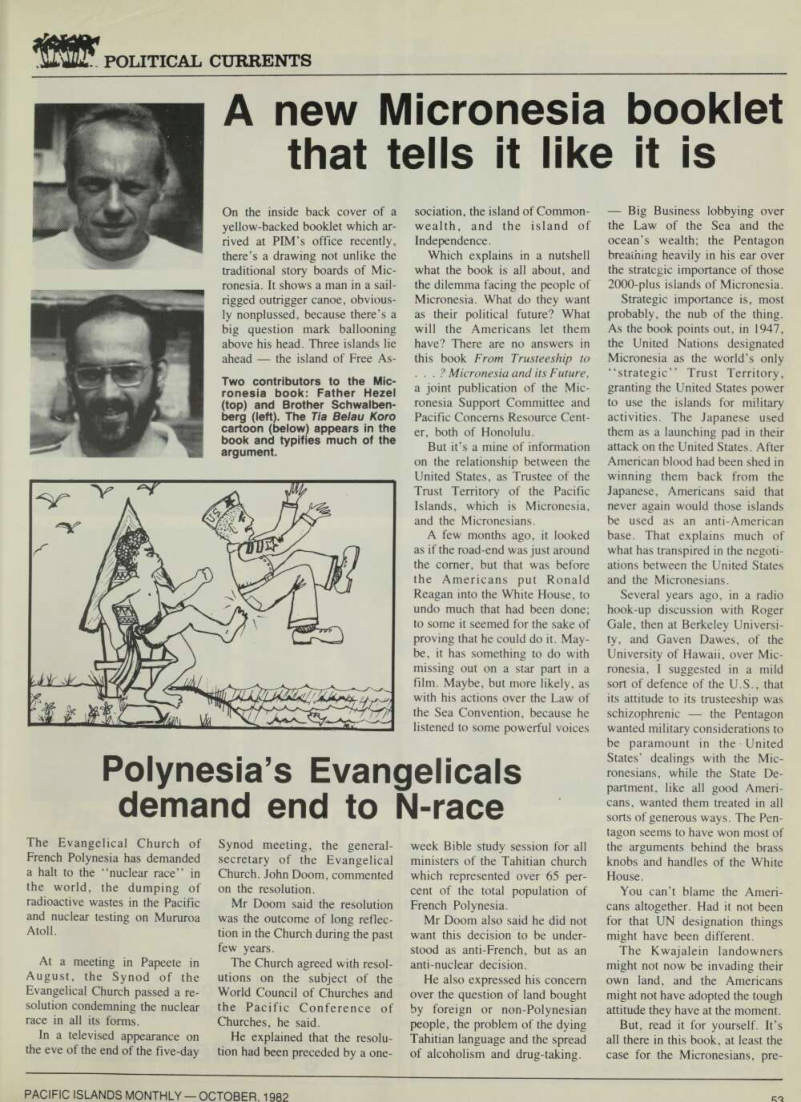
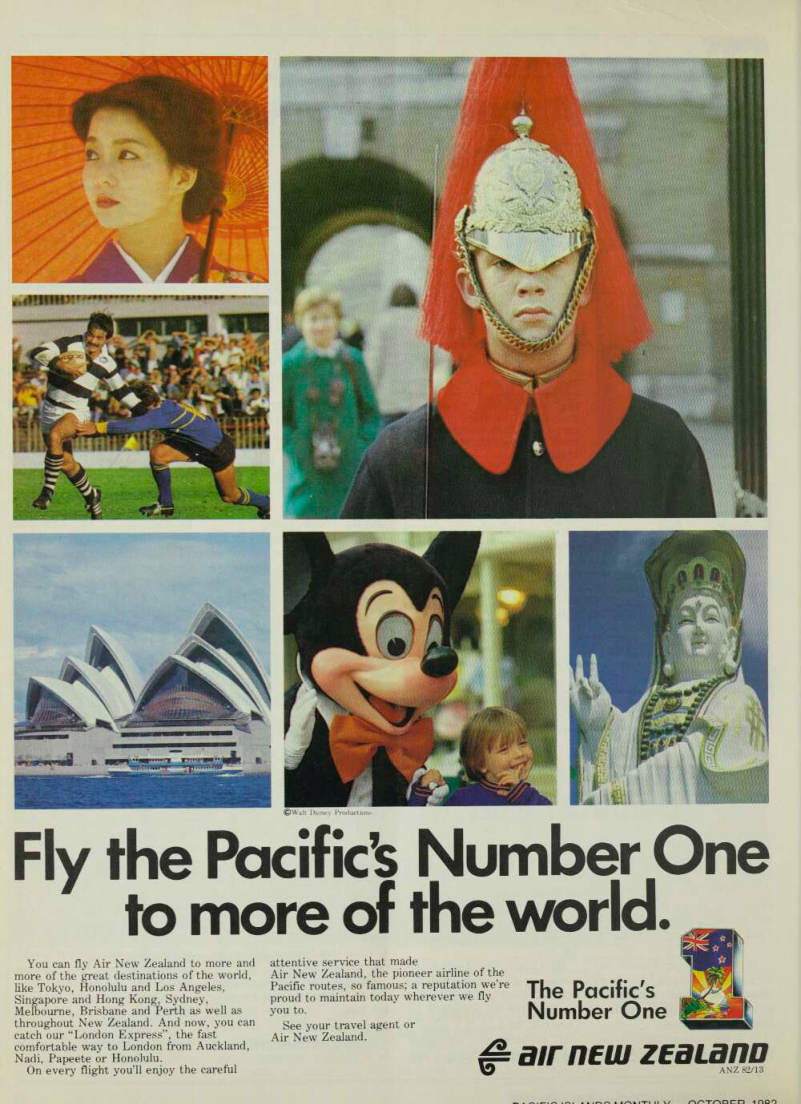
Two contributors to the Mic ronesia book: Father Hezel (top) and Brother Schwalben berg (left). The Tia Belau Koro cartoon (below) appears in the book and typifies much of the argument.
pared and presented by some of the leading authorities on the future status negotiations, all genuinely seeking justice for the Micronesians and not making political capital Professor Ro ger Clark, Dean Alegado, John Reaves, Dilmei Oikeriil, Francis Hezel SJ, Henry Schwalbenberg SJ, Cal and Laurie Yonamine, Marion and John Kelly, and many more, many of them Americans. The selected bibliog raphy, too, is far from having been chosen haphazardly.
The introduction sets the stage, with history, with extracts from statements by US officials which explain much of what is happening now. Part II is a political status chronology 1947- 1982. Part 111 underlines the im portant sections of the Compact of Free Association, including the anomalies and legal twists which the Jesuit-directed Mic ronesian Seminar in Truk has brought to the light of day in a series of memoranda dealt with in the May issue of PIM. Then follow sections on the financial provisions, radiation compensa tion, military provisions, land use and operating rights, nuclear weapons and waste, and the pro visions in the compact for settl ing disputes.
The book’s value lies not just in explaining the why and the wherefore, but uses clauses in the compact to reveal the pitfalls lurking in the compact to the
detriment of the Micronesians.
Nowhere is there condemna tion of the United States. No where is the United States attack ed. But is there any need to condemn, or to attack, when there are made available in the book the words of U.S. officials, statements like this one from a U.S. Army War College paper: “The only feasible fallback posi tion (from Asia) is unquestion ably located in Micronesia where island bases, unlike those in Southeast Asia, would be under permanent U.S. control . . .
Palau has excellent anchorages, Ponape and Babelthuap have land areas in excess of 100 square miles and are suitable for nuclear weapons storage and training areas.’’
Another quote: “The widely scattered islands in Micronesia provide the needed dispersion in the nuclear age. By using islands to support a complex of military bases instead of concentrating on a single island such as Guam, an enemy would find it difficult to destroy U.S. defenses with a single co-ordinated nuclear attack.”
That appears to put the Ameri cans’ case or that of the Pentagon.
From Trusteeship to . . . ? can be had gratis from the Mic ronesia Support Committee at 1212 University Avenue, Hon
olulu, Hawaii 96826.
John
Carter.