Withstands205MPH Cyclone
p. 40 · Read in the full issue
Low Cost House Withstands205MPH Cyclone
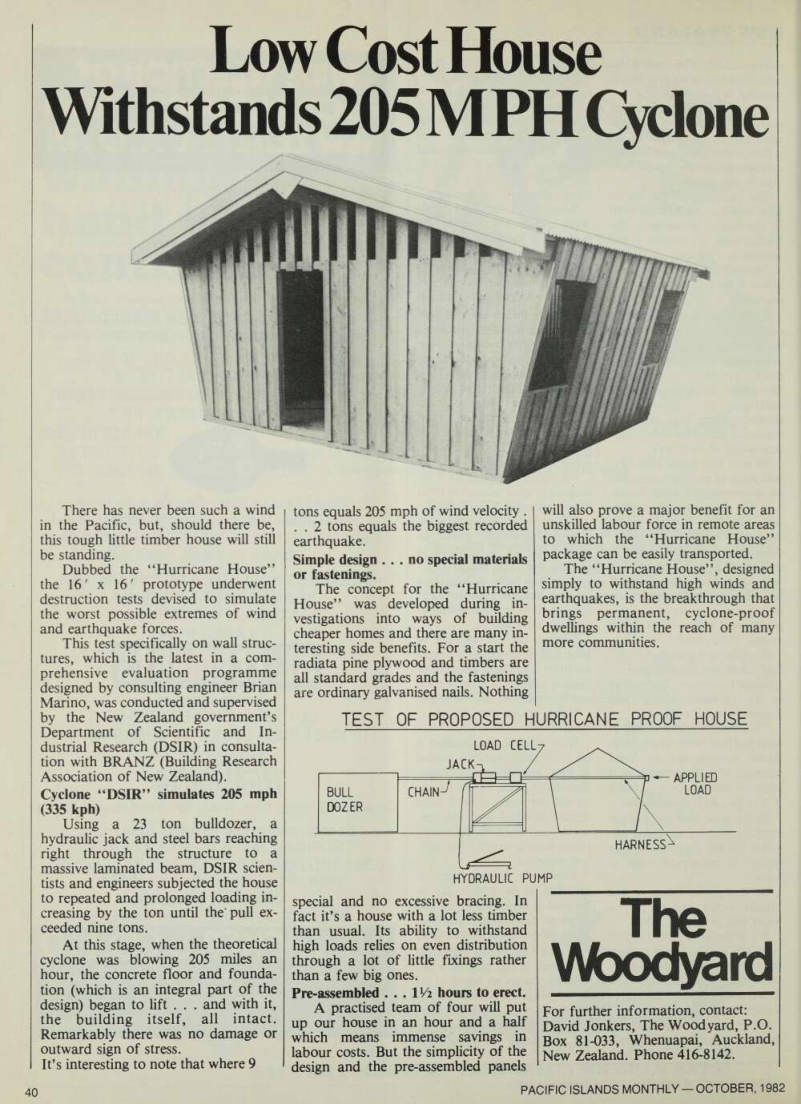
There has never been such a wind in the Pacific, but, should there be, this tough little timber house will still be standing.
Dubbed the “Hurricane House” the 16' x 16' prototype underwent destruction tests devised to simulate the worst possible extremes of wind and earthquake forces.
This test specifically on wall struc tures, which is the latest in a com prehensive evaluation programme designed by consulting engineer Brian Marino, was conducted and supervised by the New Zealand government’s Department of Scientific and In dustrial Research (DSIR) in consulta tion with BRANZ (Building Research Association of New Zealand).
Cyclone “DSIR” simulates 205 mph (335 kph) Using a 23 ton bulldozer, a hydraulic jack and steel bars reaching right through the structure to a massive laminated beam, DSIR scien tists and engineers subjected the house to repeated and prolonged loading in creasing by the ton until the'pull ex ceeded nine tons.
At this stage, when the theoretical cyclone was blowing 205 miles an hour, the concrete floor and founda tion (which is an integral part of the design) began to lift . . . and with it, the building itself, all intact.
Remarkably there was no damage or outward sign of stress.
It’s interesting to note that where 9
tons equals 205 mph of wind velocity . . . 2 tons equals the biggest recorded earthquake.
Simple design ... no special materials or fastenings The concept for the “Hurricane House” was developed during investigations into ways of building cheaper homes and there are many interesting side benefits. For a start the radiata pine plywood and timbers are all standard grades and the fastenings are ordinary galvanised nails. Nothing
will also prove a major benefit for an unskilled labour force in remote areas to which the “Hurricane House” package can be easily transported.
The “Hurricane House”, designed simply to withstand high winds and earthquakes, is the breakthrough that brings permanent, cyclone-proof dwellings within the reach of many more communities.
special and no excessive bracing. In fact it’s a house with a lot less timber than usual. Its ability to withstand high loads relies on even distribution through a lot of little fixings rather than a few big ones.
Pre-assembled . . . IVi hours to erect.
A practised team of four will put up our house in an hour and a half which means immense savings in labour costs. But the simplicity of the design and the pre-assembled panels