NZ and the Islands:
pp. 35-39 · Read in the full issue

A SPECIAL SURVEY OF NZ IN THE PACIFIC NZ and the Islands: “United we stand, divided we fall..
New Zealand’s philosophy de veloped in recent years in con nection with its relationship with the South Pacific Islands follows the theme: United we stand, di vided we fall.
That’s not an original concept but, more and more, New Zea land realises it is in its interests to have a healthy community of states developing a partnership within the region.
The benefits of that develop ment from political, economic and security angles must be obvious to the Island states as well.
If there is an over-riding theme in New Zealand’s involvement with the Island countries it is “to observe their wishes and to en courage regional co-operation if that is what the people want’’.
Always New Zealand’s ap proach to Island affairs is cauti ous. That’s partly because no other country in the South Pacific finds itself in such a difficult position as New Zealand. Its development pangs are as great as those experienced by its Island neighbors.
First, you have a people reorientating themselves to the South Pacific and Asia. For gen erations their gaze rested on Bri tain and Europe and their fate lay with these regions. This has changed.
Second, you have New Zea-
land looked on as the Mecca for Island people. Communities of Islanders are fast developing in the country. When the Minister of Foreign Affairs, Warren Cooper, can be seen dancing with Cook Island children at lun chtime in front of Parliament then you begin to realise the growing impact of Islanders in the New Zealand scene. Couple those developments with a res tive Maori population, and it can easily be perceived that the social
scene is undergoing considerable change. The dawn raids against Island overstayers some years back, and the current upheaval created over the Privy Council’s decision on New Zealand citizen ship for so many Western Sa moans, are chapters of that evolution.
Third, you find New Zealand conscious of its “Big Brother” image among the smaller Island states and sensitive to the fact that its assistance and guidance
William Gasson In
Wellington surveys New Zealand’s complex and developing relation ships with the Island countries of the South Pacific. Saying that New Zealand, too, is a developing and chang ing country, he directs attention to changes within the country which arise specifically from its relationships with the world of the Islanders.
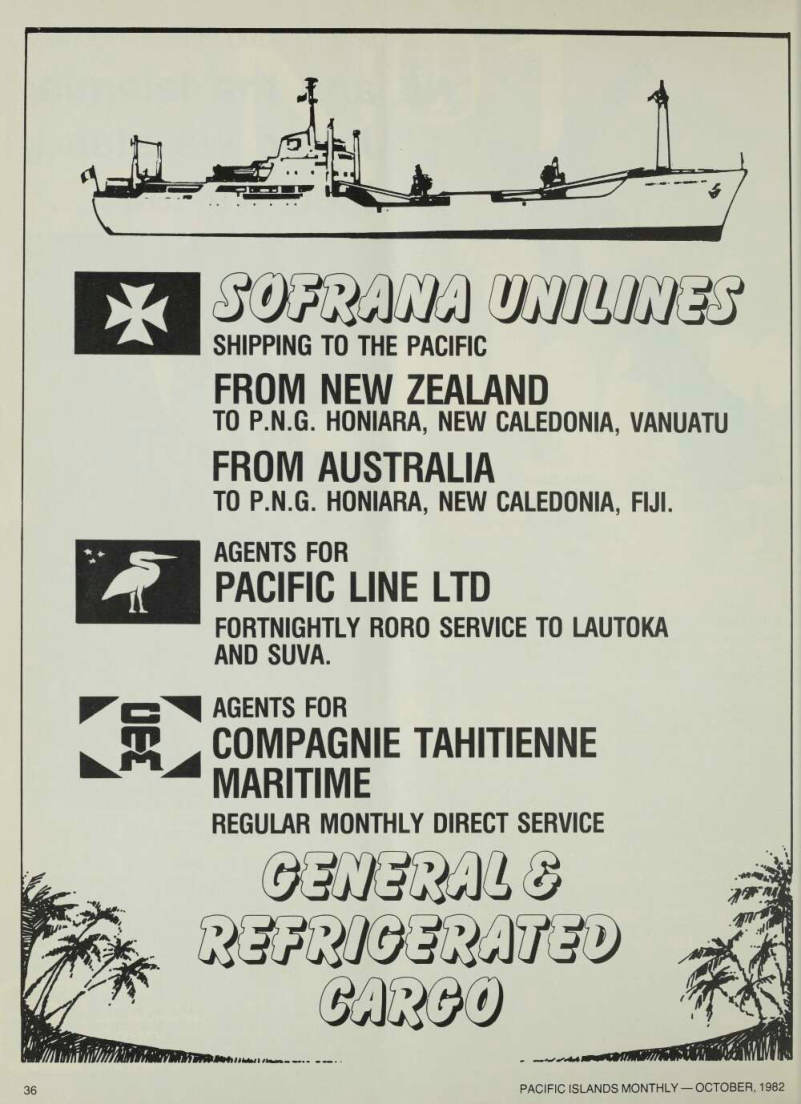
Kava ceremony with New Zealand Prime Minister Robert Muldoon: Acceptance of a Pacific identity.
could be misinterpreted as an unwanted dominance of these people. But that’s neither a New Zealand characteristic nor gov ernment policy.
Fourth, you find New Zea land, more than most countries, sensitive to the enormous economic problems the Islands face. But while it gives aid and directs more and more help to the region, it wants the regional gov ernments to make the hard deci sions on how they wish to de velop their economies. It wants the people to stand on their own feet and it’s prepared to prod them into action with verbal warnings if necessary. That, too, can create misunderstandings.
In the last few years, any trend in New Zealand’s relationship with the South Pacific has been to broaden its relationship right across the horizon. From the eastern regions it has swung its attention more and more to the western Pacific with the Melane
“If the Privy Council had a better understanding of the relationship in this part of the world, I do not believe it would have come to the same decision, but that is in the past . 99 Mr Muldoon on the Privy Council’s decision that gave some 100,000 Western Samoans New Zealand
citizenship.
sian Islands and Papua New Guinea.
Aid figures reflect the interest in Vanuatu, the Solomon Islands and Papua New Guinea. The major interest still lies in West ern Samoa, the Cook Islands, and Niue, but New Zealand has now more consciously embraced the whole region.
If New Zealand’s security hinges on political stability and economic development in the re gion, then this practical example of regional co-operation can achieve those goals more quickly.
Bilateral aid to the South Pacific this financial year has increased seven per cent to $38,266 million out of the coun try’s total bilateral aid allowance of $53 million. Last year South Pacific countries received $34,606 million.
Inflation and currency fluctua tions in the New Zealand dollar take away from the true value of
the aid figure, and New Zea land’s own financial problems make it unlikely the aid figure will jump substantially for some years. But the emphasis con
tinues towards the South Pacific.
The region also gets the big gest share of multi-lateral aid.
Increases bring the totals for the South Pacific Commission to $675,000, the South Pacific Bureau for Economic Co operation to $372,000, and the Forum Fisheries Agency to $203,000.
Further, about $7.8 million has been set aside for the South Pacific shipping services.
With the aid comes the em phasis on trade, and an element of self-development through the Pacific Islands Industrial De velopment Scheme (PUDS), and the South Pacific Regional Trade and Economic Co-operation Ag reement (SPARTECA).
The broad objective of PUDS is to foster economic develop ment and to provide employ ment, develop skills, introduce technology and broaden the pro ductive base of Island economies. It’s intended to pro
vide a framework for linking the development strategies of New Zealand and the Island nations.
Support under this scheme so far has totalled $876,000. Since its inception in 1976, financial assistance and incentives have been extended to 82 New Zea land firms to establish manufac turing operations in the Islands.
Feasibility study assistance has been approved to another 26 companies.
From the companies that re ceived full PUDS approval, 46 are now operating, five went out of business and four failed to develop. The operating com panies have provided jobs for about 600 people, including 158 in Fiji alone.
Tonga comes next with 142, then Western Samoa 134, the Cook Islands 74, Niue 54 and the Solomon Islands 34.
While New Zealand officials
“Recently I attended the diamond jubilee of my old school to find that the head prefect was a Samoan boy, while some of his Pacific Island mates lent size and strength to the pack of the first rugby fifteen — Mr Muldoon giving an example of the extent of Island migration to New Zealand.
are not happy that some of the schemes failed, the variety of the projects is considerable.
The Cook Islands are involved in roofing iron and joinery, ballet shoes, thonged footwear, pro cessed timber, fibreglass rein
forced plastic tanks, school drill wear and aluminium joinery.
Western Samoan industries have been based on industrial gases, carbonic ice, annato seed processing, metalware, house hold paper products, cigarettes, handbags, pharmaceuticals, paints and fillers, biscuits, light fittings and plasterboard.
The SPARTECA Agreement which came into effect last year opened up the New Zealand and Australian markets to the widest possible range of goods from South Pacific Forum Island countries.
New Zealand was able to give licence and duty-free entry to almost anything that could be produced in the Island countries.
The main exceptions were orange, pineapple and passion fruit where New Zealand had a commitment to take the total production of the Cook Islands and Niue.
Coconut oil has a similar re straint but, as pineapple canning in the Cook Islands has now ceased, restraint on pineapple is likely to be removed.
Transport is the key to the development of Island economies and the 13th South Pacific Forum in Rotorua in Au gust addressed itself to this issue with two important results: • Forum member countries ple dged SUSI 2.6 million which qualified the Pacific Forum Ship ping Line for a European Invest ment Bank loan of $5 million plus a grant of $1 million to buy containers. • The Forum called for a study of the requirements of the reg ion’s air transport system.
Years ago New Zealand en
couraged the idea of a regional airline only to see independent states launch their own airlines and fly into prohibitive costs.
The mood now is for rationalisa tion, with a compatibility of equipment between airlines to
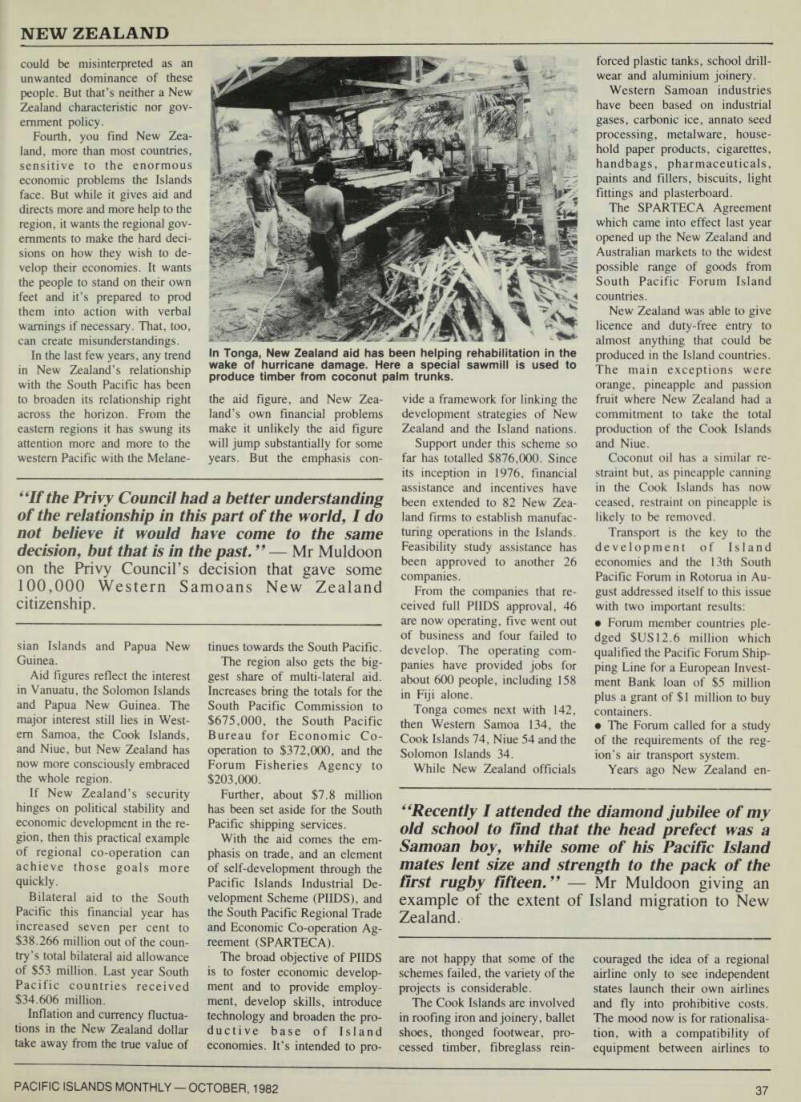
In Tonga, New Zealand aid has been helping rehabilitation in the wake of hurricane damage. Here a special sawmill is used to produce timber from coconut palm trunks.
minimise costs. The study is due to be reviewed at the next Forum meeting in Australia.
Both the Forum Line and the study on air transport represent
regional co-operation in its
widest sense and measure the commitment of the Island part ners in this principle.
The collapse of the Forum Line would sound the death knell of regional co-operation in the South Pacific. Its success and success in a regional air service strengthens the co-operative effect New Zealand strives to encourage.
It produces a flow-on effect to other Island communities outside the Forum group such as Ameri can Samoa, Guam and the Mic ronesian territories, and
strengthens the development of
relations with these com munities. These links help still dependent territories to develop a personality of their own.
As each year passes New Zea land is drawn more and more into the community of South Pacific nations. Each month heralds some new link. It might be the news that Cook Islanders in Au ckland plan to build their own $3 million five-storey community and commercial centre that will include shops, a gymnasium, a ballroom, conference rooms, professional office suites and a
student library-study.
It might be the hosting of the first South Pacific Congress in
Medical Laboratory Technology
in Christchurch where New Zealanders were told: “We have a responsibility to work and help in the whole South Pacific area, in less developed countries with less technological expertise than our own and it is a responsibility we neglect.”
At the same time not a single Pacific Island representative en rolled for the congress, despite efforts to encourage them to come.
Or it might be the news that Maoris would like to play a wider role in Pacific affairs.
It’s probably true to say that no South Pacific figure projects the region into the international arena more effectively than New Zealand’s Prime Minister Robert Muldoon.
Not everyone might like his personality, but few would doubt
his grasp of the region’s prob lems, his decision-making abili ty, his intense interest in the region and his determination to side with his Island neighbors on regional issues that clash with some of the greater advanced nations whether it’s the Un ited States over tuna fishing or France over nuclear tests.
When he travels abroad Mul doon speaks as much as the leader of a South Pacific nation with that region’s interests at heart as he does as leader of a
country populated predominantly
by people of European descent.
Recently the question of how to approach a Pacific economic community has concerned him.
He does not see such a concept coming to fruition inside at least the next two decades but already he is publicly trying to focus attention on the problem of fit ting the fragile economies of Island states into a Pacific
economic community.
His recent messages have at tempted to spell this out to other Pacific nations: “They will all be dependent to a very considerable extent on external aid for as far ahead as one can see,” he said.
“Their export potential is limited and the problems of transport both internal and inter national are immense.
“Some, but not all, can or indeed have developed a tourist industry. Some have potential or existing markets in New Zealand and Australia for their produce.
“For others the future is bleak.”
Knowledge of New Zealand in the international scene is limited at best and often inaccurate.
Knowledge of the Pacific Islands around the world is even more limited in detail and, one sus
pects, generalised via Hollywood
productions as wealth-laden trop
ical paradises.
Muldoon’s current batch of speeches on the Pacific has at
tempted to dispel the myths and
acquaint neighboring countries
of the problems the Islands face.
It’s the kind of role New Zea land feels it can play as a de veloped country on behalf of the developing territories in the South Pacific. What it can’t guarantee is that the greater pow ers will absorb the message.