People
pp. 31-33 · Read in the full issue
New Caledonia’s Alain Lazare won the International Gold Coast Marathon Race, run near Bris bane, Queensland, in August.
Lazare covered the 42.2 kilometres course in two hours, 19 minutes, 21 seconds. He took the lead early and finished almost 11 minutes ahead of his nearest rival.
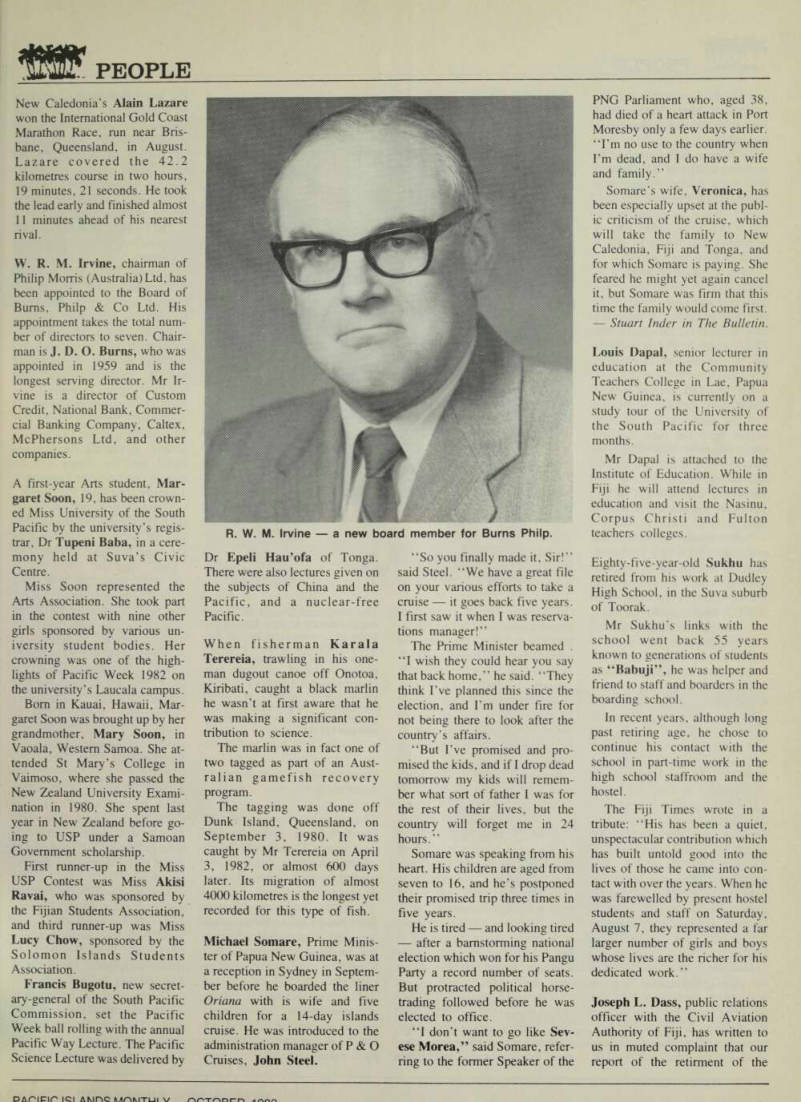
W. R. M. Irvine, chairman of Philip Morris (Australia) Ltd, has been appointed to the Board of Bums, Philp & Co Ltd. His appointment takes the total num ber of directors to seven. Chair man is J. D. O. Burns, who was appointed in 1959 and is the longest serving director. Mr Ir vine is a director of Custom Credit, National Bank, Commer
cial Banking Company, Caltex,
McPhersons Ltd, and other
companies.
A first-year Arts student, Mar garet Soon, 19, has been crown ed Miss University of the South Pacific by the university’s regis trar, Dr Tupeni Baba, in a cere mony held at Suva’s Civic Centre.
Miss Soon represented the Arts Association. She took part in the contest with nine other
girls sponsored by various un
iversity student bodies. Her crowning was one of the high lights of Pacific Week 1982 on the university’s Laucala campus.
Bom in Kauai, Hawaii, Mar garet Soon was brought up by her grandmother, Mary Soon, in Vaoala, Western Samoa. She at tended St Mary’s College in Vaimoso, where she passed the New Zealand University Exami nation in 1980. She spent last year in New Zealand before go ing to USP under a Samoan
Government scholarship.
First runner-up in the Miss USP Contest was Miss Akisi Ravai, who was sponsored by the Fijian Students Association, and third runner-up was Miss Lucy Chow, sponsored by the Solomon Islands Students Association.
Francis Bugotu, new secret ary-general of the South Pacific Commission, set the Pacific Week ball rolling with the annual Pacific Way Lecture. The Pacific Science Lecture was delivered by
Dr Epeli Hau’ofa of Tonga.
There were also lectures given on the subjects of China and the Pacific, and a nuclear-free Pacific.
When fisherman Karala Terereia, trawling in his one man dugout canoe off Onotoa, Kiribati, caught a black marlin he wasn’t at first aware that he was making a significant con tribution to science.
The marlin was in fact one of two tagged as part of an Aust ralian gamefish recovery program.
The tagging was done off Dunk Island, Queensland, on September 3, 1980. It was caught by Mr Terereia on April 3, 1982, or almost 600 days later. Its migration of almost 4000 kilometres is the longest yet recorded for this type of fish.
Michael Somare, Prime Minis ter of Papua New Guinea, was at a reception in Sydney in Septem ber before he boarded the liner Oriana with is wife and five children for a 14-day islands cruise. He was introduced to the administration manager of P & O Cruises, John Steel.
‘‘So you finally made it. Sir!” said Steel. ‘‘We have a great file on your various efforts to take a cruise it goes back five years.
I first saw it when I was reserva tions manager!”
The Prime Minister beamed .
“I wish they could hear you say that back home,” he said. ‘They think I’ve planned this since the election, and I’m under fire for not being there to look after the country’s affairs. ‘‘But I’ve promised and pro mised the kids, and if I drop dead tomorrow my kids will remem ber what sort of father I was for the rest of their lives, but the country will forget me in 24 hours.”
Somare was speaking from his heart. His children are aged from seven to 16, and he’s postponed their promised trip three times in five years.
He is tired and looking tired after a barnstorming national election which won for his Pangu Party a record number of seats.
But protracted political horse
trading followed before he was elected to office.
“I don’t want to go like Sev esc Morea,” said Somare, refer ring to the former Speaker of the
PNG Parliament who, aged 38, had died of a heart attack in Port Moresby only a few days earlier.
“I’m no use to the country when I’m dead, and I do have a wife
and family.”
Somare’s wife, Veronica, has been especially upset at the publ ic criticism of the cruise, which will take the family to New Caledonia, Fiji and Tonga, and for which Somare is paying. She feared he might yet again cancel it, but Somare was firm that this time the family would come first.
Stuart Inder in The Bulletin.
Louis Dapal, senior lecturer in education at the Community Teachers College in Lae, Papua New Guinea, is currently on a study tour of the University of the South Pacific for three months.
Mr Dapal is attached to the Institute of Education. While in Fiji he will attend lectures in education and visit the Nasinu, Corpus Christi and Fulton
teachers colleges.
Eighty-five-year-old Sukhu has retired from his work at Dudley High School, in the Suva suburb of Toorak.
Mr Sukhu’s links with the school went back 55 years known to generations of students as “Babuji”, he was helper and friend to staff and boarders in the
boarding school.
In recent years, although long past retiring age, he chose to continue his contact with the school in part-time work in the high school staffroom and the hostel.
The Fiji Times wrote in a tribute; ”His has been a quiet, unspectacular contribution which has built untold good into the lives of those he came into con tact with over the years. When he was farewelled by present hostel students and staff on Saturday, August 7, they represented a far
larger number of girls and boys
whose lives are the richer for his dedicated work.”
Joseph L. Dass, public relations officer with the Civil Aviation Authority of Fiji, has written to us in muted complaint that our report of the retirment of the
R. W. M. Irvine a new board member for Burns Philp.
former chief executive of the authority R. M. G. Varley (PIM Jun. p 36) did not do justice to the subject.
To help us make amends he enclosed a copy of the authori ty’s News Letter containing a long personal profile of “Mike”
Varley. While we cannot repro duce it in full, we hereby attempt to redress any wrong of which we may have been guilty.
After 33 years in aviation as World War II Royal Air Force navigator and later private pilot and civil aviation administrator in a number of countries, Mr Varley came to Fiji in 1974 to take up the post of Director of Civil Aviation.
His first task was to form a department capable of taking over the administration of Nadi airport from the New Zealand Civil Aviation Department on July 1, 1975, albeit still on be half of the South Pacific Air Transport Council (SPATC).
The target was met and he moved from Suva to Nadi.
Unfortunately the change over coincided with a decline in tourism, withdrawal of airlines, overflights and a consequential severe drop in income. The SPATC bank account at Nadi was heavily overdrawn at the outset. However, by the in troduction of economies, a re vised policy on charges to air craft, and the introduction of new sources of revenue, the depart ment was able to produce an operating surplus for Nadi Air port by 1978. It was then decided by its members to disband SPATC and hand Nadi Airport over entirely to Fiji.
To take the airport over and run the civil aviation infrastruc ture as a whole it was decided by the government to form the Civil Aviation Authority of Fiji. The authority came into being on October 1, 1979, and Mike ceased to be director of civil aviation. His task completed, he began preparing to return to England.
However, the then Minister for Civil Aviation, Tomasi Vakatora, indicated that he would be happy for Mike to head the authority for at least its first two years of operation. He ap plied for the post and the UK
Government agreed to his con tinued secondment up to his re tirement in 1982. That time has arrived. Jone Koroitamana took over as chief executive on January 1, 1982, and it was agreed that Mr Varley should stay on for a further seven months until the completion of his contract in an advisory
capacity.
During his stay in Fiji Mike was accompanied by his wife Joan, and between 1975 and 1977 his younger son Roderick attended Natabua High School.
His swan song was chairing the 17th meeting of the Direc tors-General of Civil Aviation in Asia and the Pacific which was held at Nadi in November 1981.
The delegates to this meeting were unanimous in their praise of the CAAF and its staff, as an example of what can be achieved in a small state.
Mike said recently: “Since go ing to Indonesia in 1955 I have
been helping developing coun
tries to localise their civil avia tion infrastructure, and I am
proud to have played a part in doing so in Fiji.”
Champagne flowed at 70 Elizabeth Street, Sydney, on Fri day, August 13, when the Pacif ic’s newest airline, Air Vanuatu, opened its first ticket office in Australia.
Vanuatu Transport Minister John Naupa cut a ribbon then surprised all and sundry by cal ling on Presbyterian pastor Bill Camden to dedicate the enterprise.
A Sydney newspaper colum nist commented: “Unusual ges ture in the airline business but not in Vanuatu, where Christian ity is taken seriously.”
Fiji has a valuable new asset in its tourist diving industry. He is Burnie Grayson, an Australian trained Professional Association of Diving Instructor (PADI) Gold Scuba Diving Instructor, who has recently joined the staff of Scubahire Ltd, a leading sport
diving organisation.
The firm will now be conduct ing certification courses for visit
ing divers.
Lorraine Evans on behalf on the company will be offering overseas agents group itineraries for novices who wish to take advantage of this novel service.
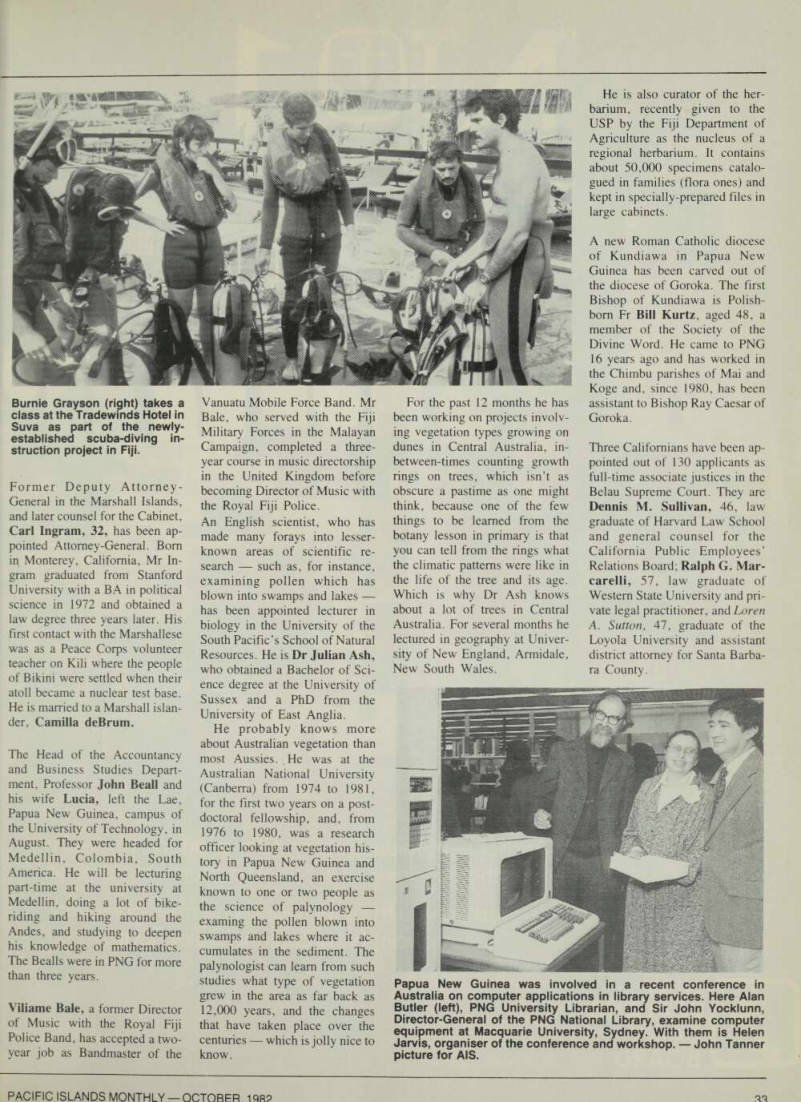
Scuba-diving is one of the world’s fastest-growing sports and there are now speciality div ing travel agents in many coun tries. The “classroom” work for Scubahire’s (PADI) courses will be conducted in the Convention Centre of Suva’s Trade winds Hotel, and the diving will be carried out from the company’s 13-metre dive boat Fiji Diver.
Grayson was one of Aust ralia’s best known instructors be fore he decided on the shift to Fiji, and was one of only five “Gold” qualified instructors in the country at that time. The “Gold” qualifications means that he is cleared by PADI the world’s largest such body, to teach and certify in seven spe ciality areas, as well as to certify divers up to assistant instructor level. Specialities available will include Rescue, Underwater
Photography, Research Diving
(including basic Oceanography and Marine Biology), Search and
Recovery and Deep Diving.
A plan to reduce or eliminate wheat imports into Papua New Guinea by using local flour made from a soya-cassava blend has been outlined by a University of Papua New Guinea food chemis try student.
Miss Carmel Pilotti, a final year student from Port Moresby, says commercial production of bread made from such composite flour will depend greatly on public acceptance. Further tests
will certainly be required.
The proposal was presented at a seminar by food chemistry stu dents. The seminar dealt with replacing food imports with local
food.
George Taunakekei.
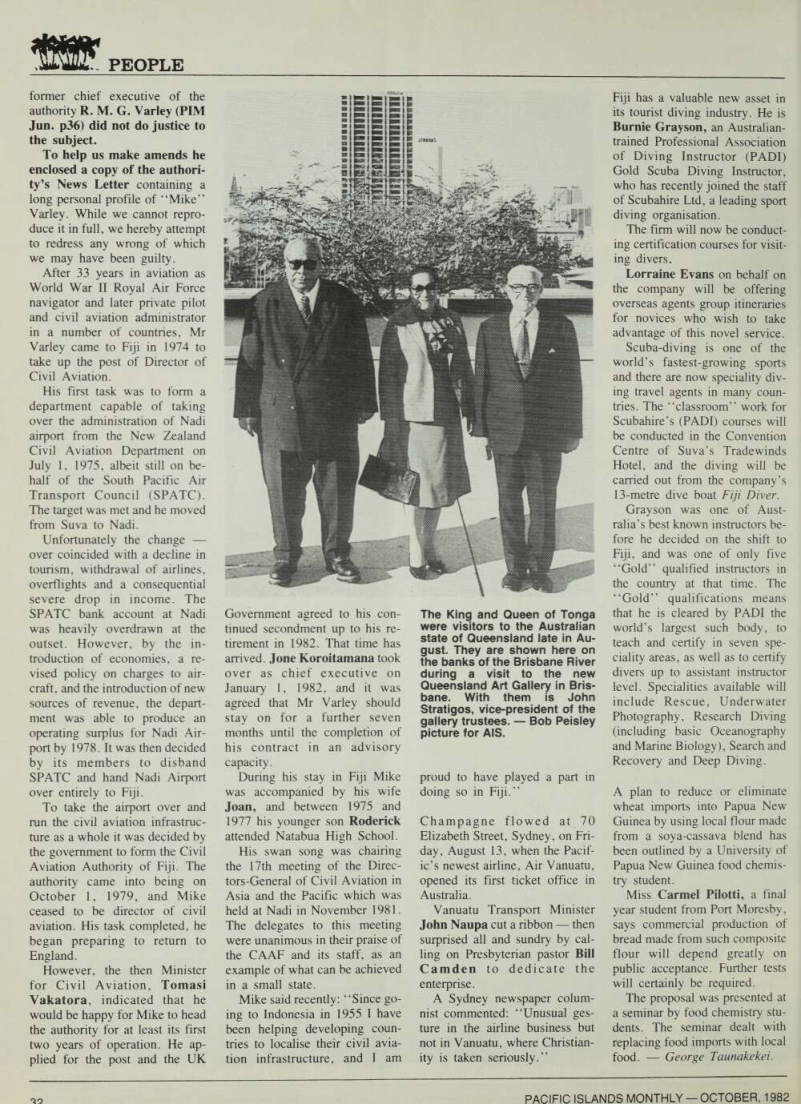
The King and Queen of Tonga were visitors to the Australian state of Queensland late in Au gust. They are shown here on the banks of the Brisbane River during a visit to the new Queensland Art Gallery in Bris bane. With them is John Stratigos, vice-president of the gallery trustees. - Bob Peisley picture for AIS.
Former Deputy Attorney- General in the Marshall Islands, and later counsel for the Cabinet, Carl Ingram, 32, has been ap
pointed Attorney-General. Bom
in Monterey, California, Mr In gram graduated from Stanford University with a BA in political science in 1972 and obtained a law degree three years later. His first contact with the Marshallese was as a Peace Corps volunteer teacher on Kili where the people of Bikini were settled when their atoll became a nuclear test base.
He is married to a Marshall islan der, Camilla deßrum.
The Head of the Accountancy and Business Studies Depart ment, Professor John Beall and his wife Lucia, left the Lae, Papua New Guinea, campus of the University of Technology, in August. They were headed for Medellin, Colombia, South America. He will be lecturing part-time at the university at Medellin, doing a lot of bike riding and hiking around the Andes, and studying to deepen his knowledge of mathematics.
The Bealls were in PNG for more than three years.
Viliame Bale, a former Director of Music with the Royal Fiji Police Band, has accepted a two year job as Bandmaster of the
Vanuatu Mobile Force Band. Mr Bale, who served with the Fiji Military Forces in the Malayan
Campaign, completed a three
year course in music directorship in the United Kingdom before becoming Director of Music with
the Royal Fiji Police.
An English scientist, who has made many forays into lesser known areas of scientific re search such as, for instance,
examining pollen which has
blown into swamps and lakes has been appointed lecturer in biology in the University of the South Pacific’s School of Natural Resources. He is Dr Julian Ash, who obtained a Bachelor of Sci ence degree at the University of Sussex and a PhD from the
University of East Anglia.
He probably knows more about Australian vegetation than most Aussies. He was at the Australian National University (Canberra) from 1974 to 1981, for the first two years on a post doctoral fellowship, and, from 1976 to 1980, was a research officer looking at vegetation his tory in Papua New Guinea and North Queensland, an exercise known to one or two people as the science of palynology examing the pollen blown into swamps and lakes where it ac cumulates in the sediment. The palynologist can learn from such studies what type of vegetation grew in the area as far back as 12,000 years, and the changes that have taken place over the centuries which is jolly nice to know.
For the past 12 months he has been working on projects involv ing vegetation types growing on dunes in Central Australia, in between-times counting growth rings on trees, which isn’t as obscure a pastime as one might think, because one of the few things to be learned from the botany lesson in primary is that you can tell from the rings what the climatic patterns were like in the life of the tree and its age.
Which is why Dr Ash knows about a lot of trees in Central Australia. For several months he lectured in geography at Univer sity of New England, Armidale, New South Wales.
He is also curator of the her barium, recently given to the
USP by the Fiji Department of
Agriculture as the nucleus of a regional herbarium. It contains about 50,000 specimens catalo gued in families (flora ones) and kept in specially-prepared files in
large cabinets.
A new Roman Catholic diocese of Kundiawa in Papua New Guinea has been carved out of the diocese of Goroka. The first Bishop of Kundiawa is Polish bom Fr Bill Kurtz, aged 48, a member of the Society of the Divine Word. He came to PNG 16 years ago and has worked in the Chimbu parishes of Mai and Koge and, since 1980, has been assistant to Bishop Ray Caesar of Goroka.
Three Californians have been ap pointed out of 130 applicants as full-time associate justices in the Belau Supreme Court. They are Dennis M. Sullivan, 46, law graduate of Harvard Law School and general counsel for the California Public Employees’
Relations Board; Ralph G. Mar carelli, 57, law graduate of Western State University and pri vate legal practitioner, and Loren A. Sutton, 47, graduate of the
Loyola University and assistant
district attorney for Santa Barba
ra County.
Burnie Grayson (right) takes a class at the Tradewinds Hotel in Suva as part of the newly established scuba-diving in struction project in Fiji.
Papua New Guinea was involved in a recent conference in Australia on computer applications in library services. Here Alan Butler (left), PNG University Librarian, and Sir John Yocklunn, Director-General of the PNG National Library, examine computer equipment at Macquarie University, Sydney. With them is Helen Jarvis, organiser of the conference and workshop. John Tanner picture for AIS.