Guinness?
pp. 21-29 · Read in the full issue


Tropicalities
Noumea horserace for Guinness?
An event in New Caledonia’s horse racing calendar will figure in The Guinness Book of Records if the publishers accept an appli cation now being prepared by an Australian woman.
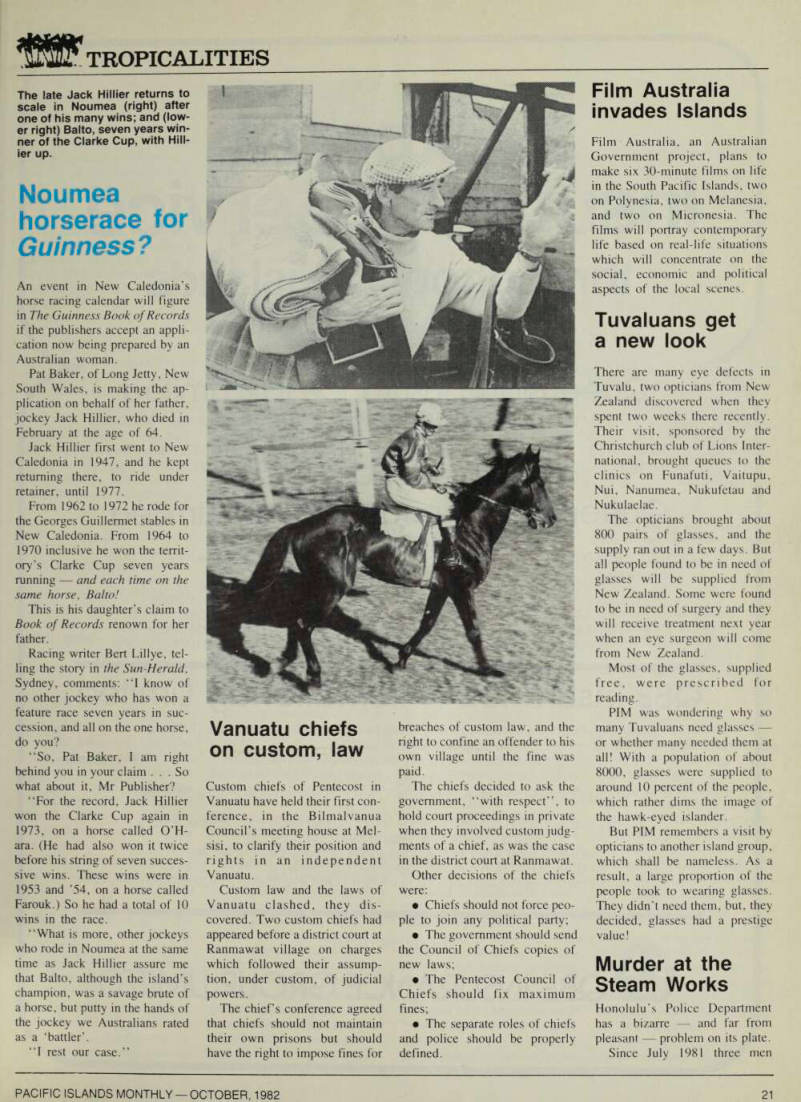
Pat Baker, of Long Jetty, New South Wales, is making the ap plication on behalf of her father, jockey Jack Hillier, who died in February at the age of 64.
Jack Hillier first went to New Caledonia in 1947, and he kept returning there, to ride under retainer, until 1977.
From 1962 to 1972 he rode for the Georges Guillermet stables in New Caledonia. From 1964 to 1970 inclusive he won the territ ory’s Clarke Cup seven years running — and each time on the same horse, Balto!
This is his daughter’s claim to Book of Records renown for her father.
Racing writer Bert Lillye, tel ling the story in the Sun-Herald, Sydney, comments; “I know of no other jockey who has won a feature race seven years in suc cession, and all on the one horse,
do you?
“So, Pat Baker, I am right behind you in your claim ... So what about it, Mr Publisher?
“For the record. Jack Hillier won the Clarke Cup again in 1973, on a horse called O’H ara. (He had also won it twice before his string of seven succes sive wins. These wins were in 1953 and ’54, on a horse called Farouk.) So he had a total of 10 wins in the race.
“What is more, other jockeys who rode in Noumea at the same time as Jack Hillier assure me that Balto, although the island’s champion, was a savage brute of a horse, but putty in the hands of the jockey we Australians rated as a ‘battler’.
“I rest our case.’’
Vanuatu chiefs
on custom, law
Custom chiefs of Pentecost in Vanuatu have held their first con ference, in the Bilmalvanua Council’s meeting house at Mel sisi, to clarify their position and rights in an independent Vanuatu.
Custom law and the laws of Vanuatu clashed, they dis covered. Two custom chiefs had appeared before a district court at Ranmawat village on charges which followed their assump tion, under custom, of judicial powers.
The chief’s conference agreed that chiefs should not maintain their own prisons but should have the right to impose fines for
breaches of custom law, and the right to confine an offender to his own village until the fine was
paid.
The chiefs decided to ask the government, “with respect’’, to hold court proceedings in private when they involved custom judg ments of a chief, as was the case in the district court at Ranmawat.
Other decisions of the chiefs were; • Chiefs should not force peo ple to join any political party; • The government should send the Council of Chiefs copies of new laws; • The Pentecost Council of Chiefs should fix maximum fines; • The separate roles of chiefs and police should be properly defined.
Film Australia
invades Islands
Film Australia, an Australian Government project, plans to make six 30-minute films on life in the South Pacific Islands, two on Polynesia, two on Melanesia, and two on Micronesia. The films will portray contemporary life based on real-life situations which will concentrate on the social, economic and political aspects of the local scenes.
Tuvaluans get
a new look There are many eye defects in Tuvalu, two opticians from New Zealand discovered when they spent two weeks there recently.
Their visit, sponsored by the Christchurch club of Lions Inter national, brought queues to the clinics on Funafuti, Vaitupu, Nui, Nanumea, Nukufetau and Nukulaelae.
The opticians brought about 800 pairs of glasses, and the supply ran out in a few days. But all people found to be in need of glasses will be supplied from New Zealand. Some were found to be in need of surgery and they will receive treatment next year when an eye surgeon will come from New Zealand.
Most of the glasses, supplied free, were prescribed for
reading.
PIM was wondering why so many Tuvaluans need glasses or whether many needed them at all! With a population of about 8000, glasses were supplied to around 10 percent of the people, which rather dims the image of the hawk-eyed islander.
But PIM remembers a visit by opticians to another island group, which shall be nameless. As a result, a large proportion of the people took to wearing glasses.
They didn’t need them, but, they decided, glasses had a prestige value!
Murder at the
Steam Works
Honolulu’s Police Department has a bizarre and far from pleasant problem on its plate.
Since July 1981 three men
The late Jack Hillier returns to scale in Noumea (right) after one of his many wins; and (low er right) Balto, seven years win ner of the Clarke Cup, with Hill ier up.
have died in mysterious cir cumstances at a Waikiki estab lishment known as the Steam Works, a bath house frequented by male homosexuals. Although in two instances, police are satis fied the victims were murdered, none of the cases has been solved.
The first to die was 24-year old Korean Sung Ki Yi. Hunched over a Space Invaders machine at the Steam Works on the night of July 8, 1981, Yi suddenly gasped and collapsed dead over the play ing screen.
After a post-mortem examina tion and pathology tests, the cause of Yi’s death was pro nounced “undetermined” by Dr Richard Wong, of the Honolulu Medical Examiner’s Office.
The next to end his days with in the walls of the Steam Works was David McKenzie, 45, Aust ralia’s representative on the In ternational Olympic Committee.
On August 9, 1981, holiday maker McKenzie was found ly ing on a bunk in a changing room.
Wong performed McKenzie’s post mortem also. He found that death had been due to asphyxia.’
McKenzie had multiple haemor rhages on the muscles on both sides of the neck, and moderate haemorrhages of the thyroid gland, injuries consistent with his having been strangled.
Reporting on the incidents from Honolulu, journalist Burl Burlingame notes in The Sydney Morning Herald of August 28: “Wong’s judgment in other cases had been under fire from police and prosecutors for being too vague. In one instance, a man whose death was labelled “undetermined” by Wong had been exhumed by Dr Charles Odom, Wong’s superior at the Medical Examiner’s Office.
Odom discovered the cause of death in that instance had been a shotgun blast to the head, which Wong had overlooked . . .”
The third man to die at the Steam Works was Frank “Haku” Tavares, 46, a self employed musician. At 9.30 in the morning of Friday, August 13, 1982, his body was found in a private booth by a cleaner.
This time Odom did the post mortem. Like McKenzie, Ta vares had haemorrhages on the
neck and thyroid gland, leading
the medical examiner’s office to say he died of “manual strangu lation”. The medical examiner said Tavare’s death was “suspi ciously similar’’ to the Australian’s.
“Are you kidding?” says Odom. “These cases are exactly alike. Two men, both fairly young, both in good health, are found strangled in a club filled with homosexuals. The similarities are obvious.”
Odom’s conclusion: “Mur der.” An investigation has been started.
But investigating cases like these is no easy matter. As the owner-operator of the Steam Works, Max Belleville (a mar ried man with three children),
told Burlingame; “The police
officers come in here feeling
very uptight. They can barely ask
questions and then they can’t wait to leave. They’ll never solve anything that way. They don’t understand that this is just a different lifestyle from theirs, that it won’t mb off on them.”
Belleville has the idea that the one-year span between the deaths of Tavares and McKenzie may provide a clue. He says: “For all we know, it might be a tourist on vacation, who comes back every year.”
Tribute to Alice
Allen Innes
Mrs Heather Barnard Of
Melbourne, Australia, has writ ten the following tribute to her mother, the late ALICE ALLEN INNES, a well-known figure in several Pacific Island environments: Many readers of this issue of PIM will be saddened to read in “Deaths of Islands People” of the passing of Alice Allen Innes, long-time contributor to the magazine.
A prolific writer for 50 years, she published articles, short stories and verse in periodicals at home and abroad.
Her writing career began as a young married woman, when she was living on isolated Pacific Islands in the Louisiade Ar chipelago. Her husband, Allen, an Islands manager with Bums, Philp, was frequently away on business inspection trips. During these lonely periods she wrote articles on Island life for The Bulletin , and became a regular contributor.
In 1927 the Inneses moved to Salamaua on the Morobe coast of New Guinea. Allen had resigned from Bums, Philp to accept a post as managing director for the
recently formed Salamaua Trad ing Company. Its function was to supply stores and accommoda tion for the New Guinea gold fields. Within a few years it had expanded into a large concern consisting of a tourist hotel, tradestores and meat freezers throughout the Territory.
These were the turbulent, ex citing years of the New Guinea gold boom which were to pro vide Alice Innes with an endless source of material for her writ ings. Enormous quantities of gold were being extracted from the rich alluvial rivers and streams of Wau, Bulolo and Edie Creek. Salamaua was the gate way to this El Dorado. As word spread, interest focused on this hitherto little-known Pacific is land. Soon an increasing number of ships were arriving at the port of Salamaua laden with men from all walks of life, of many nationalities, jobless men of the depression years, desperately ea ger to try their luck.
Following the prospectors, came explorers, planters, an-
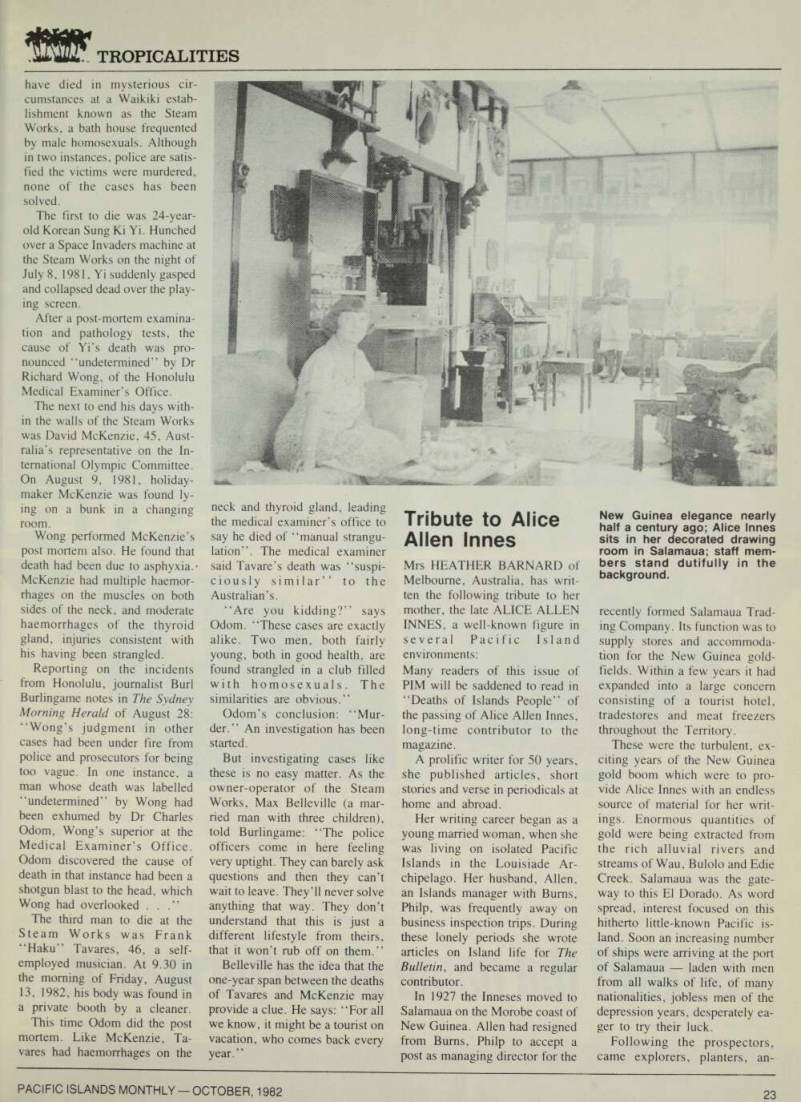
New Guinea elegance nearly
half a century ago; Alice Innes sits in her decorated drawing room in Salamaua; staff mem bers stand dutifully in the background.
thropologists and writers, many of whom played a major role in the development of the Territory.
Usually they “stayed over” at the Salamaua Hotel, awaiting flights up into the ranges or on their return, awaiting passages out. Alice was their hostess often their nurse or confidante.
She managed the busy estab lishment with efficiency and good humour, often catering for 150 diners daily. Still she found time to nurse sick guests miners suffering from tropical disorders and malnutrition, travellers who had contracted malaria and dysentry. (Alice had qualified as a nursing sister at Suva Hospital, during World War I).
Her journals of the periods are filled with fascinating, often very amusing stories, concerning the many well-known personalities who passed through her life.
She mentions the Leahy brothers of whom Michael (Mick) Leahy in particular was outstanding as a miner, explorer and writer; the miners Frank Pry ke and Leslie Joubert, discover ers of the Day Dawn mine; Wally Digby, Ernie French and Nor man Neal; the courageous Mrs Mary Booth MBE, a splendid miner and pioneer; likeable Lyn Brook, nephew of Admiral Beat ty. All of them were her good
friends. Of the writers, Beatrice Grimshaw interested her most.
Miss Grimshaw settled in Papua, and became renowned as a writer of short stories and books on the South Seas. She bought a tobac co plantation on the Laloki Riv er, about 25 kilometres from Port Moresby. The plantation had previously been owned by Errol Flynn.
Alice writes amusingly of her first encounter with the young Flynn, “There’s a most beautiful beast, with a fine broth of a lad!”, announced Alice’s Irish mother, heralding the arrival of Errol Flynn at the Salamaua Hotel in late 1932. Flynn, ac companied by a large Alsatian dog, had arrived on the isthmus to prepare for a recruiting trip to hire labor for the Wau-Edie Creek gold mines.
The high-spirited young ad venturer had originally come to New Guinea in 1927 to seek his fortune. The years he spent in the Territory brought him little but notoriety. He sailed from the islands in 1933 leaving in his wake a string of unpaid bills and unfavorable memories!
Her journal recounts Flynn’s
hasty and unannounced departure
from the Salamaua Hotel: “Flynn the rogue has fled!” writes Alice “Leaving behind an unpaid accommoda
tion bill and a deserted beast!”
Later, it was found, not only was the dog forgotten in his fast exit but also a camphor-wood box labelled ERROL FLYNN in large letters. The box re mained in a store room, un opened, for several years awaiting forwarding instructions.
Letters notifying the owner were never acknowledged. Finally, a decision was made to open it and distribute the contents to local missions. The box revealed a large supply of monogrammed hotel linen! Beneath the stolen linen a diary was found a fascinating account of Flynn’s experiences while recruiting in the highlands. Apart from report ing his daily activities, he also recorded his thoughts and feel ings, his aspirations, often in dulging in fantasy, occasionally gloating over his numerous amorous encounters.
His diary concludes with the following passage: “I am going to China, as I wish to live delib erately ... to hell with money; the pursuit of it is not going to let it rule my life. I am going to drive life into a comer to reduce it to its lowest terms and find its meaning.”
So philosophised the young Errol Flynn ... a brief glimpse only into the character of an extraordinary young man, who
was to become the world’s swashbuckling hero of the movie screen.
Another entry of interest in Alice’s journal is entitled: “The Pilot Pathfinders”.
“With gold came aviation to New Guinea,” she writes, “Our New Guinea pilots were world renowned for their efficiency and resourcefulness. Since 1927, when the first flight from Lae to Wau was made, until World War 2, there was only a very small percentage of accidents. That first trip”, she continues, “was an epic. Maybe, someday the Territory will raise a monument to the memory of The Three Musketeers’ who flew over the ranges to find the first landing ground Pard Muster, A.W.D.
Mullins and prospector Jack Lewers, who accompanied them as guide. This was the forerunner of what was to become the great est aerial transport service in the world prior to the war.”
She mentions Ray Parer, “who worked so quietly, that it was only the local people who knew of the great work he did in opening up the country by air ... It was Parer who dared the original trip across New Guinea.
His last flights over New Guinea
The picturesque settlement of Salamaua as Alice Innes knew it in the 19305.
were to evacuate women and children from areas likely to be invaded by the Japanese.”
Mention is made of other in
trepid Morobe pilots she greatly
admired; ”Les Holden, Bertie Heath, Dickie Mant, J. Sutcliffe and Johnny Jules, who once flew with a six-foot snake wrapp ed around the ‘joystick’ ”...
She explains: ‘‘Johnny’s plane had loaded rice at Lae to take to Ramu. Soon after his arrival at Ramu the weather ‘closed in’, and he was forced to stay over
night . . . After unloading,
traces of rice remained, scattered over the floor of the plane attracting the rats who attract ed the snakes!
“Next morning, Johnny, una
ware of his passengers, flew out from Ramu ... As he was ap proaching the steep Missim peaks, he was suddenly startled to see a large snake crawl out on to the wing of the plane and drop off the edge. No sooner had he recovered than, glancing down, he saw to his horror its
mate gliding towards his feet!
Wrapping itself around his leg, it slowly worked its way up gliding over his hands and on to the ‘joystick’. He daren’t move.
The snake, curling itself around the ‘stick’, began waving its vi cious fangs to and fro, in front of the pilot’s face . . . What a hor
rific experience, poor Johnny.”
The entry concludes: “With grit and control Johnny managed to bring the plane down safely on to the Lae ’drome and promptly fainted!”
Nineteen thirty-seven brought
another aviator briefly into the writer’s life Amelia Earhart.
Earhart was the first woman to cross the Atlantic by air and the first woman to fly it alone. She was then attempting her epic
round-the-world flight.
Tragically, the courageous Amelia Earhart crashed into the Pacific after leaving Lae.
This year marked the final chapter of Island life for Alice.
She was retiring to Sydney to establish a home for her children.
A decade had passed since her arrival, with her husband Allen, on the picturesque isthmus of Salamaua, and 23 years since she sailed from Australia to Fiji, to start a nursing career at what is now the Colonial War Memorial Hospital, Suva an eager young woman of boundless ener gy and inexhaustible curiosity.
These qualities, together with a bubbling sense of fun and a deep interest in people, were to remain with her all her long life, reward ing her with many rich experi ences and personal encounters.
Tuvalu’s seamen
“tops” Swire
Five Tuvaluan seamen serving in the Pacific Cutlass, a freighter which sank off Singapore earlier this year without loss of life,
have been praised by the ship’s
master for “their courage, skill and, generally, excellent be haviour.” Swire Pacific Offshore Ship Management Ltd. has told the Tuvalu Government
that the company has three new vessels coming into service and wants to crew them with Tuva luans. Both Tuvalu and Kiribati, former partners in the British colony of the Gilbert and Ellice Islands, have maritime schools whose graduates are sought after
by many shipping companies.
Big men, chiefs,
and mariners
The large, three-storey lava-rock
building has crowned this small hill for almost a century. Making our way around construction that will soon add a new pavilion, we enter the handsome lobby, pass up a broad flight of polished wooden stairs, and into a quiet, air-conditioned, two-tiered gal lery featuring artefacts from the Pacific Islands.
Here lurk Fijian war clubs which were given names and greatly feared after killing a man, mysterious Easter Island carv
ings often representing human
faces and bodies, and strange
masks and doll-like figures from Melanesia.
For over 90 years, Honolulu’s Bishop Museum has been a trea sure trove of objects from the Pacific. Now, in addition to its fine display of Hawaiian and Pacific objects in the main hall, the museum has added a perma nent show, Big Men, Chiefs and Mariners, which represents trad itional cultures of Melanesia, Polynesia, and Micronesia. It is well worth seeing.
Masks and costumes from Melanesia, decorated with feath ers and shells, and painted in vivid colors, seem to be waiting expectantly for someone to put them on. A film of their ceremo nial use would make these ob jects come alive. The imagina tion goes back to old Tarzan movies where costumed voodoo figures jumped out of deep jung le growth to chant strange spells and encourage warriors shooting poison darts (usually at Wester ners in pith helmets and tropical garb). But this is the Pacific, not darkest Africa.
One full-length garment from New Caledonia has a body cov ering of dark feathers and a wooden mask covered with hu man hair and beard. Handed down through successive genera tions, the costume was believed to embody the female forces of the universe, and was used in ceremonies to bring rain and abundance on land and sea.
Many of the Melanesian ob jects were thought to incorporate life forces, such as the masks that represented spirits or reincar nated dead ancestors. Made of rattan and covered with painted bark, they were used in dances, or in boys’ initiation ceremonies.
Are the spirits still there, lurk ing behind the museum’s glass cases? The answer depends on belief systems. Some Melanesian societies did think that spirits should be transferred from older deteriorating masks to new ones where they were believed to be happier. The older masks would be left out to rot, or perhaps given to museum expeditions.
One imagines it is 200 years ago in Polynesia.
It is a dark night and the surf pounds in the distance. Religious leaders in fluttering garments ap-
pear on a temple laboriously made of stones from distant mountains. In the midst of strict ceremonies a wooden image is raised to the heavens. Chants ask one of a pantheon of gods to enter the carving.
Today, only the stone temples remain; widespread belief in an cient religions did not long sur vive Western contact and missio nary efforts in Polynesia. But museums hold much that was collected by earlier visitors. Here are three Society Island god fi gures, each about 40 centimetres high. Two of the figures are club-shaped and made of braided coconut fibre; they represented important state gods and were once covered with the red feath ers which in Tahiti, the Mar quesas, and Hawaii were con sidered symbols of power.
The Tahitian mourner’s cos tume collected on Cook’s second voyage must have been used in religious ceremonies. It is amaz ingly intricate: a mask made of large pieces of mother-of-pearl shell is surrounded by long bird feathers, a rare feather cloak cov ers the back, and the chest is hidden behind hundreds of pieces of pearl shell below which hang coconut shell discs over a bark cloth apron. Surely an approp
riate costume for anyone who wanted to look like a spirit.
From the Marquesas there are carved, two-metre, wooden god figures that would have been used on a temple. There is a surprisingly large number of pieces from these islands, an area little heard of since the Mar quesan population was de cimated by Western diseases and blackbirding in the 19th century.
Many of the objects are for per sonal adornment indicating that the Marquesan chiefly classes moved about well ornamented.
Widely dispersed over the northern latitudes of the Pacific are the small islands of Mic ronesia. Not as romantic as fabl ed Polynesia, they are often poorly represented in museum exhibits. Happily that isn’t the case here.
A doll-like figure, made partly of stingray spines and clothed in coconut leaf, represents a type of Micronesian religious life. It is said to have been used as a magical means of dispelling storms at Lamotrek in the Yap Islands.
Stone money from Yap has become famous throughout the world. There pieces of stone were quarried on a distant island and came to be used as money;
even today large pieces can be seen leaning against a coconut tree or house, their ownership known to everyone. The exhibit also includes small pieces of this money, as well as a turtle shell dish used as money in Belau.
From the Carolines there is a man’s belt decorated with shell money.
Throughout the Pacific, shells were also used for personal adornment, and the museum has an arresting example of an ear ring from the Carolines made of nearly 100 interconnected circles of coconut shell, conus shell, turtle shell, and a few trade beads. Hung from a pierced ear, it would have reached the shoul der of the highly decorated wearer.
The famous grass skirt as seen in old movies is still worn in parts of Micronesia, although it is not exhibited here. But skirts made from the dried fibre of the banana stalk and the inner bark of the hibiscus have continued to be woven on looms and used in Truk and the Carolines, several examples testify to the beauty of the weaving which allows for varied patterns and different colors.
Leaving the exhibit and its world of traditional Pacific life and beliefs, one pauses in the bright sunshine as cars whiz by on a nearby highway, jet aircraft cross the sky, and high-rise buildings crowd in the distance.
Western contact has certainly changed Hawaii. One has to wonder about the future of other Pacific Island states, and give thanks that here in the Bishop Museum some of the past at least
is being preserved.
Robert
Graham
in Honolulu.
Marianas name
their bird
The Legislature of the Common wealth of the Northern Marianas has passed a bill naming the Paluman Tottut, the Marianas Fruit Dove, as the common wealth’s national bird. A move to declare the bird an “en dangered species’’ was defeated.
The Paluman Tottut is described as the only bird in Micronesia with the colors of the Bird of Paradise.
The 93-year-old lava-rock building of the Bernice P. Bishop Museum, Honolulu. It’s getting a new pavilion and has already opened a new Pacific display, writes Robert Graham.