“spirit road”
pp. 18-19 · Read in the full issue
Quest for the origins of a “spirit road”
In our “Postmark” article of April we described the small island of Tikopia in the Santa Cruz Group, Solomon Islands, as “the very last paradise” in the Pacific. We hope we managed to communicate to readers a little of our enthusiasm for the place.
At the same time as the Tikopians are the most “conservative” of all Polynesian peoples, they are also the most thoroughly studied and practically all the fieldwork has been done by one man, Sir Raymond Firth!
Since we returned home we have gone through all Firth’s studies (which fill a whole shelf in our library) in order to see what he has to say about the paved road skirting the crater lake which we saluted as “a splendid example of the collective engineering achievement of a small Stone Age tribe”.
Quite surprisingly, the only reference we have been able to find is contained in Firth’s History and Traditions of Tikopia, where (pp 40-41) he mentions that the Tikopians ascribe all stone works in the islands to a group of mythical spirit beings called Fiti-kai kere whom the author identifies with earth-eating Melanesians (FitUVituFiji). “They did this work not by using their hands, but by supernatural powers. According to one account, that of Pa Porima, they said to the stones, ‘You move, and turn your smooth face upwards’. Thereupon the stones moved accordingly, they were not lifted, they crawled of themselves. The result was a series of stone walls, low, long heaps of undressed stone which may well stand as witness to the energies of a former population of Tikopia.
The most impressive of these stone accumulations, that of Te Karoa on the lake shore, resembles a quayside of primitive type. It presents a fairly smooth face of rock, in large slabs, looking as if they might have been put together by human hands, and forming a platform upwards of thirty yards long, a few feet above the water’s edge. If they are indeed of human construction, these stone mounds may have been erected for some ritual purpose analagous to the use of stone marae.”
Although Firth mentions Te Karoa as the site where these walls and mounds are located, he fails, for some strange reason, to point out the existence of the very impressive, definitely hand-made paved road which is more than a metre wide and about two kilometres long.
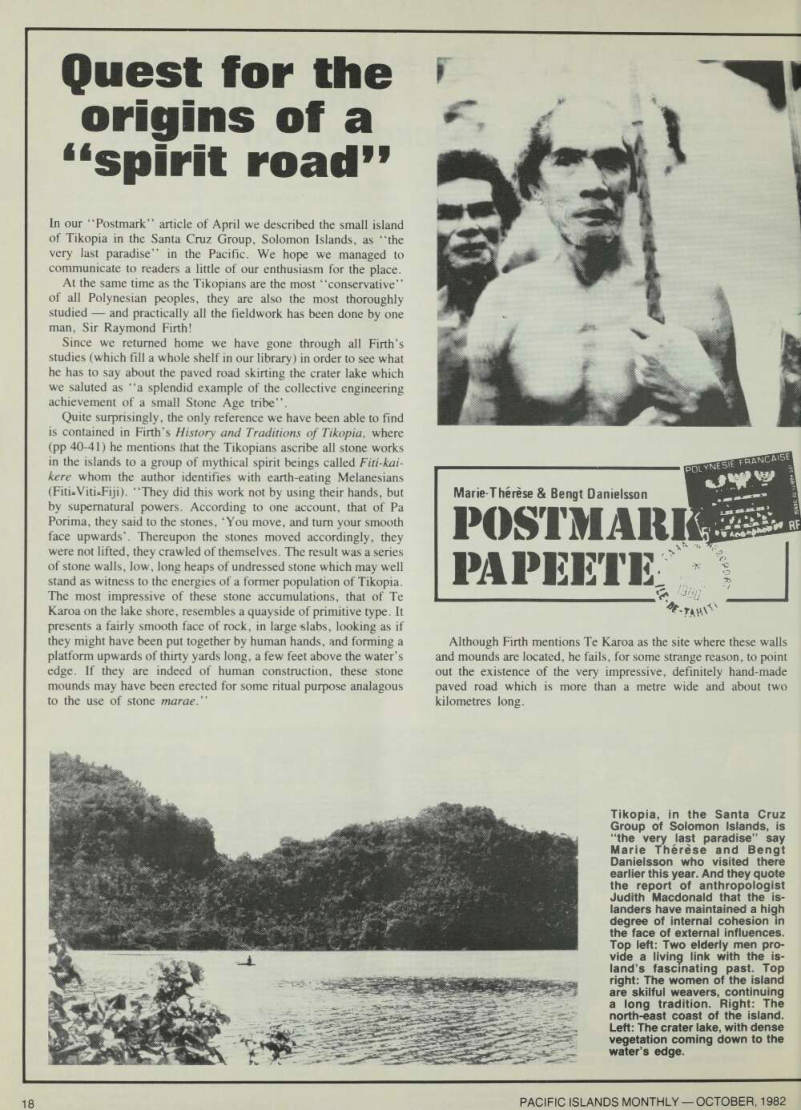
Tikopia, in the Santa Cruz Group of Solomon Islands, is “the very last paradise’’ say Marie Therese and Bengt Danielsson who visited there earlier this year. And they quote the report of anthropologist Judith Macdonald that the is landers have maintained a high degree of internal cohesion in the face of external influences.
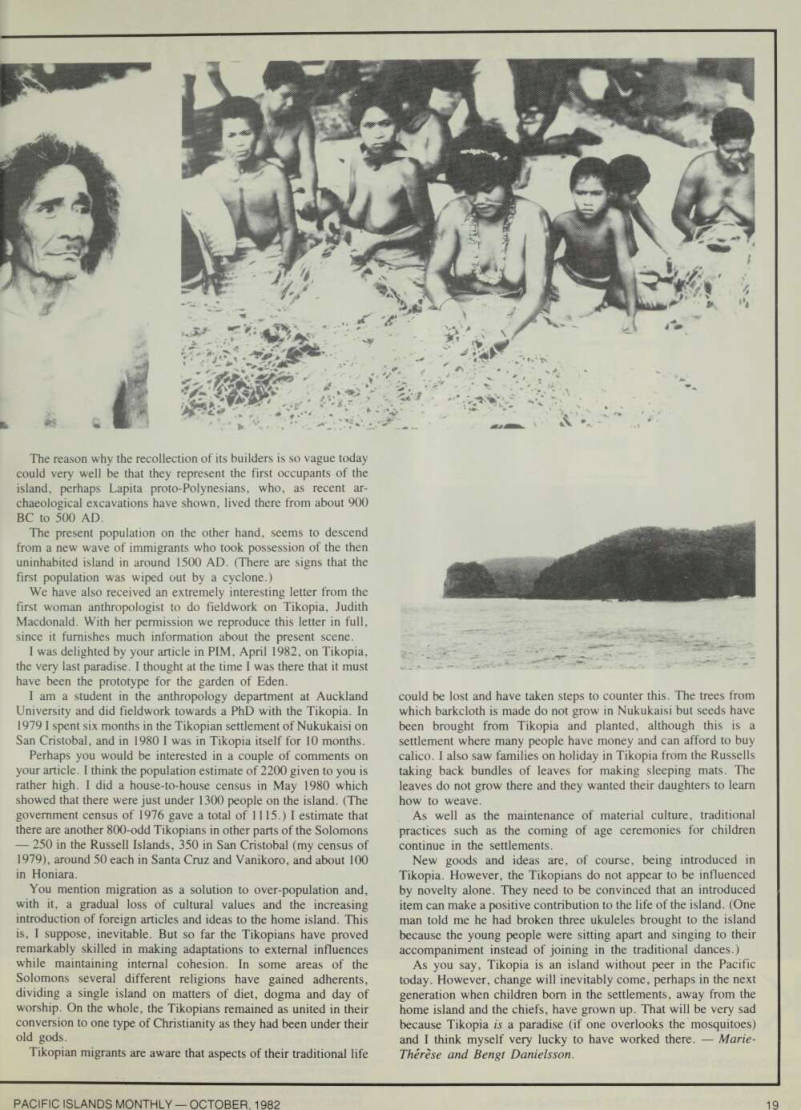
Top left: Two elderly men pro vide a living link with the is land’s fascinating past. Top right: The women of the island are skilful weavers, continuing a long tradition. Right: The north-east coast of the island.
Left: The crater lake, with dense vegetation coming down to the water’s edge.
The reason why the recollection of its builders is so vague today could very well be that they represent the first occupants of the island, perhaps Lapita proto-Polynesians, who, as recent ar chaeological excavations have shown, lived there from about 900 BC to 500 AD.
The present population on the other hand, seems to descend from a new wave of immigrants who took possession of the then uninhabited island in around 1500 AD. (There are signs that the first population was wiped out by a cyclone.) We have also received an extremely interesting letter from the first woman anthropologist to do fieldwork on Tikopia, Judith Macdonald. With her permission we reproduce this letter in full, since it furnishes much information about the present scene.
I was delighted by your article in PIM, April 1982, on Tikopia, the very last paradise. I thought at the time I was there that it must have been the prototype for the garden of Eden.
I am a student in the anthropology department at Auckland University and did fieldwork towards a PhD with the Tikopia. In 19791 spent six months in the Tikopian settlement of Nukukaisi on San Cristobal, and in 1980 I was in Tikopia itself for 10 months.
Perhaps you would be interested in a couple of comments on your article. I think the population estimate of 2200 given to you is rather high. I did a house-to-house census in May 1980 which showed that there were just under 1300 people on the island. (The government census of 1976 gave a total of 1115.) I estimate that there are another 800-odd Tikopians in other parts of the Solomons 250 in the Russell Islands, 350 in San Cristobal (my census of 1979), around 50 each in Santa Cruz and Vanikoro, and about 100 in Honiara.
You mention migration as a solution to over-population and, with it, a gradual loss of cultural values and the increasing introduction of foreign articles and ideas to the home island. This is, I suppose, inevitable. But so far the Tikopians have proved remarkably skilled in making adaptations to external influences while maintaining internal cohesion. In some areas of the Solomons several different religions have gained adherents, dividing a single island on matters of diet, dogma and day of worship. On the whole, the Tikopians remained as united in their conversion to one type of Christianity as they had been under their old gods.
Tikopian migrants are aware that aspects of their traditional life
could be lost and have taken steps to counter this. The trees from which barkcloth is made do not grow in Nukukaisi but seeds have been brought from Tikopia and planted, although this is a settlement where many people have money and can afford to buy calico. I also saw families on holiday in Tikopia from the Russells taking back bundles of leaves for making sleeping mats. The leaves do not grow there and they wanted their daughters to learn how to weave.
As well as the maintenance of material culture, traditional practices such as the coming of age ceremonies for children continue in the settlements.
New goods and ideas are, of course, being introduced in Tikopia. However, the Tikopians do not appear to be influenced by novelty alone. They need to be convinced that an introduced item can make a positive contribution to the life of the island. (One man told me he had broken three ukuleles brought to the island because the young people were sitting apart and singing to their accompaniment instead of joining in the traditional dances.) As you say, Tikopia is an island without peer in the Pacific today. However, change will inevitably come, perhaps in the next generation when children bom in the settlements, away from the home island and the chiefs, have grown up. That will be very sad because Tikopia is a paradise (if one overlooks the mosquitoes) and I think myself very lucky to have worked there. Marie- Therese and Bengt Daniels son.