Foreign affairs chief on NZ
pp. 41-43 · Read in the full issue

aid: the pros, and the cons
Merwyn Norrish,
Secretary of New Zea land’s Department of Foreign Affairs, ex pounds his country’s philosophy on the often controversial subject of overseas aid in this case, aid to the coun tries of the South Pacif ic. His remarks are not able for the frankness with which he discusses the problems associated with aid activities —for both donors and recipients.
“Economic development in the best conditions is rarely a smooth or painless process. This is be cause economic change involves gains for some groups, but al most always losses for others.
New ways to do things may be discovered, but this may be at the expense of old ways which have been employed and treasured for centuries. Hard choices are required.”
That view comes from New Zealand’s Foreign Affairs Sec retary, Merwyn Norrish, who de fines economic development as changes in national economic ac tivity which increase the ability of society to fulfill its aims.
He believes that the process of economic development can be particularly disruptive in the South Pacific because it involves the often sudden exposure of small and isolated societies to an unfamiliar outside world.
“In many instances this can lead to expectations among South Pacific peoples which sim ply cannot be fulfilled with the resources at their disposal.”
Mr Norrish outlined his philosophy on economic de velopment in the South Pacific at a recent regional seminar of the
International Council of Women in Auckland.
The exercise gave an insight into the thinking behind New Zealand’s approach to aid to the South Pacific. In doing this Mr Norrish blended sensitivity with practical advice. He pointed out the problems the Islands faced, quietly stressed urgency in facing them, and highlighted the new role of women in the South Pacific.
With New Zealand channel ling more and more of its aid to the South Pacific, Mr Norrish’s views at this time are worth summarising. He pointed out: Fiji apart, no South Pacific government has, in recent years, been able to raise more than 50 per cent of its revenue from taxation, direct or indirect. For smaller countries, the proportion has been considerably lower.
Manufacturing is, in most cases, quite insignificant, rang ing between two and eight per cent of output except in Fiji where it is somewhat higher thanks to sugar milling.
In the larger sphere of open world markets, and industries based on the use of labor, Pacific
countries are unable to compete with the much larger, newly in dustrialising countries of East and Southeast Asia and Latin America.
Most are also net importers of food. Inflation has jumped, as in Tonga (from nine to 22 per cent between 1978 and 1980), and in Western Samoa (from three to 30 per cent).
Island countries have no more control over external price changes than they do over the hurricanes that can result in such sudden economic devastation for their countries.
International-level aid from outside the region has been steadily growing. For the Island countries, with exception of Fiji, the value of aid received ranges between a third of and twice the value of government expenditure.
But aid is not without its own problems and difficulties. As it grows, so does the vulnerability of those countries to forces out side their control. Their fortunes are tied to the fortunes and priorities of donor countries and institutions.
When the capacity of donors
to give aid is reduced, as has been the case with New Zealand in recent years, this may have an impact not just on a national economy in the islands but on the lives of individual people.
Aid also heightens the tension between the desire for material success on the one hand and traditional ways and customs on the other. Many Island people lament the passing of old ways and old values. But at the same time they want the benefits of economic development and their governments actively seek out side aid to help them promote it.
Do the benefits outweigh the
problems and the disadvantages?
That is for the governments con cerned to judge, not for outsid ers. But outsiders have a respon
sibility to recognise that prob
lems exist and to be sensitive to them.
If the recipient governments choose to ask for the wrong sorts of aid, and their requests are met, this may inhibit rather than pro mote self-reliance and economic independence in the region. And it is entirely fair to say that aid may play a part in generating expectations which, in the nature of things, can often not be fulfilled.
Economic development has been promoted also at the region al level but there are limits to what can be achieved in this way.
Ultimately, economic de velopment is a national responsi
bility. Regional and international
efforts to encourage development have to be determined by nation
al priorities.
Some people argue that efforts by many South Pacific peoples to promote economic development have not been impressive, and that the people consume all they can today and still expect a better life tomorrow.
I would venture to say that in most South Pacific countries, a number of groups exist that could be encouraged to make a greater contribution to development.
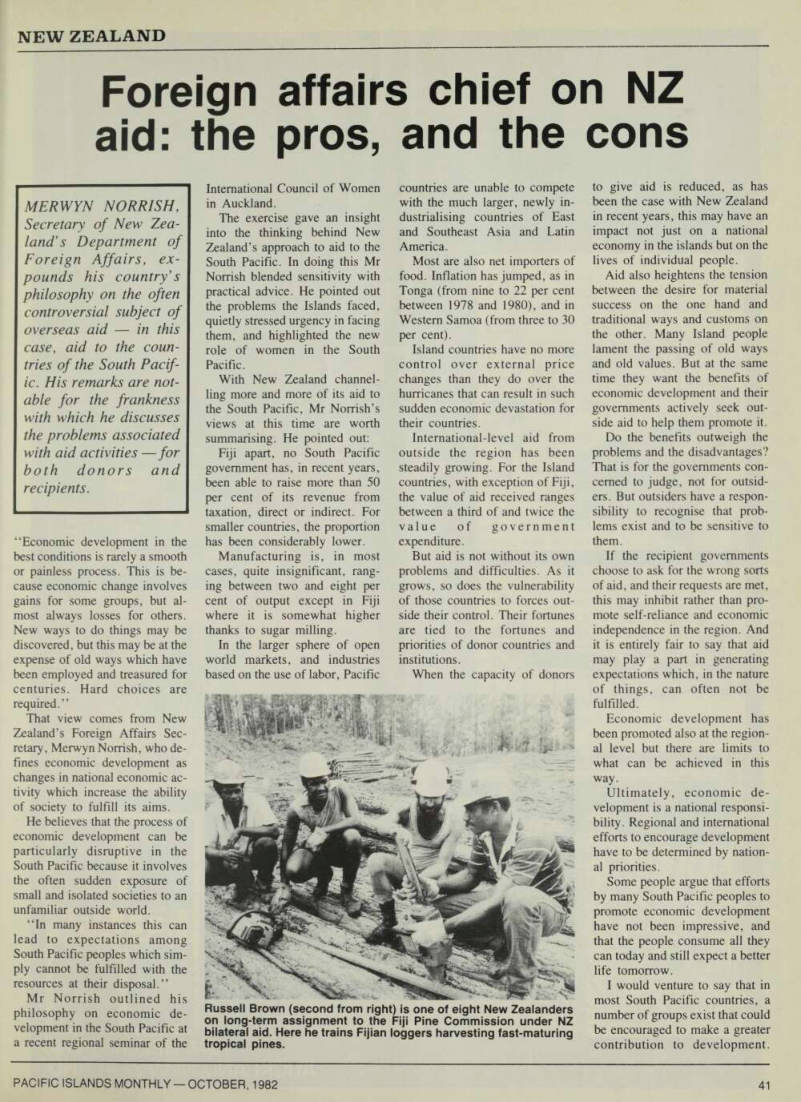
Russell Brown (second from right) is one of eight New Zealanders on long-term assignment to the Fiji Pine Commission under NZ bilateral aid. Here he trains Fijian loggers harvesting fast-maturing tropical pines.
One group is the agricultural population. For most Pacific Is land countries, agriculture re mains the most important source of employment and export in come. Yet the Asian Develop ment Bank’s South Pacific Ag ricultural Survey of 1979 con cluded that “with the exception of Solomon Islands and possibly Papua New Guinea most growth in the South Pacific has tended to come from outside agriculture.’’
In part the failure of agricul ture has been due to the tendency of aid donor countries to put requests for agricultural assist ance in the “too difficult’’ categ ory and to concentrate instead on projects like building wharves and hospitals where a less inti mate knowledge of local condi tions is required.
But South Pacific govern ments have also been to blame.
Agricultural development has not proved as attractive a prospect as starting up airlines or drilling for oil. Most South Pacific govern ments also maintain greatly over valued exchange rates, making imports cheap for those living in the town but exporting agricul tural products more difficult for those in the countryside.
Women are a second group with contribution to make to development.
The contribution women have made to economic advancement and the extent to which women’s interests have been promoted have depended on such variable factors as the traditional econom ic and social roles filled by wo men and by men, on the types of economic and demographic change occuring, on the attitude of the men who, so far, make up much of the leadership, and on women themselves.
What aid-giving countries such as New Zealand can do is to try to ensure that the interests of women are taken into account when they give aid.
We have become more aware that development assistance ac tivities, which are determined by
too narrow criteria, may actually be detrimental to the position of women in society. So we are now taking the interests of wo men more fully into account
when evaluating aid projects.
Last year Cabinet approved a new set of guiding principles for New Zealand’s bilateral assist ance. They make specific men tion of the need to safeguard women’s interests under ac tivities financed by New Zealand aid, and to increase women’s capacity to contribute to
development.
This is a worthwhile improve ment. But what matters in the Islands is that women should be actively and deeply involved in influencing the course of economic development in their home countries. I have no doubt at all that they can do this, and do it most effectively.
It is up to the people of the Island countries to ensure that the decisions their governments take on economic development are the decisions that they want.
How much economic develop ment is desirable? At how fast a
pace? Should governments spend
at rates that are beyond the re sources of their countries to maintain? Are the people pre pared to forego some benefits in order to put the priority and the emphasis on other things? How much attention should be paid to social values? And, finally, where is the money to come from, and how much sacrifice are the people prepared to make through the tax system and in
other ways?
These are all questions that are just as vital to women as they are to men, Mr Norrish concluded
William Gasson.
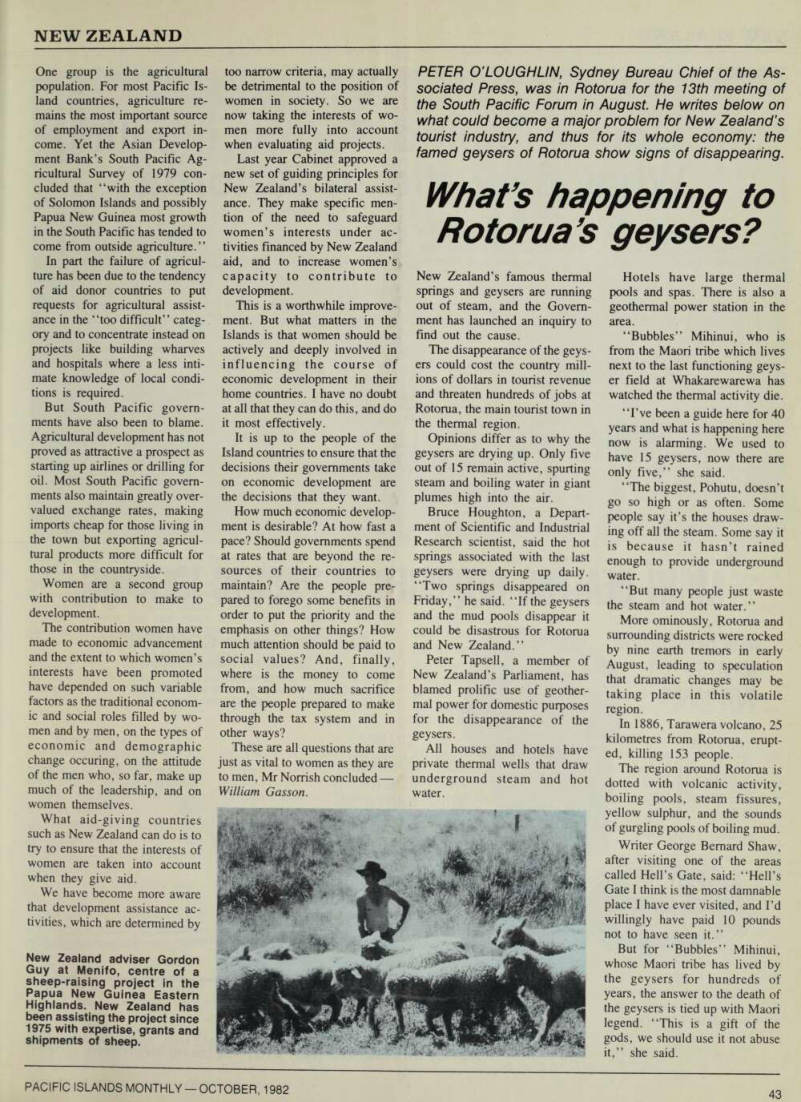
New Zealand adviser Gordon Guy at Menifo, centre of a sheep-raising project in the Papua New Guinea Eastern Highlands. New Zealand has been assisting the project since 1975 with expertise, grants and shipments of sheep.