Hawaii: Savoring the pleasures
pp. 53-57 · Read in the full issue


of Lanai, Molokai and Maui
In terms of tourist and travel literature, more has probably been written about Hawaii than any other group of is lands, and new guidebooks are coming out every year. So while not attempting to write an anywhere near complete summary of each island’s attractions, we hope to share with PIM readers what we personally have found most worthwhile this often does not include well-advertised commercial attractions for which most visitors appear to make a beeline.
Lanai: This is one of the less frequently visited islands, being entirely owned by the Dole Pineapple Company since 1930, when it was bought for just overSUSl million. Before that it was a ranch (there are still abandoned cowboy huts standing in remote areas), and
back in the last century it was the site of a Mormon settle ment, founded by Walter Mur ray Gibson, an adventurer who later became prime minister of the Hawaiian Kingdom.
Most people on Lanai are employed by the Dole Co., the largest ethnic group being Fili pinos, followed by Hawaiians.
Except for a few homesteads on the coast, nearly everyone lives in Lanai City, the small and only town (with one 12room hotel) surrounded by pineapple fields. There are plans afoot to build a new hotel, and these are regarded with some apprehension by the local people who fear it could change the island’s way of life.
This conflict has already been repeated on most of the other islands, with the locals often losing out to the interests of real estate developers and hotels.
Manele Bay, on the southern coast of Lanai, has a beautiful beach with camping facilities (camping by permit from “the Company”), a small boat har bor to which yachts from Oahu and Maui come over for the weekend, and good snorkelling on the rich reefs. This is a fine spot to observe Hawaiian cor als and reef life, with masses of colorful reef fish including wrasse, tangs, goatfish, parrotfish, and invertebrate life. Most sea creatures are known better by their Hawaiian names which we won’t attempt to reproduce.
We happened to be at Man ele Bay on Thanksgiving Night, and were spontaneously invited to a luau in progress in the picnic grounds. Luau (Hawaiian feasts) are now an established part of the tourist scene in Waikiki, but these are
unfortunately far from the “real thing.” The earth oven, imu, was the favorite method of cooking in old Hawaii and much of Oceania, and the traditional foods prepared this way are pork, fish, chicken, taro, sweet potato, and so on.
The most authentic luau are those prepared by local people and church groups for special occasions, and these will often feature some raw or marin ated foods highly regarded by the Hawaiians. Examples of foods eaten raw are fish, crabs, limpets (opihi a great delicacy eaten with seaweed), and occasionally liver and sea urchin roe. Poi, the staple traditional food, was prepared by pounding cooked taro root.
These days it is usually fac tory-made.
The road from Lanai City to Manele Bay was put through in
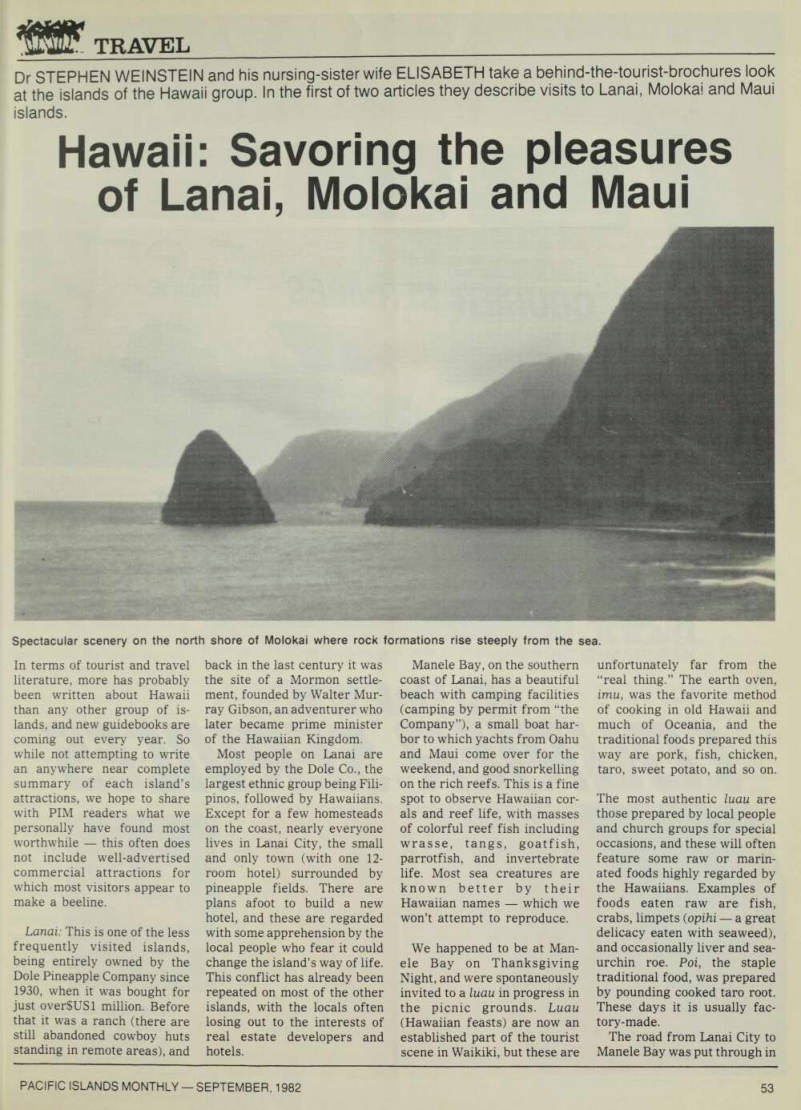
Spectacular scenery on the north shore of Molokai where rock formations rise steeply from the sea.
1941 by “Molokai” Oshiro, who now operates the island’s only car-rental establishment. In those days he was the only one on the island who could drive a bulldozer. Most of the roads on Lanai are little more than rough trails, and 4-wheel-drive vehicles are necessary to get about.
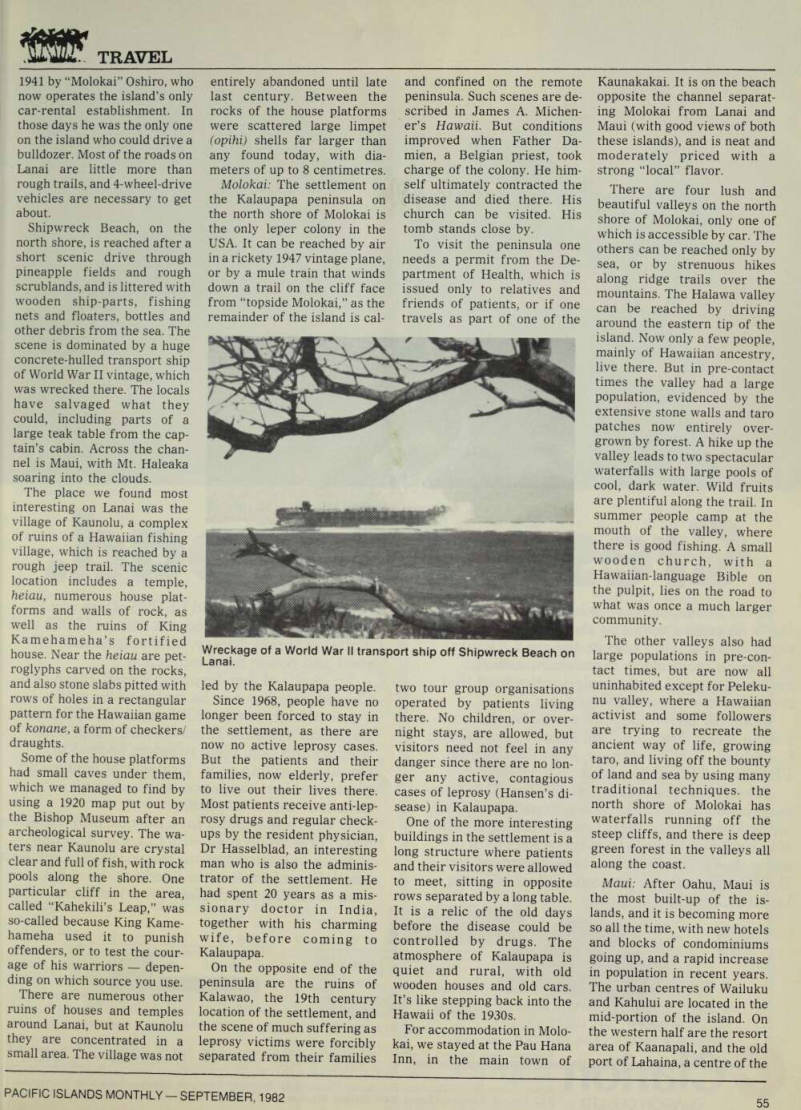
Shipwreck Beach, on the north shore, is reached after a short scenic drive through pineapple fields and rough scrublands, and is littered with wooden ship-parts, fishing nets and floaters, bottles and other debris from the sea. The scene is dominated by a huge concrete-hulled transport ship of World War II vintage, which was wrecked there. The locals have salvaged what they could, including parts of a large teak table from the cap tain’s cabin. Across the chan nel is Maui, with Mt. Haleaka soaring into the clouds.
The place we found most interesting on Lanai was the village of Kaunolu, a complex of ruins of a Hawaiian fishing village, which is reached by a rough jeep trail. The scenic location includes a temple, heiau, numerous house plat forms and walls of rock, as well as the ruins of King Kamehameha’s fortified house. Near the heiau are pet roglyphs carved on the rocks, and also stone slabs pitted with rows of holes in a rectangular pattern for the Hawaiian game of konane, a form of checkers/ draughts.
Some of the house platforms had small caves under them, which we managed to find by using a 1920 map put out by the Bishop Museum after an archeological survey. The wa ters near Kaunolu are crystal clear and full of fish, with rock pools along the shore. One particular cliff in the area, called “Kahekili’s Leap,” was so-called because King Kame hameha used it to punish offenders, or to test the cour age of his warriors depen ding on which source you use.
There are numerous other ruins of houses and temples around Lanai, but at Kaunolu they are concentrated in a small area. The village was not
entirely abandoned until late last century. Between the rocks of the house platforms were scattered large limpet (opihi) shells far larger than any found today, with dia meters of up to 8 centimetres.
Molokai: The settlement on the Kalaupapa peninsula on the north shore of Molokai is the only leper colony in the USA. It can be reached by air in a rickety 1947 vintage plane, or by a mule train that winds down a trail on the cliff face from “topside Molokai,” as the remainder of the island is cal-
led by the Kalaupapa people.
Since 1968, people have no longer been forced to stay in the settlement, as there are now no active leprosy cases.
But the patients and their families, now elderly, prefer to live out their lives there.
Most patients receive anti-lep rosy drugs and regular check ups by the resident physician, Dr Hasselblad, an interesting man who is also the adminis trator of the settlement. He had spent 20 years as a mis sionary doctor in India, together with his charming wife, before coming to Kalaupapa.
On the opposite end of the peninsula are the ruins of Kalawao, the 19th century location of the settlement, and the scene of much suffering as leprosy victims were forcibly separated from their families
and confined on the remote peninsula. Such scenes are de scribed in James A. Michen er’s Hawaii. But conditions improved when Father Da mien, a Belgian priest, took charge of the colony. He him self ultimately contracted the disease and died there. His church can be visited. His tomb stands close by.
To visit the peninsula one needs a permit from the De partment of Health, which is issued only to relatives and friends of patients, or if one travels as part of one of the
two tour group organisations operated by patients living there. No children, or over night stays, are allowed, but visitors need not feel in any danger since there are no lon ger any active, contagious cases of leprosy (Hansen’s di sease) in Kalaupapa.
One of the more interesting buildings in the settlement is a long structure where patients and their visitors were allowed to meet, sitting in opposite rows separated by a long table.
It is a relic of the old days before the disease could be controlled by drugs. The atmosphere of Kalaupapa is quiet and rural, with old wooden houses and old cars.
It’s like stepping back into the Hawaii of the 19305.
For accommodation in Molo kai, we stayed at the Pau Hana Inn, in the main town of
Kaunakakai. It is on the beach opposite the channel separat ing Molokai from Lanai and Maui (with good views of both these islands), and is neat and moderately priced with a strong “local” flavor.
There are four lush and beautiful valleys on the north shore of Molokai, only one of which is accessible by car. The others can be reached only by sea, or by strenuous hikes along ridge trails over the mountains. The Halawa valley can be reached by driving around the eastern tip of the island. Now only a few people, mainly of Hawaiian ancestry, live there. But in pre-contact times the valley had a large population, evidenced by the extensive stone walls and taro patches now entirely over grown by forest. A hike up the valley leads to two spectacular waterfalls with large pools of cool, dark water. Wild fruits are plentiful along the trail. In summer people camp at the mouth of the valley, where there is good fishing. A small wooden church, with a Hawaiian-language Bible on the pulpit, lies on the road to what was once a much larger community.
The other valleys also had large populations in pre-con tact times, but are now all uninhabited except for Peleku nu valley, where a Hawaiian activist and some followers are trying to recreate the ancient way of life, growing taro, and living off the bounty of land and sea by using many traditional techniques, the north shore of Molokai has waterfalls running off the steep cliffs, and there is deep green forest in the valleys all along the coast.
Maui: After Oahu, Maui is the most built-up of the is lands, and it is becoming more so all the time, with new hotels and blocks of condominiums going up, and a rapid increase in population in recent years.
The urban centres of Wailuku and Kahului are located in the mid-portion of the island. On the western half are the resort area of Kaanapali, and the old port of Lahaina, a centre of the
Wreckage of a World War II transport ship off Shipwreck Beach on Lanai.
19th century Pacific whaling industry.
Now heavily commercial ised, the waterfront is full of souvenir shops, like a minia ture Waikiki. Lahaina is also home port to a large fleet of yachts, and the yearly Lahaina-Hawaii Yacht Race was the reason we found ourselves in Maui on the weekend of our visit.
During the months of Janu ary to March whales can be seen in the channel on their way to Maalaea Bay where they have their young, and charter boats take tourists out for closer viewing. Near Olo walu are the little publicised petroglyphs, which have been much abused by more recent graffitists. Museums abound, displaying ancient Hawaiian artefacts.
In our view, the eastern part of Maui offers most of in terest. To reach it one follows the “Hana Highway,” a narrow two-lane road winding its way through small valleys, past waterfalls and pools, and final ly reaching Hana, a quiet little town inhabited mainly by peo ple of Hawaiian descent. Along the Hana Highway are the two villages of Keanae and Wailua, with their taro patches adding color to the dramatic coastal scenery.
Before reaching Hana prop er, one passes the Waianapana pa camp grounds and caves.
These caves were originally formed by lava tubes, and are now partially filled with clear, fresh rainwater. The cave mouths are reached by a short paved trail, and the water sup ports a unique population of tiny red shrimps.
Legend has it that a Hawaiian princess hid from her abusive husband in these caves, but was caught and killed, with the shrimps now serving as a reminder of her shed blood.
Past Hana the road gets poorer, with more hairpin bends, until one reaches the Seven Pools, marked on some maps as the “Seven Sacred Pools,” though there appears to be no evidence that the old Hawaiians regarded them as anything but secular, the
“Sacred” having presumably been added to promote tour ism in more recent times. In addition to the very pretty pools joined by small water falls, there is a trail leading to larger falls further upstream, with good swimming in the pools.
The nearby camp ground has some stone walls dating from pre-Captain Cook times, as well as a view of Mauna Kea’s peak on the Big Island across the channel. After liv ing in Honolulu we are always impressed by how bright and clear the stars are out in places like this where there are no electric lights to dim the view.
Near the Seven Pools area is Kipahulu church, now re stored after having fallen into disrepair in the 19605. In this remote little place is the grave of Charles Augustus Lind bergh, first solo trans-Atlantic aviator, who lived in eastern Maui for his last years. Here the paved road ends, and we were prevented from explor ing the ranches that lay farth er on by the car-rental con tract, which does not extend to travel on dirt roads.
Maui’s most famous attrac tion is perhaps Mt. Haleakala, the dormant (as opposed to extinct) volcano, where legend has it that the Polynesian demi-god Maui lassoed the sun and slowed its daily passage across the skies. The crater itself contains numerous smal ler cinder cones with their own craters, and, being above the tree-line, it is as barren as a lunar landscape. Several hik ing trails cross the crater, but
warm clothes are needed as it gets quite chilly. In fact during the winter months it snows up here, though not to the degree to make skiing possible.
There are beautiful silvers word ferns, and Nene geese.
But more impressive is the view taking in the rest of Maui, plus four of the other islands.
One of these is the uninha bited Kahoolawe, which is used as a target range by the navy. It was once a ranch, and
still has a number of wild goats, who could well be suffering from shell-shock by now. A couple of years ago the Kahoolawe Ghana , a Hawaiian land-rights activist group “occupied” the island by a sit-in, to draw attention to the historical value of some sites there. But today it remains uninhabited while agreements are being worked out.
Next month: Kahoolawe, Kauai, Hawaii, Oahu.
Rock carving near Kaunolo village, a remote fishing settlement on Lanai.
Hawaiian geese at Mount Haleakala on Maui Island approach visitors’ cars to be fed.