tries his bag of
p. 51 · Read in the full issue
Mr von Daniken tries his bag of tricks on Kiribati
The Stones of Kiribati: Path ways to the Gods? By Erich Von Daniken. Published by Souvenir Press Ltd., 43 Great Russell Street, London WCIB SPA 1982. Distributed by Hutchinson Group (Aust.) Pty.
Ltd., 330-370 Wattle Street, Ultimo, Australia 2007.
5A17.95. Isbn 0 285 62523 3.
Was the earth visited by extra terrestrial beings from outer space in prehistoric times?
Swiss author Erich von Daniken is convinced that this was so, and has so far written eight books citing evidence in support of his theory. He attained world-wide fame with his book Chariot of the Gods and has since acquired a following of devotees in all parts of the globe. It was one of these, a former missionary to Kiribati, who gave him the idea which resulted in his latest book, The Stones of Kiri bati.
I was most intrigued to find out what von Daniken could have unearthed in support of his theory on the coral atolls of Kiribati.
After describing in great de tail his journey to Kiribati via Nauru, the author arrived in Tarawa in the midst of a strike by civil servants. This strike disturbed his plans in more ways than one, yet he managed to charter a plane and fly to Abaiang, Tamana and Arorae.
The large stone structures, which he had come all the way to Kiribati to find, in the hope of adding more evidence to his theory, failed to materialise on Abaiang, where all the islan ders could show him were some old graves. On Tamana he was even less lucky, but on Arorae he was delighted to find something that interested him.
Von Daniken found there the stones that give the title to his book, a cluster of large weath
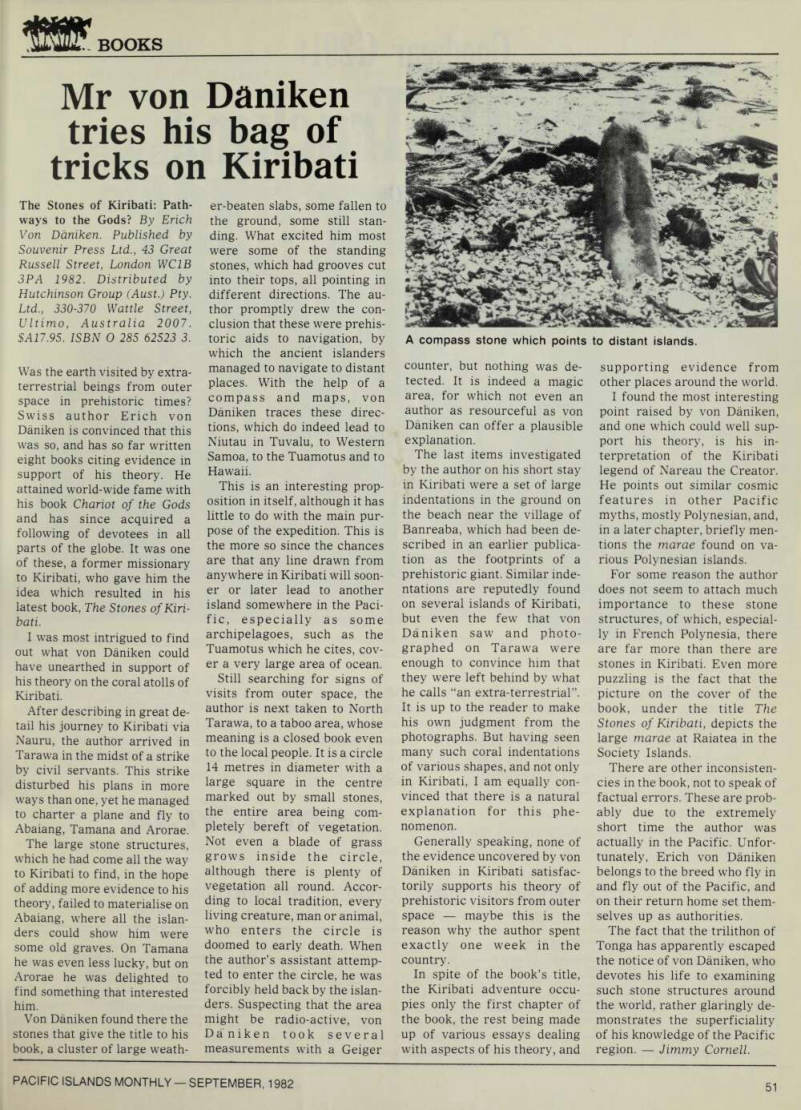
er-beaten slabs, some fallen to the ground, some still stan ding. What excited him most were some of the standing stones, which had grooves cut into their tops, all pointing in different directions. The au thor promptly drew the con clusion that these were prehis toric aids to navigation, by which the ancient islanders managed to navigate to distant places. With the help of a compass and maps, von Daniken traces these direc tions, which do indeed lead to Niutau in Tuvalu, to Western Samoa, to the Tuamotus and to Hawaii.
This is an interesting prop osition in itself, although it has little to do with the main pur pose of the expedition. This is the more so since the chances are that any line drawn from anywhere in Kiribati will soon er or later lead to another island somewhere in the Paci fic, especially as some archipelagoes, such as the Tuamotus which he cites, cov er a very large area of ocean.
Still searching for signs of visits from outer space, the author is next taken to North Tarawa, to a taboo area, whose meaning is a closed book even to the local people. It is a circle 14 metres in diameter with a large square in the centre marked out by small stones, the entire area being com pletely bereft of vegetation.
Not even a blade of grass grows inside the circle, although there is plenty of vegetation all round. Accor ding to local tradition, every living creature, man or animal, who enters the circle is doomed to early death. When the author’s assistant attemp ted to enter the circle, he was forcibly held back by the islan ders. Suspecting that the area might be radio-active, von Daniken took several measurements with a Geiger
counter, but nothing was de tected. It is indeed a magic area, for which not even an author as resourceful as von Daniken can offer a plausible explanation.
The last items investigated by the author on his short stay in Kiribati were a set of large indentations in the ground on the beach near the village of Banreaba, which had been de scribed in an earlier publica tion as the footprints of a prehistoric giant. Similar inde ntations are reputedly found on several islands of Kiribati, but even the few that von Daniken saw and photo graphed on Tarawa were enough to convince him that they were left behind by what he calls “an extra-terrestrial”.
It is up to the reader to make his own judgment from the photographs. But having seen many such coral indentations of various shapes, and not only in Kiribati, I am equally con vinced that there is a natural explanation for this phe nomenon.
Generally speaking, none of the evidence uncovered by von Daniken in Kiribati satisfac torily supports his theory of prehistoric visitors from outer space maybe this is the reason why the author spent exactly one week in the country.
In spite of the book’s title, the Kiribati adventure occu pies only the first chapter of the book, the rest being made up of various essays dealing with aspects of his theory, and
supporting evidence from other places around the world.
I found the most interesting point raised by von Daniken, and one which could well sup port his theory, is his in terpretation of the Kiribati legend of Nareau the Creator.
He points out similar cosmic features in other Pacific myths, mostly Polynesian, and, in a later chapter, briefly men tions the marae found on va rious Polynesian islands.
For some reason the author does not seem to attach much importance to these stone structures, of which, especial ly in French Polynesia, there are far more than there are stones in Kiribati. Even more puzzling is the fact that the picture on the cover of the book, under the title The Stones of Kiribati, depicts the large marae at Raiatea in the Society Islands.
There are other inconsisten cies in the book, not to speak of factual errors. These are prob ably due to the extremely short time the author was actually in the Pacific. Unfor tunately, Erich von Daniken belongs to the breed who fly in and fly out of the Pacific, and on their return home set them selves up as authorities.
The fact that the trilithon of Tonga has apparently escaped the notice of von Daniken, who devotes his life to examining such stone structures around the world, rather glaringly de monstrates the superficiality of his knowledge of the Pacific
region.
Jimmy Cornell.
A compass stone which points to distant islands.