Upsetting old
p. 49 · Read in the full issue
ideas of how PNG came to be
Papua New Guinea’s Prehis tory: An Introduction. By Pamela Swadling. Published by the National Museum and Art Gallery of Papua New Guinea, P.O. Box 5560, Boroko, PNG, in conjunction with Gor don & Gotch (PNG) Pty. Ltd., 1981. Airmail to Australia K 0.75; to New Zealand Kl; to Europe and North America K 1.75. Discounts available if ordered in quantity. ISBN 0 7247 0869 3.
The last two decades have overturned everything we thought we knew about the history of Papua New Guinea.
People have been there for more than 40,000 years; they developed agriculture at least 10,000 years ago; there is little sign that major changes came as a result of invasion or diffu sion from ‘higher’ cultures in Asia; and New Guineans are not closely related to Africans but are related to Australian Aborigines. This beautifully produced and very inexpen sive book from the National Museum of PNG summarises some of these recent dis coveries.
The book is based on the elegant pre-history display in the National Museum. It cov ers the early settlements, agricultural history, mortars and pestles. There are brief sections on the settlement of the other Pacific islands, and on radiocarbon dating. In each section there are many colored illustrations of excavations and artefacts recovered from them, as well as of recent traditional practices which illustrate aspects of the pre historic past. There is also a series of dramatically colored maps which give an im mediately comprehensible overview of particular topics such as the location of sites, the homelands of various crop plants, and the distribution of
languages. The book is color ful, well laid out, and generally accurate in its information.
The first part discusses climatic change and the early settlements. It shows why peo ple must have come to PNG by sea around 50,000 years ago.
There are photos of sites up to 30,000 years old, and of some of their artefacts. Prominent among these are “waisted blades” which are like a stone axehead with notches in the side for hafting. This book calls them “axes”, but they may equally well have been clubheads or digging tools.
Some have been found on up lifted coral reefs on the Huon Peninsula the first time anything older than 10,000 years has been found in the lowland parts of the main island.
The second major chapter is about the excavations at Kuk, near Mt. Hagen, where drains and channels, clearly for gardening purposes, have been dated to more than 9000 years ago. Pamela Swadling properly points out that many, probably all, of the earliest crops were indigenous to the island, and that gardening was a local development based on long-term knowledge of local foodplant resources. In the highlands, at least, the coinci dence between the dates for the beginning of gardening
and of major climatic change (the end of the “ice age”) is striking, and it seems likely that the latter stimulated the former. The book also accepts the generally believed idea that sweet potato has only been in PNG for about 300 years: some of us now see reasons for suggesting that about 1000 years is a more likely time. But there is no direct evidence of this yet.
The discussion on mortars and pestles is excellent. It points out that these have most commonly been found in areas where taro is, or was, the major crop, and that very simi lar artefacts are still used for making taro puddings, often of ceremonial importance, in the islands of Melanesia. It sug gests that this is what the prehistoric examples were used for. This is probably the most likely explanation ever proposed.
There are two important gaps in this book. First, there is no discussion of the physical nature of Niuginians, their ancestors, and their relation ships with other people in the world. Second, and more sur prisingly, there is nothing ab out the pre-history of lowland areas. Pamela Swadling has herself researched for some years around Port Moresby and has written scientifically about that area.
Further, we now know that obsidian lias been mined and traded around New Britain and New Ireland for about 10,000 years, and it is out of this background that many of the Pacific islands were set tled some 3000 to 4000 years ago. It seems rather a shame that none of these things has been mentioned since they add significantly to the story of PNG’s pre-history.
Nonetheless, what has been published is excellent. The book will be widely used with in PNG, for it is a cheap and intelligent text. It will be valu able to people visiting the museum, and should help dis pel some of the myths about the history of PNG which are still widespread in Australian
and other white societies.
J.
Peter White.
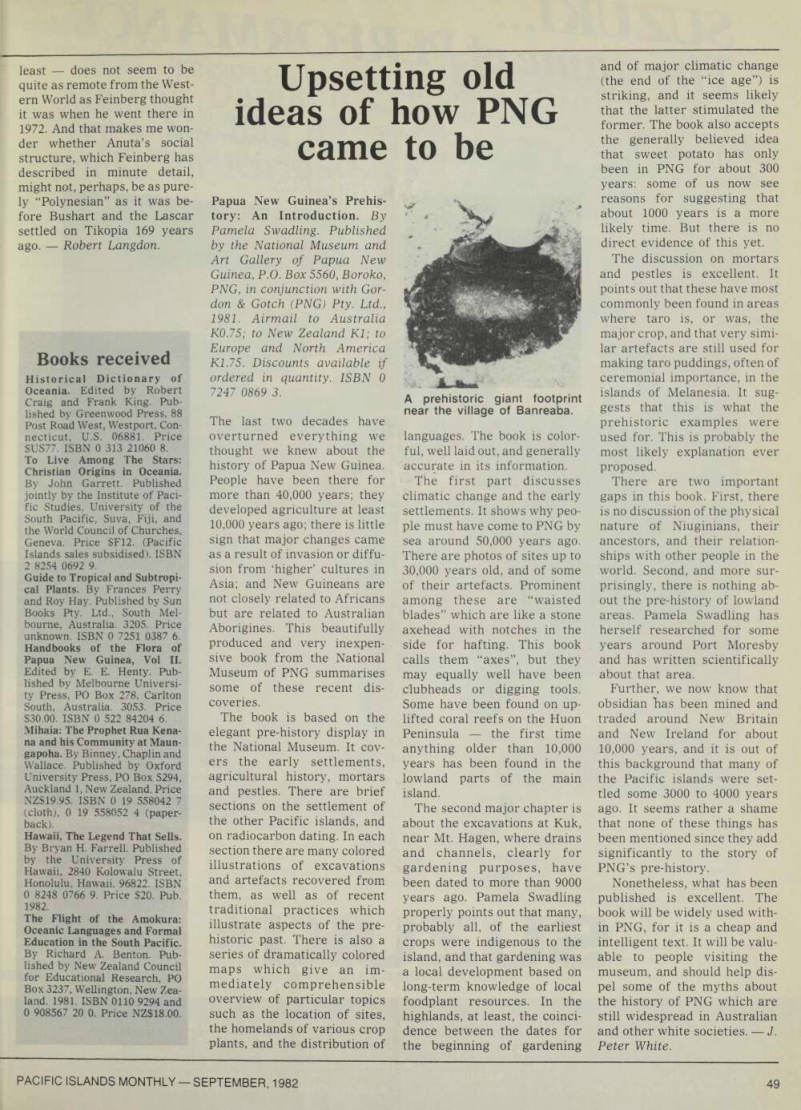
A prehistoric giant footprint near the village of Banreaba.