Pacific
Islands
Monthly
Semmiis, W
American Samoa US$l.75 Australia *A$l.5O Cook Islands NZ$l.5O Fiji F 51.50 Hawaii US$l.95 Kiribati A 51.75 Nauru A 51.75 New Caledonia CFPI9O New Zealand NZ$2.OO Niue NZ$l.5O Norfolk Island A 51.50 Papua New Guinea K 1.50 Solomon Islands 551.50 Tahiti CFPI9O Tonga P 1.50 M|„ A 51.75 U 5%... U 552.25
USTTOjPSuam US$l.95
Vanuatu's.. VI .50 Western Samoa... T 1.95 •RecommendeoS'etail price only Registered by Australia Post Publication No NBPI2IO
Of The Chief
Mkiua New Guinea
Pmmsi St?l3W»iriciaiiii
Rutting On Pressure
e\m :o*eeetoW'
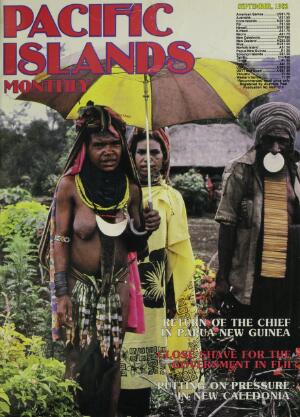
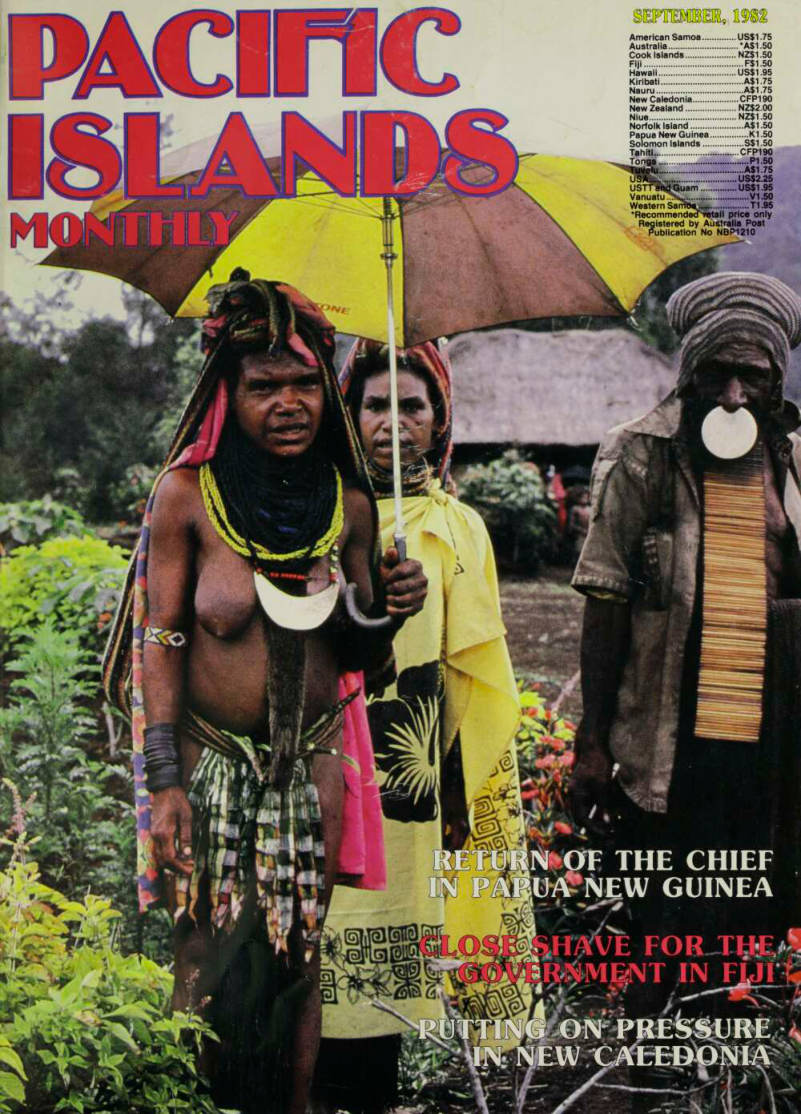
Cover picture: Jimmy Cornell photographed this family group outside Goroka In the Papua New Guinea Highlands
Advertisements & other items, p. 2 (1 item)
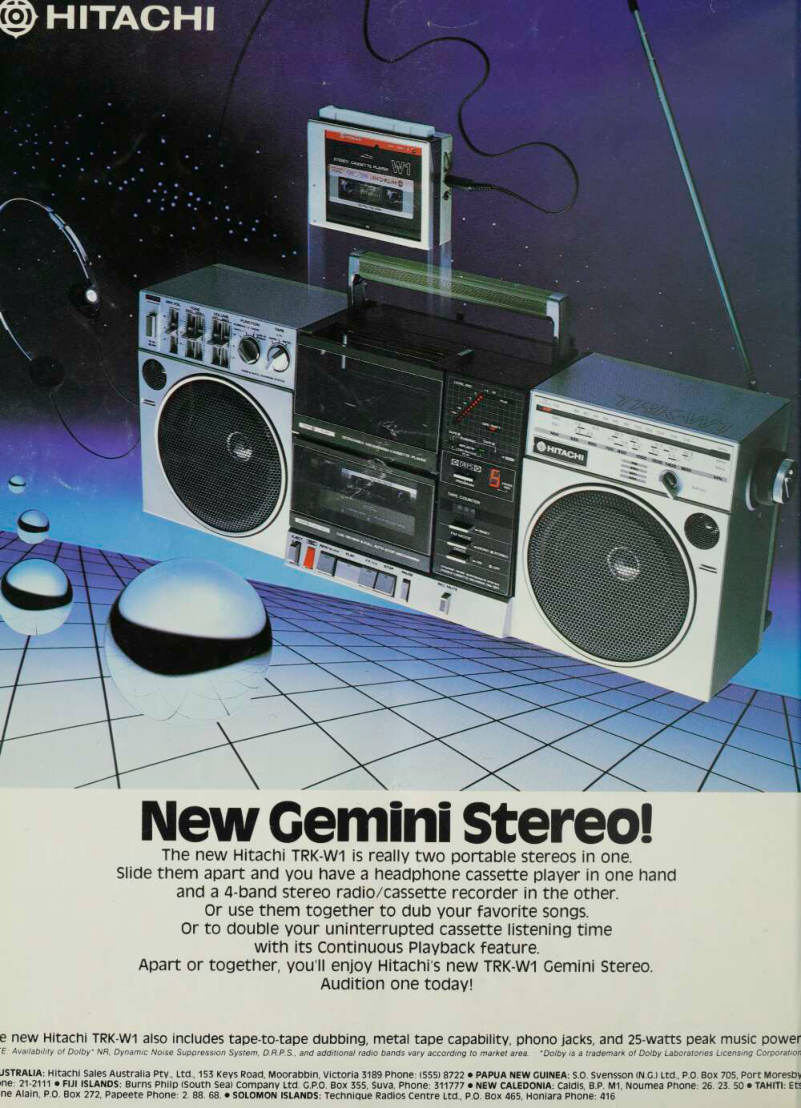
New Gemini stereo!
The new Hitachi TRK-W1 is really two portable stereos In one.
Slide them apart and you have a headphone cassette player in one hand and a 4-band stereo radio/cassette recorder in the other.
Or use them together to dub your favorite songs.
Or to double your uninterrupted cassette listening time with its Continuous Playback feature.
Apart or together, you'll enjoy Hitachi's new TRK-W1 Gemini Stereo.
Audition one today! e new Hitachi TRK-W1 also includes tape-to-tape dubbing, metal tape capability, phono jacks, and 25-watts peak music power £. Availability of Dolby ' NR, Dynamic Noise Suppression System, D.R.P.S., and additional radio bands vary according to market area. *Dolby is a trademark of Dolby Laboratories Licensing Corporation JSTRALIA; Hitachi Sales Australia Pty., Ltd., 153 Keys Road, Moorabbin, Victoria 3189 Phone: (555) 8722 • PAPUA NEW GUINEA; S.O. Svensson (N.C.) Ltd., P.o. Box 705, Port Moresby me: 21-2111 • FIJI ISLANDS: Burns Philp (South Sea) company Ltd. C.P.O. Box 355, Suva, Phone: 311777 • NEW CALEDONIA: Caldis, B.P. Ml, Noumea Phone: 26. 23. 50 • TAHITI: Ets ne Alain, P.o. Box 272, Papeete Phone: 2. 88. 68. • SOLOMON ISLANDS; Technique Radios Centre Ltd., P.o. Box 465, Honiara Phone: 416
Pacific Islands Monthly
Vol 53
No. 9
September 1982
(Usps 952480)
Representatives
AUSTRALIA; Distribution: The Herald and Weekly Times Ltd., 44-74 Flinders St., Melbourne, Vic., 3000 Advertis ing Reps Brisbane D. Wood, Anday Agency, Box 1918, GPO, Brisbane 4001. telephone 44 3485, 44 1546: Adelaide Hastwell Media, PO Box 30, Glen Osmond, SA 5064, 23 Avenue Road. Frewville, SA 5063, telephone 79 9271.
FIJI: Distribution and subscriptions Desai Book shops. PO Box 160, Suva, Fiji, telephone Suva 23036.
Advertising Fiji Times & Herald Ltd., 20 Gordon St., Suva, telephone 312 111, telex FJ2124.
FRENCH POLYNESIA: Distribution Hachette Pacifi que, 10 Ave Bruat, Papeete, telephone 25610.
HAWAII, UNITED STATES: Distribution PIM, Hawaii. PO Box 22250. Honolulu, Hawaii 96822. Advertising Roger Brookes, PO Box 10217, Honolulu, Hawaii 96816, tele phone 808 536 6677.
JAPAN: Advertising and subscriptions Universal Media Corporation, GPO Box 1762, Tokyo, telephone 666 3036.
NEW CALEDONIA: Distribution Depot Centre de Presse Michel Pentecost, CBP2, Noumea, telephone 27 2434, 27 4729.
NEW ZEALAND: Distribution Gordon & Gotch, PO Box 584, 2 Carr Road, Mt, Roskill, Auckland 4, Advertising International Media Representatives Ltd, PO Box 2313, Auckland, telephone 795 487; 493 389, cables lnte r eps, Auckland, Subscriptions Ross Haines & Son Ltd, PO Box 1289, Auckland, telephone 769 042.
PAPUA NEW GUINEA: Distribution Gordon & Gotch, PO Box 3395, Port Moresby, telephone 254551, 254855.
Advertising PNG Post-Courier, PO Box 85, Port Moresby, telephone 21 2577.
UNITED KINGDOM: The Herald & Weekly Times Ltd, No. 1 Maltravers Street, LondonWC2R 3DZ, England, telephone 01 836 5162, telex London 21989.
UNITED STATES MAINLAND: Advertising Joshua B Powers Jr, Powers International Inc., 551 Fifth Ave., New York, New York 10 017, telephone 867 9580, telex 236514.
Subscriptions PIM, Hawaii, PO Box 22250, Honolulu, Hawaii 96822.
Payments by personal cheque are only acceptable in Australian (from a branch in Australia), US and New Zealand currency. For all other remittances please send an international bank draft in Australian dollars.
Published monthly by Pacific Publications (Aust.) Pty. Ltd and printed in Australia by Walter Alten Printing (Australia) Pty. Ltd, Moorabbin, Vic.
Australian cover price is recommended retail only. Regis tered by Australia Post, publication No. NBPI2IO. Second class postage paid at Honolulu, Hawaii. Copyright Pacific Publications (Aust.) Pty. Ltd.
Postmaster Honolulu: Send address changes to PIM Hawaii, PO Box 22250, Honolulu Hawaii 96822.
brtbh
Subscriptions
Local Aust.
American Samoa
Sus21
Si 8 Australia SA18 S18 Canada
Sus27
$25 Cook Islands $19 Fiji $18 French Polynesia $22 Guam
Sus23
$20 Hawaii
Sus23
$20 Japan $20 Kiribati $19 Micronesia
Sus23
$20 Nauru $21 New Caledonia $22 New Zealand
Snz24
$18 Niue $19 Norfolk Island $15 Northern Marianas
Sus23
520 Papua New Guinea 523 Solomon Islands $19
Tonga
$19 Tuvalu $19
United Kingdom
Stg 15 525 US Mainland
Sus27
$25 Vanuatu $19 Western Samoa $18 Elsewhere $A25
The Month
• ELECTION FEVER Robert Keith-Reid reports on the turbulent post-election scene in Fiji, and Angus Smales writes on Papua New Guinea politics following the sweeping comeback victory in the recent elections of the country’s founding Prime Minister Michael Somare 10,15 • MARSHALL ISLANDS American journalist Gift Johnson reports from Kwajalein as Marshallese landowners occupy the giant U.S. missile-testing base, and U.S. officialdom shows itself increasingly opposed to the independence option which the Marshallese claim is their right 30 • NEW CALEDONIA Helen Fraser reports from Noumea on the growing pressures of nationalism 19 • MARLON BRANDO For the first time in more than 20 years, the U.S. film star Marlon Brando has granted a press interview to the Papeete daily, Les Nouvelles. He talks about films, life, the bomb and why he loves Tahiti 33 • TRADEWINDS A large-scale display of Pacific Islands products planned for Sydney in September has inspired a new aggression in the marketing approach of many Island countries 58 • HAWAII Dr Stephen Weinstein begins a two-part report of an off-the-beaten track exploration of several islands of the Hawaii group. This month he visits Lanai, Molokai and Maui 53
Books 47 Brando. Marlon 33 Cook Islands 35 Deaths 73 Fiji 10 France in the Pacific 19, 27 French Polynesia 33, 41 Hawaii 53 Islands Press 18 Kiribati 37, 51 Letters 7 Micronesia 30 New Caledonia 19
New Zealand in the Pacific 35, 40 Pacific Report 5 Papua New Guinea 7, 15, 49 People 41 Political Currents 27 Postmark Papeete 24 Shipping Services 69 Travel 53 Tradewinds 58 Tropicalities 33 U.S. in the Pacific 30 Vanuatu 40, 27 Yachts 65
Advertisements & other items, pp. 3-4 (2 items)
Founded 1930 by R. W. Robson
Editor Angus Smales Associate Editor Malcolm Salmon Advertising Manager Stephen Brandon Editorial Adviser John Carter A Pacific Publications production 76 Clarence Street, Sydney 2000 GPO Box 3408 Sydney 2001 Cables: PACPUB Sydney Telex: 21242 (answers INTARAD) Telephone: Sydney 20-231 Melbourne 63-0211 Manager: John Berry (03) 63-0211 Ext. 1860.
Profit from
Australian
Household Products
Australia makes a vast range of consumer products, many of which sell successfully in international markets. So most likely Australia can supply whatever your customer wants.
For anything from tools to toys, from furniture to refrigerators, check your nearest and quickest supplier first-Australia. fgl Ask the Australian l£J Trade Commissioner The Australian Trade Commissioner can give you details of suppliers. You can contact the Australian Trade Commissioner at: Fiji: P.O. Box 1252, Suva, Phone 31 2844.
New Caledonia: P.O. Box 22, Noumea, Phone 27 2414 Hawaii: Australian Consulate, 1000 Bishop Street, Hawaii, 96813, Phone (808)524 5050.
Papua New Guinea: P.O. Box 9129, Hohola, Phone 259333.
ISSBSI
i wwawwm mm
Pacific Report
Doings Of The South Pacific Forum
Heads of government at the 13th meeting of the South Pacific Forum in Rotorua in New Zealand, in August, agreed not to push France on the subject of the decolonisation of New Caledonia, as they were satisfied she was genuine in her current efforts to bring about reforms. But they “urged” France to work closely with the Kanak people for a peaceful transition to independence.
The Forum rejected a call by the Prime Minister of Vanuatu, Father Uni, to have New Caledonia listed as a colony in the UN so as to make sure that world pressure is kept up on France. It was decided that such a move, while France was working on New Caledonia’s problems, would be “counter-productive”. The question has been put on the agenda for the next Forum meeting to be held in Australia next year, but meanwhile Vanuatu has said that it might unilaterally put on pressure to have New Caledonia listed at the UN. On other matters the Forum also agreed to supply the Pacific Forum Line with another $U.5.12.6 million to allow it to meet conditions for a European Investment Bank loan so that it can buy containers instead of leasing them; decided to arrange for a study of civil aviation needs in the islands so that proper regional plans can be drawn up that might help the Islands airlines out of their economic downturn; attacked the United States for not signing the Law of the Sea convention and asked for that country to revise its policy on highly migratory fish species; and decided to put aside the question of whether there should be one regional body in place of the South Pacific Commission, SPEC and the Forum. A full report of the meeting will appear in the October issue of PIM.
Marshall Islands Poll Deferred
As forecast by U.S. journalist Giff Johnson on page 30 of this month’s PIM, the U.S. has deferred the August referendum in the Marshall Islands. The referendum is to seek opinion on the Compact of Free Association which is to be established between the two countries. The contentious issue in the referendum is whether questions about independence should be included. The U.S. now wants the referendum postponed to October 1 at the earliest. Marshallese Foreign Secretary Tony deßrum responded by saying he would lead a delegation to Washington to invoke the aid of Congress and the White House, and to the United Nations Decolonisation Committee in New York. Back in June, the U.S. had asked for a postponement, because, it claimed, the August date did not allow enough time for public education concerning the proposals. Speaking at a meeting of the UN Trusteeship council in May, Mr deßrum had named October 1 as the day on which the Marshalls would become independent, if the people rejected the compact, or the U.S. failed to ratify it. At that time the raising of the independence issue was seen as merely a Marshallese attempt to force the hand of the Americans. John Carter.
NOW IT’S SOVIET MEDDLING IN FIJI POLL Allegations of Soviet intervention in Fiji’s July election through secret funding of the opposition National Federation Party (NFP) are to be the subject of a judicial inquiry. The allegations, made by Prime Minister Ratu Sir Kamisese Mara, also link Indian Government officials with the funding, and have thus thrown considerable strain on India-Fiji relations. The charges of Soviet intervention came on the heels of NFP charges of Australian interference in the elections (see Robert Keith-Reid’s report this issue). These charges will also be investigated. In the wake of the KGB slush fund claims, the Fiji Government clapped a ban on all visits by Soviet ships to Fiji ports a move which will cost the country $F500,000 a year, according to the managing director of the company handling the docking and re-supplying of Soviet vessels visiting Fiji.
70-Kilotonne Blast At Moruroa
A nuclear test at Moruroa Atoll on July 25 was in the range of 70 kilotonnes, more than three times the power of the bomb dropped on Hiroshima in August 1945, according to New Zealand scientists. An observatory in the Netherlands had earlier estimated the blast at 50 kilotonnes. A Radio Australia
report said that altogether 52 blasts have been recorded at Moruroa. The tests have been underground since 1975, with the biggest, of 140 kilotonnes, being recorded in 1979. The original Dutch reports said that the July 25 explosion triggered a tremor registering 5.9 on the Richter scale. It said the blast was the strongest in the past two years, and the fourth for the month of July.
U.N. Mission Head In Micronesia
A United Nations mission, on an inspection tour of the United States Trust Territory of the Pacific Islands (Micronesia) (PIM Aug. P 5), assured a welcoming group on Yap that the termination of the trusteeship would be simultaneous in all Micronesian states. The assurance was given by Trusteeship Council President Paul Poudade, of France, in reply to Yap leaders who had expressed concern at recent trends in the negotiations, saying that U.S. Ambassador Zeder appeared to be offering the Marshall Islands a different deal from those offered to the Federated States of Micronesia and the Republic of Belau. Outlining the program leading up to trusteeship termination, Mr Poudade said intensive political education on the compact would follow completion of the negotiations. A plebiscite would then follow and, if approved, the compact would go to the legislatures for endorsement and then to the U.S.
President and Congress. If sanctioned, the compact would go to the UN Security Council for final approval. Asked about a possible veto of the compact by the Soviet Union, Mr Poudade said he could not comment until the compact reached the Security Council. It was a sensitive issue since the Trust Territory was a strategic area. Mr Poudade promised to convey to the Japanese Government’s Ambassador at the United Nations “strong” Yapese opposition to Japan s proposal to dump low-level nuclear waste in the Pacific Ocean.
“Fiji Soldiers Spying’’ Israel
Fiji soldiers serving with the United Nations Interim Force in Lebanon (UNIFIL) were among those accused of selling intelligence about Israeli attack plans to Palestinian guerrillas.
The charge was made by Israel's Military Chief of Staff Lieutenant-General Raphael Eytan. An Israeli military spokes man claimed that UNIFIL soldiers from Ireland, France, Senegal and Fiji had taken part in the traffic. The charge was based on documents allegedly written by captured Palestine Liberation Organisation (PLO) personnel. Denying the charges, UNIFIL commander Major-General William Callaghan told Eytan in a letter that he was “frankly surprised by your evaluation of these extremely primitive, inaccurate and amateur documents, and I find nothing in them to support your contention”. The Fiji Times in an editorial dismissed the charges as “laughable”, pointing out that not even Israel’s closest allies knew what it was going to do next. The editorial said the charges were “a red herring to divert world attention from the horrendous punishment Israel has inflicted and is continuing to inflict on Beirut and other Lebanese towns and villages in which thousands of civilians have died”.
Oz Scientists Oppose French Uranium Stake
Two leading Australian scientists have joined in urging the Australian Government not to allow French interests into the Australian uranium mining industry, saying Australia’s credibility in the Pacific would be “seriously undermined” if they were permitted to join. The scientists are Bob Robotham, formerly with the British Atomic Energy Commission, and Dr Don Hutton of the Physics Department, Monash University, Melbourne.
Radio Australia’s Melbourne office reported in August that the French Government is negotiating for an equity stake in the Yeelirrie uranium deposit in Western Australia.
Solomon Wins Through In Solomons
Solomon Islands Prime Minister Solomon Mamaloni beat off a late-July challenge to his position when parliament voted on a motion of no-confidence in him 20 against, 12 for, and five (including Mr Mamaloni) declining to vote. The motion was brought by former Foreign Affairs Minister Ezekiel Alebua, who resigned in June (PIM Jul. P 5). His motion alleged misbehaviour by some ministers. A by-election held at about the same time
was won by the National Democratic Party, junior partner in the ruling coalition. Party numbers in parliament are now: Alliance Party (Mamaloni) 11, NDP four, the opposition United Party 12, and Independents 11.
Lafleur Election Dates Set
The election in New Caledonia made necessary by the politically-inspired resignation of Rightwing Deputy to the National Assembly, Jacques Lafleur, has been set for Septem ber 5 (first round) and September 12 (second round). Claiming that the new Government Council in the territory is unrepre sentative of majority opinion, Mr Lafleur claims that his new election will have the character of a “referendum”. He is virtually certain of re-election in his west coast constituency with its large concentration of European voters. But the main significance of the affair will lie in the size of the vote he receives in comparison with the last time he stood. If it is up, he will claim to have proved his point. If it is down, his whole exercise will be seen to have backfired.
Fsm. U.S., To Talk Again
The Federated States of Micronesia Truk, Ponape, Yap and Kosrae and the U.S. plan to resume talks in September on subsidiary agreements to the Compact of Free Association. The talks had been suspended since October, 1981. Chief FSM negotiator Andon Amaraich said in August that problems associated with the transition issues and unfulfilled U.S. commitments remain to be solved. Transition issues included aid for upgrading communications, construction of a new FSM capital (probably at Palikir in Ponape) and a new community college, land claims, a capital improvements program, and the maintenance of utilities. Subsidiary agreements are pending on the status of military forces, military use and operating rights, federal programs (including postal and weather services), federal aviation administration and civil aviation, extradition and law enforcement, transfer of property, telecommunications, disaster control and mutual security.
Filling Out Vanuatu Parliament At Last
After a long delay, nominations were called for in July for by-elections in the four parliamentary seats in Vanuatu that have been vacant since independence on July 30,1980. Three of the seats were won in the 1979 elections by candidates of the opposition so-called 'Moderate” parties. These have been vacant since one of the three MPs, Alexis Yolou, was shot dead in pre-independence trouble on the island of Tanna in June 1980, and the other two were deported to New Caledonia after the collapse of the secessionist revolt on Santo in August 1980.
The fourth seat was held by the Vanuaaku Party, but fell vacant when the incumbent MP. George Kalkoa, resigned from parliament to take office as President Ati George Sokomanu.
Vanuatu's electoral office announced that two of the by elections for Port-Vila Urban and Efate Rural were to be held on August 26, the one for Luganville on August 31, and that for Tanna on September 2.
Kolone. Muldoon Huddle On Citizenship
Western Samoa's Prime Minister Va'ai Kolone held talks in Wellington in August with New Zealand Prime Minister Muldoon on a recent ruling by the Privy Council in London that some Samoans automatically have New Zealand citizenship. Mr Muldoon said after the talks that legislation would be introduced in New Zealand to circumvent the ruling, but ruled out any hasty action on the part of his government.
OZ FURY AT U.S. OVER LAW OF SEA Rumblings from the U.S. refusal to sign the Law of the Sea Convention (PIM Aug. P 5) continue to be heard, with unnamed Australian officials in particular expressing fury at the U.S. action. One official involved with the negotiations told The Sydney Morning Herald’s correspondent in New York, Paul Sheehan, that the Americans “are behaving like a bunch of clowns.” He added: “The decision by the U.S. was a sledgehammer blow. This conference is a landmark because it does so much and the difficult negotiation of it over many years was a triumph for world diplomacy. U.S. diplomacy has been of a deplorably low quality since the Reagan administration took over. One of President Reagan’s first acts on taking office was to sack the entire American delegation to the conference. The
deputy U.S. negotiator in the Reagan-appointed team is Leigh Ratiner, a former legal adviser to the Kennecott Corporation, which has significant interests in deep-sea mining. Mr Ratiner claims to have been a main mover in having the U.S. refuse to sign the treaty, which among other things declares the moon to be “the common heritage of mankind”.
VANUATU GETS A NEW PARTY, THE VIAP Breakaway elements from Vanuatu’s ruling Vanuaaku Party have formed a new party, the Vanuatu Independent Alliance Party. Speakers at its first rally in Luganville in July were dismissed government ministers Thomas Reuben Seru (Santo) and George Worek (Banks), supported by Kalmar Vocor, John Tari, and Morrison Tangarasi. According to a French-language report in the government newspaper Tam-Tam party supporters at the rally numbered no more than 30, the rest of the sparse crowd being made up of curious onlookers. Mr Seru said that the VIAP would attempt to position itself between the government and the opposition “to try to give new directions in the functioning of the government”.
WORLD WAR II REMEMBRANCE DAY IN PNG An Australian naval patrol boat, HMAS Warrnambool, was in Papua New Guinea for Remembrance Day, July 23. Remem brance Day has been designated a national holiday by the PNG Government in commemoration of Australian, American, New Zealand and Papua New Guinean soldiers who died in the country during World War 11.
Typhoid Outbreak In Fiji
More than 30 typhoid cases were being treated at Suva’s Colonial War Memorial Hospital in early August. The epidemic was mainly confined to the Central Division of the main island of Viti Levu. But on August 12 doctors said that it appeared to be spreading to the western half of the island, with a 25-year-old woman being admitted to the Lautoka Hospital for treatment for the disease. A major campaign of inoculation was mounted in the affected areas.
Nauru’S “Yes’’ To Sparteca
Nauru announced in August its readiness to join SPARTECA, the South Pacific Regional Trade and Economic Agreement under which Australia and New Zealand permit duty-free access to a range of goods from member countries of the South Pacific Forum. Nauru was the last Forum country to join.
Back At Spec: Mahe Tupouniua
The founding director of the South Pacific Bureau of Economic Co-operation, Mahe Tupouniua, has been reappointed to the post, a move foreshadowed by PIM when he stepped down earlier this year as Tonga’s finance minister (PIM May PI 5). The former director, Papua New Guinea’s Dr Gabriel Gris, died in office in March.
Solomon Islands’ Devaluation
Solomon Islands devalued its currency by 10 per cent from August 13. The devaluation meant that the SSI exchanged at about U.5.95c, and A97c. Finance Minister Bartholomew Ulufa’alu said the move would help local producers to compete against imports. Other measures included an increase in depreciation allowances on investments in production and manufacturing, and a cut in import duties on goods required to boost performance by local exporters and manufacturers.
Wellington Meeting For Democratic Union
The first executive meeting of the newly formed Pacific Democratic Union (PIM July P 6), is expected to be held in Wellington in November or December. New Zealand’s National Party President, Sir George Chapman, brought back the news from the union’s inauguration in Tokyo. The party’s general director Barrie Leay has been appointed conference secretary.
The union a sister body to the European Democratic Union was a political structure of Centre-Right parties in the United States, Japan, Australia and New Zealand, Sir George said. The aim was to bring both unions together as the International Democratic Union that would balance the Socialist International.
The Pacific Union was committed to free enterprise, democracy, and peace and freedom in the region, said Sir George, who added that the objective was to bring other Pacific countries into the union. William Gasson in Wellington.
Milne Bay,
Letters
Remembering Milne Bay, 40 years on
Forty years ago, from August 24 to September 7, 1942, a handful of Australian militia men, together with a small force of AIF, probably changed the outcome of World War 2 at the battle of Milne Bay.
There is a tale worth telling of the aftermath of that vic tory. It concerns the reluct ance of General MacArthur and his staff to give credit for the victory to Australian troops.
A Captain R. E. G. Cunning ham arrived at Milne Bay with an AIF unit late in 1943. Half way along Turnbull Field he noted a piece of tin nailed to a coconut tree stump bearing the message “This marks the spot of the first land defeat of the Japanese army in the Pacific.” “In memory of the Australian men who lost their lives in this action.”
Some time later Cunning ham found that the sign had gone souvenired undoubted ly by U.S. troops who had arrived about the same time as Cunningham’s unit.
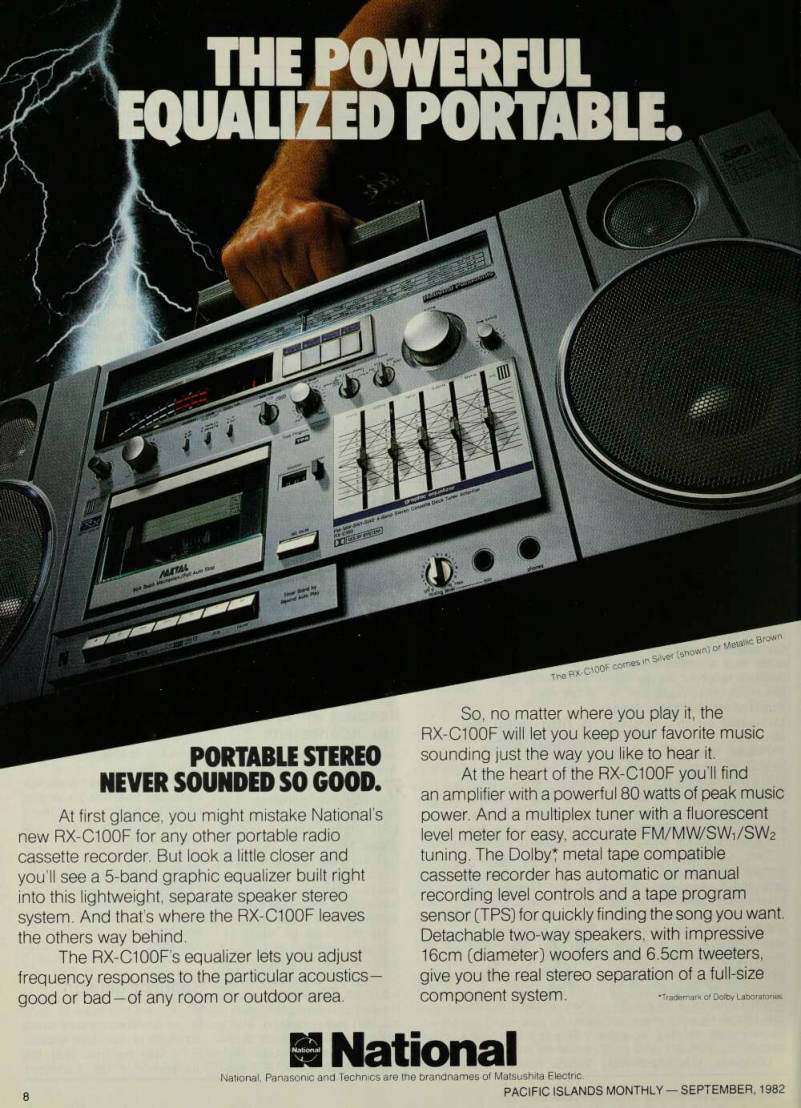
He was so upset that he decided to erect on the site something that could not be removed and had a draftsman in his unit design a concrete structure.
Twelve men of his unit helped construct it in their spare time, and the U.S. forces generously supplied a slab of copper upon which were en graved the words originally on the coconut stump sign.
Two Australian war cor respondents heard of the pro ject and a story and photo graph were published in the Sydney Morning Herald.
Subsequent to this, an order was issued to all AIF units from LHQ Melbourne which said: “From this date, no memorial or plaque will be erected and especially word ing placed on such structure by any unit serving in any area.”
Obviously, this order was
issued in response to the art icle and was aimed at avoiding offence to the Americans.
From then on, the Australian Army was banned from taking any action, however commen dable, to tell the truth about its feats. But the monument was already up and glorifies the Australian victory at Milne Bay.
Geoff Masters
Hawthorne, Qld.
Australia
A film tells the
nuclear story
I am writing to commend to you and to your readers a film that has recently begun circulating in North America.
It is called The Atomic Cafe and is a very effective gather ing together of old film clips (U.S. Army training films, Civil Defence films, early films of nuclear tests) from the ’4os and ’sos concerning the atomic bomb, nuclear test ing, and civil defence. In cluded are film excerpts of U.S. Army officers explaining to Bikini Islanders the use of their island for nuclear test ing.
This is a film that I believe would be very effective in the Pacific Islands if it could be
circulated there. You perhaps know about the film already.
However, I am writing just in case you do not. It is a film that I hope PIM will discuss and bring to the attention of Pacif ic Islanders.
With very best wishes.
(The Rev.) Terry Brown
Faculty of Divinity Trinity College Toronto, Ont.
Canada
Keeping an eye on
the Indonesians . . .
Now that Indonesian incur sions into Papua New Guinea are becoming more blatant, frequent, intimidating and provocative, perhaps Austra lians and the Australian Gov ernment will begin to realise that Australia’s most probable enemy in the next few years is militant Indonesia, at least while Indonesia has its present form and type of government.
Having stood by while In donesia raped East Timor, and perhaps even condoned that aggression, Australia has en couraged the Jakarta junta to attempt in the next few years a similar move against PNG.
Make no mistake about it, In donesia intends to take over PNG. When (not if) this hap
pens, what will Australia do?
There is little doubt that Reagan-type governments in the USA will condone, possibly even encourage, such Indo nesian aggression in the same way as the USA and Australia encouraged Indonesian aggression against East Timor.
Can PNG depend on Austra lian support in any dispute with Indonesia? Indications are that such support is ex tremely doubtful.
Australian Governments both Labor and Liberal toler ated the Indonesian invasion of East Timor and continue to ignore genocide in that unhap py island. Australia’s support of Vanuatu was lukewarm dur ing the foreign-inspired in surrection there, while there is now evidence of Australian interference in the internal affairs of Fiji. All this com bined with economic imperial ism on the part of Australian companies makes Australia a doubtful ally for any small Pacific Island nation.
Anyone who has witnessed the suave but sinister activi ties of the Indonesian Consu late staff in Darwin, NT (video files of Timorese refugees, etc.) will know that PNG would just be a stepping stone on the way to an Indonesian invasion of Australia’s Northern Terri tory.
All Australia’s defence and diplomatic efforts should be directed to containing Indo nesia and supporting indepen dent PNG.
By the way what an un fortunate headline yours was on the cover of the June PIM. I refer of course to “Indian chal lenge in Fiji election”. That was a deliberately provocative title calculated to arouse racial fears. Irresponsible journalism!
Bruce Turner
Mildura, Vic.
Australia
Spanish galleon
or . . .?
In a television news item screened in Auckland recent ly, it was reported that the discoverer of the Northland
The memorial at Turnbull Field, Milne Bay: Not so easy to carry away. - Stuart Inder picture.
“sunken galleon” (PIM Jul.
P 27) has received from Spain confirmation of his identifi cation of the wreck ... it appears that he sent a sketch of the “galleon” to a Spanish marine expert who thinks it is the wreck of the San Lesme.
Needless to say, I am still doubtful. There have been no press releases on the iden tification of the wreck, nor is there any news of Robert Langdon having visited it. The discoverer of the “galleon” appeared to believe that Mr Langdon would be on the first plane once he’d heard about the wreck.
As an archaeologist and wri ter specialising in classical Maori culture, I am very in terested in cultural diffusion and, naturally, view with the utmost suspicion any claims in support of Spanish exploration within Eastern Polynesia and, more specifically, New Zea land. Hopefully PIM will be cautious in its coverage of the San Lesme discovery. Over the past few weeks there has been another controversy, revol ving around the discovery in Tahiti of a canoe that some enthusiasts believe is made of New Zealand totara thus proving evidence of a return voyage to Tahiti by classic Maori navigators. However, Professor Sinoto of Bishop Museum denied that the wood was totara.
Alan Taylor
Auckland New Zealand
Another Kiap
bash
Three cheers for the “Legen dary Kiaps” and Bert E. Wes ton (PIM Jun. P 8). In his long and impressive list of Kiap- Mates he only seems to have forgotten Errol Flynn. That is surprising indeed.
Bert E. Weston describes efficiently his own pre-war activities in Papua New Guinea from “Recruiter” (in more simple terms “Black birder”) to heroic shoot-outs with unruly Kanakas who did not want to work for a stick of tobacco, or to be separated from their families. The only
comment that’s called for is that nobody ever asked Mr Weston or his Kiap-Mates to come to PNG in the first place.
Kessua Tamai (PIM Mar.
P 10) dared to make reference to the number of half-castes roaming the PNG towns and villages. Congratulations to Kessua Tamai for having the guts to pick up this sad chapter of Australian colonial admin istration of PNG, which Bert E. Weston considers to be a normal part of colonisation.
The latest figures received for New Britain alone record no fewer than 3700 half-castes, whose proud Kiap fathers were in a hurry to get home to Australia, and let their offspring and their mothers fight for themselves, with the children now belonging neith er to one nor the other.
Vitaliz Paingame
Cairns, Qld.
Australia This letter cut for length.
Editor.
Meet the Campes
of Saint Michel
I would not like to appear from my last letter (PIM Apr. P 9) some sort of “yachtie-basher”, and, in fact, am happy to write today about the yacht Saint Michel and her crew (men tioned earlier in your yachts section).
Our family met the wonder
ful Campes when they called in Cairns for an overhaul of Saint Michel after a long cruise around the world.
They certainly could not be classified as the “leisure class”, nor among the inex perienced sailors criticised by your correspondents Frank Lewsi, Dr Patil, etc.
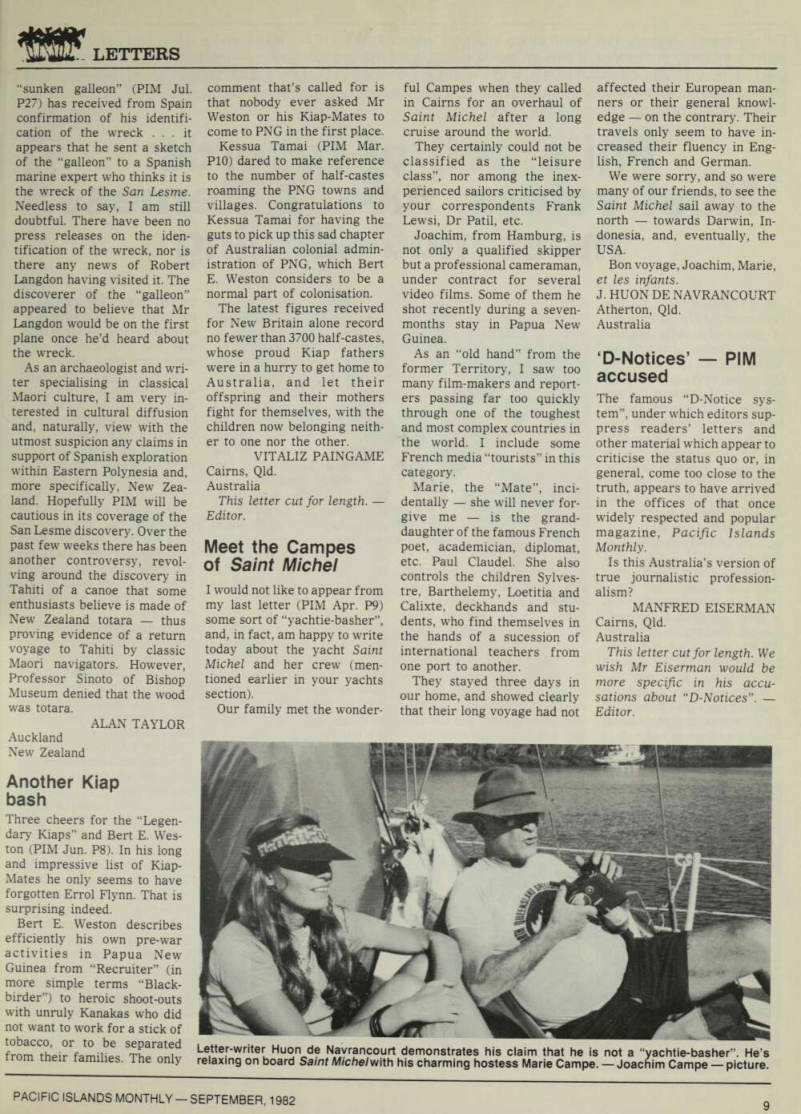
Joachim, from Hamburg, is not only a qualified skipper but a professional cameraman, under contract for several video films. Some of them he shot recently during a seven months stay in Papua New Guinea.
As an “old hand” from the former Territory, I saw too many film-makers and report ers passing far too quickly through one of the toughest and most complex countries in the world. I include some French media “tourists” in this category.
Marie, the “Mate”, inci dentally she will never for give me is the grand daughter of the famous French poet, academician, diplomat, etc. Paul Claudel. She also controls the children Sylves tre, Barthelemy, Loetitia and Calixte, deckhands and stu dents, who find themselves in the hands of a sucession of international teachers from one port to another.
They stayed three days in our home, and showed clearly that their long voyage had not
affected their European man ners or their general knowl edge on the contrary. Their travels only seem to have in creased their fluency in Eng lish, French and German.
We were sorry, and so were many of our friends, to see the Saint Michel sail away to the north towards Darwin, In donesia, and, eventually, the
Usa.
Bon voyage, Joachim, Marie, et les infants.
J. Huon De Navrancourt
Atherton, Qld.
Australia
‘D-Notices’ PIM
accused
The famous “D-Notice sys tem”, under which editors sup press readers’ letters and other material which appear to criticise the status quo or, in general, come too close to the truth, appears to have arrived in the offices of that once widely respected and popular magazine, Pacific Islands Monthly.
Is this Australia’s version of true journalistic profession alism?
Manfred Eiserman
Cairns, Qld.
Australia This letter cut for length. We wish Mr Eiserman would be more specific in his accu sations about “D-Notices”.
Editor.
Letter-writer Huon de Navrancourt demonstrates his claim that he is not a “yachtie-basher”. He’s relaxing on board Saint Michel with his charming hostess Marie Campe.-Joachim Campe - picture.
Advertisements & other items, p. 8 (1 item)
H National
PORTABLE STEREO
NEVER SOUNDED SO GOOD.
At first glance, you might mistake National’s new RX-CIOOF for any other portable radio cassette recorder. But look a little closer and you’ll see a 5-band graphic equalizer built right into this lightweight, separate speaker stereo system. And that’s where the RX-CIOOF leaves the others way behind.
The RX-C 1 OOF's equalizer lets you adjust frequency responses to the particular acousticsgood or bad-of any room or outdoor area.
So, no matter where you play it, the RX-CIOOF will let you keep your favorite music sounding just the way you like to hear it.
At the heart of the RX-CIOOF you’ll find an amplifier with a powerful 80 watts of peak music power. And a multiplex tuner with a fluorescent level meter for easy, accurate FM/MW/SWI/SW2 tuning. The Dolby 1 ) metal tape compatible cassette recorder has automatic or manual recording level controls and a tape program sensor [TPS) for quickly finding the song you want.
Detachable two-way speakers, with impressive 16cm (diameter) woofers and 6.5 cm tweeters, give you the real stereo separation of a full-size component system . 'Trademark of Dolby Laboratories.
H National
National, Panasonic and Technics are the brandnames of Matsushita Electric.
most mud-slinging

Fiji’s poll of records: Most voters, most bitterness, most mud-slinging
Fiji’s general election, the fourth since independence came in 1970, was won by the ruling Alliance Party with its majority cut to four. It was an election calling for many superlatives the biggest turn-out of voters, the bitterest, fought on racial levels, and the dirtiest, indicating that Fiji’s politicians in some respects have little to learn from their counterparts in the so-called developed countries. Below, ROBERT KEITH-REID, Fiji’s leading political commentator, tells the story.
Tense times lie ahead for the Parliament of Fiji. After years of relatively soft, unchal lenged living, the ruling Alliance Party faces an Opposition with a strength and collection of talent sufficient to keep government ministers on their toes, clutching ner vously at their portfolio pap ers, for the next five years.
The July election saw the Alliance retain power, but only just. It had its majority in the 52-seat House of Representa tives slashed from 20 to four, winning 28 seats against 36 in September, 1977. The National Federation Party (NFP), sup ported by most of the coun try’s Indian community, won 22 seats. Its small Fijian part ner, the Western United Front (WUF), picked up two as a present from the NFP, making for an Opposition side of 24.
A four-seat majority is suffi cient for the Fijian-dominated Alliance to control parliament, but, as a winning score, it is not really a convincing one.
But for some miscalcula
tions, the NFP could have won the election, getting 27 or 28 seats. In three vital constituen cies, the total vote in favor of the Alliance carried a margin of only 2000 votes.
A week before seven days of polling began on July 10, with each voter casting four votes, to elect one communal and three cross-voting, or national, MPs, the Alliance was in a critical position. It had had its credibility ripped apart by re velations that it had hired fore ign consultants to devise a campaign strategy for it.
Months of careful planning and preparation to convince 292,000 registered voters they should “keep Fiji in safe hands” seemed to be cascading down the drain as the NFP flourished, with gleeful hor ror, copies of the report, pre pared by a team led by an Australian business consul tant, Alan Carroll, and flooded the country with about 300 copies of an Australian Broad casting Commission Four Cor
ners current affairs television programme. This claimed that the report was evidence of sinister foreign interest in Fi ji’s affairs, business interests who wanted to see the Alliance remain in power.
The contents of the report suggested that, to beat the NFP, the Alliance should smear the character of the Opposition Leader, Mr Jai Ram Reddy, and the WUF leader, Ratu Osea Gavidi; ex ploit racial and religious ten sions; buy off or threaten other opponents, and use other curious techniques such as “stroking” and “toe-cutting” in its endeavours to do down the
Nfp.
Alliance leader and Prime Minister Ratu Sir Kamisese Mara admitted the existence of the report but angrily re futed claims that it had been used. It was repugnant to all that he personally, and the Alliance, stood for, he said.
A lot of people were shocked by what they read in Fiji’s daily newspapers about the
Carroll report. The showing of the Four Corners programme, arranged country-wide in cine mas and on video-TV sets, made them more uneasy.
But the NFP went overboard with its efforts to convince the electorate of the wickedness of the Alliance, and the impact backfired on it badly.
Seizing on particular com ment in the Four Corners show that Ratu Mara was the descendant of chiefs who “clubbed and ate thir way to power” in bad, old cannibal days the Alliance ham mered into Fijian minds the belief that their traditions and chiefs had been insulted in a manner never to be forgotten or forgiven.
The insult had come from “racist” foreigners,and, by spreading it around the coun try on video screens, the NFP was associating itself fully with it, thundered the Alliance in a series of newspaper advertisements.
Voting statistics worked out after the election showed how well the counter-attack had worked for the Alliance, although they cannot be said to have been soley affected by it.
The Alliance won all 12 Fi jian communal seats, includ ing one regained from the WUF leader, Gavidi, and the three communal seats re served for General (non-Fijian and non-Indian) voters. It took all the cross-voting (national) seats for constituencies hav ing Fijian majorities in them, plus two for constituencies with small Indian majorities.
The NFP easily won all the 12 Indian communal seats and with two exceptions it took cross-voting seats for consti-
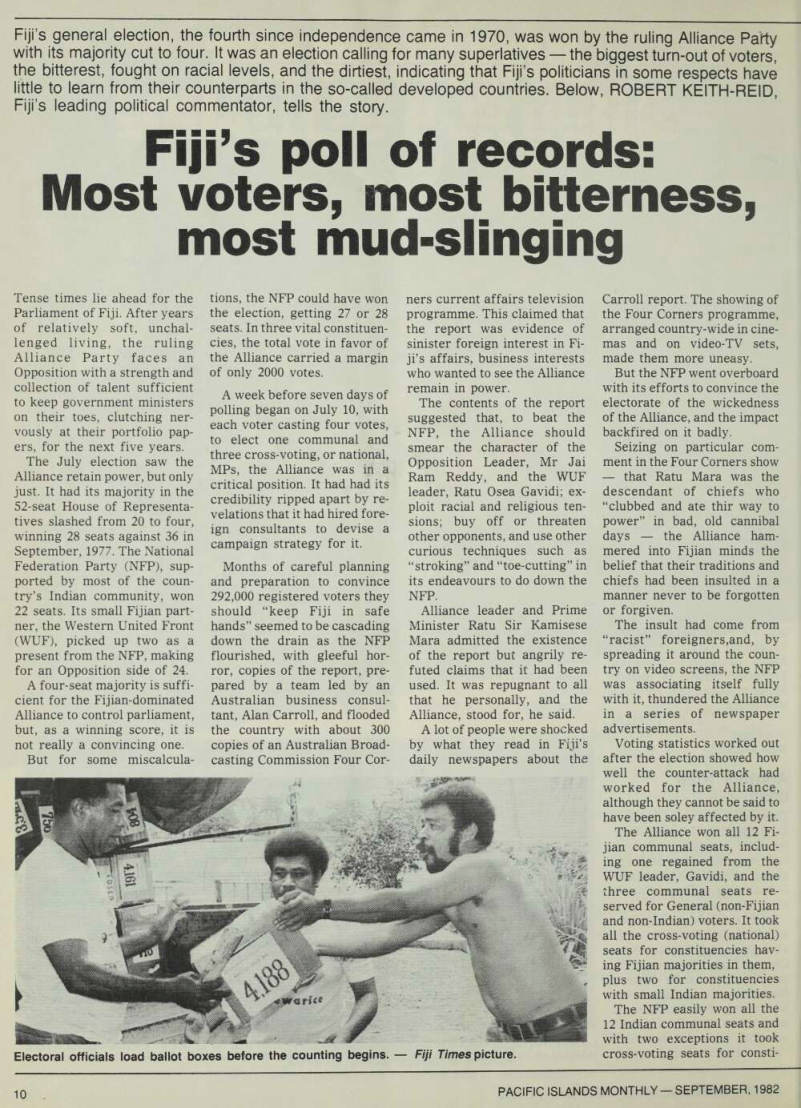
Electoral officials load ballot boxes before the counting begins. — Fiji Times picture.
tuencies having Indian majori ties.
Voters turn-out was about 86 per cent by far the greatest proportion in the history of the country’s general elections, and a clear reflection of the feelings stirred up by an over long and notably acrimonious campaign.
The Alliance got 86 per cent of the Fijian communal vote; WUF got seven percent and the NFP only 0.8 per cent.
On the other hand, the NFP won 84 per cent of the Indian communal vote. The Alliance got just over 15 per cent.
Curiously, in winning 28 seats, the Alliance took 51.8 per cent of the total vote while, in the second election of 1977, having narrowly lost an elec tion six months earlier, it got only 44 per cent of the total vote in winning 36 seats.
Jai Ram Reddy, who before the count had been aggressive ly predicting a win for his party, by 30 seats, quickly capitulated with the complaint that voting had been entirely racial.
At a press conference two days after the election, Ratu Mara agreed, saying: “I feel sure it will be a long time before we achieve a multi racial Fiji.”
Ratu Mara may have pulled a few more critical votes his way when, after being caught outside a polling station by The Fiji Times, he announced that, unless the Alliance won at least 30 seats, he would resign.
If the next government had a majority of only two or three seats he would consider that he had failed and would hand over to another leader.
At the post-election press
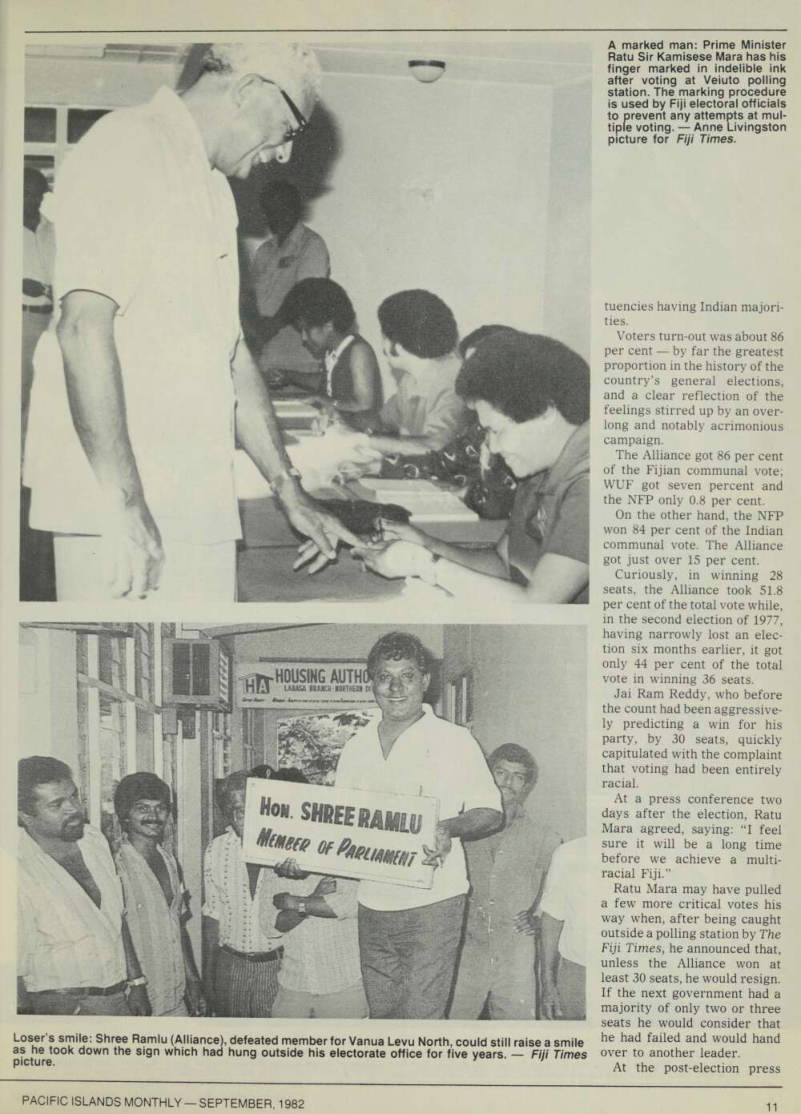
Loser's smile: Shree Ramlu (Alliance), defeated member for Vanua Levu North, could still raise a smile as he took down the sign which had hung outside his electorate office for five years. - Fiji Times picture.
A marked man: Prime Minister Ratu Sir Kamisese Mara has his finger marked in indelible ink after voting at Veiuto polling station. The marking procedure is used by Fiji electoral officials to prevent any attempts at mul
tiple voting. - Anne Livingston
picture for Fiji Times.
conference, at which he lashed out at “interference” in Fiji affairs by foreign journalists and hinted that curbs might be introduced to prevent intru sions by them at election times, Ratu Mara was asked if he’d been sincere about his resignation threat.
A few hours before the meeting with the press he had been unanimously re-elected party leader by his 27 fellow Alliance MPs and had then gone to Government House to be reappointed as PM.
Why had he changed his mind?
Because of that vote, he said, referring to the 51.8 per cent overall poll for the Alliance.
For a government which had more or less been in power for 16 years, to score that level of support was “more than ever we expected,” and not a figure that could be achieved easily in any other democratic country.
His threat to resign had “spurred a lot of people into the polling booths,” he agreed, but it had been made to a reporter because “people like you like instant answers, and you build images of people by instant answers.”
“You don’t like considered answers. You ask instant ques tions and you get instant answers.”
The Alliance went into the election counting heavily on a repetition of 1977 when quarrelling in the NFP be tween its then leader, Siddiq Koya, and other personalities, split the party so badly that it was unable to form a govern ment after winning an election in April of that year, but not with a working majority. The rift between the two factions was so great by September that the Indian community was seriously split and the Alliance scored a resounding victory.
The NFP’s leader, Mr Red dy, deserves admiration for his achievement in reconstruc ting the NFP, holding it together through the election just over, and steering it to within a hairsbreath of taking over government.
Throughout the campaign there were signs that all was not completely well within the NFP, and that Reddy had wor ries about Koya. After five
years’ absence from parlia ment, Mr Koya was re-elected as member for an Indian com munal seat. After the election, there were anonymous de mands for Mr Reddy’s remo val as party leader. It seemed likely, however, that he would still be in the Opposition Lead er’s chair when the new House of Representatives held its first meeting on August 17.
Two Fijian opponents of the Alliance, WUF and the Fijian Nationalist Party, were shown by the election results to be of little significance in the na tion’s affairs. WUF was formed in mid-1981 by the then independent member for the Nadroga-Navosa Fijian communal seat, Ratu Osea Gavidi, who agreed with Mr Reddy on the formation of a coalition government should they beat the Alliance.
Mr Reddy hoped that the association with WUF would diffuse the NFP’s “Indian par ty” image.
There were moments when WUF looked as if it might be a serious problem for the Alliance. As things turned out, it did badly in five of the Fijian communal constituencies in which it fought.
Two WUF supporters won cross-voting seats, but only because of the large pro-NFP Indian vote in those consti tuencies. The NFP had agreed that WUF should contest them without NFP opposition.
The election had obliterated the Fijian Nationalists who, in the first election of 1977, won almost 25 percent of the Fijian communal vote and were re sponsible for the Alliance de feat at that time. All its 22 candidates failed, many losing their deposits.
Alliance losses included three ministers of state Mr Bill Clark (Energy), Mr Sakiasi Waqanivavalagi (Lands, Minerals and Youth) and Mr Ishwar P. Bajpai (Co operatives). New faces in its team include millionaire businessmen Mr Jim Ah Koy and Mr Peter Stinson, and Dr Ahmed Ali, formerly director of the University of the South Pacific’s Institute of Social and Administrative Studies.
The NFP side features Sir Vijay Singh, a former member of the Alliance and former
Alliance Attorney-General, Mr Sharda Nand, a former perma nent secretary for Commerce and Industry, and now manag ing director of a large flour milling company, and another senior academic from the uni versity, Dr Satya Nandan.
The inclusion of these and other new faces has produced what should be the most able Opposition ever seated in the House of Representatives.
But, memories and resent ments lingering from what be came a bitter and, at times, an ugly, personal duel between Ratu Mara and Mr Reddy, and the presence of the Opposi tion’s benches of such formid able politicians as Mr Koya and Sir Vijay Singh, could make the next five years stor my ones for parliamentary staff to ride through that’s if the House’s life lasts that long.
Ratu Mara has made it plain that he doesn’t think he can work well with Mr Reddy any more in getting parliamentary routines and procedures work ed out. He’d prefer to see Mr Koya someone he wasn’t talking to five years ago back in the Opposition Lead er’s seat.
Mr Reddy will press for a full inquiry into the implica tions of the Carroll report, and Ratu Mara has promised that any inquiry will be a judicial one.
Fiji’s electors, despite what their leaders said and did ab out each other, did their bit by voting in a notably calm and incident-free fashion. They seem anxious to see all the sound and fury of the election die away, and eventually be
forgotten. Unfortunately for them, however, the two lead ers, who pretend to have thick skins but really haven’t, seem loath to lower their lances.
An enlarged Cabinet of 15 ministers was announced by the PM on July 26. Three ministers of state were also appointed and the contents of some portfolios were shuffled around.
Ratu Mara gave up foreign affairs, which he has held since 1970, handing the port folio to former House of Rep resentatives’ Speaker Mr Mosese Qionibaravi, who is also Minister for Tourism.
Ratu Sir Penaia Ganilau con tinues as Deputy Prime Minis ter and Minister for Fijian Affairs and Rural Develop ment.
Other posts are: Agriculture and Fisheries, donate Mavoa; Employment and Industrial Relations, Mohammed Ram zan; Economic Planning and Development, Ratu David Toganivalu; Transport and Civil Aviation, Edward Bed does; Finance, Charles Wal ker; Communications and Works, Semesa Sikivou; Lands, Local Government and Housing, Militoni Leweniqila; Attorney-General Senator Manikam Pillai; Home Affairs, Ratu William Toganivalu; Energy and Minerals, Peter Stinson; Education and Youth, Dr Ahmed Ali; Health and Social Welfare, Dr Apenisa Kuruisaqila.
Ministers of State are: Co operatives, Livai Nasilivata; Forests, Ratu Josaia Tavaiqia; Minister without Portfolio, Apisai Tora.
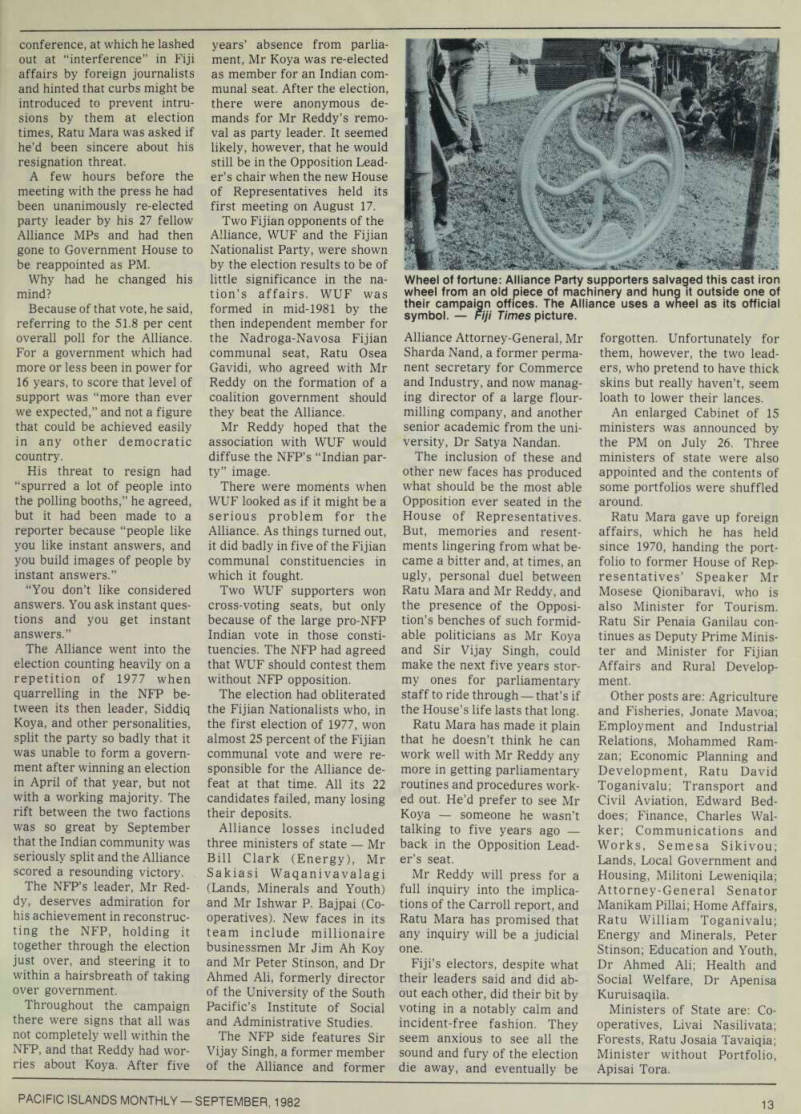
Wheel of fortune: Alliance Party supporters salvaged this cast iron wheel from an old piece of machinery and hung it outside one of their campaign offices. The Alliance uses a wheel as its official symbol. - Fiji Times picture.
Advertisements & other items, pp. 12-14 (1 item)
Let Your Imagination Run Wild
Imagine the dynamic sound of a quality stereo system. And imagine how nice it would be if you could take this sound along with you wherever you go. A fairy tale? Not at Sansui.
We let our imagination run wild and developed Portable Component Systems, the newest Sansui Hi-Tech Compo sound idea.
The creative folks at Sansui borrowed many advanced features from full-size home components. Next, we packed them all into tiny #Vd.
O mini-component-sized packages. And as a final touch, we snapped them together and attached a convenient carrying handle.
The result? Dynamic sounding portables that disassemble to form full-feature mini component systems.
Sansui. Imagine what we'll do next. aat we 11 do sxt. y
c o< C > ,of
cO J 0
Sansui.
PORTABLE COMPONENT SYSTEM CP-7
SANSUI ELECTRIC CO., LTD. 14-1 Izumi 2-chome, Suginami-ku, Tokyo 168, Japan. • Australia VANFI (Aust.) Pty. Ltd. 297, City Road, South Melbourne, Victoria 3205, Australia Phone: 690-6200/283 Alfred Street, North Sydney, N S W. 2060, Australia Phone: 929-0293 • Fiji Prabhu Brothers Ltd. PO. Box 183, Nadi Phone: 71122 • Papua New Guinea Oceania Indent Agency (P.N.G.) Pty, Ltd. Box 5518, Boroko, Port Moresby Phone: PM 256406 % New Zealand David Reid Electronics Ltd. PO. Box 2630, Auckland, Phone: 488-049 • New Caledonia Ets Michel MERCIER B P. 1123, Noumea Phone: 27.59.11 Central Pacific Nauru Co-operative Society Republic of Nauru • Vanuatu The Sound Centre PO. Box 434, Port Villa Phone: 2035 • Tahiti SIMEL PO. Box 3338 Phone: 26979
Expert
Insurance Service
throughout the islands
Queensland Insurance (Fiji) Limited
Head Office. 34 Usher St., SUVA . General Manager: L. G. Liddell A.A.1.1. Assistant Managers : R, Jackson, Vijay Lai. Phone: 23851.
LAUTOKA OFFICE: Burns Philp Bldg., Naviti St. District Manager: J. Dalton. Phone: 60642.
LABASA OFFICE: Burns Philp Bldg. District Manager: R. SHARMA, Phone: 8 2139
Queensland Insurance (PNG) Limited
PAPUA NEW GUINEA
Head Office, B.N.G. Building, Musgrave St.PORT MORESBY. General Manager: J. M. Dawe.
Phone: 21 2144, LAE. 4th St & Coronation Drive. District Manager: C. D. Hillier Phone: 423873.
MOUNT HAGEN: Hagen Drive. District Manager: G. W. Jack Phone: 521002.
ARAWA: Chebu St. District Manager: J. Longbut. Phone: 951555.
MADANG: Kasagten St. District Manager. N. D. Ramage. Phone. 822020, RABAUL: Wirraway St. District Manager: W. F Tinker, Phone: 921014.
QBE Insurance (International) Limited
VANUATU, PORT VILA: Rue de Paris, Suite 19, Oceania Bldg, Manager I. R. Martin.
Phone: 2299.
SANTO: Burns Philp ( Vanuatu) Ltd Phone. 230.
PACIFIC AGENCIES
NEW CALEDONIA: Ste. W. A, Johnston, S.A.R.L. 5 Rue Anatole France, NOUMEA.
Phone: 272083.
TAHITI: Arthur Chung. Immeuble B I S., Front de Mer, PAPEETE . Phone: 2,86,19 NIUE: Burns Philp (South Sea) Company Ltd.
NORFOLK ISLAND: Burns Philp ('N I ) Company Ltd. Phone: 2191.
SAMOA: APIA. Burns Philp (South Sea) Company Ltd. Phone: 22611.
TONGA: Burns Philp (South Sea) Company Ltd, NUKUALOFA. Phone 21500 HAAPAI, VAVAU.
MEMBERS OF THE:
INSURANCE GROUP UMITED
after a bitter PNG campaign
“The Chief” regains his leadership after a bitter PNG campaign
Michael Somare the man they call “The Chief” is back as Prime Minister of Papua New Guinea. True to his prediction he survived two weeks of bitter political fighting in the wake of a general election to emerge early in August with the numbers to form a government. ANGUS SMALES tells the story:
The July count in the Papua New Guinea general election left Mr Michael Somare’s Pan gu Party with the biggest col lection of seats of any party, but too few to form a govern ment without aid. Somare, the man who led PNG to independ ence in a 1975 but who lost his national leadership in a par liamentary vote in 1980, set out to organise the extra sup port he needed. He won after an intense campaign which was marked by bitter ex changes and fluctuating loyal ties. Under the PNG con stitutional system in which parliament directly votes for its prime minister he was re turned by 66 votes to 40. The man he defeated in the formal ballot was his former ally Father John Momis, represen ting the disrupted Chan coali tion.
Sir Julius Chan himself, for mer leader of the coalition and prime minister, did not figure in the vote. He valiantly fought a rearguard action for some days after the election count, and then with tacit support of his Peoples Progress Party he withdrew from the running.
Effective leadership was be coming impossible in the atmosphere of dissent, he said.
The former deputy prime minister, Mr lambakey Okuk, did not get a chance to figure in the fight because he had lost his parliamentary seat. Mr Ted Diro, entering parliament for the first time after a milit ary career which led him to command the PNG Defence Force, took over the National Party leadership from Mr Okuk and became leader of the Opposition. He was criticised in some quarters for pushing too hard, but his opposition leadership is a rare achieve ment for a first-term-in-office man. He could well have been deputy prime minister under
Somare had he played his cards differently.
Mr Paias Wingti, a low key but effective and solid Somare man, went in as deputy prime minister and Mr Dennis Young as Speaker of Parliament. Mr Young, a naturalised PNG citizen, came to PNG 16 years ago and was born in England.
He is the second naturalised citizen to hold the position since Independence. The other was Australian born Mr Barry Holloway who is now a mem ber of the Somare ministry.
Towards the end of July
after the general success of the Pangu vote had been con firmed, intense lobbying be gan in the campaign to form a government. Sir Julius Chan and Michael Somare both appeared to have strong chances, with Ted Diro being seen in the role of a king maker. Sir Julius stressed that the coalition was still united, Sir Julius and Somare each issued figures claiming a majority of supporters but the figures they quoted added up to 15 more than the membership of parliament.
By the end of July it became apparent that there were strains in the Chan coalition group, largely centred on the leadership issue. Sir Julius was seen as the natural leader by seniority and because he was still prime minister, but Diro provided a challenge be cause he led the biggest party grouping. Somare at this stage was making little comment ex cept to say he was confident of mustering the numbers to govern.
July ended with three dramatic developments. The first was when the five-mem ber-strong United Party announced that although it was technically part of the coali tion group it had been holding secret talks with Somare and had decided to join forces with the Somare Pangu Party. With candor if not with grace the United Party leader, Mr Roy Evara, said “We are not in terested in mere numbers we want to be in government for the next five years.”
The second development was when the Melanesian Alliance, led by Father John Momis, said it intended to throw its eight supporters be hind Somare.
And the final development was an announcement by Sir Julius that he was pulling out of the controversy over leadership of the coalition. “I have no wish to hang on to leadership of a coalition which is so split by dissent that it cannot say who its leader is,” he said.
In the final run up to the formation of a government there was yet another surprise Father Momis relinquished his plan to join forces with the Somare group and became the coalition group’s nomination for prime minister.
Michael Somare went back to office with no trouble soon
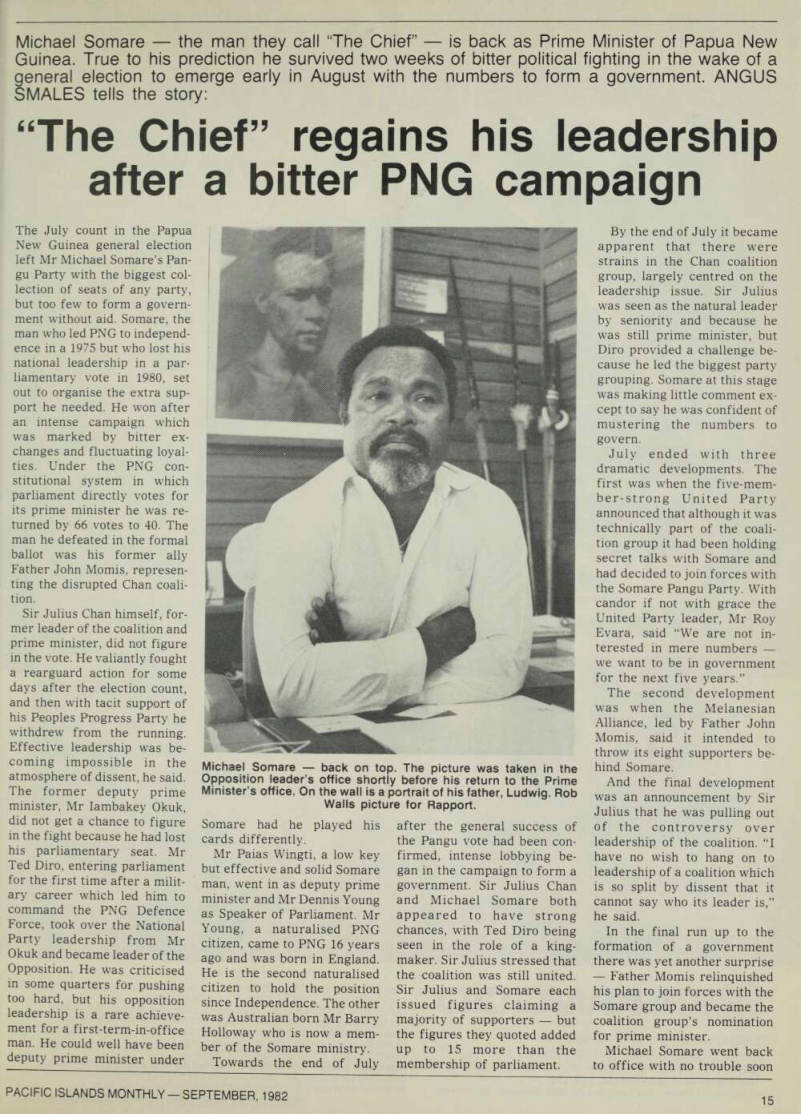
Michael Somare - back on top. The picture was taken in the Opposition leader’s office shortly before his return to the Prime Minister’s office. On the wall is a portrait of his father, Ludwig. Rob Walls picture for Rapport.
afterwards. Three days later the opposition came to grips with its leadership problem and voted on the issue. Ted Diro defeated Sir Julius Chan by 19 votes to 18 to become opposition leader, and Sir Julius then deferred to Father Momis who was confirmed as deputy opposition leader.
The Governor General, Sir Tore Lokoloko, formally addressed parliament on the aims of the new Somare gov ernment. He told the official opening of the new parliament that measures similar to those used in wartime were needed to restore the country’s de velopment targets and nation al priorities in health, educa tion, agriculture, housing and industry.
Members of the new So mare ministry are: Michael Somare, Prime Minister; Paias Wingti, Deputy Prime Minister, National Plan ning and Development, Prim ary Industry; Rabbie Namaliu, Foreign Affairs and Trade; Phillip Bouraga, Finance; Karl Stack, Commerce and Indus try; Francis Didman, Minerals and Energy; Matthew Ben dumb, Transport and Civil Aviation; Barry Holloway, Education; Tony Siaguru, Pub lic Service; Roy Evara, Home Affairs; Bebes Korowaro, Lands; Kala Swokim, Urban Development; John Nilkare, Decentralisation; Epel Tito, Defence; Sir Pita Lus, Par liamentary Services; Kaspar Angua, Labour and Employ ment; Michael Pondros, Public Utilities; Martin Tovadek, Health; Pundia Range, Cor rectional Services and Liquor Licensing; MacKenzie Jovoka, Culture and Tourism; Tony Bais, Justice; Tom Awasa, Re ligion, Youth and Recreation; John Giheno, Police; Halalu Mai, Environment and Con servation; Lukas Waka, Forests; Boyamo Sali, Media; Pato Kakarya, Works and Supply.
Eleven members of the new Cabinet are entering Parlia ment for the first time, although some of the newcom ers particularly Tony Siaguru, Rabbie Namaliu, Phil lip Bouraga and John Nilkare should be of particular value because of their senior
public service experience. The only survivors of Mr Somare’s “old guard” when he first led PNG are Barry Holloway and Sir Pita Lus.
Mr Somare was three days behind schedule in naming his Cabinet and he freely admitted that the delay was caused be cause he was running into what he called “regional prob lems.” This is a particularly sensitive issue in PNG where the country’s clearly-defined regions tacitly demand equal representation in Cabinet. The upshot was that Mr Somare was to some extent obliged to appoint a bigger Cabinet than he would have liked. To do otherwise would have been to invite early dissent and electo rate dissatisfactions. He had already campaigned on the basis that Pangu would cut administrative waste, and no doubt felt some embarrass ment in naming a Cabinet which, in terms of numbers, was right on the constitutional limit.
He was quick to assure Parliament that he would re view his team within three months and hoped to “effec tively reduce” the numbers.
Mr Somare said he realised he had selected a big Cabinet at a time when the country was facing economic hardship, and he was aware that critics would see his action as con trary to his stated policies.
However he believed it would have been premature to re duce the numbers immediate ly because no information was available on the areas where savings could best be made.
It is hard to escape the conclusion that Mr Somare has merely deferred a difficult de cision, particularly as he also told Parliament that he would be failing in his duty to the constitution if he didn’t spread regional representation as widely as possible. If there is no wastage in his Cabinet in the first three months, he is going to find extreme political difficulty in shedding some of his ministers.
An editorial in the Papua New Guinea Post-Courier, published in Port Moresby, was critical of the size of the Cabinet in political and practi cal terms and accused Mr So
mare of having made obvious and unnecessary concessions to regional jealousies. The editorial suggested that Mr Somare was well aware that the ministry was too big to be compatible with a policy of national belt tightening. “The anachronistic tradition of sharing the ministries among the regions must be aban doned,” the editorial said.
But from his newly influen tial position as Leader of the Opposition, Mr Ted Diro alleged that regional jealousies were far from
soothed anyway. Mr Diro’s claim was that a nucleus of four men from the East Sepik region now had a firm grip on PNG’s national affairs because of the strength and integration of their portfolios. He named the four as Mr Somare, leading the National Executive Coun cil; Mr Siaguru, controlling the public service; Sir Pita Lus, controlling the parliamentary legislative programme; and Mr Bais, heading the country’s judicial arm. Mr Diro said the situation confirmed a view held by many that Mr Somare was effectively becoming a dictator, and that the Sepik people through their bloc in Parliament were in a position to control national manage ment. Mr Somare later denied the allegations, saying that he
and all his ministers were sub ject to the democratic check and balance which PNG had built into its constitution. (The East Sepik, Mr Somare’s home area, is in the north-west of the PNG mainland).
The new Somare govern ment appears to have entered its stewardship in an atmos phere of some bitterness and a measure of recrimination. The spirit of national crusade and cross-party links which marked every facet of PNG politics in the days of self government and independence is no longer there. This was perhaps inevitable as national management became a task rather than a target, and as a growing corps of new politi cians split and rejoined and split again in the contest for the top. The climate of today’s PNG economy an economy affected by outside forces as much as by internal politics is another factor which has clouded the political atmos phere.
Outside the immediate areas of political factionalism there’s a general feeling that Mr Somare will bring back something of the spirit which marked his first term of office, and which could do much to remove the divisive ness which has become appa rent in PNG affairs. Sir Julius Chan was a direct-minded and capable Prime Minister who dissipated much of his effectiveness in a never-en ding battle to hold his govern ment together. Michael So mare gives the impression of being neither more nor less capable, but he goes back to office with one big advantage he has done it all before.
When he lost office he de scribed his introduction to the Opposition ranks as “the start of a rest before I think things over and come back again.”
Not all his supporters be lieved he could make the comeback, but even before the election it was apparent that his position was strengthen ing. His present intention is to retire in 1987, the year of the next general election. He will then be 52 years of age and will have been in Parliament continuously for 19 years.
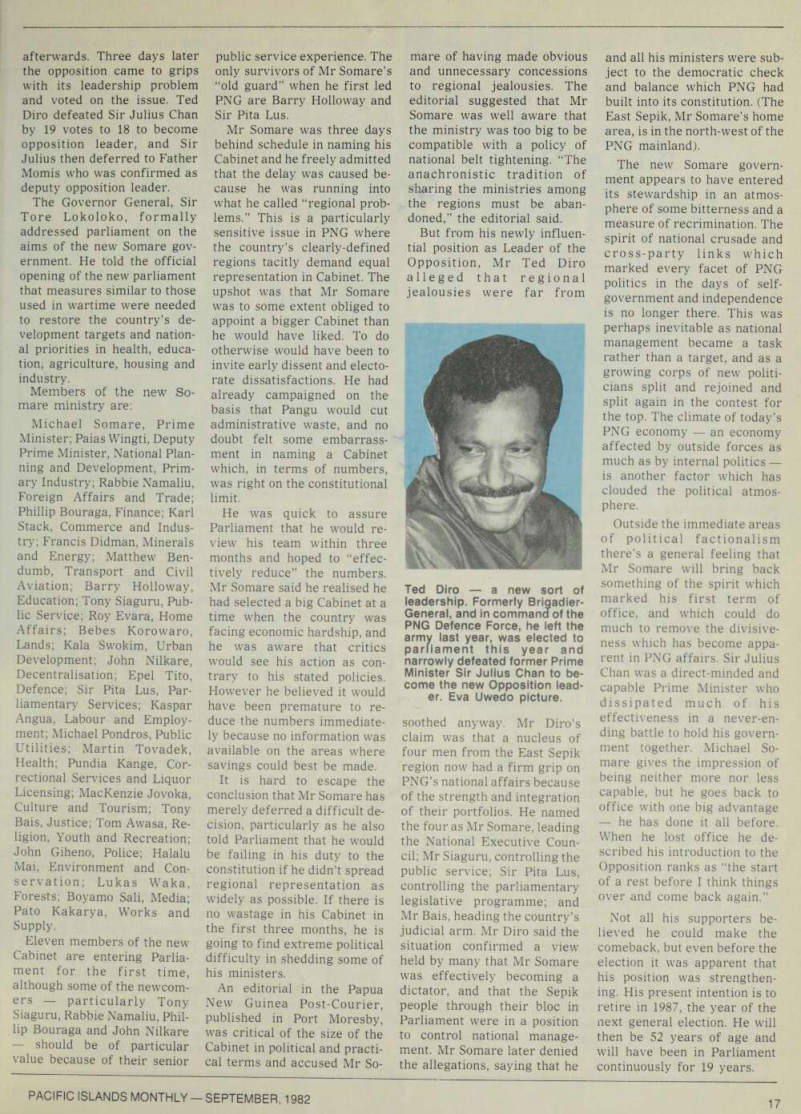
Ted Diro - a new sort of leadership. Formerly Brigadier- General, and in command of the PNG Defence Force, he left the army last year, was elected to parliament this year and narrowly defeated former Prime Minister Sir Julius Chan to be come the new Opposition lead er. Eva Uwedo picture.
Advertisements & other items, p. 16 (1 item)
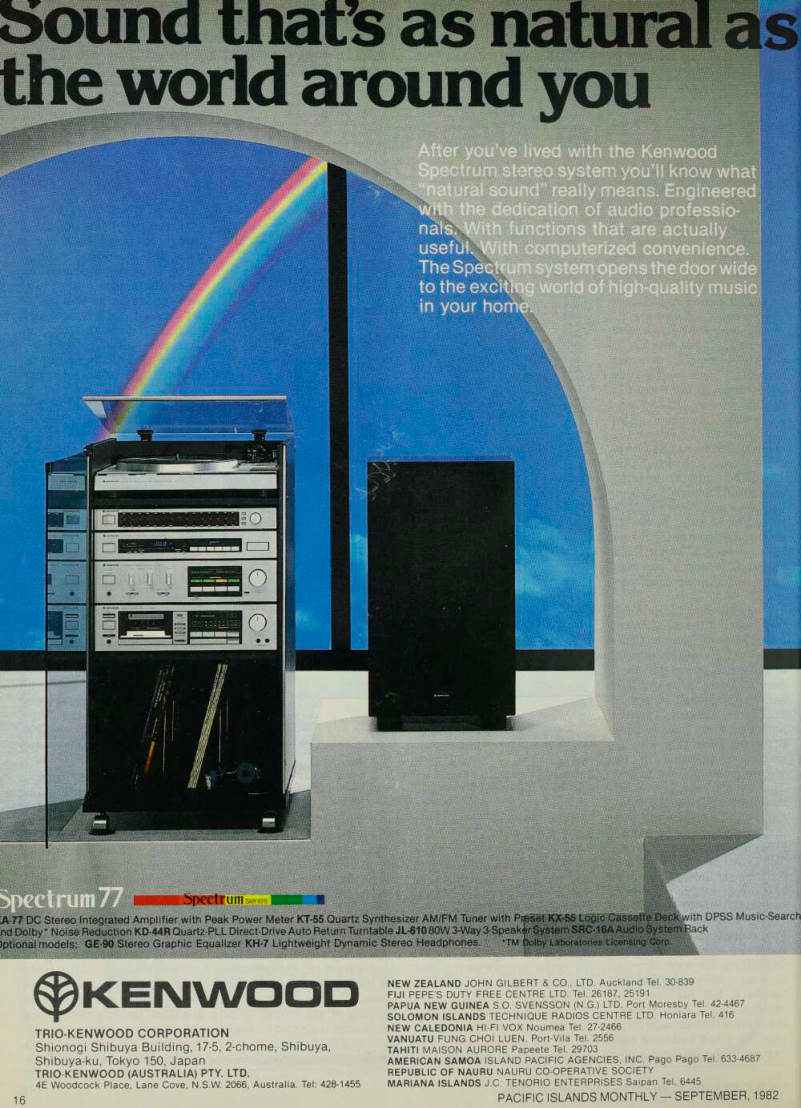
the world around you
as
■ QJ □ d o □ □ o o □ T ■
HHH
. m urn series A-77 DC Stereo Integrated Amplifier with Peak Power Meter KT-55 Quartz Synthesizer AM/FM Tuner with nd Dolby * Noise Reduction KD-44R Quartz-PLL Direct-Drive Auto Return Turntable JL-610 SOW 3-Way 3-Speak. )ptional models; GE-90 Stereo Graphic Equalizer KH-7 Lightweight Dynamic Stereo Headphones. *tm botby Laboratories Licensing Corp •55 Logic Cassette Deck with DPSS Music-Search m SRC-16A Audio System Fa k
TRIO-KEN WOOD CORPORATION
Shionogi Shibuya Building, 17-5, 2-chome, Shibuya,
Shibuya-ku, Tokyo 150, Japan
TRIO-KENWOOD (AUSTRALIA) PTY. LTD.
4E Woodcock Place, Lane Cove, N.S.W. 2066, Australia. Tel: 428-1455 NEW ZEALAND JOHN GILBERT & CO., LTD. Auckland Tel. 30-839 FIJI PEPE’S DUTY FREE CENTRE LTD. Tel. 26187, 25191 PAPUA NEW GUINEA S.O. SVENSSON (N.G.) LTD. Port Moresby Tel. 42-4467 SOLOMON ISLANDS TECHNIQUE RADIOS CENTRE LTD. Honiara Tel. 416 NEW CALEDONIA HI-FI VOX Noumea Tel. 27-2466 VANUATU FUNG CHOI LUEN. Port-Vila Tel. 2556
TAHITI MAISON AURORE Papeete Tel. 29703
AMERICAN SAMOA ISLAND PACIFIC AGENCIES, INC. Pago Pago Tel. 633-4687
REPUBLIC OF NAURU NAURU CO-OPERATIVE SOCIETY
MARIANA ISLANDS J.C. TENORIO ENTERPRISES Saipan Tel. 6445
Islands
From the
Press
From Comment by Sports Editor Numa Alu in the
Papua New Guinea Post-Courier, Port Moresby
Representative teams all over the world wear national emblems on their uniform. And those sporting organisations do not seem to have any hassle with their governments on the use of those emblems. Although our Kumul rugby league team can wear the national crest, the Secretary of the Prime Minister’s Department, Mr Fred Reiher, in his wisdom, has seen fit to refuse the PNG Commonwealth Games Committee the privilege. His reason for the refusal is that the crest represents the Government and not the country. If that is so, what is our national emblem, or don’t we have one? . . .
From The Observer, Apia
Western Samoa “tala” cannot buy a carton of herring any more at Chan Mow & Co. Ltd. wholesaling outfit at Saleufi.
Buyers are turned away if they do not have U.S. dollars to do their purchasing. According to the manager of Chan Mow’s wholesale department, Komisi Chan Mow, “the idea is to help out the banks with their foreign revenues” ... He said the move had been decided upon when his company found out that a lot of small store owners in the villages were buying their cartons of herrings direct from American Samoa.
Komisi said those U.S. dollars should not keep pouring out to American Samoa. They should be banked in local banks, he believed.
From Marianas Variety News & Views, Saipan What the Northern Marianas needs is fewer political science majors and lawyers and more plumbers, carpenters and electricians. At least that’s the view of Rep. Mike Sablan who made the comments during a House committee hearing into a bill to establish post secondary education assistance. “It seems in the near future we’re going to have 100 political science majors and 50 lawyers and nobody cares about learning to fix up houses and parks,” he said.
From The Fiji Times, Suva If you’re wondering why Suva City Council workmen are painting the city’s manholes white, here’s the answer. The Government Lands Department wants to plot the city’s sewer and stormwater manhole system from the air. So the manholes have to be clearly identifiable on aerial photographs that will be taken in the next two weeks.
Hard-working Cook Islanders, as instanced by
Prime Minister Sir Thomas Davis and reported in the Cook Islands News, Rarotonga Sir Thomas gave the example of Aitutaki, whose 2000 people, he said, have managed to produce more bananas than Samoa or Tonga.
From the Samoa Times, Apia “The marriage between Polynesian Airlines and the Australian internal carrier Ansett has been consummated”, is the graphic description used by the Minister of Economic Development, Lauofo Meti, to express delight at the satisfactory development now reached for the purchase of the Boeing 737 jet “Sina” from the government of Nauru through its financial arm RONFIN (Republic of Nauru Finance and Investment Corporation).
From a speech by President Ati George Sokomanu during a visit to Ambae and Maewo, reported in
Tam-Tam, Port-Vila
He said since independence people don’t really understand the meaning of independence and are still expecting the Government to supply all their needs as the British and French Governments (did) during the colonial days.
From an editorial in the Samoa Times, Apia His Highness the Head of State broke protocol yesterday, according to our understanding anyway, by greeting the Governor-General of New Zealand, a mere representative of Her Majesty the Queen, the constitutional Head of State of New Zealand, and his proper counterpart. Further, His Highness was forced, more by ill-prepared underlings than his own doing, to yield even his proper place as host, when a Foreign Affairs liaison officer and a Police Officer misdirected the Governor-General to the left hand seat of the Head of State’s limousine.
From the Pitcairn Miscellany When Pastor Petty came ashore, he brought with him a carton which has somewhat changed evenings on Pitcairn. It was a video TV and a mass of recorded programs. The first showing was in the Court House, and the locals were able to see a video tape Thurman (Pastor Petty) took of various Pitcairners now living in New Zealand. There was many a happy tear in the Court House that night as relatives and close friends were recognised, some after an absence of many years. Since that time there have been regular showings of the “Muppets” and first-rate feature films such as “Blue Lagoon”, “Kramer v. Kramer” and “Sink the Bismarck”. Thurman says he has around 60 feature films as well as other programs; so there are a few nights’ entertainment in store yet. Certainly everyone on the island has been enjoying these showings, although I sometimes reflect that it is perhaps a little sad that TV has invaded even this remote spot.
From the “Crew didn’t like it”, by C. Hoepper, in the Cook Islands News, Rarotonga It was going to cost, if they wanted to bring them through customs. That’s what the flight crew of last Thursday’s plane from Tahiti found when they tried to bring French bread into the country. They were told they would have to pay a “use” tax of $2 per loaf, never mind that the long, thin loaves had only cost 300 francs (about 30 cents) back in Papeete. Well, the off shot of this was that the crew took their bread back with them on the plane rather than pay the duty, and friends of the crew here lost out on the chance of getting some French bread.
From “an unemployed youth’s view of things”, by columnist Mika in The Observer, Apia . . .You people sit on your “ivory towers” and pontificate to us, telling us what is wrong with us; what’s good for us. How would you know when you haven’t experienced what it’s like to be unemployed? When you have to steal to live. You people talk about justice, about honesty, about everything else that we are not. How can you talk about justice when those of you who commit offences like smuggling, defrauding government of revenues are not brought to justice . . .
From a news report on Radio Vanuatu Mr Robert Early, a linguist who comes from the Summer Institute of Linguistics in New Zealand, is now on Epi. He is there to do translation work. Pastor Willie Oli, an Epi man, said this morning that Mr Early will undertake a project of translation of hymns, parts of the Bible, and custom stories into the Epi language. However, he said, Mr Early will firstly be learning the Epi language before beginning his work. The last translation from English to Epi language was done in 1906. Mr Early has previously done translation work in Papua New Guinea, Solomon Islands and Western Samoa.
Clubs, rocks, tear gas - and the

New Caledonia
Clubs, rocks, tear gas - and the freeing of a murder suspect
HELEN FRASER in Noumea reports on the latest events in the long ordeal of New Caledonia: the day of violence on July 22, and the controversial release on bail of Dominique Canon, suspected killer of the leading pro-independence figure, Pierre Declercq.
As New Caledonia continued to hold the attention of the Pacific in August, High Commissioner Christian Nucci took off on a series of visits to nefghboring countries during which he sought to explain to their governments French plans for reform in the territory. Among countries he visited were Fiji, Vanuatu, Australia and New Zealand.
As he travelled, shock waves from the outburst of violence in Noumea on July 22 were still being felt throughout New Caledonia.
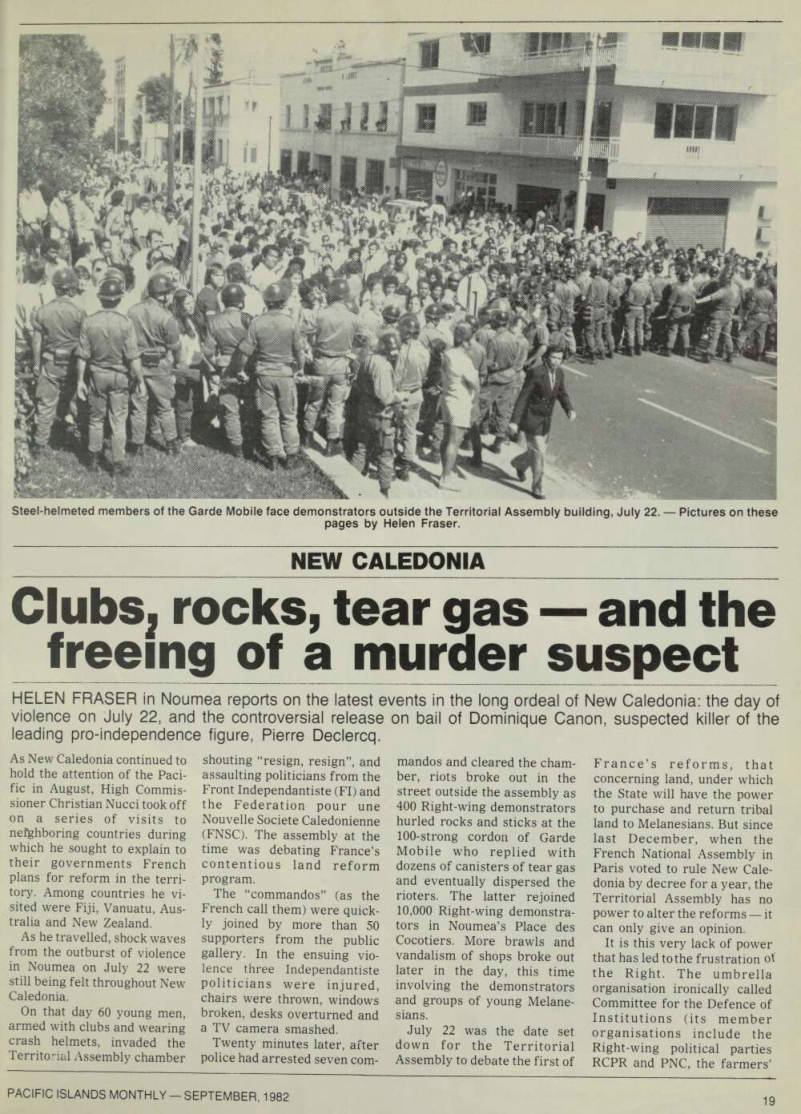
On that day 60 young men, armed with clubs and wearing crash helmets, invaded the Territorial Assembly chamber
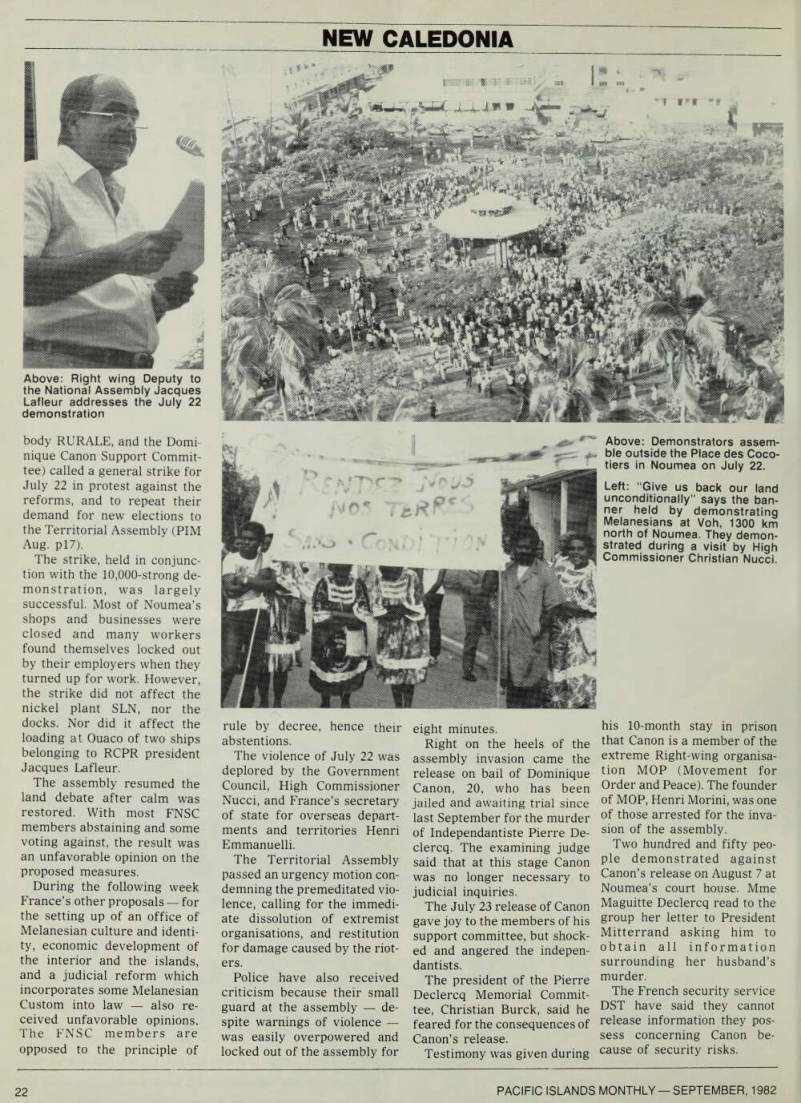
shouting “resign, resign”, and assaulting politicians from the Front Independantiste (FI) and the Federation pour une Nouvelle Societe Caledonienne (FNSC). The assembly at the time was debating France’s contentious land reform program, The “commandos” (as the French call them) were quick ly joined by more than 50 supporters from the public gallery. In the ensuing vio lence three Independantiste politicians were injured, chairs were thrown, windows broken, desks overturned and a TV camera smashed, Twenty minutes later, after police had arrested seven com
mandos and cleared the cham ber, riots broke out in the street outside the assembly as 400 Right-wing demonstrators hurled rocks and sticks at the 100-strong cordon of Garde Mobile who replied with dozens of canisters of tear gas and eventually dispersed the rioters. The latter rejoined 10,000 Right-wing demonstra tors in Noumea’s Place des Cocotiers. More brawls and vandalism of shops broke out later in the day, this time involving the demonstrators and groups of young Melane sians.
July 22 was the date set down for the Territorial Assembly to debate the first of
France’s reforms, that concerning land, under which the State will have the power to purchase and return tribal land to Melanesians. But since last December, when the French National Assembly in Paris voted to rule New Cale donia by decree for a year, the Territorial Assembly has no power to alter the reforms it can only give an opinion.
It is this very lack of power that has led to the frustration of the Right. The umbrella organisation ironically called Committee for the Defence of Institutions (its member organisations include the Right-wing political parties RCPR and PNC, the farmers’
Steel-helmeted members of the Garde Mobile face demonstrators outside the Territorial Assembly building, July 22. - Pictures on these pages by Helen Fraser.
body RURALE, and the Domi nique Canon Support Commit tee) called a general strike for July 22 in protest against the reforms, and to repeat their demand for new elections to the Territorial Assembly (PIM Aug. p!7).
The strike, held in conjunc tion with the 10,000-strong de monstration, was largely successful. Most of Noumea’s shops and businesses were closed and many workers found themselves locked out by their employers when they turned up for work. However, the strike did not affect the nickel plant SEN, nor the docks. Nor did it affect the loading at Ouaco of two ships belonging to RCPR president Jacques Lafleur.
The assembly resumed the land debate after calm was restored. With most FNSC members abstaining and some voting against, the result was an unfavorable opinion on the proposed measures.
During the following week France’s other proposals for the setting up of an office of Melanesian culture and identi ty, economic development of the interior and the islands, and a judicial reform which incorporates some Melanesian Custom into law also re ceived unfavorable opinions.
The FNSC members are opposed to the principle of
rule by decree, hence their abstentions.
The violence of July 22 was deplored by the Government Council, High Commissioner Nucci, and France’s secretary of state for overseas depart ments and territories Henri Emmanuelli.
The Territorial Assembly passed an urgency motion con demning the premeditated vio lence, calling for the immedi ate dissolution of extremist organisations, and restitution for damage caused by the riot ers.
Police have also received criticism because their small guard at the assembly de spite warnings of violence was easily overpowered and locked out of the assembly for
eight minutes.
Right on the heels of the assembly invasion came the release on bail of Dominique Canon, 20, who has been jailed and awaiting trial since last September for the murder of Independantiste Pierre Declercq. The examining judge said that at this stage Canon was no longer necessary to judicial inquiries.
The July 23 release of Canon gave joy to the members of his support committee, but shocked and angered the independantists.
The president of the Pierre Declercq Memorial Committee, Christian Burck, said he feared for the consequences of Canon’s release.
Testimony was given during
his 10-month stay in prison that Canon is a member of the extreme Right-wing organisa tion MOP (Movement for Order and Peace). The founder of MoP > Henri Morini, was one °f those arrested for the inva s*on °f the assembly, Two hundred and fifty peo- P^ e demonstrated against Canon s release on August 7 at Noumea’s court house. Mme Maguitte Declercq read to the § rou P her letter to President Mitterrand asking him to obtain all information surrounding her husband’s mu rder.
The French security service have said they cannot re l ease information they pos sess concerning Canon be cause °f security risks.
Above: Right wing Deputy to the National Assembly Jacques Lafleur addresses the July 22 demonstration
Above: Demonstrators assem ble outside the Place des Coco tiers in Noumea on July 22.
Left: “Give us back our land unconditionally” says the ban ner held by demonstrating Melanesians at Voh, 1300 km north of Noumea. They demon strated during a visit by High Commissioner Christian Nucci.
Advertisements & other items, pp. 20-23 (1 item)
Pacific Islands Monthly September,T9B2
Hfr-
Take your show on the road.
Who else but Pioneer could put so much performance in a portable. On the shelf or on the road, a quick glance at these show-stoppers and you’ll see why Pioneer’s top technology and sleek styling puts them above the rest.
On the SK-757F a feather light touch of the computer-like 1C Full Logic tape controls with One-Touch Music Search and you’ll hear why Pioneer’s Sound Trek steals the show every time.
On the SK-353F, Dolby* cuts out the noise and brings in the melody. This, plus many other exciting features like Music Search.
Great speakers mean great music and both these Sound Trek models give you the best. Separately mounted high-efficiency tweeters, plus room size (not boom size) 16cm woofers, so you can turn up the volume without wearing down your ears.
Pioneer’s Sound Trek stereo radio-cassette recorders. Wherever you take them, they’re the stars of your show. •‘Dolby’ and the double-D symbol are trademarks of Dolby Laboratories Licensing Corporation.
SK-353F
SK-757F
Qj) PIONEER
For further information, please contact: Australia Pioneer Marketing Services Pty. Ltd., P.O. Box 317, Mordialloc, Victoria. 3195.
Tel; 90-9011.
Fiji Islands: Brijlal & Company, G.P.O. Box No. 362, Suva, Fiji Islands. Tel: 2-2258.
New Zealand: Monaco Distributors Ltd., 2 Poland Road, Glenfield, Auckland, New Zealand. Tel: (09) 444-9144.
Norfolk Island: Burns Philp (Norfolk Island) Ltd., P.O. Box 21, Norfolk Island.
Vanuatu; Burns Philp (New Hebrides) Ltd., Vila, Vanuatu.
Nauru Island: Jacob Enterprises, P.O. Box No. 4, Republic of Nauru.
Tahiti: Tahiti Hi-Fi, P.O. Box No. 848, Papeete, Tahiti.
New Caledonia: Menard Pacifique Sari, B.P. 3899, Noumea, New Caledonia. Tel: 48-24-36.
American Samoa: Transpac Corporation, P.O. Box 1477, Pago Pago, American Same 9-6799. Tel: 633-5224.
Rarotonga: South Seas International Ltd., P.O. Box 49, Rarotonga, Cook Islands. Tel 2327.
GENTLEMEN
PREFER PARKER.
Add weight to your words with a pen from Parker. Fine writing instruments that spell out your own special style.
Or the style of someone special. The choice is yours from a wide range of pens to suit all pockets. Parker. The world’s most wanted pen.
Trade enquiries to Parker Pen (Australia) Pty. Ltd., 159 Cleveland Street, Chippendale, N.S.W 2088. Telephone: Sydney ♦
(02) 6994405,Te1ex: SYDNEYPPENSY 22026_ T PARKER
A
SSB/PP/016
Changing face
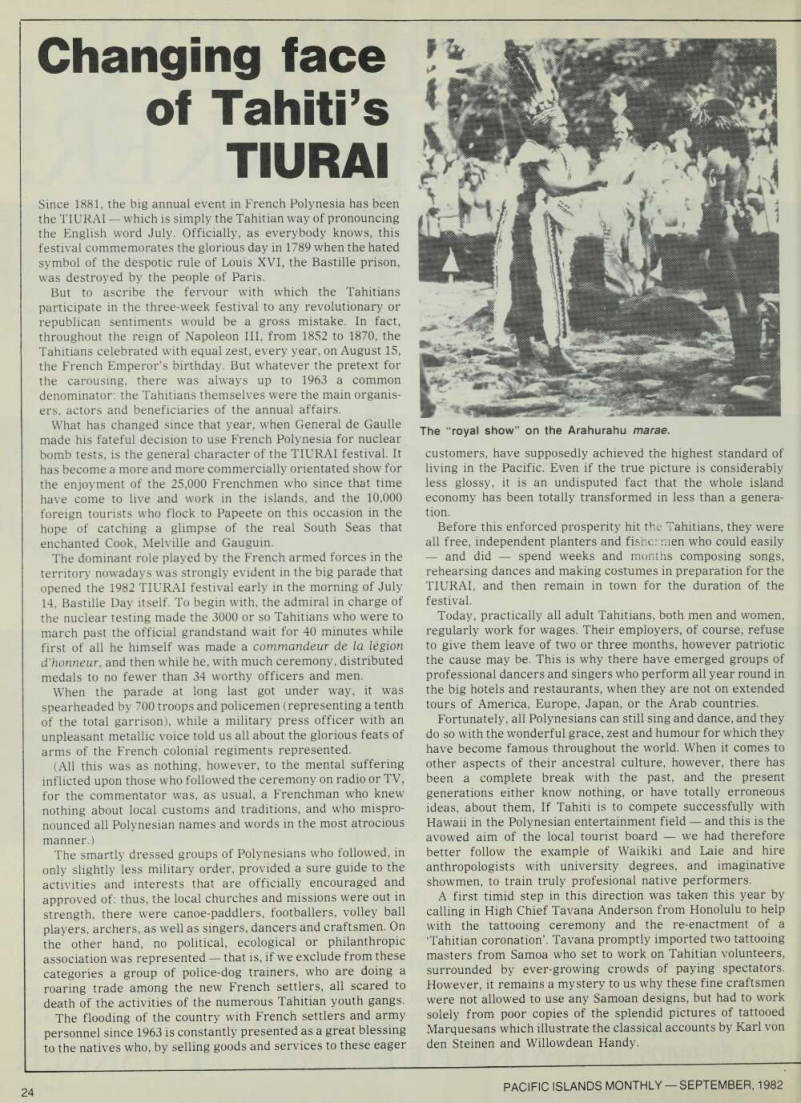
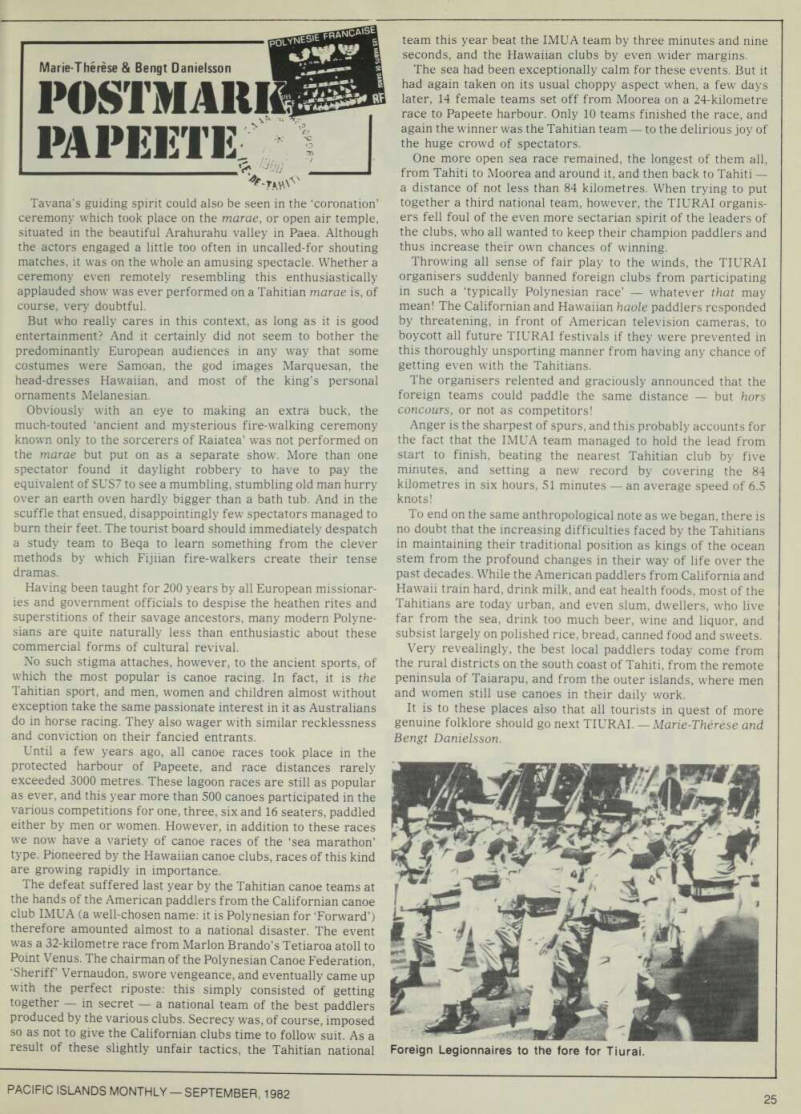
of Tahiti’s
Tiurai
Since 1881, the big annual event in French Polynesia has been the TIURAI which is simply the Tahitian way of pronouncing the English word July. Officially, as everybody knows, this festival commemorates the glorious day in 1789 when the hated symbol of the despotic rule of Louis XVI, the Bastille prison, was destroyed by the people of Paris.
But to ascribe the fervour with which the Tahitians participate in the three-week festival to any revolutionary or republican sentiments would be a gross mistake. In fact, throughout the reign of Napoleon 111, from 1852 to 1870, the Tahitians celebrated with equal zest, every year, on August 15, the French Emperor’s birthday. But whatever the pretext for the carousing, there was always up to 1963 a common denominator: the Tahitians themselves were the main organis ers, actors and beneficiaries of the annual affairs.
What has changed since that year, when General de Gaulle made his fateful decision to use French Polynesia for nuclear bomb tests, is the general character of the TIURAI festival. It has become a more and more commercially orientated show for the enjoyment of the 25,000 Frenchmen who since that time have come to live and work in the islands, and the 10,000 foreign tourists who flock to Papeete on this occasion in the hope of catching a glimpse of the real South Seas that enchanted Cook, Melville and Gauguin.
The dominant role played by the French armed forces in the territory nowadays was strongly evident in the big parade that opened the 1982 TIURAI festival early in the morning of July 14, Bastille Day itself. To begin with, the admiral in charge of the nuclear testing made the 3000 or so Tahitians who were to march past the official grandstand wait for 40 minutes while first of all he himself was made a commandeur de la legion d'honneur, and then while he, with much ceremony, distributed medals to no fewer than 34 worthy officers and men.
When the parade at long last got under way, it was spearheaded by 700 troops and policemen (representing a tenth of the total garrison), while a military press officer with an unpleasant metallic voice told us all about the glorious feats of arms of the French colonial regiments represented. (All this was as nothing, however, to the mental suffering inflicted upon those who followed the ceremony on radio or TV, for the commentator was, as usual, a Frenchman who knew nothing about local customs and traditions, and who mispro nounced all Polynesian names and words in the most atrocious manner.) The smartly dressed groups of Polynesians who followed, in only slightly less military order, provided a sure guide to the activities and interests that are officially encouraged and approved of; thus, the local churches and missions were out in strength, there were canoe-paddlers, footballers, volley ball players, archers, as well as singers, dancers and craftsmen. On the other hand, no political, ecological or philanthropic association was represented that is, if we exclude from these categories a group of police-dog trainers, who are doing a roaring trade among the new French settlers, all scared to death of the activities of the numerous Tahitian youth gangs.
The flooding of the country with French settlers and army personnel since 1963 is constantly presented as a great blessing to the natives who, by selling goods and services to these eager
customers, have supposedly achieved the highest standard of living in the Pacific. Even if the true picture is considerably less glossy, it is an undisputed fact that the whole island economy has been totally transformed in less than a genera tion.
Before this enforced prosperity hit the Tahitians, they were all free, independent planters and fishermen who could easily and did spend weeks and months composing songs, rehearsing dances and making costumes in preparation for the TIURAI, and then remain in town for the duration of the festival.
Today, practically all adult Tahitians, both men and women, regularly work for wages. Their employers, of course, refuse to give them leave of two or three months, however patriotic the cause may be. This is why there have emerged groups of professional dancers and singers who perform all year round in the big hotels and restaurants, when they are not on extended tours of America, Europe, Japan, or the Arab countries.
Fortunately, all Polynesians can still sing and dance, and they do so with the wonderful grace, zest and humour for which they have become famous throughout the world. When it comes to other aspects of their ancestral culture, however, there has been a complete break with the past, and the present generations either know nothing, or have totally erroneous ideas, about them, If Tahiti is to compete successfully with Hawaii in the Polynesian entertainment field and this is the avowed aim of the local tourist board we had therefore better follow the example of Waikiki and Laie and hire anthropologists with university degrees, and imaginative showmen, to train truly profesional native performers.
A first timid step in this direction was taken this year by calling in High Chief Tavana Anderson from Honolulu to help with the tattooing ceremony and the re-enactment of a ‘Tahitian coronation’. Tavana promptly imported two tattooing masters from Samoa who set to work on Tahitian volunteers, surrounded by ever-growing crowds of paying spectators.
However, it remains a mystery to us why these fine craftsmen were not allowed to use any Samoan designs, but had to work solely from poor copies of the splendid pictures of tattooed Marquesans which illustrate the classical accounts by Karl von den Steinen and Willowdean Handy.
The “royal show” on the Arahurahu marae.
Tavana’s guiding spirit could also be seen in the ‘coronation’ ceremony which took place on the marae, or open air temple, situated in the beautiful Arahurahu valley in Paea. Although the actors engaged a little too often in uncalled-for shouting matches, it was on the whole an amusing spectacle. Whether a ceremony even remotely resembling this enthusiastically applauded show was ever performed on a Tahitian marae is, of course, very doubtful.
But who really cares in this context, as long as it is good entertainment? And it certainly did not seem to bother the predominantly European audiences in any way that some costumes were Samoan, the god images Marquesan, the head-dresses Hawaiian, and most of the king’s personal ornaments Melanesian.
Obviously with an eye to making an extra buck, the much-touted ‘ancient and mysterious fire-walking ceremony known only to the sorcerers of Raiatea’ was not performed on the marae but put on as a separate show. More than one spectator found it daylight robbery to have to pay the equivalent of SUS 7 to see a mumbling, stumbling old man hurry over an earth oven hardly bigger than a bath tub. And in the scuffle that ensued, disappointingly few spectators managed to burn their feet. The tourist board should immediately despatch a study team to Beqa to learn something from the clever methods by which Fijiian fire-walkers create their tense dramas.
Having been taught for 200 years by all European missionar ies and government officials to despise the heathen rites and superstitions of their savage ancestors, many modern Polyne sians are quite naturally less than enthusiastic about these commercial forms of cultural revival.
No such stigma attaches, however, to the ancient sports, of which the most popular is canoe racing. In fact, it is the Tahitian sport, and men, women and children almost without exception take the same passionate interest in it as Australians do in horse racing. They also wager with similar recklessness and conviction on their fancied entrants.
Until a few years ago, all canoe races took place in the protected harbour of Papeete, and race distances rarely exceeded 3000 metres. These lagoon races are still as popular as ever, and this year more than 500 canoes participated in the various competitions for one, three, six and 16 seaters, paddled either by men or women. However, in addition to these races we now have a variety of canoe races of the ‘sea marathon’ type. Pioneered by the Hawaiian canoe clubs, races of this kind are growing rapidly in importance.
The defeat suffered last year by the Tahitian canoe teams at the hands of the American paddlers from the Californian canoe club IMUA (a well-chosen name: it is Polynesian for ‘Forward’) therefore amounted almost to a national disaster. The event was a 32-kilometre race from Marlon Brando’s Tetiaroa atoll to Point Venus. The chairman of the Polynesian Canoe Federation, ‘Sheriff’ Vernaudon, swore vengeance, and eventually came up with the perfect riposte: this simply consisted of getting together in secret a national team of the best paddlers produced by the various clubs. Secrecy was, of course, imposed so as not to give the Californian clubs time to follow suit. As a result of these slightly unfair tactics, the Tahitian national
team this year beat the IMUA team by three minutes and nine seconds, and the Hawaiian clubs by even wider margins.
The sea had been exceptionally calm for these events. But it had again taken on its usual choppy aspect when, a few days later, 14 female teams set off from Moorea on a 24-kilometre race to Papeete harbour. Only 10 teams finished the race, and again the winner was the Tahitian team to the delirious joy of the huge crowd of spectators.
One more open sea race remained, the longest of them all, from Tahiti to Moorea and around it, and then back to Tahiti a distance of not less than 84 kilometres. When trying to put together a third national team, however, the TIURAI organis ers fell foul of the even more sectarian spirit of the leaders of the clubs, who all wanted to keep their champion paddlers and thus increase their own chances of winning.
Throwing all sense of fair play to the winds, the TIURAI organisers suddenly banned foreign clubs from participating in such a ‘typically Polynesian race’ whatever that may mean! The Californian and Hawaiian haole paddlers responded by threatening, in front of American television cameras, to boycott all future TIURAI festivals if they were prevented in this thoroughly unsporting manner from having any chance of getting even with the Tahitians.
The organisers relented and graciously announced that the foreign teams could paddle the same distance but hors concours, or not as competitors!
Anger is the sharpest of spurs, and this probably accounts for the fact that the IMUA team managed to hold the lead from start to finish, beating the nearest Tahitian club by five minutes, and setting a new record by covering the 84 kilometres in six hours, 51 minutes an average speed of 6.5 knots!
To end on the same anthropological note as we began, there is no doubt that the increasing difficulties faced by the Tahitians in maintaining their traditional position as kings of the ocean stem from the profound changes in their way of life over the past decades. While the American paddlers from California and Hawaii train hard, drink milk, and eat health foods, most of the Tahitians are today urban, and even slum, dwellers, who live far from the sea, drink too much beer, wine and liquor, and subsist largely on polished rice, bread, canned food and sweets.
Very revealingly, the best local paddlers today come from the rural districts on the south coast of Tahiti, from the remote peninsula of Taiarapu, and from the outer islands, where men and women still use canoes in their daily work.
It is to these places also that all tourists in quest of more
genuine folklore should go next TIURAI.
Marie-Thérèse and
Bengt Danielsson.
Foreign Legionnaires to the fore for Tiurai.
Advertisements & other items, p. 26 (1 item)
flies to London.
air m
From August 25th
Air New Zealand
flies to London.
SOLOMONS
• X
VANUATU N. /
NADI
NEW
CALEDONIA
SAMOA
AUCKLAND
PAPEETE
Now Air New Zealand can fly you all the way to London! Board our 747 flight from Nadi to Los Angeles any Wednesday or Saturday. Then join our non-stop
LONDON
747 “London Express” service. It’s the fast comfortable way, all the way to Britain. And of course if you’re going on to Europe, our “London Express” gives you superb connections.
This service is brand new, but the in-cabin care and attention you’ll enjoy is traditional: we’ll do everything we can to make every food, fine wines, and the latest movies. At Air New Zealand we’ll be very proud to count you among the first to fly our new “London Express”, so see your travel agent soon.
The Pacific’s Number One moment you fly with us relaxed, interesting and JSL air new z entertaining, with good
bankruptcy
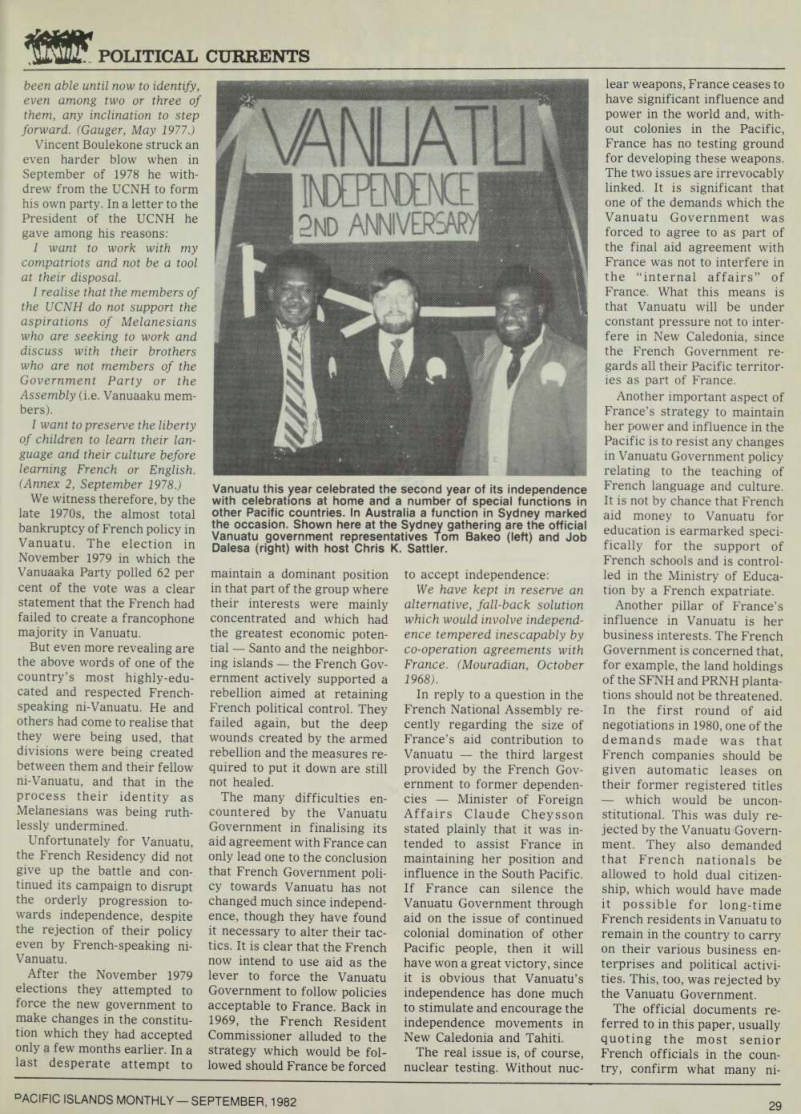
Political Currents
Before Vanuatu
Final bankruptcy of plans for pro-French majority
HOWARD VAN TREASE this month concludes his three-part series of analyses of a number of confidential reports to Paris by successive French Resident Commissioners in Port-Vila, New Heb rides/Vanuatu. The reports, inadvertently left be hind by French diplomatic personnel in the flurry of their departure on Vanuatu’s accession to independence in 1980, cover the period 1969 up to the eve of independence.
The most difficult task facing French officials was getting the various parties on which they were working to put aside their rivalries and differences and agree to a common strategy.
For the time being the agree ment between parties on a concerted strategy is still hypothetical, despite the in tervention of the French Re sidency. (Gauger, September 1975.) Even with the French Resi dent Commissioner’s direct in volvement, dbtaining unity among the “moderate” parties proved difficult.
MANH leaders, temporarily in Port Vila, remained elusive faced by our reprimands, in spite of the warning I gave them that they would receive no help from the Residency if they did not agree to an “en tente” with UCNH. (Gauger, October 1975.) One of the key issues was persuading the various parties to limit the number of candi dates to constituencies where they had a chance of winning, and to prevent vote-splitting in others.
Reports from delegates and from the Police Station made one fear a resounding defeat of the moderates in North Efate.
Individual talks with the lead ers of the MANH finally shook their pride. They agreed finally in the last week of October during an ultimate interven tion on my part in Santo to withdraw six candidates from MANH and Nagriamel as well as related independents.
Among these are Bouletare on Pentecost and Ruru Gratiana on Malekula, which will give Vincent Boulekone and Father Leymang a better chance. At the same time the Residency obtained the resignation of Lionel Michel, French candi date of the National Party, thus ensuring the election of a French UCNH in the town.
These are no small advan tages. (Gauger, October 1975.) In addition, despite the cool ing of relations, the French Residency still maintained contact with Jimmy Stevens, though with little success. The French Resident Commission
er intervened personally to get Nagriamel support: Despite assurances which he gave to me during my visit to Santo, Jimmy Stevens has done nothing yet or would do nothing towards withdrawing the Ambrym and Epi-Paama candidates. (Gauger, October 1975.) The difficulty which the French Residency encoun tered in its attempted man ipulation of the “moderate” parties shows the degree to which they had overestimated their ability to create a loyalty to France, even among their supporters, when local issues were at stake.
The French Residency, however, carried its manipula tion of political events even further to the extent that French officials attempted to buy votes by authorising di rect aid and assistance to va rious key constituencies.
According to instructions re ceived in the course of a tour of South Pentecost, I have been able to organise certain road jobs in the Melsisi region with the help of the High Commis sioner and the armed forces of
New Caledonia. This should draw a few hesitant voters towards Vincent Boulekone.
On his side, the French District Agent of Santo has been able to proceed to clear rocks from many roads in Maewo and the Banks Islands out of private funds, thus being able at the most opportune moment to keep old promises. On October 14 I handed over publicly to various families and Melane sian communities of Santo, land titles representing more than 3000 hectares bought back by the State from SFNH. (Gauger, October 1977.) However, despite this wheeling and dealing, the National Party won 55 per cent of the Melanesian vote in the 1975 election, and proved that ni-Vanuatu minds were not as easily moulded or bought as the French had thought.
The effect of the defeat in the 1975 Representative Assembly election brought French Residency officials to the conclusion that more di rect support was necessary for the so-called “moderate” par ties and in particular the UCNH if a French political
victory was to be achieved.
It remains certain the UCNH is our surest and princi pal ally and it can play a major role in the political life of the Archipelago if it is given the means. Started from nothing, based on good will, it managed to lead an intense electoral battle confronted by 50 years of one-way political and reli gious indoctrination. The re sult was unexpected. It could even improve if that party had the means to pay at least two permanent officials who could take over from those who, to day, leave their professional occupation to fulfil a deserving job in difficult conditions. (Gauger, May 1976.) Unfortunately, we do not have the full set of monthly reports from that time on wards. Thus it is not possible to confirm for certain whether the French Government sup ported UCNH financially, though given their record of direct involvement in politics, it can be assumed that they did.
French Residency officials, however, again misjudged their ability to manipulate the political situation and control the ni-Vanuatu involved.
Rather than rallying behind France and her policies in the years following the 1975 elec tion, French-educated ni- Vanuatu became less and less willing to allow themselves to be used by the French Govern ment. In May 1977 the French Resident Commissioner com mented: The French-trained primary teachers, whom I had the in tention of relying on as the basis for a new political elite, are disengaging themselves from the worn-out political parties and seem disoriented.
They do not want to associate themselves with either the TAN-UNION or the Federa tion. Nor do they want to join up with the Vanuaaku Party, which retains the image of the party of independence. I am striving to mobilise them under three themes: defence of bi-lingualism, defence of democracy, defence of French influences. But the response remains modest and I have not
been able until now to identify, even among two or three of them, any inclination to step forward. (Gauger, May 1977.) Vincent Boulekone struck an even harder blow when in September of 1978 he with drew from the UCNH to form his own party. In a letter to the President of the UCNH he gave among his reasons: I want to work with my compatriots and not be a tool at their disposal.
I realise that the members of the UCNH do not support the aspirations of Melanesians who are seeking to work and discuss with their brothers who are not members of the Government Party or the Assembly (i.e. Vanuaaku mem bers).
I want to preserve the liberty of children to learn their lan guage and their culture before learning French or English. (Annex 2, September 1978.) We witness therefore, by the late 19705, the almost total bankruptcy of French policy in Vanuatu. The election in November 1979 in which the Vanuaaka Party polled 62 per cent of the vote was a clear statement that the French had failed to create a francophone majority in Vanuatu.
But even more revealing are the above words of one of the country’s most highly-edu cated and respected French speaking ni-Vanuatu. He and others had come to realise that they were being used, that divisions were being created between them and their fellow ni-Vanuatu, and that in the process their identity as Melanesians was being ruth lessly undermined.
Unfortunately for Vanuatu, the French Residency did not give up the battle and con tinued its campaign to disrupt the orderly progression to wards independence, despite the rejection of their policy even by French-speaking ni- Vanuatu.
After the November 1979 elections they attempted to force the new government to make changes in the constitu tion which they had accepted only a few months earlier. In a last desperate attempt to
maintain a dominant position in that part of the group where their interests were mainly concentrated and which had the greatest economic poten tial Santo and the neighbor ing islands the French Gov ernment actively supported a rebellion aimed at retaining French political control. They failed again, but the deep wounds created by the armed rebellion and the measures re quired to put it down are still not healed.
The many difficulties en countered by the Vanuatu Government in finalising its aid agreement with France can only lead one to the conclusion that French Government poli cy towards Vanuatu has not changed much since independ ence, though they have found it necessary to alter their tac tics. It is clear that the French now intend to use aid as the lever to force the Vanuatu Government to follow policies acceptable to France. Back in 1969, the French Resident Commissioner alluded to the strategy which would be fol lowed should France be forced
to accept independence; We have kept in reserve an alternative, fall-back solution which would involve independ ence tempered inescapably by co-operation agreements with France. (Mouradian, October 1968).
In reply to a question in the French National Assembly re cently regarding the size of France’s aid contribution to Vanuatu the third largest provided by the French Gov ernment to former dependen cies Minister of Foreign Affairs Claude Cheysson stated plainly that it was in tended to assist France in maintaining her position and influence in the South Pacific.
If France can silence the Vanuatu Government through aid on the issue of continued colonial domination of other Pacific people, then it will have won a great victory, since it is obvious that Vanuatu’s independence has done much to stimulate and encourage the independence movements in New Caledonia and Tahiti.
The real issue is, of course, nuclear testing. Without nuc
lear weapons, France ceases to have significant influence and power in the world and, with out colonies in the Pacific, France has no testing ground for developing these weapons.
The two issues are irrevocably linked. It is significant that one of the demands which the Vanuatu Government was forced to agree to as part of the final aid agreement with France was not to interfere in the “internal affairs” of France. What this means is that Vanuatu will be under constant pressure not to inter fere in New Caledonia, since the French Government re gards all their Pacific territor ies as part of France.
Another important aspect of France’s strategy to maintain her power and influence in the Pacific is to resist any changes in Vanuatu Government policy relating to the teaching of French language and culture.
It is not by chance that French aid money to Vanuatu for education is earmarked speci fically for the support of French schools and is control led in the Ministry of Educa tion by a French expatriate.
Another pillar of France’s influence in Vanuatu is her business interests. The French Government is concerned that, for example, the land holdings of the SFNH and PRNH planta tions should not be threatened.
In the first round of aid negotiations in 1980, one of the demands made was that French companies should be given automatic leases on their former registered titles which would be uncon stitutional. This was duly re jected by the Vanuatu Govern ment. They also demanded that French nationals be allowed to hold dual citizen ship, which would have made it possible for long-time French residents in Vanuatu to remain in the country to carry on their various business en terprises and political activi ties. This, too, was rejected by the Vanuatu Government.
The official documents re ferred to in this paper, usually quoting the most senior French officials in the coun try, confirm what many ni-
Vanuatu this year celebrated the second year of its independence with celebrations at home and a number of special functions in other Pacific countries. In Australia a function in Sydney marked the occasion. Shown here at the Sydney gathering are the official Vanuatu government representatives tom Bakeo (left) and Job Dalesa (right) with host Chris K. Sattler.
Vanuatu had long suspected: in Vanuatu, despite the re straining effect of Great Bri tain one of France’s closest allies in Europe the French Government used Vanuatu and its people without any concern for their welfare as pawns to achieve its ambition for power and influence in the Pacific.
Moreover, it is important to remember that French offi cials in Vanuatu prior to inde pendence were under the dire ction of the Governor (later High Commissioner) in Noumea, who for most of the colonial era co-ordinated poli cy for all French territories in the Pacific.
One must conclude, there fore, that the policies followed by French officials in Vanuatu reflect the overall strategy of the French Government: to ap ply whatever techniques would achieve their goal of maintaining New Caledonia, Wallis/Futuna and Tahiti, as colonies of France forever.
Advertisements & other items, pp. 28-30 (2 items)
PCffßt
Starting & Staying
* J#- 'jr r,
AMP
lbed -'> ■ an iMiMI
marM
now
Amr
/ “J*2S«*c£ 02527 0227
Power Boats Need Different Batteries
There is a big difference between a car battery and a marine battery.
A car battery, for example, is never really discharged, as it is only used for a few seconds each day a nd promptly re-charged. Not so your cruiser or sportsfisherman.
Starting the engine is only the beginning. During the day, weekend or cruise, how often will you run the live bait tank, the depth sounder, the nav. lights or maintain a listening watch on your radio transceiver?
As well as cranking power, boats need staying power. Boats need Besco's Marine Batteries, deep cycle, heavy duty marine batteries.
If your boat is getting a little flat in the electrics department, write or phone BESCO today and ask for more information, more facts about
BESCO MARINE BATTERIES.
BESCO
h Papua New Guinea: Lae/Rabaul Auto Marine Industries, PO Box 785, Lae. 42-1125. Port Moresby: Par Sales Pty. Ltd., Boroko. 25-6266. Fiji: Bar Motor Parts Ltd., PO Box 51, Bar, 74-070. New Caledonia: Lotissement Industrie!, BP 889, Noumea. 27-4906. Hong Kong: T.l.
Knight & Co., PO Box 5585, T.S.T. Kowloon, 3-66 5341. N.Z.: Battery Services (Industrial) Ltd., PO 27-375, Auckland 4, 694-111. Gould Batteries, 58 Hautana St., Lower Hutt, Wellington.
Telex: CHACO N.Z. 3714. Other Areas: Jarwil International Pty. Ltd., 410 Kent St., Sydney, Batteries Division Of S,ms Products Pty Ltd. / 2000. (02) 264-3477. Telex: AA 72102. Besco Batteries, Villawood, 2163. (02) 632-0251.
***°"*»*i°'*»"*** leaders in battery technology-
The International Marketing Institute of Australia
offers
A MARKETING FELLOWSHIP
with tuition and accommodation paid at top Australian marketing programme The R. N. McDonald Fellowship entitles the successful nominee to free attendance at the Institute’s Intermediate Programme for Development in Marketing with 50 Australian marketing executives.
To be held: 16th-29th January. 1983 Mitchell College of Advanced Education. Bathurst. NSW Australia The course is taught by leading American and Australian instructors. Preference in awarding this Fellowship will be given to applicants of Polynesian or Melanesian birth.
Complete and mail coupon below for further details and nomination form The International Marketing Institute of Australia
P.O. Box 40. GORDON. NSW 2072
Please send me details of the R. N. McDonald Fellowship: Name: Organisation: Address: P/Code
29
D ACIFIC ISLANDS MONTHLY —SEPTEMBER, 1982
political currents
occupy Kwajalein

U.S. vetoes independence as Marshallese landowners occupy Kwajalein
Reporting from where the action is the Marshall Islands’ Kwajalein Atoll, and neighboring Ebeye Island U.S. journalist GIFF JOHNSON tells the story of the tense battle being waged by Kwajalein landowners, and in other ways and other places by the Marshalls Government, over the terms of their post-Trusteeship relations with the U.S.
Landowners at the United States Army’s strategic Kwajalein Missile Range have mounted a major “sail-in” occupation of their off-limits islands, calling for rejection of the recently signed Compact of Free Association (PIM Aug., p 33). In response, the U.S. has demanded that independence earlier agreed by U.S. and Marshall Islands negotiatiors as an option for Marshallese voters be removed from the ballot for the upcoming re ferendum on the compact. The
U.S. Defense Department has attempted to impose a total media blackout of the Kwaja lein sail-in by barring repor ters access to Kwajalein, and prohibiting normal telephone communications.
The 5000-member Kwajalein Atoll Corporation announced its opposition to the compact immediately after the May 30 agreement was signed by U.S. and Marshallese negotiators, ending 13 years of negotia tions. Late in July more than 1000 landowners were occupy ing at least eight islands in Kwajalein, including six in the hazard zone for incoming mis siles. They were protesting against compact provisions granting the U.S. 50 years use of Kwajalein; a Mutual Secur ity pact giving the U.S. perma nent military denial powers; proposed annual payments of 5U.5.1.9 million, well below the current $9 million yearly rent; and no provisions for past-use compensation.
U.S. Ambassador Fred Zeder and Marshalls Foreign Secret ary Tony deßrum in mid-May signed a Memorandum of Understanding for an acceler ated shedule to end the United Nations Trusteeship by Octo ber 1. It outlined two options for Marshallese voters in an August 17 referendum: appro val of the compact of Free Association, or full independ ence. In either case, U.S. con trol via the United Nations agreement which deßrum said “hangs like a millstone on our economic advancement (and) political freedom” would terminate.
The U.S. Government would not have objected to the inde pendence option if compact
approval was a certainty, say informed sources. When Kwajalein landowners put compact approval in jeopardy, however, U.S. officals quickly repudiated Zeder’s memoran dum. “We have done every thing we can to expedite the process” of granting greater autonomy to the Marshallese, said Deputy assistant Secret ary of Defense Noel Koch, “but declaring independence simply isn’t an available option to them” under international law. This statement was made despite UN Trusteeship provi sions binding the U.S. to de velop Micronesia “toward self government or independence, as may be appropriate...”
Pentagon officials were re portedly “furious” because they feared the Marshallese would vote for independence and then demand more than the annual $1.9 million pay ments specified in the com pact. The Pentagon is vitally concerned with the future of Kwajalein wrote The Wall Street Journal (July 9), be cause “it would cost as much as $2 billion, according to some Pentagon planners, to set up a similar testing establish ment elsewhere. What’s more important, military strategists say, is that it would be ex tremely difficult to find a com parable site that missiles could reach without flying them over major population centres.
Virtually all of America’s nuc lear-weapons delivery sys tems have been tested at the multi-billion range, and the new MX missile is scheduled for testing there in a few months.
Meanwhile, calling their occupation “Operation
Homecoming”, Kwajalein landowners say they have no intention of leaving their is lands, many of them dotted with radar and other missile tracking equipment. Both the U.S. and Marshall Islands Gov ernments, however, are taking a tough stand against the pro tests which threaten to disrupt missile-testing operations.
Both governments contend the Kwajalein Atoll corpora tion is bound by an Interim Use Agreement for Kwajalein, which expires on September 30. The KAC, which refused to sign the agreement, but has received payments specified in the pact, says it is not legally bound by it. The Mar shalls Government, at the occupation’s outset, obtained a Temporary Restraining Order from Marshalls High court Justice John Lanham, barring the KAC from occupying is lands or interfering with Kwajalein Missile Range operations. This court order gave the U.S. legal authority for the arrest of 13 KAC lead ers as they entered a re stricted area, said the Kwaja lein security police. But George Allen, legal counsel for the KAC, contends the real reason the arrests were made was because they were moving into the swimming area for Kwajalein’s predominantly white, American population.
The Temporary Restraining Order was overturned by a higher court and the Marshal lese released. Since then, however, the Marshalls Gov ernment has received a new court order fining the KAC for all costs caused by KAC
disruption of missile range activities. In mid-July, the fi gure was well over $lOO,OOO and growing daily. The Mar shalls and U.S. Governments contend that “all functions of the range are continuing normally.” But landowners claim that two missile tests, normally targeted for Kwaja lein’s 2300-square kilometre lagoon, were re-targeted to land well away from the Atoll.
Occupation of the six islands in the “mid-corridor” hazard zone “precludes testing into the lagoon unless the military are going to violate their own safety regulations”, said Allen.
The U.S. has also refused to make the July $2 million rental payment the final instal ment of the one-year interim use agreement until the occupation ends, and has insti tuted a series of actions to pressure the landowners to re turn to tiny 27-hectare Ebeye Island, where approximately 8000 Marshallese live. Ebeye is five kilometres from Kwaja lein Island, and the 700 or so Marshallese employees are ferried to and from work daily, as they must be off Kwajalein by night.
Kwajalein security police in July were searching everyone who left Kwajalein for Ebeye and confiscating all food, cigarettes and other items.
The day this writer arrived, an entire crate of fresh mangoes, brought from Honolulu by a Marshallese woman, was taken by security police.
Additionally, all . Marshal lese, excepting Kwajalein em ployees with ID badges, have officially been prevented from
going to Kwajalein, which pre cludes Marshallese use of the bank. There is no bank on Ebeye. Unable to pay off loans and other bills, and prevented from picking up food ship ments from Kwajalein, Ebeye businesses are both losing money and running “danger ously low on food supplies”, said Chamber of Commerce President Fountain Inok. At the request of the Chamber of Commerce, President Amata Kabua cabled the Defense De partment asking for a re-open ing of bank services to the business community on Ebeye.
There had been no response at time of writing.
These events have been sur rounded by a shroud of secre cy. In early July, an Australian network film crew, with valid Marshalls Government passes for Ebeye, were arrested on the day of their arrival on Ebeye and flown back to Ma juro. After negotiations and an apology from the Marshalls Government, they were allowed back to Ebeye for one day of filming. A Guam Pacific Daily News reporter was re peatedly denied access, and a local reporter for the Marshall Islands Journal was thrown off Kwajalein by security police.
The Marshall Islands Gov ernment has scheduled a re ferendum for August 17 on the Compact of Free Association, but strong U.S. opposition to the rush suggests it may be postponed. Some observers be lieve the U.S. wants a referen dum delay to “take the steam” out of the anti-compact pro tests at Kwajalein.
Since the late 19605, Kwaja
lein landowners have con tinuously protested at living conditions on Ebeye and at the lack of compensation.
The landowners believe they are caught between the U.S.
Trust Territory bureaucracy, and a Kwajalein army com mand unconcerned with their problems on Ebeye. They say it is only when they physicially occupy their islands in protest that they are able to force action by U.S. officials. After a major occupation in 1979 (PIM Sept. 1979 Pl 9) the U.S. upped compensation payments from a few hundred thousand dol lars a year to $9 million annually. KAC leaders were not surprised to hear President Kabua announce on June 30 10 days after the current pro tests began —that $6 million is now available to upgrade the power plant and sewage sys tem and to provide drinking water for every Ebeye home.
Senator Ataji Balos, Chair man of the KAC, who in June resigned his post as Minister for Internal Security in the Marshall Islands Cabinet, summarised the Kwajalein landowners’ position on the compact: “I was the only mem ber of the congress of Mic ronesia Joint Committee on Future Status who refused to sign the 1976 compact. If I could not support a compact which gave the U.S. 15 years at Kwajalein with no hope of help for my people, how can I now support a compact which gives 50 years?”
Footnote: As foreshadowed by Giff Johnson, the U.S. did veto the August 17 plebiscite, as told in Pacific Report, P. 6.
Advertisements & other items, pp. 31-32 (1 item)
Consult the leading lights FREE,
Thorn EMI Lighting offer a free advisory service.
We provide lighting for all applications so you can benefit from our expertise and experience no matter what your specific requirements are.
Thorn have a system that meets your needs and your budget.
We even supply photographic,vehicle and domestic lamps.
We’ll throw some light on your question . . . absolutely free.
If it’s got anything to do with lights or lighting give us a call. We are in your hands.
H HORN EMI
Lighting (N.Z.
)Ltd
P.O. Box 15150 New Lynn, Auckland, New Zealand.
Telephone 887-155 Auckland. Telex NZ 2648. ■* - V IE 1 Fluorescent tubes and fittings for domestic, industrial and special purpose applications. Incandescent lamps and fittings, emergency lighting, floodlighting (including lamps, poles and columns), streetlighting. Marine lighting, airfield lighting, lighting for the food processing industry. Vehicle, miniature or photographic lamps.
Compact of Free Association US bases tradition Belau the price of Independence, a TV documentary available in 1' Vs'. ’/a', PAL, NTSC, produced by M.
Bongiovanni, D. Ross contact P.O. Box N 224, Grosvenor St. Sydney 2000, Tel (02) 309 2339. Australia. nuclear free pacific economic development
films, life, and
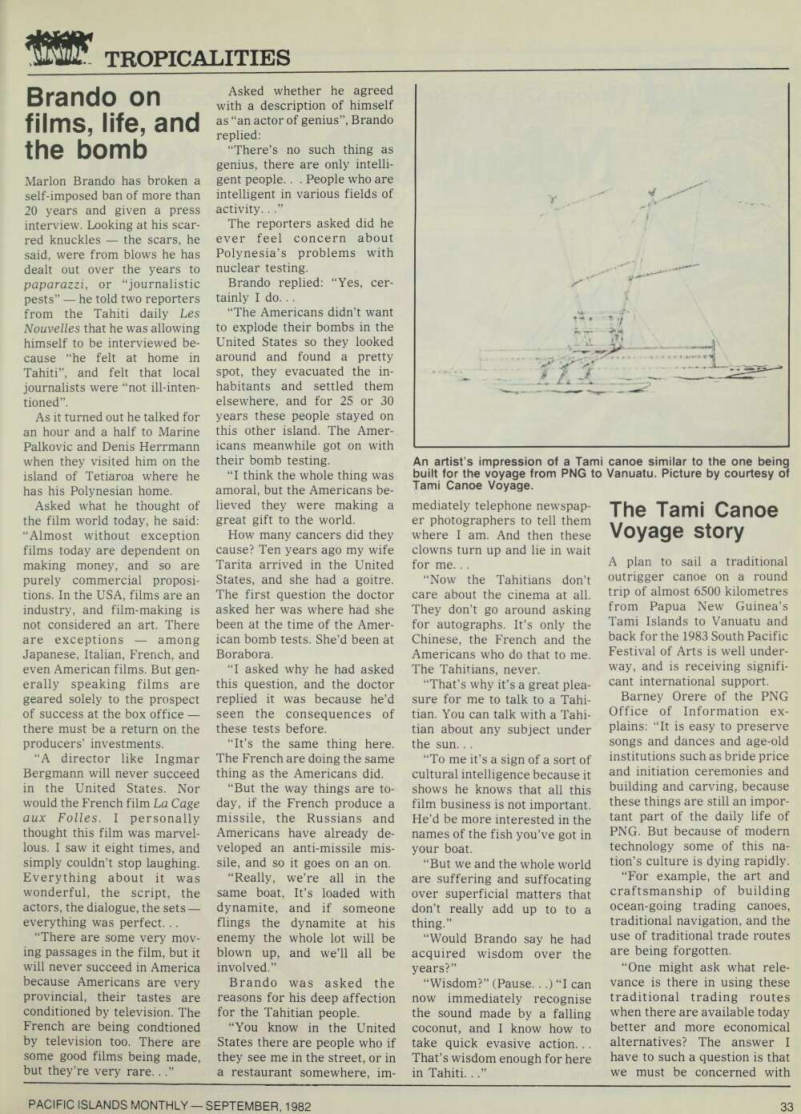
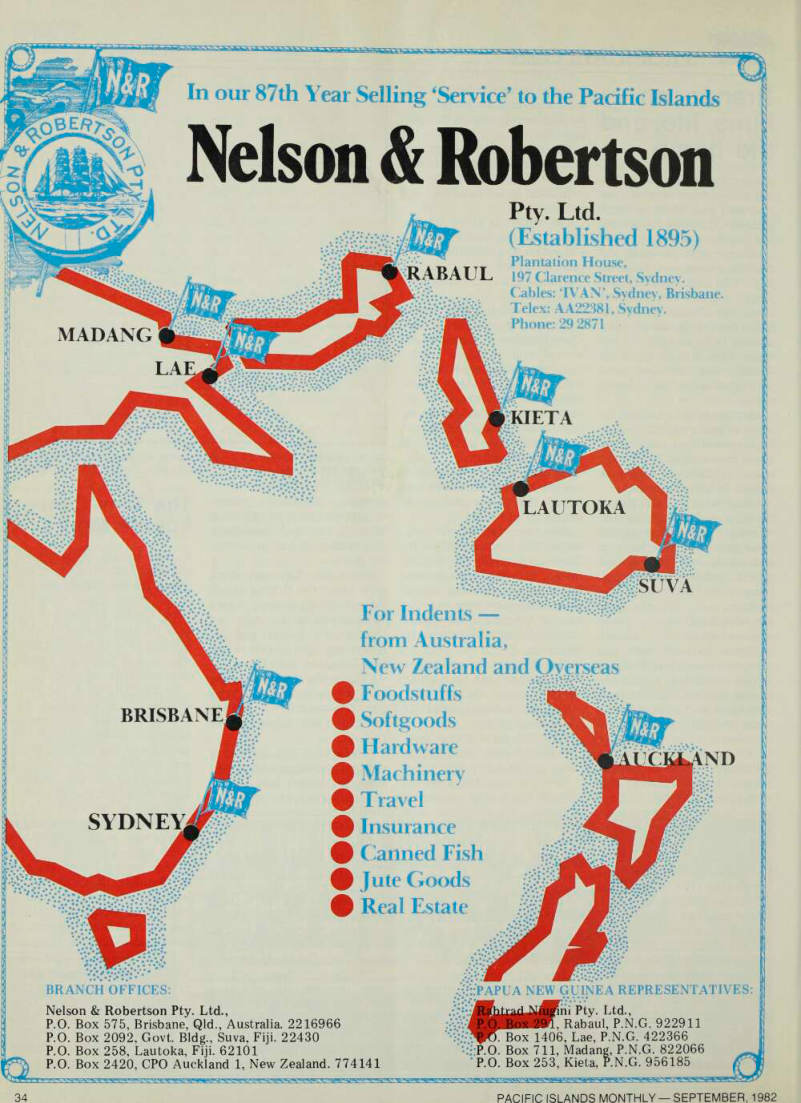
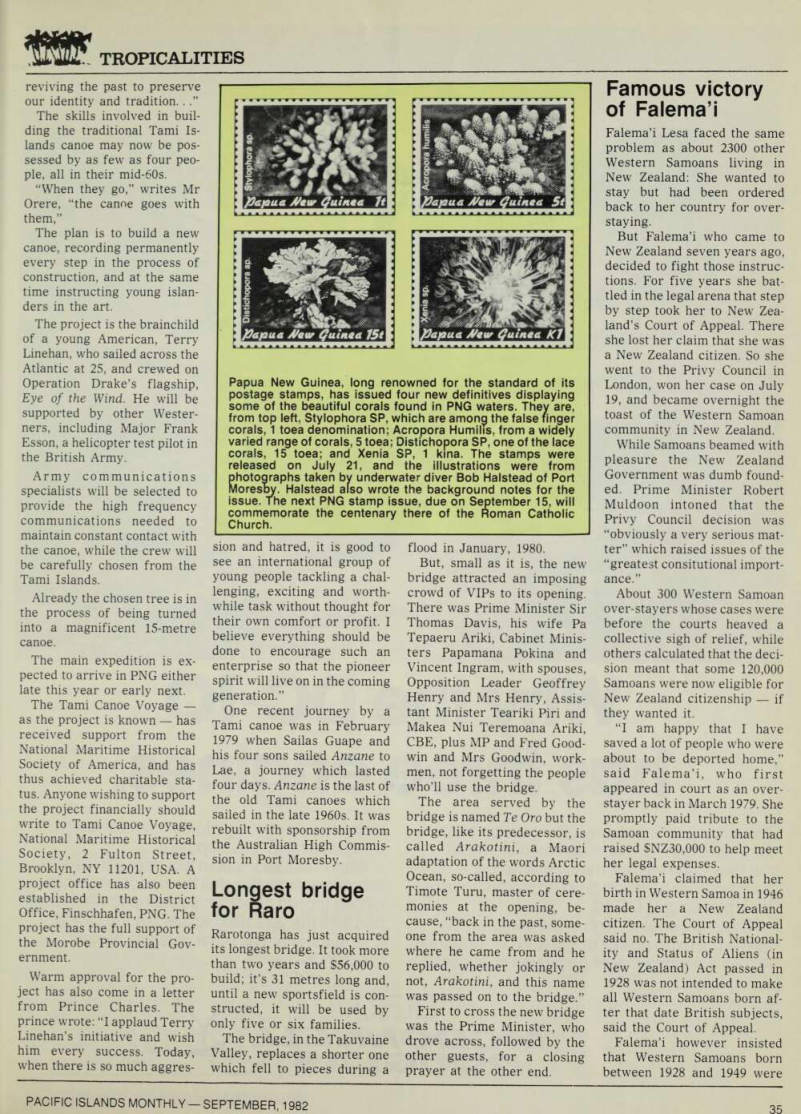

Tropicalities
Brando on films, life, and the bomb
Marlon Brando has broken a self-imposed ban of more than 20 years and given a press interview. Looking at his scar red knuckles the scars, he said, were from blows he has dealt out over the years to paparazzi, or “journalistic pests” he told two reporters from the Tahiti daily Les Nouvelles that he was allowing himself to be interviewed be cause “he felt at home in Tahiti”, and felt that local journalists were “not ill-inten tioned”.
As it turned out he talked for an hour and a half to Marine Palkovic and Denis Herrmann when they visited him on the island of Tetiaroa where he has his Polynesian home.
Asked what he thought of the film world today, he said: “Almost without exception films today are dependent on making money, and so are purely commercial proposi tions. In the USA, films are an industry, and film-making is not considered an art. There are exceptions among Japanese, Italian, French, and even American films. But gen erally speaking films are geared solely to the prospect of success at the box office there must be a return on the producers’ investments.
“A director like Ingmar Bergmann will never succeed in the United States. Nor would the French film La Cage aux Folles. I personally thought this film was marvel lous. I saw it eight times, and simply couldn’t stop laughing.
Everything about it was wonderful, the script, the actors, the dialogue, the sets everything was perfect...
“There are some very mov ing passages in the film, but it will never succeed in America because Americans are very provincial, their tastes are conditioned by television. The French are being condtioned by television too. There are some good films being made, but they’re very rare...”
Asked whether he agreed with a description of himself as “an actor of genius”, Brando replied; “There’s no such thing as genius, there are only intelli gent people.. . People who are intelligent in various fields of activity...”
The reporters asked did he ever feel concern about Polynesia’s problems with nuclear testing.
Brando replied; “Yes, cer tainly I d 0...
“The Americans didn’t want to explode their bombs in the United States so they looked around and found a pretty spot, they evacuated the in habitants and settled them elsewhere, and for 25 or 30 years these people stayed on this other island. The Amer icans meanwhile got on with their bomb testing.
“I think the whole thing was amoral, but the Americans be lieved they were making a great gift to the world.
How many cancers did they cause? Ten years ago my wife Tarita arrived in the United States, and she had a goitre.
The first question the doctor asked her was where had she been at the time of the Amer ican bomb tests. She’d been at Borabora.
“I asked why he had asked this question, and the doctor replied it was because he’d seen the consequences of these tests before.
“It’s the same thing here.
The French are doing the same thing as the Americans did.
“But the way things are to day, if the French produce a missile, the Russians and Americans have already de veloped an anti-missile mis sile, and so it goes on an on.
“Really, we’re all in the same boat, It’s loaded with dynamite, and if someone flings the dynamite at his enemy the whole lot will be blown up, and we’ll all be involved.”
Brando was asked the reasons for his deep affection for the Tahitian people.
“You know in the United States there are people who if they see me in the street, or in a restaurant somewhere, im-
mediately telephone newspap er photographers to tell them where I am. And then these clowns turn up and lie in wait for me...
“Now the Tahitians don’t care about the cinema at all.
They don’t go around asking for autographs. It’s only the Chinese, the French and the Americans who do that to me.
The Tahitians, never.
“That’s why it’s a great plea sure for me to talk to a Tahi tian. You can talk with a Tahi tian about any subject under the sun...
“To me it’s a sign of a sort of cultural intelligence because it shows he knows that all this film business is not important.
He’d be more interested in the names of the fish you’ve got in your boat.
“But we and the whole world are suffering and suffocating over superficial matters that don’t really add up to to a thing.”
“Would Brando say he had acquired wisdom over the years?”
“Wisdom?” (Pause...) “I can now immediately recognise the sound made by a falling coconut, and I know how to take quick evasive action.. .
That’s wisdom enough for here in Tahiti...”
The Tami Canoe
Voyage story
A plan to sail a traditional outrigger canoe on a round trip of almost 6500 kilometres from Papua New Guinea’s Tami Islands to Vanuatu and back for the 1983 South Pacific Festival of Arts is well under way, and is receiving signifi cant international support.
Barney Orere of the PNG Office of Information ex plains: “It is easy to preserve songs and dances and age-old institutions such as bride price and initiation ceremonies and building and carving, because these things are still an impor tant part of the daily life of PNG. But because of modern technology some of this na tion’s culture is dying rapidly.
“For example, the art and craftsmanship of building ocean-going trading canoes, traditional navigation, and the use of traditional trade routes are being forgotten.
“One might ask what rele vance is there in using these traditional trading routes when there are available today better and more economical alternatives? The answer I have to such a question is that we must be concerned with
An artist’s impression of a Tami canoe similar to the one being built for the voyage from PNG to Vanuatu. Picture by courtesy of Tami Canoe Voyage.
reviving the past to preserve our identity and tradition..
The skills involved in buil ding the traditional Tami Is lands canoe may now be pos sessed by as few as four peo ple, all in their mid-60s.
“When they go,” writes Mr Orere, “the canoe goes with them,”
The plan is to build a new canoe, recording permanently every step in the process of construction, and at the same time instructing young islan ders in the art.
The project is the brainchild of a young American, Terry Linehan, who sailed across the Atlantic at 25, and crewed on Operation Drake’s flagship, Eye of the Wind. He will be supported by other Wester ners, including Major Frank Esson, a helicopter test pilot in the British Army.
Army communications specialists will be selected to provide the high frequency communications needed to maintain constant contact with the canoe, while the crew will be carefully chosen from the Tami Islands.
Already the chosen tree is in the process of being turned into a magnificent 15-metre canoe.
The main expedition is ex pected to arrive in PNG either late this year or early next.
The Tami Canoe Voyage as the project is known has received support from the National Maritime Historical Society of America, and has thus achieved charitable sta tus. Anyone wishing to support the project financially should write to Tami Canoe Voyage, National Maritime Historical Society, 2 Fulton Street, Brooklyn, NY 11201, USA. A project office has also been established in the District Office, Finschhafen, PNG. The project has the full support of the Morobe Provincial Gov ernment.
Warm approval for the pro ject has also come in a letter from Prince Charles. The prince wrote: “I applaud Terry Linehan’s initiative and wish him every success. Today, when there is so much aggres-
sion and hatred, it is good to see an international group of young people tackling a chal lenging, exciting and worth while task without thought for their own comfort or profit. I believe everything should be done to encourage such an enterprise so that the pioneer spirit will live on in the coming generation.”
One recent journey by a Tami canoe was in February 1979 when Sailas Guape and his four sons sailed Anzane to Lae, a journey which lasted four days. Anzane is the last of the old Tami canoes which sailed in the late 19605. It was rebuilt with sponsorship from the Australian High Commis sion in Port Moresby.
Longest bridge
for Raro
Rarotonga has just acquired its longest bridge. It took more than two years and $56,000 to build; it’s 31 metres long and, until a new sportsfield is con structed, it will be used by only five or six families.
The bridge, in the Takuvaine Valley, replaces a shorter one which fell to pieces during a
flood in January, 1980.
But, small as it is, the new bridge attracted an imposing crowd of VIPs to its opening.
There was Prime Minister Sir Thomas Davis, his wife Pa Tepaeru Ariki, Cabinet Minis ters Papamana Pokina and Vincent Ingram, with spouses, Opposition Leader Geoffrey Henry and Mrs Henry, Assis tant Minister Teariki Piri and Makea Nui Teremoana Ariki, CBE, plus MP and Fred Good win and Mrs Goodwin, work men, not forgetting the people who’ll use the bridge.
The area served by the bridge is named Te Oro but the bridge, like its predecessor, is called Arakotini, a Maori adaptation of the words Arctic Ocean, so-called, according to Timote Turu, master of cere monies at the opening, be cause, “back in the past, some one from the area was asked where he came from and he replied, whether jokingly or not, Arakotini, and this name was passed on to the bridge.”
First to cross the new bridge was the Prime Minister, who drove across, followed by the other guests, for a closing prayer at the other end.
Famous victory
of Falema’i
Falema’i Lesa faced the same problem as about 2300 other Western Samoans living in New Zealand; She wanted to stay but had been ordered back to her country for over staying.
But Falema’i who came to New Zealand seven years ago, decided to fight those instruc tions. For five years she bat tled in the legal arena that step by step took her to New Zea land’s Court of Appeal. There she lost her claim that she was a New Zealand citizen. So she went to the Privy Council in London, won her case on July 19, and became overnight the toast of the Western Samoan community in New Zealand.
While Samoans beamed with pleasure the New Zealand Government was dumb found ed. Prime Minister Robert Muldoon intoned that the Privy Council decision was “obviously a very serious mat ter” which raised issues of the “greatest consitutional import ance.”
About 300 Western Samoan over-stayers whose cases were before the courts heaved a collective sigh of relief, while others calculated that the deci sion meant that some 120,000 Samoans were now eligible for New Zealand citizenship if they wanted it.
“I am happy that I have saved a lot of people who were about to be deported home,” said Falema’i, who first appeared in court as an over stayer back in March 1979. She promptly paid tribute to the Samoan community that had raised SNZ3O,OOO to help meet her legal expenses.
Falema’i claimed that her birth in Western Samoa in 1946 made her a New Zealand citizen. The Court of Appeal said no. The British National ity and Status of Aliens (in New Zealand) Act passed in 1928 was not intended to make all Western Samoans born af ter that date British subjects, said the Court of Appeal.
Falema’i however insisted that Western Samoans born between 1928 and 1949 were
Papua New Guinea, long renowned for the standard of its postage stamps, has issued four new definitives displaying some of the beautiful corals found in PNG waters. They are, from top left, Stylophora SP, which are among the false finger corals, 1 toea denomination; Acropora Humilis, from a widely varied range of corals, 5 toea; Distichopora SP, one of the lace corals, 15 toea; and Xenia SP, 1 kina. The stamps were released on July 21, and the illustrations were from photographs taken by underwater diver Bob Halstead of Port Moresoy. Halstead also wrote the background notes for the issue. The next PNG stamp issue, due on September 15, will commemorate the centenary there of the Roman Catholic Church.
New Zealand citizens and so were their children. This co vered some 35,000 Samoans born between those dates and their 85,000 children.
Until January 1, 1949, all New Zealanders were British subjects because they lived in New Zealand. From that date the Government introduced the status of “New Zealand citizen” under the British Nationality and New Zealand Citizenship Act 1948.
British subjects born in New Zealand before then became New Zealnd citizens automa tically.
The Privy Council decision said in effect that persons born in Western Samoa before January 1, 1949, were also to be regarded as natural-born British subjects. Those people were automatically New Zea land citizens as a result of the 1948 Act which made anyone who was a British subject im mediately before the Act came into force, a New Zealand citizen if he or she was born in Western Samoa.
The reason for linking New Zealand with Western Samoa in the first place dates back to 1914 when New Zealand troops landed in what was then a German colony shortly after the outbreak of World War 1.
New Zealand was given administrative responsibility for the islands under a League of Nations mandate from 1919.
From 1946 it continued its administrative role under the United Nations until Western Samoa became independent in 1962.
Over the years the move ment of Western Samoans and other Polynesian people to New Zealand has accelerated to make Auckland the world’s biggest Polynesian city.
New Zealand authorities have fought a rearguard action against the growing number of over-stayers who prefer the working and living opportuni ties in Auckland to their own tropical paradises.
Falema’i appears now to have opened the floodgates for 75 per cent of Western Samoa’s population to go to New Zealand. But a headlong rush is not anticipated.
Muldoon himself saw “no immediate urgency” in finding a solution to the citizenship issue. “To take advantage of this decision they have got to identify themselves as coming inside the definition that the Privy Council lays down and, to do that, you’ve got to get a birth certificate and you’ve got to be able to show you’re the person referred to on the birth certificate and that’s not always going to be easy or quick,” he said.
Nor would Western Samoa like to lose its able-bodied people, while New Zealand officials wince at the prospect of increasing the ranks of un skilled and unemployed people in New Zealand with the atten dant financial, educational, health and housing problems.
Until the Government had a chance to read the fine print in the Privy Council’s ruling, Muldoon stopped issuing further permits for temporary visitors from Samoa.
The Government had the re sponsibility to solve the prob lem in a spirit of goodwill and generosity, said Muldoon in his weekly column in the news paper Truth.
The effect of the Privy Council ruling spreads wider than just New Zealand.
“If Samoans are automa tically New Zealand citizens, then clearly they can enter Australia without visas and they have the same rights in regard to entry to Britain as New Zealanders,” wrote Mul doon.
How the Government solves the issue concerns many New Zealanders. The New Zealand Herald spelt out that concern in an editorial when it said: “What happens now must be the subject of some anxious study. The first consideration should be that the woman who won her case and others in a similar position should not be disadvantaged by retroactive legislation aiming to make them subject to prosecution and conviction as over stayers. Any such move would be widely seen as a gross abuse of power.” William Gasson in Wellington.
Von Stellmach in
the Pacific again
That tireless and talented maker of films, Karl-Heinz Stellmach of West Germany, is on the job again, this time in Kiribati, homeland of his wife Aborina.
His project? A series enti tled Adventure South Seas, which has been commissioned by West German television.
The first of the 45-minute documentaries, Kabua A Fisherman of Kiribati, is ex pected to be screened in Ger many around Christmas time.
Aborina is now a fully trained movie camera oper ator, and will do most of the photography involving women. She says: “I personal ly have never felt dominated by men, but I do think that the female touch in many TV film serials is lacking, because the film crews consist almost en tirely of men.”
Karl-Heinz claims they are not going to do a rush job on the series, saying: “It’s just not possible to make a really good film in the Pacific within two or three weeks. Because of this we told the television peo ple in Germany that we’re going to take our time about it, and make something of which we and the Pacific Islanders can be really proud.”
On a severely practical note he says: “The basic idea of our series is to give a realistic picture of the Pacific Islands so that the ‘bosses’ of the
European Economic Commun ity will be better able to help in the area.
“It’s most unfortunate that even today many persons in high places in Europe really have very little idea of condi tions in the modern Pacific.
“Hence our film series which, apart from imparting realistic information, will also, we hope, be highly entertain ing. The ‘straight’ TV documentary is a bit out of fashion these days.”
Karl-Heinz is confident his series will eventually be seen in English-speaking countries, as well as his own and in countries using a lot of other languages as well.
Karl-Heinz’s family film company was founded by his grandfather in the early 19205.
Among his grandfather’s pro ductions was the famous film The Blue Angel, starring Mar lene Dietrich.
Karl-Heinz himself first came to international promin ence when he did the outdoor shooting for The Sound of Music.
Introducing
Piwo
The Pacific Islands Women’s Organisation (PIWO) was established in February 1982, based in Honolulu. Its membership includes women from American Samoa, the Cook Islands, Fiji, Hawaii, the Northern Marianas, Papua New Guinea, Tahiti, Tonga, and Western Samoa. Some members are studying in Hawaii. Others live there per manently.
Objectives of the organisa tion include: Participation and co-operation in national and regional development; to learn about women’s activities in all the Pacific Islands and other countries; to share and disseminate information on women’s activities in the Paci fic Islands; to establish regio nal linkages and networks among Pacific Island women to facilitate regional co-opera tion and to establish and main tain contact with other natio nal regional and international organisations.
The group holds monthly
Aborina Stellmach and camera -a return to Kiribati.
meetings. One meeting was addressed by guest speaker, Ruth Kovoho, from PNG on “Women in Development.”
PIWO participated in activi ties for National Women’s His tory Week held during March 7-13, where it staged an exhibit on Pacific Islands Women in History. The national celebra tion was designed to raise awareness of the wealth of women’s history that has been omitted from history books.
The exhibit included photo graphs of Pacific Islands women taken in the last cent ury as well as artifacts and handicrafts made by women.
PIWO also sponsored an ex hibit for the East-West Cen ter’s International Fair held in April.
Officers elected to the ex ecutive council are Pamela Takiora Ingram Pryor, presi dent; Kaleve Tufono, vice president; and Leilani Rodby, executive secretary/treasurer.
Sydney honours
Vanuatu’s day
Acting on behalf of the Vanuatu Government, the Au stralian-based export-import firm Henry P. Cumines Pty.
Ltd. hosted a cocktail party in Sydney on July 30 to mark the second anniversary of Vanuatu’s independence, which fell on that day.
Representing the Vanuatu Government were First Secretary of the Department of Home Affairs Tom Bakeo, and Job Dalesa, Commission er, Northern District. Mr Dale sa, stationed in Santo, had perhaps the roughest time of any government official dur
ing the abortive secessionist revolt of May-August 1980.
Other Ni-Vanuatu present included theological student Thomas Niditauae, and Mary Labi, who is studying to per fect her English at the Sydney college.
Hosting the gathering on be half of Henry Cumines were one of the company’s dire ctors, Chris K. Sattler, and Cindy-Lee Warren, a former resident of Vanuatu.
Alkan Tololo, Consul-Gene ral in Sydney of Papua New Guines, represented his gov ernment, and there were rep resentatives present from the British High Commission and the French Consulate General.
Other guests attended on be half of a number of Australian Government departments, in cluding Foreign Affairs, Im migration, Customs, and Trade and Resources.
Film Australia was repre sented by Bob Kingsbury, a veteran of film-making in Vanuatu.
Associate Editor Malcolm Salmon was present on behalf of PIM.
Cooks “leaders”
trained in NZ
New Zealand’s Cook Islands community now has 23 mem bers who have graduated in community leadership.
The group, including six women, received their certifi cates from the Minister of Education Merv Wellington at the end of their year-long course run by the Pacific Islanders’ Educational Re source Centre in Auckland.
They will form a Cook Is-
lands leadership organisation that will help their people and other Polynesian groups to cope with New Zealand condi tions, while preserving their own cultural identity.
The resource centre plans to hold similar courses for other Pacific Island groups.
“There is a need for our people not only to take part but to know what is happening in New Zealand,” said the Cook Islands orientation tutor
Tupae Pepe.
William Gasson
in Wellington.
Heritage body
set up
Creation of a Pacific Heritage Foundation was proposed at the opening ceremony of a Cultural Heritage Conserva tion Seminar held at the East- West Center in Honolulu from July 21 to August 4. The call for the setting-up of a founda tion came from Bill Lane, Jr., publisher of Sunset Magazine, who was the main speaker at the start of the conference.
Lane pledged part of his perso nal time and substantial finan cial support if the proposed organisation met his criteria of independent operation mul tilateral representation, adequate budgeting, and re ponsible research.
Nearly 50 participants from 14 Asian and Pacific countries including American Samoa, Fiji and Kiribati received a warm “aloha” welcome from Hawaii’s Governor Ariyoshi.
The governor stressed the need and benefit of individuals retaining contact and pride in their ethnic origins, even though they lived elsewhere.
Ariyoshi eloquently expressed his belief that the diversity of Hawaii’s present population and cultural heritage was as important an aspect of her beauty and uniqueness as any of her physical attributes.
Dr Victor Li, president of the East-West Center, sensi tively pointed out a less ob vious point that preserva tion of a cultural heritage in volved more than mere techniques. For just as the qualities and objects of a herit age express a society, the
means to preserve them must also fit within the basic framework and structure of the culture.
One definition of “cultural heritage” offered by Robert Collins of the U.S. National Trust embraces: Social tradi tions, ethics, manners, mar kets and market goods, the way people dress, drive, drink, die, weep, worship and weave ... how they earn, spend, relax and go to war ... their tools, fabrics, doorways, music, me tals, masks, boxes, beads, cof fins, bottles, weapons, charms, utensils, hats and handshakes.
The workshop’s theme that tourism and the preservation of such historical and cultural heritages are compatible appears somewhat controver sial.
But Bill Lane in his keynote speech gave examples in which tourist revenue and the private sector help support and maintain features of cultu ral and historical importance.
One instance is the botanical garden on Kuai, Hawaii. Funds from a private drug company interested in the medicinal qualities of the plants, as well as tourist revenues, support this project.
More specific information on ways and means to safe guard and maintain one’s cultural heritage was provided at individual sessions cover ing, among other subjects, the philosophy of cultural heritage in national development plans, identification and inventory of cultural resources, assemb ling information into usable forms, discussion of conserva tion processes, institutional frameworks, developing, financing and packing herit age material, the restoration of archaeological sites, and network support systems.
Making tourism and the pri vate sector support and main tain aspects of a country’s cultural heritage is a very worthwhile and important goal. Equally impressive, however, is the strong and growing recognition of the value of the many and diverse cultures of the Pacific as well
as its natural beauties.
Caro-
line Yacoe in Honolulu.
Thomas Niditauae (left), a theological student from Vanuatu, and District Commissioner Job Dalesa, who represented the Vanuatu government, share a joke at the Vanuatu independence reception in Sydney. Another picture on page 27.
Advertisements & other items, pp. 34-39 (1 item)
Nelson & Robertson
In our 87th Year Selling ‘Service’ to the Pacific Islands
Tfe at>a t tt Plantation House, I\AljA LJ L 197 Clarence Street, Sydney.
Cables: ‘IVAN’, Sydney, Brisbane.
Telex: AA22381, Sydney.
Phone: 29 2871 nBERr St O 2: o 3 G
MADANG
LA
KIETA
BRISBANE
SYDNEY
••• P.O
Pty. Ltd.
(Established 1895)
LAUTOKA
f
Sg SUVA
For Indents
from Australia,
New Zealand and Overseas Foodstuffs
Softgoods
Hardware
Machinery
Travel Insurance Canned Fish
Jute Goods
Real Estate G v ** * •/* • • * ND
BRANCH OFFICES:
Nelson & Robertson Pty. Ltd., P.O. Box 575, Brisbane, Qld., Australia. 2216966 P.O. Box 2092, Govt. Bldg., Suva, Fiji. 22430 P.O. Box 258, Lautoka, Fiji. 62101 P.O. Box 2420, CPO Auckland 1, New Zealand. 774141
PAPUA NEW GUINEA REPRESENTATIVES
ini Pty. Ltd., Rabaul, P.N.G. 922911 Box 1406, Lae, P.N.G. 422366 Box 711, Madang, P.N.G. 822066 P.O. Box 253, Kieta, P.N.G. 956185
pPf^
f '* * * 01 ' ,** :f4^X *-■■ m Z€ ' m m i. *,
Why the DC-IO
has three engines.
Two-engine airliners may offer enough seats for passengers on short and medium routes, but they deny airlines the profit-making, cargo-carrying, nation-building advantages of the three-engine DC-10.
That third engine, high in the tail, gives an airline the extra power, range and performance to haul a nation’s freight on proven continental distances, or on long intercontinental routes now opening for development.
Short-haul wide-cabin jets offer a false efficiency because they fail the needs of airlines whose growth opportunities abound when equipped with the versatile big jets like the DC-10.
And there are no other versatile big jets like the DC-10.
DCIO
MCDOISIIM
HI ACE
avfp
TOYOTA
SERVICE
PAPUA NEW GUINEA: ELA MOTORS.
Scratchley Rd., Badili, P.O. Box 675, Port Moresby.
NORTHERN MARIANAS & U.S.T.T.:
MICROL CORPORATION, P.O. Box 267, Saipan.
FIJI: AUTOMOTIVE SUPPLIES COMPANY, G.P.O.
Box 355, Suva.
AMERICAN SAMOA: BURNS PHILP
(SOUTHSEA) CO., LTD., P.O. Box 129, Pago Pago.
WESTERN SAMOA: BURNS PHILP (SOUTHSEA)
CO., LTD., P.O. Box 188, Apia.
TONGA: BURNS PHILP (SOUTHSEA) CO.. LTD.,
P.O. Box 55, Nuku’alofa.
GUAM: ATKINS, KROLL (GUAM) LTD., P.O. Box 6428, Tamuning.
DYNA
HI-LUX
DOUBLE CAB
m m * j w
TRUCK
HEAVY DUTY
jag ■
¥ m ’j
THE TOYOTA ROADMASTERS:
READY TO TAKE
ON THE TOUGHEST JOBS
Meet Toyota’s hard working commercial vehicles.
Tough. Durable. Ready to meet the challenge of the worst roads and climates. Ready to do the Job called for with ease.
Rugged veterans, each one specifically designed to meet the different demands of the world’s businesses.
One of them is just right for you.
There are no vehicles more reliable. And if you need it, Toyota is ready with fast backup servjg
Toyota’s roadmasters, they’re a
?8; Vila - !° RIBATI: TARAWA MOTORS, Box 36, Bairiki.
LOMON: MENDANA ENTERPRISES (5.1.) LTD.
.0. Box 174, Honiara.
HITI: NIPPON AUTOMOTO, B.P. 342, Papeete
OK ISLANDS: COOK ISLANDS TRADING
RPORATION LTD., P.O. Box 92. Rarotonga
JRU: NAURU COOPERATIVE SOCIETY.
Tarawa, Kiribati.
NORFOLK ISLAND: BORRY’S RENTAL CARS
MOUNT PITT (ENTERPRISES) LTD., P.O. Box 169
NEW CALEDONIA: SERVICE IMPORTATION
AUTOMOBILE DU PACIFIQUE, Rond-Point
du Pacifique (Station Total) B.P. 438, Noumea.
The Toyota range includes:
COROLLA, STARLET, CORONA, CRESSIDA, HI-LUX,
STOUT. HI ACE DYNA DDARTFR anH I &Mn noi iiccd
People
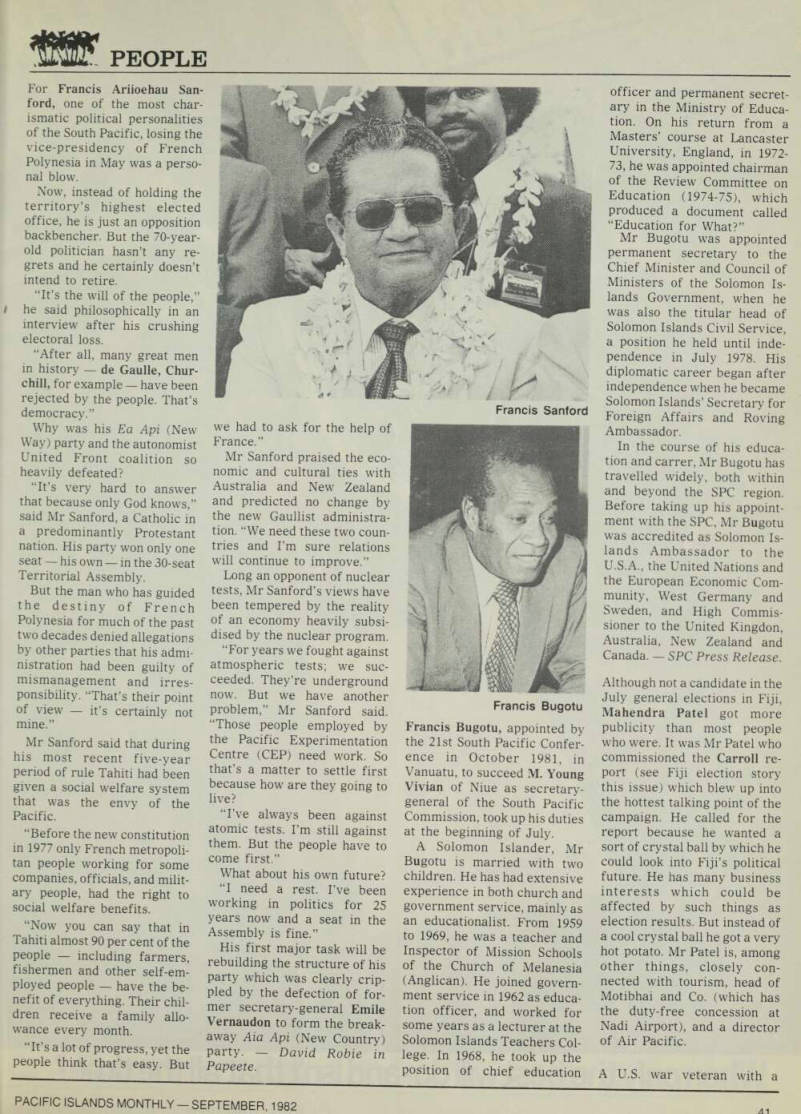
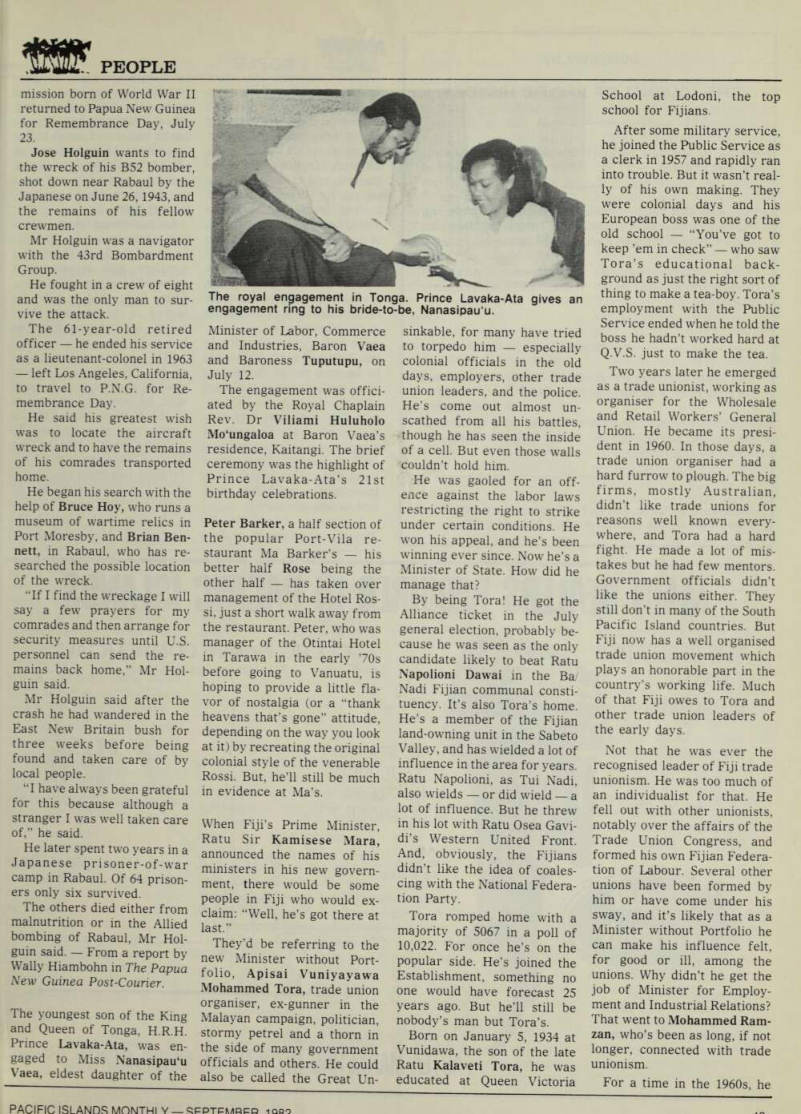
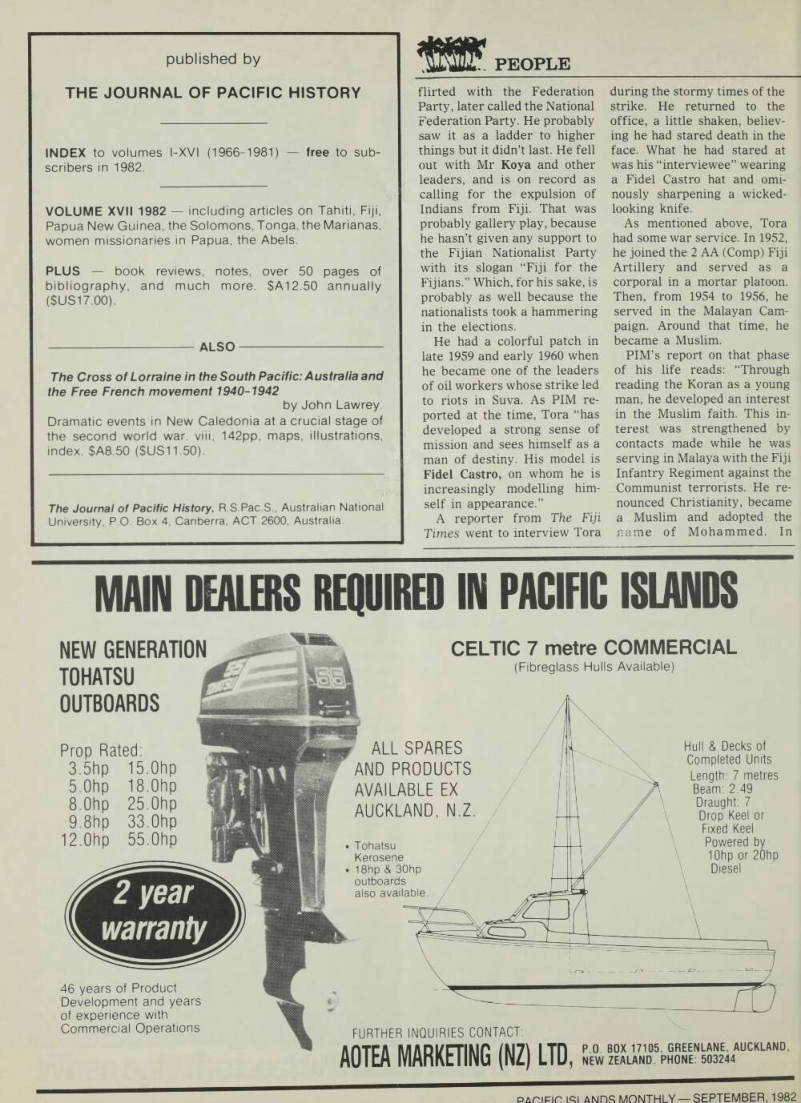
For Francis Ariioehau San ford, one of the most char ismatic political personalities of the South Pacific, losing the vice-presidency of French Polynesia in May was a perso nal blow.
Now, instead of holding the territory’s highest elected office, he is just an opposition backbencher. But the 70-year old politician hasn’t any re grets and he certainly doesn’t intend to retire.
“It’s the will of the people,” he said philosophically in an interview after his crushing electoral loss.
“After all, many great men in history de Gaulle, Chur chill, for example have been rejected by the people. That’s democracy.”
Why was his Ea Api (New Way) party and the autonomist United Front coalition so heavily defeated?
“It’s very hard to answer that because only God knows,” said Mr Sanford, a Catholic in a predominantly Protestant nation. His party won only one seat his own in the 30-seat Territorial Assembly.
But the man who has guided the destiny of French Polynesia for much of the past two decades denied allegations by other parties that his admi nistration had been guilty of mismanagement and irres ponsibility. “That’s their point of view it’s certainly not mine.”
Mr Sanford said that during his most recent five-year period of rule Tahiti had been given a social welfare system that was the envy of the Pacific.
“Before the new constitution in 1977 only French metropoli tan people working for some companies, officials, and milit ary people, had the right to social welfare benefits.
“Now you can say that in Tahiti almost 90 per cent of the people including farmers, fishermen and other self-em ployed people have the be nefit of everything. Their chil dren receive a family allo wance every month.
“It’s a lot of progress, yet the people think that’s easy. But
we had to ask for the help of France.”
Mr Sanford praised the eco nomic and cultural ties with Australia and New Zealand and predicted no change by the new Gaullist administra tion. “We need these two coun tries and I’m sure relations will continue to improve.”
Long an opponent of nuclear tests, Mr Sanford’s views have been tempered by the reality of an economy heavily subsi dised by the nuclear program.
“For years we fought against atmospheric tests; we suc ceeded. They’re underground now. But we have another problem,” Mr Sanford said.
“Those people employed by the Pacific Experimentation Centre (CEP) need work. So that’s a matter to settle first because how are they going to live?
“I’ve always been against atomic tests. I’m still against them. But the people have to come first.”
What about his own future?
“I need a rest. I’ve been working in politics for 25 years now and a seat in the Assembly is fine.”
His first major task will be rebuilding the structure of his party which was clearly crip pled by the defection of for mer secretary-general Emile Vernaudon to form the break away Aia Api (New Country) party. David Robie in Papeete.
Francis Bugotu, appointed by the 21st South Pacific Confer ence in October 1981, in Vanuatu, to succeed M. Young Vivian of Niue as secretary general of the South Pacific Commission, took up his duties at the beginning of July.
A Solomon Islander, Mr Bugotu is married with two children. He has had extensive experience in both church and government service, mainly as an educationalist. From 1959 to 1969, he was a teacher and Inspector of Mission Schools of the Church of Melanesia (Anglican). He joined govern ment service in 1962 as educa tion officer, and worked for some years as a lecturer at the Solomon Islands Teachers Col lege. In 1968, he took up the position of chief education
officer and permanent secret ary in the Ministry of Educa tion. On his return from a Masters’ course at Lancaster University, England, in 1972- 73, he was appointed chairman of the Review Committee on Education (1974-75), which produced a document called “Education for What?”
Mr Bugotu was appointed permanent secretary to the Chief Minister and Council of Ministers of the Solomon Is lands Government, when he was also the titular head of Solomon Islands Civil Service, a position he held until inde pendence in July 1978. His diplomatic career began after independence when he became Solomon Islands’ Secretary for Foreign Affairs and Roving Ambassador.
In the course of his educa tion and carrer, Mr Bugotu has travelled widely, both within and beyond the SPC region.
Before taking up his appoint ment with the SPC, Mr Bugotu was accredited as Solomon Is lands Ambassador to the U.S.A., the United Nations and the European Economic Com munity, West Germany and Sweden, and High Commis sioner to the United Kingdon, Australia, New Zealand and Canada. SPC Press Release.
Although not a candidate in the July general elections in Fiji, Mahendra Patel got more publicity than most people who were. It was Mr Patel who commissioned the Carroll re port (see Fiji election story this issue) which blew up into the hottest talking point of the campaign. He called for the report because he wanted a sort of crystal ball by which he could look into Fiji’s political future. He has many business interests which could be affected by such things as election results. But instead of a cool crystal ball he got a very hot potato. Mr Patel is, among other things, closely con nected with tourism, head of Motibhai and Co. (which has the duty-free concession at Nadi Airport), and a director of Air Pacific.
A U.S. war veteran with a
Francis Sanford
Francis Bugotu
mission born of World War II returned to Papua New Guinea for Remembrance Day, July 23.
Jose Holguin wants to find the wreck of his 852 bomber, shot down near Rabaul by the Japanese on June 26,1943, and the remains of his fellow crewmen.
Mr Holguin was a navigator with the 43rd Bombardment Group.
He fought in a crew of eight and was the only man to sur vive the attack.
The 61-year-old retired officer he ended his service as a lieutenant-colonel in 1963 left Los Angeles, California, to travel to P.N.G. for Re membrance Day.
He said his greatest wish was to locate the aircraft wreck and to have the remains of his comrades transported home.
He began his search with the help of Bruce Hoy, who runs a museum of wartime relics in Port Moresby, and Brian Ben nett, in Rabaul, who has re searched the possible location of the wreck.
“If I find the wreckage I will say a few prayers for my comrades and then arrange for security measures until U.S. personnel can send the re mains back home,” Mr Hol guin said.
Mr Holguin said after the crash he had wandered in the East New Britain bush for three weeks before being found and taken care of by local people.
“I have always been grateful for this because although a stranger I was well taken care of,” he said.
He later spent two years in a Japanese prisoner-of-war camp in Rabaul. Of 64 prison ers only six survived.
The others died either from malnutrition or in the Allied bombing of Rabaul, Mr Hol guin said. From a report by Wally Hiambohn in The Papua New Guinea Post-Courier.
The youngest son of the King and Queen of Tonga, H.R.H.
Prince Lavaka-Ata, was en gaged to Miss Nanasipau‘u Vaea, eldest daughter of the
Minister of Labor, Commerce and Industries, Baron Vaea and Baroness Tuputupu, on July 12.
The engagement was offici ated by the Royal Chaplain Rev. Dr Viliami Huluholo Mo‘ungaloa at Baron Vaea’s residence, Kaitangi. The brief ceremony was the highlight of Prince Lavaka-Ata’s 21st birthday celebrations.
Peter Barker, a half section of the popular Port-Vila re staurant Ma Barker’s his better half Rose being the other half has taken over management of the Hotel Ros si, just a short walk away from the restaurant. Peter, who was manager of the Otintai Hotel in Tarawa in the early 70s before going to Vanuatu, is hoping to provide a little fla vor of nostalgia (or a “thank heavens that’s gone” attitude, depending on the way you look at it) by recreating the original colonial style of the venerable Rossi. But, he’ll still be much in evidence at Ma’s.
When Fiji’s Prime Minister, Ratu Sir Kamisese Mara, announced the names of his ministers in his new govern ment, there would be some people in Fiji who would ex claim: “Well, he’s got there at last.”
They’d be referring to the new Minister without Port folio, Apisai Vuniyayawa Mohammed Tora, trade union organiser, ex-gunner in the Malayan campaign, politician, stormy petrel and a thorn in the side of many government officials and others. He could also be called the Great Un
sinkable, for many have tried to torpedo him especially colonial officials in the old days, employers, other trade union leaders, and the police.
He’s come out almost un scathed from all his battles, though he has seen the inside of a cell. But even those walls couldn’t hold him.
He was gaoled for an off ence against the labor laws restricting the right to strike under certain conditions. He won his appeal, and he’s been winning ever since. Now he’s a Minister of State. How did he manage that?
By being Tora! He got the Alliance ticket in the July general election, probably be cause he was seen as the only candidate likely to beat Ratu Napolioni Dawai in the Ba/ Nadi Fijian communal consti tuency. It’s also Tora’s home.
He’s a member of the Fijian land-owning unit in the Sabeto Valley, and has wielded a lot of influence in the area for years.
Ratu Napolioni, as Tui Nadi, also wields or did wield a lot of influence. But he threw in his lot with Ratu Osea Gavi di’s Western United Front.
And, obviously, the Fijians didn’t like the idea of coales cing with the National Federa tion Party.
Tora romped home with a majority of 5067 in a poll of 10,022. For once he’s on the popular side. He’s joined the Establishment, something no one would have forecast 25 years ago. But he’ll still be nobody’s man but Tora’s.
Born on January 5, 1934 at Vunidawa, the son of the late Ratu Kalaveti Tora, he was educated at Queen Victoria
School at Lodoni, the top school for Fijians.
After some military service, he joined the Public Service as a clerk in 1957 and rapidly ran into trouble. But it wasn’t real ly of his own making. They were colonial days and his European boss was one of the old school “You’ve got to keep ’em in check” who saw Tora’s educational back ground as just the right sort of thing to make a tea-boy. Tora’s employment with the Public Service ended when he told the boss he hadn’t worked hard at Q.V.S. just to make the tea.
Two years later he emerged as a trade unionist, working as organiser for the Wholesale and Retail Workers’ General Union. He became its presi dent in 1960. In those days, a trade union organiser had a hard furrow to plough. The big firms, mostly Australian, didn’t like trade unions for reasons well known every where, and Tora had a hard fight. He made a lot of mis takes but he had few mentors.
Government officials didn’t like the unions either. They still don’t in many of the South Pacific Island countries. But Fiji now has a well organised trade union movement which plays an honorable part in the country’s working life. Much of that Fiji owes to Tora and other trade union leaders of the early days.
Not that he was ever the recognised leader of Fiji trade unionism. He was too much of an individualist for that. He fell out with other unionists, notably over the affairs of the Trade Union Congress, and formed his own Fijian Federa tion of Labour. Several other unions have been formed by him or have come under his sway, and it’s likely that as a Minister without Portfolio he can make his influence felt, for good or ill, among the unions. Why didn’t he get the job of Minister for Employ ment and Industrial Relations?
That went to Mohammed Ram zan, who’s been as long, if not longer, connected with trade unionism.
For a time in the 19605, he
The royal engagement in Tonga. Prince Lavaka-Ata gives an engagement ring to his bride-to-be, Nanasipau'u.
flirted with the Federation Party, later called the National Federation Party. He probably saw it as a ladder to higher things but it didn’t last. He fell out with Mr Koya and other leaders, and is on record as calling for the expulsion of Indians from Fiji. That was probably gallery play, because he hasn’t given any support to the Fijian Nationalist Party with its slogan “Fiji for the Fijians.” Which, for his sake, is probably as well because the nationalists took a hammering in the elections.
He had a colorful patch in late 1959 and early 1960 when he became one of the leaders of oil workers whose strike led to riots in Suva. As PIM re ported at the time, Tora “has developed a strong sense of mission and sees himself as a man of destiny. His model is Fidel Castro, on whom he is increasingly modelling him self in appearance.”
A reporter from The Fiji Times went to interview Tora
during the stormy times of the strike. He returned to the office, a little shaken, believ ing he had stared death in the face. What he had stared at was his “interviewee” wearing a Fidel Castro hat and omi nously sharpening a wicked looking knife.
As mentioned above, Tora had some war service. In 1952, he joined the 2 AA (Comp) Fiji Artillery and served as a corporal in a mortar platoon.
Then, from 1954 to 1956, he served in the Malayan Cam paign. Around that time, he became a Muslim.
PlM’s report on that phase of his life reads: “Through reading the Koran as a young man, he developed an interest in the Muslim faith. This in terest was strengthened by contacts made while he was serving in Malaya with the Fiji Infantry Regiment against the Communist terrorists. He re nounced Christianity, became a Muslim and adopted the name of Mohammed. In
Malaya he also developed an interest in, and sympathy for, the terrorists against whom he was fighting.” As you can see, Tora is a man of many parts, many facets, and his career as one of Her Majesty’s Minis ters of State will be watched with great interest.
He’d probably like to be Prime Minister! John Carter.
Guam’s Patty Chong Kerkos was “first runner-up” in the Miss Universe Pageant held in July in Lima, Peru. It was the first time that a Guam contes tant has won the title.
In the event that Miss Cana da, Karen Baldwin, is unable to fulfil her role as Miss Uni verse, Kerkos will assume the title.
The 18-year-old had earlier received the Miss Internatio nal Press award at a banquet where newsmen officially pre sented her with the crown. It was the first year that this award has been presented at the Miss Universe Pageant.
Kerkos lives with her family in Hyundai, Mongmong. She has lived on Guam for 11 years. She attends the Uni versity of Guam and plans to attend a fashion design school in France.
She was born in Seoul, Korea, and has lived in Japan, the U.S., Korea and now Guam, which she considers home.
Kerkos, who speaks five lan guages Korean, Japanese, English, Spanish and Chinese is also a gymnast, body builder, practises martial arts and is a modern dance instruc tor. Guam Visitors Bureau.
When Auckland-based Tahi tian Nat Mara flew to Paris 39 years ago his mission was sim ple to drop bombs. In July 1982 he flew back there.
Only this time it was to be feted as a wartime hero.
Natapu Mara, 60, was one of three Tahitians invited by the French Government to the annual Bastille Day parade on July 14.
Before flying to Paris, Mr Mara, who has lived in New
Zealand for the past 30 years, was feted by French High Commissioner Paul Noirot- Cosson in Papeete.
“It was a great honor for me to go back to Paris and see many of my old wartime com rades after so long,” he said.
Now a social worker for the Tahitian community in New Zealand and living in the Auck land suburb of Te Atatu, his first visit to Paris seems as vivid to him as if it had hap pened yesterday.
He still remembers with ex citement seeing the Eiffel Tower for the first time on that 1943 mission. But he is also sad that his task then was to drop bombs on a target in the city of his dreams.
Mr Mara has scars on his right leg which are permanent reminders of his service with the Free French Air Force.
His other wartime souvenirs include the Medaille Militaire, Croix de Guerre with three palms, Medaille de Resistance,
Medaille Commemoratif and the lanyard of the Legion d’Honneur.
The citation with the Croix de Guerre tells how he saved the life of a French pilot when their Boston medium-range bomber was shot down over the English Channel shortly before his 21st birthday.
In 1941, after the fall of France, Mr Mara had gone to New Zealand with 21 other Tahitian volunteers to join the Royal New Zealand Air Force but only 12 were accepted.
They were eventually trained in Canada and Britain and joined the Free French forces.
Six of the volunteers joined the Lorraine Squadron. Mr Mara was the only one of them who wasn’t either killed or taken prisoner. Two died in training, two were killed over
Europe, and another was cap tured by the Nazis.
Mr Mara, a wireless oper ator and air gunner, flew a total of 51 operational flights.
“They used to call me the last of the Mohicans,” he said with a chuckle. “They wouldn’t let me fly any more after those 51 missions.”
Ten years ago, he was awarded a French knighthood Chevalier dans I’Ordre national du Merite, second only to the Legion d’Honneur, for his social work in New Zealand.
His work among Tahitians includes interpreting for them in consultations with doctors, and arranging accommoda tion. About 500 Tahitians a year go to New Zealand for medical treatment. Mr Mara has also been president of the Tahiti Nui club in Auckland, and managed a group of Tahi tian dancers for more than 20 years.
He led the first group of Maori entertainers to visit Tahiti, and has exported pre fabricated houses to the French-speaking Pacific in collaboration with a brother in Noumea.
Though still a French Polynesian, Mr Mara is mar ried to a New Zealander, Julie, and the couple have five chil dren. They were delighted ab out his Paris trip.
When he got there, one place Mr Mara certainly didn’t miss was the famous girlie cabaret Folies Bergeres.
“The last time I went there I was never so embarrassed in all my life. I went with an Irishman and he just got so excited and carried away when everybody else was dead
quiet.”
David Robie in Auck-
land.
Seini Vakasiuola, a nurse and associate director of the Tongan Foundation for the South Pacific, took up a Nuf field Visitors’ Award in Au gust. The award was arranged by the United Kingdom Found ation for the peoples of the South Pacific (FSP) Miss Vaka siuola will spend five months in Britain exploring how Brit
ish voluntary agencies work, and attending a course in De velopment Studies at the Selly Oak Colleges in Birmingham.
Miss Vakasiuola has been deputy director in Tonga of the FSP programme since 1978. Previously she worked with the Niuola Women in De velopment Association and be fore that followed a career in nursing to become assistant deputy matron at Vaiola Hospital in Tonga.
The UK FSP was formed in November 1981 and aims to support projects and program mes in the South Pacific region.
This is the first Nuffield Visitors’ Award to a Pacific Islander.
Wayne Heffernan has taken up the newly created post of Air Pacific’s cargo sales mana ger in Australia. Mr Heffernan comes to the new job after experience in cargo covering 18 months with Air New Zea land and five years with the Australian domestic carrier Ansett.
Air Pacific’s cargo manager Seth Maharaj commented: “Mr Heffernan is needed be cause of the big increase in cargo movement between Aus tralia and Fiji.
“With our shared service on the Qantas 747 out of Mel bourne and Sydney, coupled with our daily service on our 737 out of Brisbane, our capability to move cargo has increased substantially.”
Air Pacific’s existing cargo representatives in the Austra lian States of New South Wales, Queensland and Victor ia will now report directly to Mr Heffernan.
Jane Dickhudt has been appointed editor of the Marianas Variety newspaper by publishers Abed and Paz Castro Younis.
Ms Dickhudt, 26, has served as associate editor of the paper since January 1981.
She succeeds Kurt Liepman, who has resigned.
An avid runner, Ms Dick hudt won the Guam Marathon women’s division last year.
Nat Mara
Advertisements & other items, pp. 42-46 (3 items)
When only the best will do-and isn’t that all the time?
o f"/ r * ■ mim ‘>rr-^: 'v S® £j» When only the best will do-and isn’t that all the time?
published by
THE JOURNAL OF PACIFIC HISTORY
INDEX to volumes l-XVI (1966-1981) free to subscribers in 1982.
VOLUME XVII 1982 including articles on Tahiti, Fiji, Papua New Guinea, the Solomons, Tonga, the Marianas, women missionaries in Papua, the Abels.
PLUS book reviews, notes, over 50 pages of bibliography, and much more. $A12.50 annually
(SUSI7.OO).
ALSO
The Cross of Lorraine in the South Pacific: Australia and the Free French movement 1940-1942 by John Lawrey Dramatic events in New Caledonia at a crucial stage of the second world war. viii, 142 pp, maps, illustrations, index. $A8.50 (SUSII.SO).
The Journal of Pacific History, R.S.Pac.S., Australian National University, P.O. Box 4, Canberra, ACT 2600, Australia.
MAIN DEALERS REQUIRED IN PACIFIC ISLANDS
NEW GENERATION
TOHATSU
OUTBOARDS
Prop Rated:
3.5 hp 15.0 hp
s.ohp
B.ohp
9.Bhp
12.0 hp 18.0 hp 25.0 hp 33.0 hp 55.0 hp 46 years of Product Development and years of experience with Commercial Operations
CELTIC 7 metre COMMERCIAL
(Fibreglass Hulls Available)
ALL SPARES
AND PRODUCTS
AVAILABLE EX
AUCKLAND, N.Z
Tohatsu Kerosene 18hp & 30hp outboards also available.
Hull & Decks of Completed Units Length: 7 metres Beam; 2.49 Draught: 7 Drop Keel or Fixed Keel Powered by lOhp or 20hp Diesel
FURTHER INQUIRIES CONTACT:
AOTEA MARKETING INZI LTD
PO BOX 17105, GREENLANE, AUCKLAND
NEW ZEALAND. PHONE: 503244
SOLAREX
ELECTRICITY FROM SUNLIGHT
Oil short, ruralised, developing nations are great beneficiaries of the advances being made in SOLAR ELECTRIC GENERATORS H um m H m / . m m * & • V-.;
ihi
LV > * mk & * 9 The communal hut of this Pacific island village has a projector and video recorder powered by a photovoltaic generator. These units are* used toi show the viNagers current farming techniques, basic health and child care along with providing valuable assistance or the regional educational powered lighting system and the communal health centre keeps drugs sterile and temperate in a solar-powered refrigerator-freezer The viHagers have a water catchment supplied by a Solarex Photovoltaic Pumping System while communications are effected by means of a H.F. radio network powered by the central solar generator.
Photovoltaic generators where chosen over the more traditional liquid fuelled systems because they were the most cost effective option when the following was considered •Virtual unlimited operational life* Fuel free •Minimal maintenance to be carried out by non-skilled personnel* Foreign exchange savings resulting from a lower liquid fuel bill.
Solar powered generators are often the most economic alternative for: • Remote homes and villages • Remote communication sites • Water pumping • Telemetry outstations, etc.
If you would like to know more about the Pacific areas most abundant free energy source, contact: SOLAREX PTY. LIMITED THE FREE ENERGY COMPANY" 5 BELLONA AVE • REGENTS PARK 2143 AUSTRALIA • P.O. BOX 204 i • TELEPHONE 644 5055 • TELEX AA21975
CHESTER HILL 2162
People
43
PACIFIC ISLANDS MDNTHI Y SPPTPMRPD iqqo
Darifin I.Qi Amds Monthly September, 1982
PEOPLE
on the anthropological map
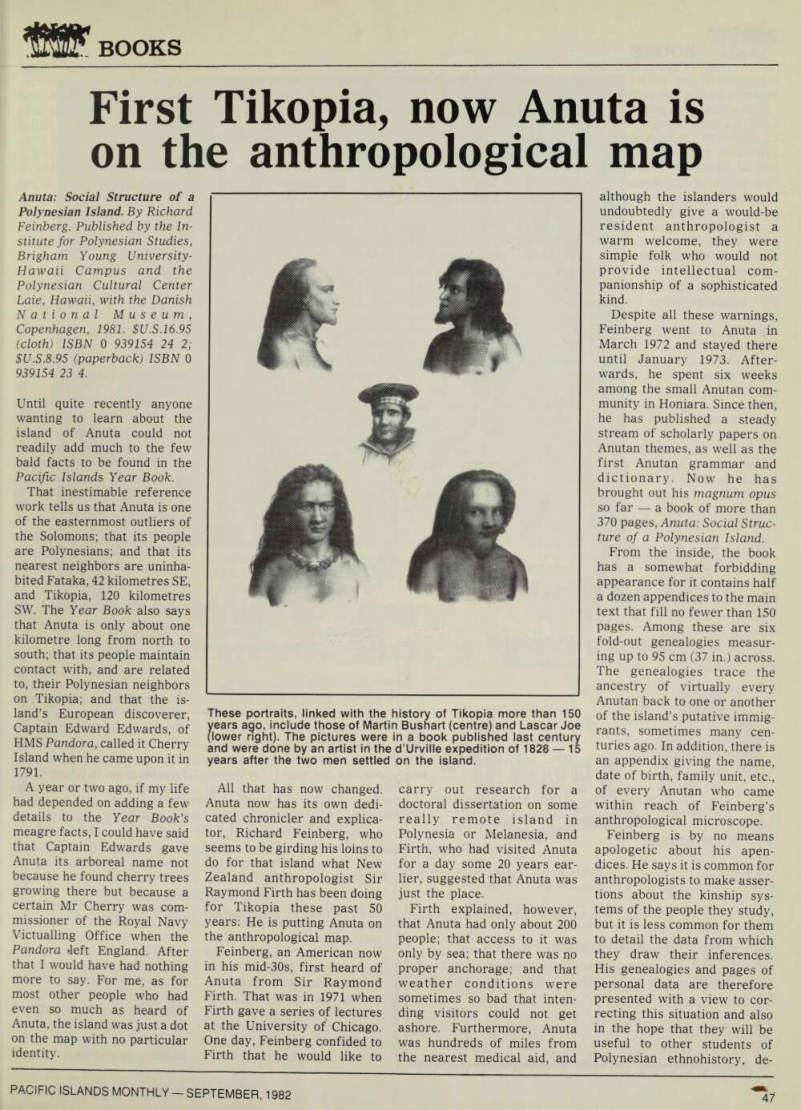
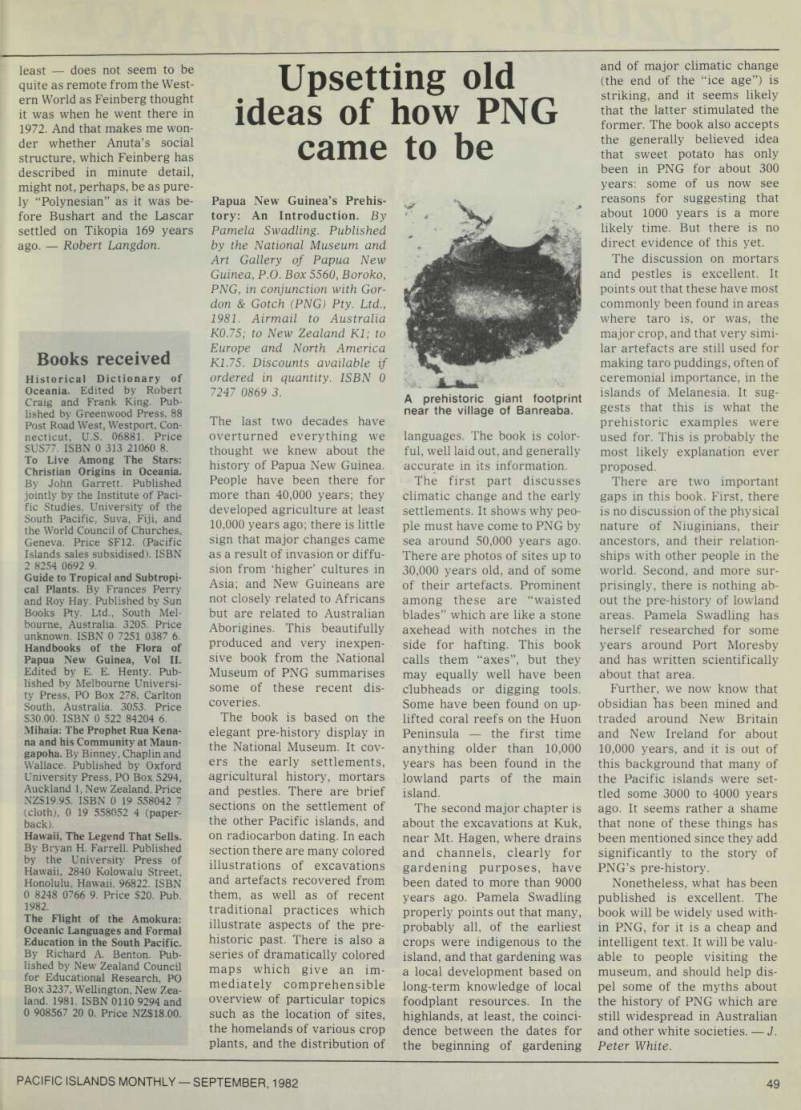
Books
First Tikopia, now Anuta is on the anthropological map
Anuta: Social Structure of a Polynesian Island. By Richard Feinberg. Published by the In stitute for Polynesian Studies, Brigham Young University- Hawaii Campus and the Polynesian Cultural Center Laie, Hawaii, with the Danish National Museum, Copenhagen, 1981. $U.5.16.95 (cloth) ISBN 0 939154 24 2; $U.5.8.95 (paperback) ISBN 0 939154 23 4.
Until quite recently anyone wanting to learn about the island of Anuta could not readily add much to the few bald facts to be found in the Pacific Islands Year Book.
That inestimable reference work tells us that Anuta is one of the easternmost outliers of the Solomons; that its people are Polynesians; and that its nearest neighbors are uninha bited Fataka, 42 kilometres SE, and Tikopia, 120 kilometres SW. The Year Book also says that Anuta is only about one kilometre long from north to south; that its people maintain contact with, and are related to, their Polynesian neighbors on Tikopia; and that the is land’s European discoverer, Captain Edward Edwards, of HMS Pandora, called it Cherry Island when he came upon it in 1791.
A year or two ago, if my life had depended on adding a few details to the Year Book's meagre facts, I could have said that Captain Edwards gave Anuta its arboreal name not because he found cherry trees growing there but because a certain Mr Cherry was com missioner of the Royal Navy Victualling Office when the Pandora >left England. After that I would have had nothing more to say. For me, as for most other people who had even so much as heard of Anuta, the island was just a dot on the map with no particular identity.
All that has now changed.
Anuta now has its own dedi cated chronicler and explica tor, Richard Feinberg, who seems to be girding his loins to do for that island what New Zealand anthropologist Sir Raymond Firth has been doing for Tikopia these past 50 years: He is putting Anuta on the anthropological map.
Feinberg, an American now in his mid-30s, first heard of Anuta from Sir Raymond Firth. That was in 1971 when Firth gave a series of lectures at the University of Chicago.
One day, Feinberg confided to Firth that he would like to
carry out research for a doctoral dissertation on some really remote island in Polynesia or Melanesia, and Firth, who had visited Anuta for a day some 20 years ear lier, suggested that Anuta was just the place.
Firth explained, however, that Anuta had only about 200 people; that access to it was only by sea; that there was no proper anchorage; and that weather conditions were sometimes so bad that inten ding visitors could not get ashore. Furthermore, Anuta was hundreds of miles from the nearest medical aid, and
although the islanders would undoubtedly give a would-be resident anthropologist a warm welcome, they were simple folk who would not provide intellectual com panionship of a sophisticated kind.
Despite all these warnings, Feinberg went to Anuta in March 1972 and stayed there until January 1973. After wards, he spent six weeks among the small Anutan com munity in Honiara. Since then, he has published a steady stream of scholarly papers on Anutan themes, as well as the first Anutan grammar and dictionary. Now he has brought out his magnum opus so far a book of more than 370 pages, Anuta: Social Struc ture of a Polynesian Island.
From the inside, the book has a somewhat forbidding appearance for it contains half a dozen appendices to the main text that fill no fewer than 150 pages. Among these are six fold-out genealogies measur ing up to 95 cm (37 in.) across.
The genealogies trace the ancestry of virtually every Anutan back to one or another of the island’s putative immig rants, sometimes many cen turies ago. In addition, there is an appendix giving the name, date of birth, family unit, etc., of every Anutan who came within reach of Feinberg’s anthropological microscope.
Feinberg is by no means apologetic about his apen dices. He says it is common for anthropologists to make asser tions about the kinship sys tems of the people they study, but it is less common for them to detail the data from which they draw their inferences.
His genealogies and pages of personal data are therefore presented with a view to cor recting this situation and also in the hope that they will be useful to other students of Polynesian ethnohistory, de-
These portraits, linked with the history of Tikopia more than 150 years ago, include those of Martin Bushart (centre) and Lascar Joe (lower right). The pictures were in a book published last century and were done by an artist in the d’Urville expedition of 1828 - 15 years after the two men settled on the island.
mographic patterns or, perhaps, population genetics.
Feinberg’s book proper con sists of eight chapters which, in the main, concentrate on getting to grips with Anuta’s social structure. They are written in crisp, reasonably simple English, which is agreeably free of the jargon that many social anthropolig ists use. The second chapter, “The Setting”, provides an ex cellent background to Fein berg’s study. Three memor able points he makes are: (1) although Anuta’s land area is only 0.15 square miles, a re markable variety of vegetable life has been squeezed into this small space; (2) the Anutan agricultural system is one of the most intensive in the Paci fic; and (3) for someone com ing from a non-oceanic en vironment, the variety of ways in which the Anutans catch fish is “nothing less than in credible”.
Feinberg says that the origin of Anuta’s first human inhabi
tants is unknown and that little is known about its people until the time of Pu Ariki, a chief from Tikopia of about 14 generations ago. From then on, Anuta is said to have been settled by people from Tonga, Wallis Island, Samoa and Rotu ma, and has always maintained relations with Tikopia.
“There is currently a great deal of Tikopian admixture in the Anutan population,” Fein berg says. “The languages of the two islands are mutually intelligible. Their culture and social structure are similar, and the people of the two islands see themselves as being closely allied when com paring themselves with the rest of the world.” Feinberg says also that although Tongan and Samoan blood has been retained through Anuta’s women, the island’s present chiefly line traces its ancestry back to one Pu Taupare, an immigrant from Wallis Island, which is otherwise known as East Uvea.
These statements are parti cularly interesting in the light of a recently published study by Professor Bruce Biggs, a specialist in Polynesian lan guages at the University of Auckland. This study, which was partly based on Feinberg’s Anutan dictionary, had not been published when Fein berg’s book went to press. It is entitled “The Position of East Uvean and Anutan in the Polynesian Language Family” (Te Reo, vol. 23, 1980), and it reveals that Anutan is basical ly a dialect of Tikopian, which has been heavily overlaid by borrowings from Wallisian, or East Uvean. In other words, Biggs’ study generally con firms what Feinberg learned about Anutan prehistory from local traditions.
However, neither Biggs’ study nor Feinberg’s book does anything to explain why the elderly, tattooed Anutan man whose photograph in col our graces the cover of Fein berg’s book, looks decidedly European. Not only does the man have the characteristical ly lean body structure of many Europeans, his skin color is remarkably light, his facial features and hair form are Caucasoid, and he is unusually bald for a “true-blue” Pacific Islander.
For what it is worth, I have my own theory as to why the man on Feinberg’s cover looks as European as he does, even though Anuta had never had any resident Europeans until the last few years. My theory is that the man is a descendant of a Prussian seaman, Martin Bushart, who was left on Tiko pia in 1813 with his pregnant Fijian wife and a Lascar called Joe. One of the officers in the ship that brought Tikopia these early aliens was Peter Dillon, an Irish seaman, who returned to Tikopia in his own ship some 13 years later.
Bushart and the Lascar came out to greet him; and it was because the Lascar had a sil ver sword guard with him, obtained from neighboring Vanikoro, that Dillon later elucidated the fate of the French explorer La Perouse.
Bushart actually accompa nied Dillon to Vanikoro, and then went on to Calcutta with him. However, when Dillon brought him back to the Paci fic in the following year, Bushart was determined to re turn to Tikopia, “there to end his days”, as Dillon put it, “in retirement from worldly affairs”. Dillon’s statement suggests to me that Bushart had left a family on Tikopia.
Indeed, it would be surprising if he had not and if he did, it would have been a part-Euro pean family whose genes would, inevitably, have been passed down the years to the Tikopians of today as well as to their close relatives, the Anu tans.
As far as I know, however, the possibility that either Bushart or the Lascar or, for that matter, several other early European beachcombers on Tikopia could have left descendants on that island is nowhere mentioned in the works of Sir Raymond Firth, even though European-looking faces peer occasionally from the not-terribly-good photo graphs that illustrate his pages.
Social anthropologists seem to have a blind spot for this sort of thing for they like to believe that the remote and isolated communities they in vestigate are uncontaminated by genetic or cultural influ ences from the outside world.
This being so, I hope that any ethnohistorians, demog raphers or geneticists who have occasion in future to use Feinberg’s superb genealogies will spare a thought for Martin Bushart, the Lascar and those other early beachcombers.
The fact is that although Bushart and the Lascar, for example, were but two distinc tive aliens in the Tikopian population of 1813, their Prus sian and Indian genes could now be so widespread that every living Tikopian and Anu tan is of part-Prussian or part- Indian descent to a greater or lesser degree!
In short, despite the difficul ty one still has in getting to and then getting on to Anuta, that island in an ethnic sense, at
least does not seem to be quite as remote from the West ern World as Feinberg thought it was when he went there in 1972. And that makes me won der whether Anuta’s social structure, which Feinberg has described in minute detail, might not, perhaps, be as pure ly “Polynesian” as it was be fore Bushart and the Lascar settled on Tikopia 169 years
ago.
Robert Langdon.
Advertisements & other items, p. 48 (1 item)
Instant Houses
WITH
Therma-Panel®
THE FULLY INSULATED BUILDING SYSTEM
$ rg [ , • , •> v « 'V ■ , r-})^ . K ■ r *■
Ijil
- *• Fast • Economical . Sim p|e • Homes • Shearer’s quarters • Amenity blocks • School buildings • Farm buildings • Offices
THE HOME YOU CAN ASSEMBLE
George Hudson Homes p*y sl L Jd, (|F M r 186 Hume Hway, Cabramatta, N.S.W.2166 Telephone: (02) 727 9066. Telex; AA25800.
For details and prices. Name post coupon to Address George Hudson Homes MUUI cc>;:> (Aust.) Rty. Ltd. Phone Do you own a block of land yes □ no □
Books received
Historical Dictionary of Oceania. Edited by Robert Craig and Frank King. Pub lished by Greenwood Press, 88 Post Road West, Westport, Con necticut, U.S. 06881. Price SUS 77. ISBN 0 313 21060 8.
To Live Among The Stars: Christian Origins in Oceania.
By John Garrett. Published jointly by the Institute of Paci fic Studies, University of the South Pacific, Suva, Fiji, and the World Council of Churches, Geneva. Price SFI2. (Pacific Islands sales subsidised). ISBN 2 8254 0692 9.
Guide to Tropical and Subtropi cal Plants. By Frances Perry and Roy Hay. Published by Sun Books Pty. Ltd., South Mel bourne, Australia. 3205. Price unknown. ISBN 0 7251 0387 6.
Handbooks of the Flora of Papua New Guinea, Vol IL Edited by E. E. Henty. Pub lished by Melbourne Universi ty Press, PO Box 278, Carlton South, Australia, 3053. Price
530.00. Isbn 0 522 84204 6.
Mihaia: The Prophet Rua Kena na and his Community at Maun gapoha. By Binney, Chaplin and Wallace. Published by Oxford University Press, PO Box 5294, Auckland 1, New Zealand. Price
Nz519.95. Isbn 0 19 558042 7
(cloth), 0 19 558052 4 (paper back).
Hawaii, The Legend That Sells.
By Bryan H. Farrell. Published by the University' Press of Hawaii, 2840 Kolowalu Street, Honolulu, Hawaii. 96822. ISBN 0 8248 0766 9. Price $2O. Pub. 1982.
The Flight of the Amokura: Oceanic Languages and Formal Education in the South Pacific.
By Richard A. Benton. Pub lished by New Zealand Council for Educational Research, PO Box 3237, Wellington, New Zea land. 1981. ISBN 0110 9294 and 0 908567 20 0. Price NZ$lB.OO.
Upsetting old
ideas of how PNG came to be
Papua New Guinea’s Prehis tory: An Introduction. By Pamela Swadling. Published by the National Museum and Art Gallery of Papua New Guinea, P.O. Box 5560, Boroko, PNG, in conjunction with Gor don & Gotch (PNG) Pty. Ltd., 1981. Airmail to Australia K 0.75; to New Zealand Kl; to Europe and North America K 1.75. Discounts available if ordered in quantity. ISBN 0 7247 0869 3.
The last two decades have overturned everything we thought we knew about the history of Papua New Guinea.
People have been there for more than 40,000 years; they developed agriculture at least 10,000 years ago; there is little sign that major changes came as a result of invasion or diffu sion from ‘higher’ cultures in Asia; and New Guineans are not closely related to Africans but are related to Australian Aborigines. This beautifully produced and very inexpen sive book from the National Museum of PNG summarises some of these recent dis coveries.
The book is based on the elegant pre-history display in the National Museum. It cov ers the early settlements, agricultural history, mortars and pestles. There are brief sections on the settlement of the other Pacific islands, and on radiocarbon dating. In each section there are many colored illustrations of excavations and artefacts recovered from them, as well as of recent traditional practices which illustrate aspects of the pre historic past. There is also a series of dramatically colored maps which give an im mediately comprehensible overview of particular topics such as the location of sites, the homelands of various crop plants, and the distribution of
languages. The book is color ful, well laid out, and generally accurate in its information.
The first part discusses climatic change and the early settlements. It shows why peo ple must have come to PNG by sea around 50,000 years ago.
There are photos of sites up to 30,000 years old, and of some of their artefacts. Prominent among these are “waisted blades” which are like a stone axehead with notches in the side for hafting. This book calls them “axes”, but they may equally well have been clubheads or digging tools.
Some have been found on up lifted coral reefs on the Huon Peninsula the first time anything older than 10,000 years has been found in the lowland parts of the main island.
The second major chapter is about the excavations at Kuk, near Mt. Hagen, where drains and channels, clearly for gardening purposes, have been dated to more than 9000 years ago. Pamela Swadling properly points out that many, probably all, of the earliest crops were indigenous to the island, and that gardening was a local development based on long-term knowledge of local foodplant resources. In the highlands, at least, the coinci dence between the dates for the beginning of gardening
and of major climatic change (the end of the “ice age”) is striking, and it seems likely that the latter stimulated the former. The book also accepts the generally believed idea that sweet potato has only been in PNG for about 300 years: some of us now see reasons for suggesting that about 1000 years is a more likely time. But there is no direct evidence of this yet.
The discussion on mortars and pestles is excellent. It points out that these have most commonly been found in areas where taro is, or was, the major crop, and that very simi lar artefacts are still used for making taro puddings, often of ceremonial importance, in the islands of Melanesia. It sug gests that this is what the prehistoric examples were used for. This is probably the most likely explanation ever proposed.
There are two important gaps in this book. First, there is no discussion of the physical nature of Niuginians, their ancestors, and their relation ships with other people in the world. Second, and more sur prisingly, there is nothing ab out the pre-history of lowland areas. Pamela Swadling has herself researched for some years around Port Moresby and has written scientifically about that area.
Further, we now know that obsidian lias been mined and traded around New Britain and New Ireland for about 10,000 years, and it is out of this background that many of the Pacific islands were set tled some 3000 to 4000 years ago. It seems rather a shame that none of these things has been mentioned since they add significantly to the story of PNG’s pre-history.
Nonetheless, what has been published is excellent. The book will be widely used with in PNG, for it is a cheap and intelligent text. It will be valu able to people visiting the museum, and should help dis pel some of the myths about the history of PNG which are still widespread in Australian
and other white societies.
J.
Peter White.
A prehistoric giant footprint near the village of Banreaba.
Advertisements & other items, p. 50 (1 item)
SUZUKI— ppnfQjiMANCE
The name of P£RK ». «**
SUZUKI prepay TjXp\m«re. Eaek he* *£» ymr («(„*i b# * : \1 I® I ii
B> BQ
Hr
SUZUKI I
SUZUKI MOTOR CO, LTD Hamamatsu, Japan SUZUKI GENERATOR SEIBDI • NEW ZEALAND SOUTH PACIFIC SUZUKI DISTRIBUTORS LTD. PHONE: 58-599 • PAPUA NEW GUINEA HI SPEED DIESEL SERVICE PTY. LTD. PHONE: 42-2679 • FIJI NIRANJANS AUTOPORT LTD. PHONE: 381555 •TAHITI NIPPON AUTOMOTO PHONE: 2-98-1 • SOLOMON SOLOMON ISLAND PHONE: 565 • VANUATU HENRI LEROUX • NEW CALENDONIA STE. SUPERCAL PHONE: 272068 • AMERIAN SAMOA PACIFIC PRODUCTS, INC. PHONE: 639-9140 •WESTERN SAMOA VATCO LTD. ©GUAM ISLAND CYCLERY, INC.
PHONE: 565-2298 • NIUE BURNS PHILP CO.,LTD. • NAURU EQUIPAC MOTORS PHONE: 4019 • TONGA TONGA EQUIPMENT • YAP AMBROSE • KOROR BECHESRRAK T. COMPANY PHONE: 338 • TRUK KIOMASA STORE PHONE: 470
tries his bag of
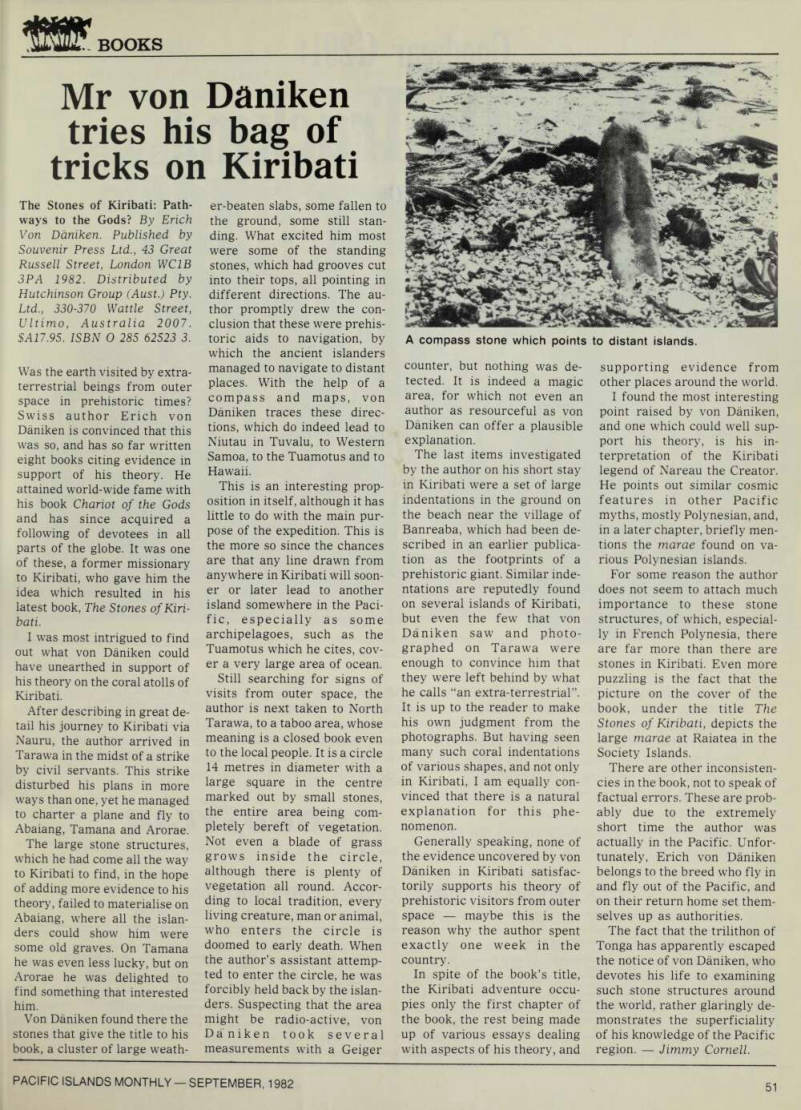
Mr von Daniken tries his bag of tricks on Kiribati
The Stones of Kiribati: Path ways to the Gods? By Erich Von Daniken. Published by Souvenir Press Ltd., 43 Great Russell Street, London WCIB SPA 1982. Distributed by Hutchinson Group (Aust.) Pty.
Ltd., 330-370 Wattle Street, Ultimo, Australia 2007.
5A17.95. Isbn 0 285 62523 3.
Was the earth visited by extra terrestrial beings from outer space in prehistoric times?
Swiss author Erich von Daniken is convinced that this was so, and has so far written eight books citing evidence in support of his theory. He attained world-wide fame with his book Chariot of the Gods and has since acquired a following of devotees in all parts of the globe. It was one of these, a former missionary to Kiribati, who gave him the idea which resulted in his latest book, The Stones of Kiri bati.
I was most intrigued to find out what von Daniken could have unearthed in support of his theory on the coral atolls of Kiribati.
After describing in great de tail his journey to Kiribati via Nauru, the author arrived in Tarawa in the midst of a strike by civil servants. This strike disturbed his plans in more ways than one, yet he managed to charter a plane and fly to Abaiang, Tamana and Arorae.
The large stone structures, which he had come all the way to Kiribati to find, in the hope of adding more evidence to his theory, failed to materialise on Abaiang, where all the islan ders could show him were some old graves. On Tamana he was even less lucky, but on Arorae he was delighted to find something that interested him.
Von Daniken found there the stones that give the title to his book, a cluster of large weath
er-beaten slabs, some fallen to the ground, some still stan ding. What excited him most were some of the standing stones, which had grooves cut into their tops, all pointing in different directions. The au thor promptly drew the con clusion that these were prehis toric aids to navigation, by which the ancient islanders managed to navigate to distant places. With the help of a compass and maps, von Daniken traces these direc tions, which do indeed lead to Niutau in Tuvalu, to Western Samoa, to the Tuamotus and to Hawaii.
This is an interesting prop osition in itself, although it has little to do with the main pur pose of the expedition. This is the more so since the chances are that any line drawn from anywhere in Kiribati will soon er or later lead to another island somewhere in the Paci fic, especially as some archipelagoes, such as the Tuamotus which he cites, cov er a very large area of ocean.
Still searching for signs of visits from outer space, the author is next taken to North Tarawa, to a taboo area, whose meaning is a closed book even to the local people. It is a circle 14 metres in diameter with a large square in the centre marked out by small stones, the entire area being com pletely bereft of vegetation.
Not even a blade of grass grows inside the circle, although there is plenty of vegetation all round. Accor ding to local tradition, every living creature, man or animal, who enters the circle is doomed to early death. When the author’s assistant attemp ted to enter the circle, he was forcibly held back by the islan ders. Suspecting that the area might be radio-active, von Daniken took several measurements with a Geiger
counter, but nothing was de tected. It is indeed a magic area, for which not even an author as resourceful as von Daniken can offer a plausible explanation.
The last items investigated by the author on his short stay in Kiribati were a set of large indentations in the ground on the beach near the village of Banreaba, which had been de scribed in an earlier publica tion as the footprints of a prehistoric giant. Similar inde ntations are reputedly found on several islands of Kiribati, but even the few that von Daniken saw and photo graphed on Tarawa were enough to convince him that they were left behind by what he calls “an extra-terrestrial”.
It is up to the reader to make his own judgment from the photographs. But having seen many such coral indentations of various shapes, and not only in Kiribati, I am equally con vinced that there is a natural explanation for this phe nomenon.
Generally speaking, none of the evidence uncovered by von Daniken in Kiribati satisfac torily supports his theory of prehistoric visitors from outer space maybe this is the reason why the author spent exactly one week in the country.
In spite of the book’s title, the Kiribati adventure occu pies only the first chapter of the book, the rest being made up of various essays dealing with aspects of his theory, and
supporting evidence from other places around the world.
I found the most interesting point raised by von Daniken, and one which could well sup port his theory, is his in terpretation of the Kiribati legend of Nareau the Creator.
He points out similar cosmic features in other Pacific myths, mostly Polynesian, and, in a later chapter, briefly men tions the marae found on va rious Polynesian islands.
For some reason the author does not seem to attach much importance to these stone structures, of which, especial ly in French Polynesia, there are far more than there are stones in Kiribati. Even more puzzling is the fact that the picture on the cover of the book, under the title The Stones of Kiribati, depicts the large marae at Raiatea in the Society Islands.
There are other inconsisten cies in the book, not to speak of factual errors. These are prob ably due to the extremely short time the author was actually in the Pacific. Unfor tunately, Erich von Daniken belongs to the breed who fly in and fly out of the Pacific, and on their return home set them selves up as authorities.
The fact that the trilithon of Tonga has apparently escaped the notice of von Daniken, who devotes his life to examining such stone structures around the world, rather glaringly de monstrates the superficiality of his knowledge of the Pacific
region.
Jimmy Cornell.
A compass stone which points to distant islands.
Advertisements & other items, p. 52 (1 item)
Keep On Truckin
Goodyear G 291-
Featuring flexomatic tread, this revolutionary
new design is the world’s first tire with self-adjusting tread. A top performing tire, the
thread consists of 336 independent wedge-like
projections. As the tread enters and leaves the
tire-print, these projections independently
self-adjust, resulting in reduced friction and less
tread wear.
Designed for long dependable service, the G 291 wide belts provide excellent resistance to tread and shoulder wear and increase side-wall and puncture resistance. An all-wheel tire, the G 291 works well on front, drive, and trailer wheels. It’s saves you the time and expense of rotation, reduces tire inventory and assures maximum tread life so you can keep on trucking.
GOODYEAR
See the complete line of over-the-road truck tires by Goodyear.
GOODYEAR INTERNATIONAL CORPORATION
1603, WING ON CENTER, 111 CONNAUGHT ROAD CENTRAL, HONG kONG. TEL; 5-433320, 5-433331 TELEX 75606 GODYR HX GOODYEAR DISTRIBUTORS IN S.E. ASIA AND PACIFIC BASIN Richard Pieris & Co., Ltd.
Colombo, Sri Lanka Nepal Motor Company (P) Ltd.
Biratnagar, Nepal Navana Ltd.
Dacca, Bangladesh.
Diethelm & Co., Ltd.
Bangkok, Thailand Landis Brothers & Co., Ltd.
Hong Kong Guam Tire & Supply Co.
Agana, Guam Susupe Enterprises Saipan, Mariana Is.
Micro! Corporation Saipan, Mariana Is.
Truk Trading Co.
Truk E. Caroline Is.
P.A.M.I.
Kolonia, Ponape Island Transport Service Co.
Majuro Marshall Is.
Yap Cooperative Ass.
Yap. W. Carolone Is.
Cook Islands Motor Centre Ltd.
Rarotonga, Cook Is.
Ngiratkel Etpison Co., Ltd.
Koror, Palau Boroko Motors Ltd.
Port Moresby, Papua New Guinea Solomon Motors Ltd.
Honiara, Solomon Is.
Santo Engineers Santo, New Hebrides Pacific Motors Vila, New Hebrides
S.G.A.
Noumea, New Caledonia Duncombe Bay Garage Norfolk Is.
Coral Island Motors Suva, Fiji Morris Hedstrom Ltd.
Nukualofa, Tonga Morris Hedstrom Ltd.
Apia, Western Samoa Western Samoa Transport Cooperative Society Ltd.
Apia, Western Samoa Samoa Motors Inc.
Pago Pago, American Samoa Service Mobil Papeete, Tahiti In Shun Company Ltd.
Taipei, Taiwan GOODYEAR manufacturing locations in Asia: Philippines, Taiwan, Malaysia, Indonesia, Australia, India, Thailand.
Travel
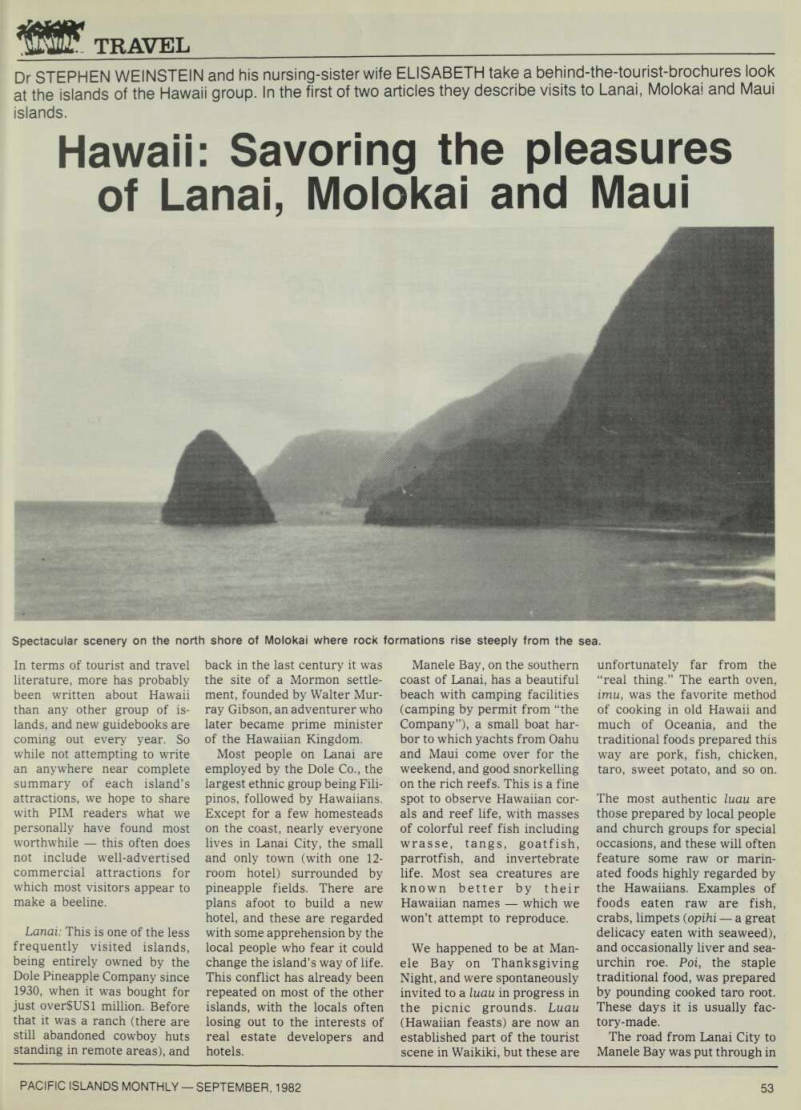
Dr STEPHEN WEINSTEIN and his nursing-sister wife ELISABETH take a behind-the-tourist-brochures look at the islands of the Hawaii group. In the first of two articles they describe visits to Lanai, Molokai and Maui islands.
Hawaii: Savoring the pleasures

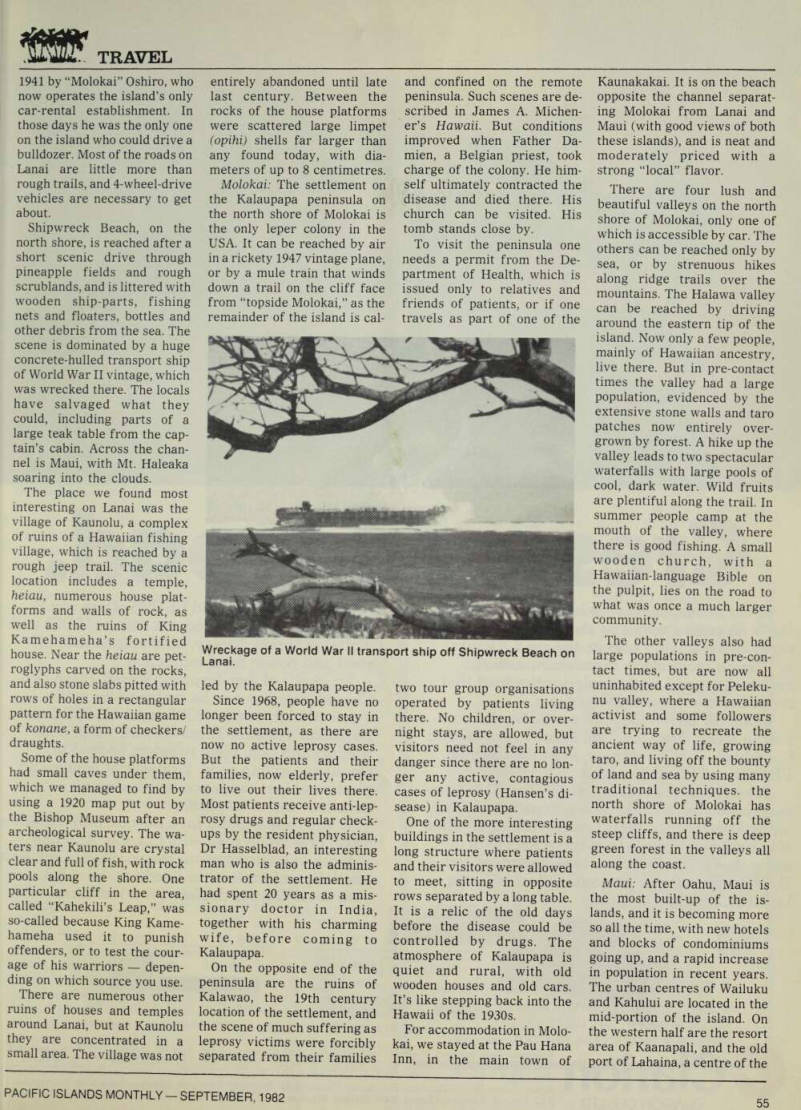
of Lanai, Molokai and Maui
In terms of tourist and travel literature, more has probably been written about Hawaii than any other group of is lands, and new guidebooks are coming out every year. So while not attempting to write an anywhere near complete summary of each island’s attractions, we hope to share with PIM readers what we personally have found most worthwhile this often does not include well-advertised commercial attractions for which most visitors appear to make a beeline.
Lanai: This is one of the less frequently visited islands, being entirely owned by the Dole Pineapple Company since 1930, when it was bought for just overSUSl million. Before that it was a ranch (there are still abandoned cowboy huts standing in remote areas), and
back in the last century it was the site of a Mormon settle ment, founded by Walter Mur ray Gibson, an adventurer who later became prime minister of the Hawaiian Kingdom.
Most people on Lanai are employed by the Dole Co., the largest ethnic group being Fili pinos, followed by Hawaiians.
Except for a few homesteads on the coast, nearly everyone lives in Lanai City, the small and only town (with one 12room hotel) surrounded by pineapple fields. There are plans afoot to build a new hotel, and these are regarded with some apprehension by the local people who fear it could change the island’s way of life.
This conflict has already been repeated on most of the other islands, with the locals often losing out to the interests of real estate developers and hotels.
Manele Bay, on the southern coast of Lanai, has a beautiful beach with camping facilities (camping by permit from “the Company”), a small boat har bor to which yachts from Oahu and Maui come over for the weekend, and good snorkelling on the rich reefs. This is a fine spot to observe Hawaiian cor als and reef life, with masses of colorful reef fish including wrasse, tangs, goatfish, parrotfish, and invertebrate life. Most sea creatures are known better by their Hawaiian names which we won’t attempt to reproduce.
We happened to be at Man ele Bay on Thanksgiving Night, and were spontaneously invited to a luau in progress in the picnic grounds. Luau (Hawaiian feasts) are now an established part of the tourist scene in Waikiki, but these are
unfortunately far from the “real thing.” The earth oven, imu, was the favorite method of cooking in old Hawaii and much of Oceania, and the traditional foods prepared this way are pork, fish, chicken, taro, sweet potato, and so on.
The most authentic luau are those prepared by local people and church groups for special occasions, and these will often feature some raw or marin ated foods highly regarded by the Hawaiians. Examples of foods eaten raw are fish, crabs, limpets (opihi a great delicacy eaten with seaweed), and occasionally liver and sea urchin roe. Poi, the staple traditional food, was prepared by pounding cooked taro root.
These days it is usually fac tory-made.
The road from Lanai City to Manele Bay was put through in
Spectacular scenery on the north shore of Molokai where rock formations rise steeply from the sea.
1941 by “Molokai” Oshiro, who now operates the island’s only car-rental establishment. In those days he was the only one on the island who could drive a bulldozer. Most of the roads on Lanai are little more than rough trails, and 4-wheel-drive vehicles are necessary to get about.
Shipwreck Beach, on the north shore, is reached after a short scenic drive through pineapple fields and rough scrublands, and is littered with wooden ship-parts, fishing nets and floaters, bottles and other debris from the sea. The scene is dominated by a huge concrete-hulled transport ship of World War II vintage, which was wrecked there. The locals have salvaged what they could, including parts of a large teak table from the cap tain’s cabin. Across the chan nel is Maui, with Mt. Haleaka soaring into the clouds.
The place we found most interesting on Lanai was the village of Kaunolu, a complex of ruins of a Hawaiian fishing village, which is reached by a rough jeep trail. The scenic location includes a temple, heiau, numerous house plat forms and walls of rock, as well as the ruins of King Kamehameha’s fortified house. Near the heiau are pet roglyphs carved on the rocks, and also stone slabs pitted with rows of holes in a rectangular pattern for the Hawaiian game of konane, a form of checkers/ draughts.
Some of the house platforms had small caves under them, which we managed to find by using a 1920 map put out by the Bishop Museum after an archeological survey. The wa ters near Kaunolu are crystal clear and full of fish, with rock pools along the shore. One particular cliff in the area, called “Kahekili’s Leap,” was so-called because King Kame hameha used it to punish offenders, or to test the cour age of his warriors depen ding on which source you use.
There are numerous other ruins of houses and temples around Lanai, but at Kaunolu they are concentrated in a small area. The village was not
entirely abandoned until late last century. Between the rocks of the house platforms were scattered large limpet (opihi) shells far larger than any found today, with dia meters of up to 8 centimetres.
Molokai: The settlement on the Kalaupapa peninsula on the north shore of Molokai is the only leper colony in the USA. It can be reached by air in a rickety 1947 vintage plane, or by a mule train that winds down a trail on the cliff face from “topside Molokai,” as the remainder of the island is cal-
led by the Kalaupapa people.
Since 1968, people have no longer been forced to stay in the settlement, as there are now no active leprosy cases.
But the patients and their families, now elderly, prefer to live out their lives there.
Most patients receive anti-lep rosy drugs and regular check ups by the resident physician, Dr Hasselblad, an interesting man who is also the adminis trator of the settlement. He had spent 20 years as a mis sionary doctor in India, together with his charming wife, before coming to Kalaupapa.
On the opposite end of the peninsula are the ruins of Kalawao, the 19th century location of the settlement, and the scene of much suffering as leprosy victims were forcibly separated from their families
and confined on the remote peninsula. Such scenes are de scribed in James A. Michen er’s Hawaii. But conditions improved when Father Da mien, a Belgian priest, took charge of the colony. He him self ultimately contracted the disease and died there. His church can be visited. His tomb stands close by.
To visit the peninsula one needs a permit from the De partment of Health, which is issued only to relatives and friends of patients, or if one travels as part of one of the
two tour group organisations operated by patients living there. No children, or over night stays, are allowed, but visitors need not feel in any danger since there are no lon ger any active, contagious cases of leprosy (Hansen’s di sease) in Kalaupapa.
One of the more interesting buildings in the settlement is a long structure where patients and their visitors were allowed to meet, sitting in opposite rows separated by a long table.
It is a relic of the old days before the disease could be controlled by drugs. The atmosphere of Kalaupapa is quiet and rural, with old wooden houses and old cars.
It’s like stepping back into the Hawaii of the 19305.
For accommodation in Molo kai, we stayed at the Pau Hana Inn, in the main town of
Kaunakakai. It is on the beach opposite the channel separat ing Molokai from Lanai and Maui (with good views of both these islands), and is neat and moderately priced with a strong “local” flavor.
There are four lush and beautiful valleys on the north shore of Molokai, only one of which is accessible by car. The others can be reached only by sea, or by strenuous hikes along ridge trails over the mountains. The Halawa valley can be reached by driving around the eastern tip of the island. Now only a few people, mainly of Hawaiian ancestry, live there. But in pre-contact times the valley had a large population, evidenced by the extensive stone walls and taro patches now entirely over grown by forest. A hike up the valley leads to two spectacular waterfalls with large pools of cool, dark water. Wild fruits are plentiful along the trail. In summer people camp at the mouth of the valley, where there is good fishing. A small wooden church, with a Hawaiian-language Bible on the pulpit, lies on the road to what was once a much larger community.
The other valleys also had large populations in pre-con tact times, but are now all uninhabited except for Peleku nu valley, where a Hawaiian activist and some followers are trying to recreate the ancient way of life, growing taro, and living off the bounty of land and sea by using many traditional techniques, the north shore of Molokai has waterfalls running off the steep cliffs, and there is deep green forest in the valleys all along the coast.
Maui: After Oahu, Maui is the most built-up of the is lands, and it is becoming more so all the time, with new hotels and blocks of condominiums going up, and a rapid increase in population in recent years.
The urban centres of Wailuku and Kahului are located in the mid-portion of the island. On the western half are the resort area of Kaanapali, and the old port of Lahaina, a centre of the
Wreckage of a World War II transport ship off Shipwreck Beach on Lanai.
19th century Pacific whaling industry.
Now heavily commercial ised, the waterfront is full of souvenir shops, like a minia ture Waikiki. Lahaina is also home port to a large fleet of yachts, and the yearly Lahaina-Hawaii Yacht Race was the reason we found ourselves in Maui on the weekend of our visit.
During the months of Janu ary to March whales can be seen in the channel on their way to Maalaea Bay where they have their young, and charter boats take tourists out for closer viewing. Near Olo walu are the little publicised petroglyphs, which have been much abused by more recent graffitists. Museums abound, displaying ancient Hawaiian artefacts.
In our view, the eastern part of Maui offers most of in terest. To reach it one follows the “Hana Highway,” a narrow two-lane road winding its way through small valleys, past waterfalls and pools, and final ly reaching Hana, a quiet little town inhabited mainly by peo ple of Hawaiian descent. Along the Hana Highway are the two villages of Keanae and Wailua, with their taro patches adding color to the dramatic coastal scenery.
Before reaching Hana prop er, one passes the Waianapana pa camp grounds and caves.
These caves were originally formed by lava tubes, and are now partially filled with clear, fresh rainwater. The cave mouths are reached by a short paved trail, and the water sup ports a unique population of tiny red shrimps.
Legend has it that a Hawaiian princess hid from her abusive husband in these caves, but was caught and killed, with the shrimps now serving as a reminder of her shed blood.
Past Hana the road gets poorer, with more hairpin bends, until one reaches the Seven Pools, marked on some maps as the “Seven Sacred Pools,” though there appears to be no evidence that the old Hawaiians regarded them as anything but secular, the
“Sacred” having presumably been added to promote tour ism in more recent times. In addition to the very pretty pools joined by small water falls, there is a trail leading to larger falls further upstream, with good swimming in the pools.
The nearby camp ground has some stone walls dating from pre-Captain Cook times, as well as a view of Mauna Kea’s peak on the Big Island across the channel. After liv ing in Honolulu we are always impressed by how bright and clear the stars are out in places like this where there are no electric lights to dim the view.
Near the Seven Pools area is Kipahulu church, now re stored after having fallen into disrepair in the 19605. In this remote little place is the grave of Charles Augustus Lind bergh, first solo trans-Atlantic aviator, who lived in eastern Maui for his last years. Here the paved road ends, and we were prevented from explor ing the ranches that lay farth er on by the car-rental con tract, which does not extend to travel on dirt roads.
Maui’s most famous attrac tion is perhaps Mt. Haleakala, the dormant (as opposed to extinct) volcano, where legend has it that the Polynesian demi-god Maui lassoed the sun and slowed its daily passage across the skies. The crater itself contains numerous smal ler cinder cones with their own craters, and, being above the tree-line, it is as barren as a lunar landscape. Several hik ing trails cross the crater, but
warm clothes are needed as it gets quite chilly. In fact during the winter months it snows up here, though not to the degree to make skiing possible.
There are beautiful silvers word ferns, and Nene geese.
But more impressive is the view taking in the rest of Maui, plus four of the other islands.
One of these is the uninha bited Kahoolawe, which is used as a target range by the navy. It was once a ranch, and
still has a number of wild goats, who could well be suffering from shell-shock by now. A couple of years ago the Kahoolawe Ghana , a Hawaiian land-rights activist group “occupied” the island by a sit-in, to draw attention to the historical value of some sites there. But today it remains uninhabited while agreements are being worked out.
Next month: Kahoolawe, Kauai, Hawaii, Oahu.
Rock carving near Kaunolo village, a remote fishing settlement on Lanai.
Hawaiian geese at Mount Haleakala on Maui Island approach visitors’ cars to be fed.
Advertisements & other items, pp. 54-57 (1 item)
Courier Services
a PI m r Alls r
SERVICES
PACIFIC
COURIER
Now oar smiles go door-to-door.
One phone call gets Air Pacific Courier Cargo going. A jet express courier service that A||)Pfr* / picks up and delivers nliTlFir throughout Fiji, throughout Air Pacific’s
YOUR ISLAND IN THE SKY
growing Pacific route network, or linking up with international airline networks around the world.
It all starts with one phone call. And it finishes with Air Pacific’s smile of success, because we’ll get it there fast, door-to-door.
AIR PACIFIC
COURIER SERVICES
■ ■an * The smile of success.
Nadi Phone 72694 done Tavuto or Anne McComber Suva 382-444 Alfred or Narend (or Sales Rep: Jenny Wallace)
Crescendo rood.
In-car acoustics may be less than ideal. But that's no reason why you shouldn't be able to snjoy home-quality hi-fi on the road. Thanks to Clarion technology there's now a stereo system designed exclusively for the road that rivals the one in your living room.
Imagine! 20 W + 20W of car-filling stereo to soothe away those long lonesome hours behind the wheel. That's precisely what the Clarion PE-868 and PE-875 deliver.
Take the new silver-faced PE-868. This autoreverse model is metal-tape compatible. It will automatically play your favorite tape side after side until you choose to eject it. And with separate volume/balance, tone, loudness and Dolby* NR controls, personal sound tailoring facilities are right at hand. r b) o Ola rton r a C=3 C 3 The champagne-gold PE-875 offers you 8selection automatic program control (APC) with digital program display, auto engine shut-off eject and power level indication.
For watts of awe-inspiring sound, these two Clarion beauties can be matched up with a pair of high-power (SOW max.) GS-528 2-way, 2-speaker systems. These feature 12cm cone woofers and scm cone tweeters housed in
resonance-killing solid, lightweight compound
plastic cabinets with acoustic lenses for excellent sound dispersion.
If you're searching for a new driving experien travel crescendo road with Clarion. Any one of these exciting cassette stereo players will kee] you fully entertained in fine hi-fi style. Ask your local Clarion dealers for a test drive. i j QHo Dolby and the double-D symbol are trademarks of Dolby Laboratories Licensing Corporation.
srsE i».—
adicm i Tn d n\ aq Mow (Guinea: Haaemever (P.N.G.) Pty. t + r D Cl IAOR Rr,rnlm Port Morest
Rugged Reliable Economical
DIESEL ENGINES
GENERATING SETS
from 3KW (4HP) to 300 KW (400 HP) Heat-exchanger Cooled Radiator Cooled Air Cooled / Division of MacQuarrie Industries Pty. Ltd.
P.O. Box 20, COBURG. Victoria 3058.
Phone: (03) 350 3411 Telex; AA33729.
Trade Winds
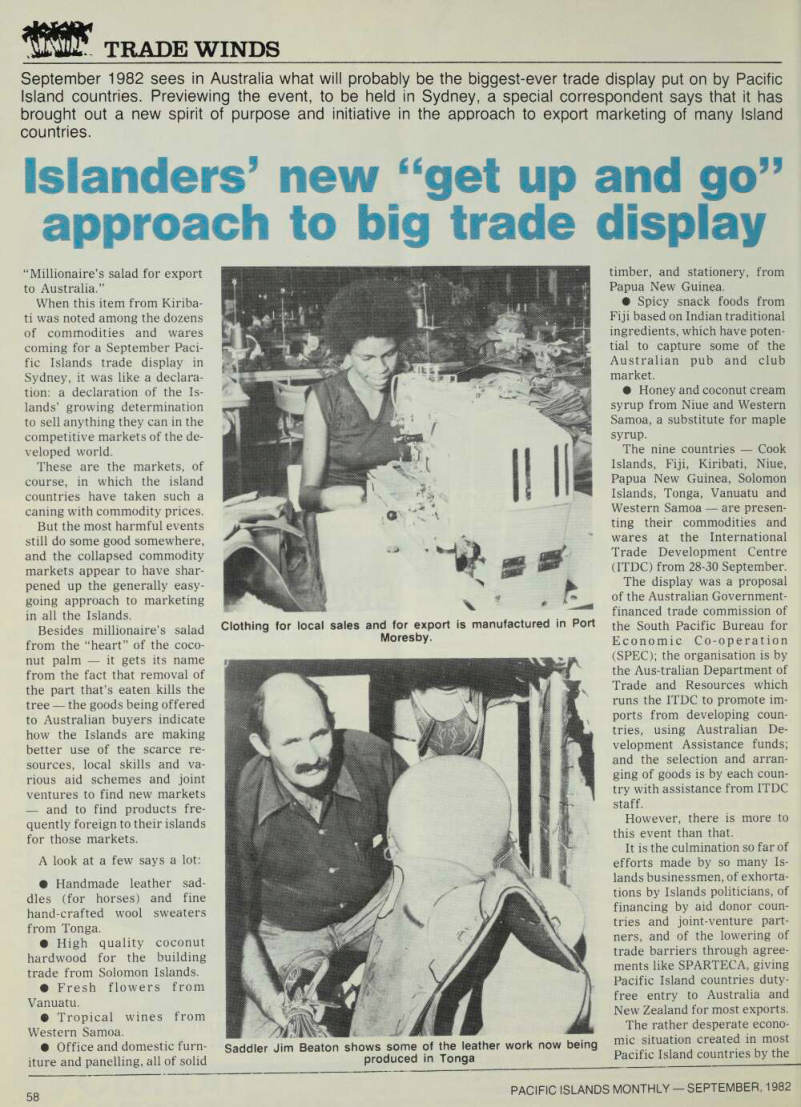
September 1982 sees in Australia what will probably be the biggest-ever trade display put on by Pacific Island countries. Previewing the event, to be held in Sydney, a special correspondent says that it has brought out a new spirit of purpose and initiative in the approach to export marketing of many Island countries.
approach to big trade display
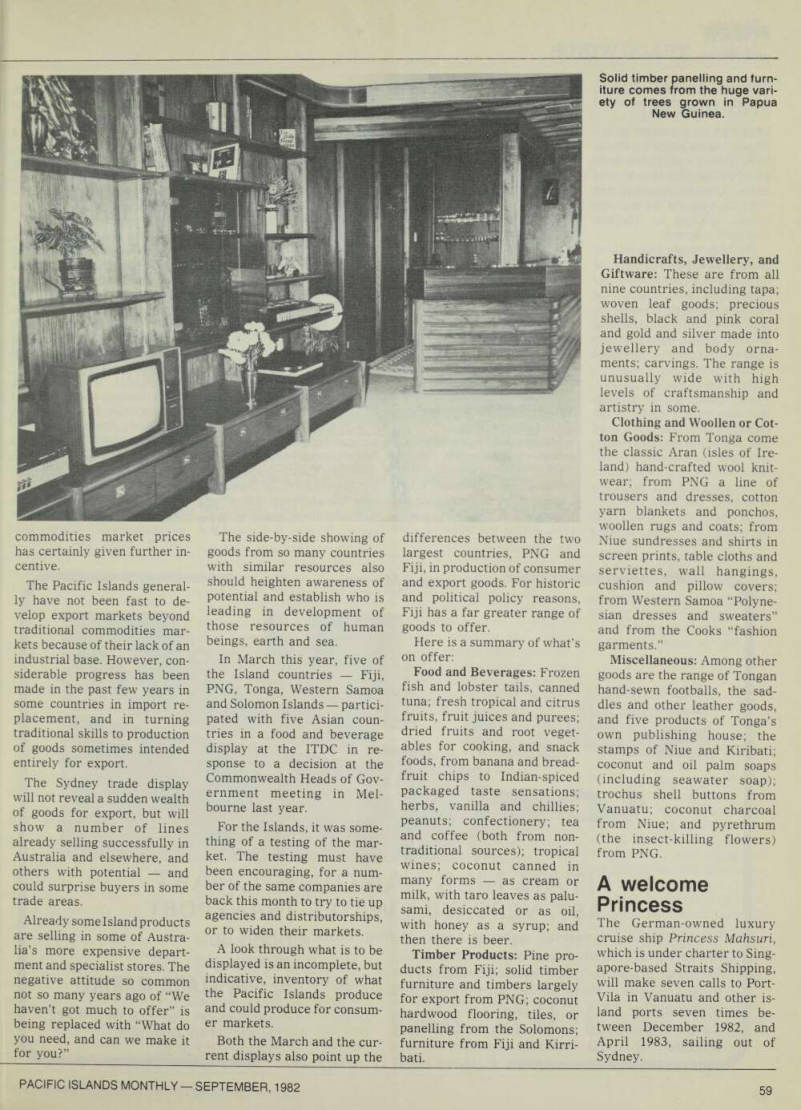
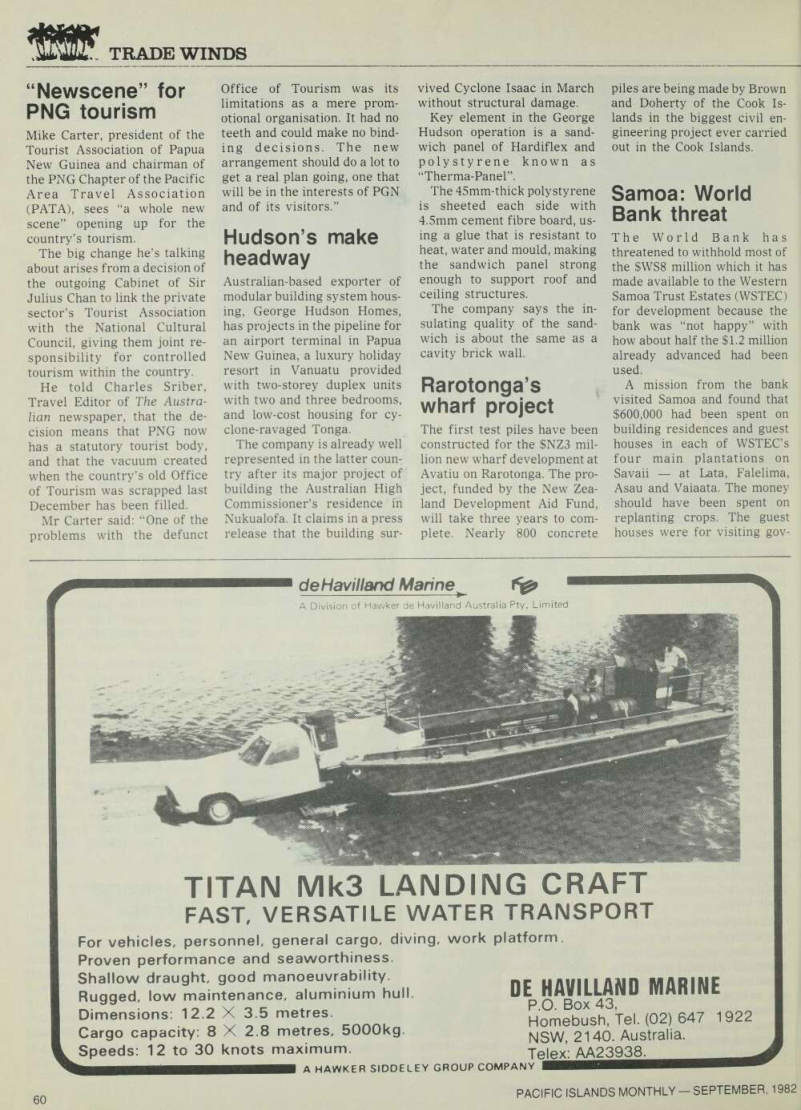
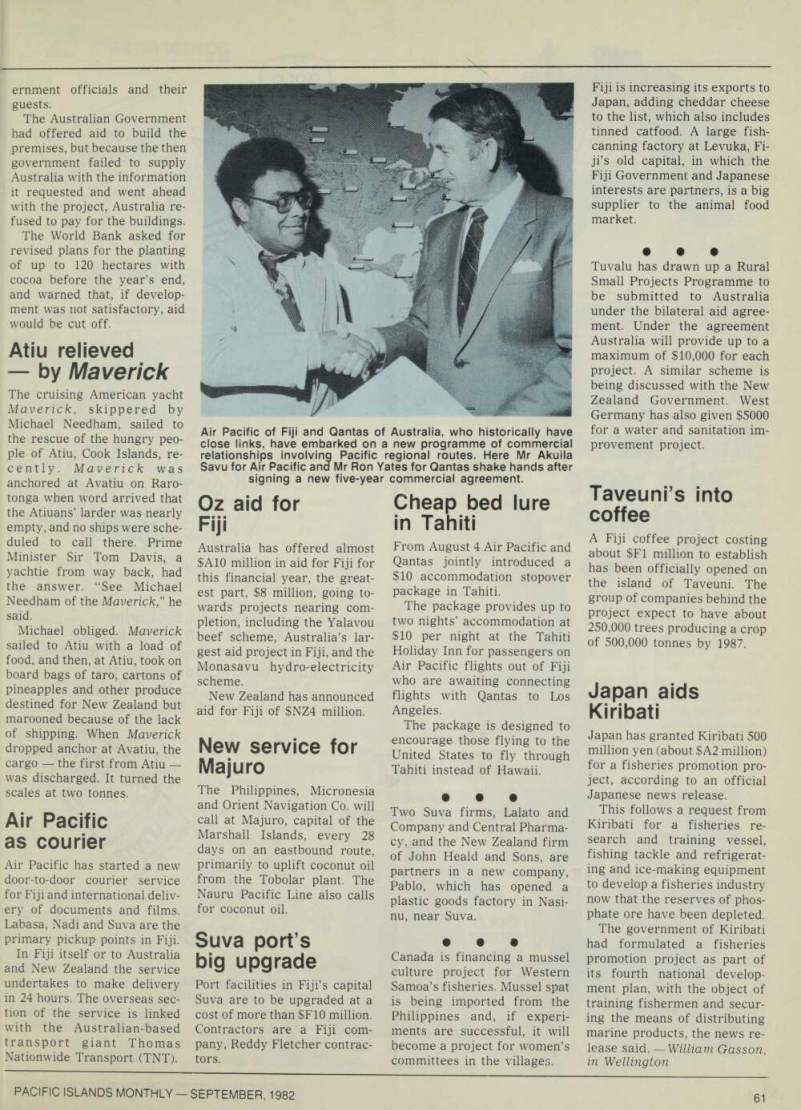
Islanders’ new “get up and go” approach to big trade display
“Millionaire’s salad for export to Australia.”
When this item from Kiriba ti was noted among the dozens of commodities and wares coming for a September Paci fic Islands trade display in Sydney, it was like a declara tion: a declaration of the Is lands’ growing determination to sell anything they can in the competitive markets of the de veloped world.
These are the markets, of course, in which the island countries have taken such a caning with commodity prices.
But the most harmful events still do some good somewhere, and the collapsed commodity markets appear to have shar pened up the generally easy going approach to marketing in all the Islands.
Besides millionaire’s salad from the “heart” of the coco nut palm it gets its name from the fact that removal of the part that’s eaten kills the tree the goods being offered to Australian buyers indicate how the Islands are making better use of the scarce re sources, local skills and va rious aid schemes and joint ventures to find new markets and to find products fre quently foreign to their islands for those markets.
A look at a few says a lot: • Handmade leather sad dles (for horses) and fine hand-crafted wool sweaters from Tonga. • High quality coconut hardwood for the building trade from Solomon Islands. • Fresh flowers from Vanuatu. • Tropical wines from Western Samoa. • Office and domestic furn iture and panelling, all of solid
timber, and stationery, from Papua New Guinea. • Spicy snack foods from Fiji based on Indian traditional ingredients, which have poten tial to capture some of the Australian pub and club market. • Honey and coconut cream syrup from Niue and Western Samoa, a substitute for maple syrup.
The nine countries Cook Islands, Fiji, Kiribati, Niue, Papua New Guinea, Solomon Islands, Tonga, Vanuatu and Western Samoa are presen ting their commodities and wares at the International Trade Development Centre (ITDC) from 28-30 September.
The display was a proposal of the Australian Government financed trade commission of the South Pacific Bureau for Economic Co-operation (SPEC); the organisation is by the Aus-tralian Department of Trade and Resources which runs the ITDC to promote im ports from developing coun tries, using Australian De velopment Assistance funds; and the selection and arran ging of goods is by each coun try with assistance from ITDC staff.
However, there is more to this event than that.
It is the culmination so far of efforts made by so many Is lands businessmen, of exhorta tions by Islands politicians, of financing by aid donor coun tries and joint-venture part ners, and of the lowering of trade barriers through agree ments like SPARTECA, giving Pacific Island countries duty free entry to Australia and New Zealand for most exports.
The rather desperate econo mic situation created in most Pacific Island countries by the
Clothing for local sales and for export is manufactured in Port Moresby.
Saddler Jim Beaton shows some of the leather work now being produced in Tonga
commodities market prices has certainly given further in centive.
The Pacific Islands general ly have not been fast to de velop export markets beyond traditional commodities mar kets because of their lack of an industrial base. However, con siderable progress has been made in the past few years in some countries in import re placement, and in turning traditional skills to production of goods sometimes intended entirely for export.
The Sydney trade display will not reveal a sudden wealth of goods for export, but will show a number of lines already selling successfully in Australia and elsewhere, and others with potential and could surprise buyers in some trade areas.
Already some Island products are selling in some of Austra lia’s more expensive depart ment and specialist stores. The negative attitude so common not so many years ago of “We haven’t got much to offer” is being replaced with “What do you need, and can we make it for you?”
The side-by-side showing of goods from so many countries with similar resources also should heighten awareness of potential and establish who is leading in development of those resources of human beings, earth and sea.
In March this year, five of the Island countries Fiji, PNG, Tonga, Western Samoa and Solomon Islands partici pated with five Asian coun tries in a food and beverage display at the ITDC in re sponse to a decision at the Commonwealth Heads of Gov ernment meeting in Mel bourne last year.
For the Islands, it was some thing of a testing of the mar ket. The testing must have been encouraging, for a num ber of the same companies are back this month to try to tie up agencies and distributorships, or to widen their markets.
A look through what is to be displayed is an incomplete, but indicative, inventory of what the Pacific Islands produce and could produce for consum er markets.
Both the March and the cur rent displays also point up the
differences between the two largest countries, PNG and Fiji, in production of consumer and export goods. For historic and political policy reasons, Fiji has a far greater range of goods to offer.
Here is a summary of what’s on offer: Food and Beverages: Frozen fish and lobster tails, canned tuna; fresh tropical and citrus fruits, fruit juices and purees; dried fruits and root veget ables for cooking, and snack foods, from banana and bread fruit chips to Indian-spiced packaged taste sensations; herbs, vanilla and chillies; peanuts; confectionery; tea and coffee (both from non traditional sources); tropical wines; coconut canned in many forms as cream or milk, with taro leaves as palu sami, desiccated or as oil, with honey as a syrup; and then there is beer.
Timber Products: Pine pro ducts from Fiji; solid timber furniture and timbers largely for export from PNG; coconut hardwood flooring, tiles, or panelling from the Solomons; furniture from Fiji and Kirri bati.
Handicrafts, Jewellery, and Giftware: These are from all nine countries, including tapa; woven leaf goods; precious shells, black and pink coral and gold and silver made into jewellery and body orna ments; carvings. The range is unusually wide with high levels of craftsmanship and artistry in some.
Clothing and Woollen or Cot ton Goods: From Tonga come the classic Aran (isles of Ire land) hand-crafted wool knit wear; from PNG a line of trousers and dresses, cotton yarn blankets and ponchos, woollen rugs and coats; from Niue sundresses and shirts in screen prints, table cloths and serviettes, wall hangings, cushion and pillow covers; from Western Samoa “Polyne sian dresses and sweaters” and from the Cooks “fashion garments.”
Miscellaneous: Among other goods are the range of Tongan hand-sewn footballs, the sad dles and other leather goods, and five products of Tonga’s own publishing house; the stamps of Niue and Kiribati; coconut and oil palm soaps (including seawater soap); trochus shell buttons from Vanuatu; coconut charcoal from Niue; and pyrethrum (the insect-killing flowers) from PNG.
A welcome
Princess
The German-owned luxury cruise ship Princess Mahsuri, which is under charter to Sing apore-based Straits Shipping, will make seven calls to Port- Vila in Vanuatu and other is land ports seven times be tween December 1982, and April 1983, sailing out of Sydney.
Solid timber panelling and furn iture comes from the huge vari ety of trees grown in Papua New Guinea.
“Newscene” for
PNG tourism
Mike Carter, president of the Tourist Association of Papua New Guinea and chairman of the PNG Chapter of the Pacific Area Travel Association (PATA), sees “a whole new scene” opening up for the country’s tourism.
The big change he’s talking about arises from a decision of the outgoing Cabinet of Sir Julius Chan to link the private sector’s Tourist Association with the National Cultural Council, giving them joint re sponsibility for controlled tourism within the country.
He told Charles Sriber, Travel Editor of The Austra lian newspaper, that the de cision means that PNG now has a statutory tourist body, and that the vacuum created when the country’s old Office of Tourism was scrapped last December has been filled.
Mr Carter said: “One of the problems with the defunct
Office of Tourism was its limitations as a mere prom otional organisation. It had no teeth and could make no bind ing decisions. The new arrangement should do a lot to get a real plan going, one that will be in the interests of PGN and of its visitors.”
Hudson’s make
headway
Australian-based exporter of modular building system hous ing, George Hudson Homes, has projects in the pipeline for an airport terminal in Papua New Guinea, a luxury holiday resort in Vanuatu provided with two-storey duplex units with two and three bedrooms, and low-cost housing for cy clone-ravaged Tonga.
The company is already well represented in the latter coun try after its major project of building the Australian High Commissioner’s residence in Nukualofa. It claims in a press release that the building sur
vived Cyclone Isaac in March without structural damage.
Key element in the George Hudson operation is a sand wich panel of Hardiflex and polystyrene known as “Therma-Panel”.
The 45mm-thick polystyrene is sheeted each side with 4.5 mm cement fibre board, us ing a glue that is resistant to heat, water and mould, making the sandwich panel strong enough to support roof and ceiling structures.
The company says the in sulating quality of the sand wich is about the same as a cavity brick wall.
Rarotonga’s
wharf project
The first test piles have been constructed for the SNZ3 mil lion new wharf development at Avatiu on Rarotonga. The pro ject, funded by the New Zea land Development Aid Fund, will take three years to com plete. Nearly 800 concrete
piles are being made by Brown and Doherty of the Cook Is lands in the biggest civil en gineering project ever carried out in the Cook Islands.
Samoa: World
Bank threat
The World Bank has threatened to withhold most of the SWSB million which it has made available to the Western Samoa Trust Estates (WSTEC) for development because the bank was “not happy” with how about half the $1.2 million already advanced had been used.
A mission from the bank visited Samoa and found that $600,000 had been spent on building residences and guest houses in each of WSTEC’s four main plantations on Savaii at Lata, Falelima, Asau and Vaiaata. The money should have been spent on replanting crops. The guest houses were for visiting gov
ernment officials and their guests.
The Australian Government had offered aid to build the premises, but because the then government failed to supply Australia with the information it requested and went ahead with the project, Australia re fused to pay for the buildings.
The World Bank asked for revised plans for the planting of up to 120 hectares with cocoa before the year’s end, and warned that, if develop ment was not satisfactory, aid would be cut off.
Atiu relieved
by Maverick
The cruising American yacht Maverick, skippered by Michael Needham, sailed to the rescue of the hungry peo ple of Atiu, Cook Islands, re cently. Maverick was anchored at Avatiu on Raro tonga when word arrived that the Atiuans’ larder was nearly empty, and no ships were sche duled to call there. Prime Minister Sir Tom Davis, a yachtie from way back, had the answer. “See Michael Needham of the Maverick,” he said.
Michael obliged. Maverick sailed to Atiu with a load of food, and then, at Atiu, took on board bags of taro, cartons of pineapples and other produce destined for New Zealand but marooned because of the lack of shipping. When Maverick dropped anchor at Avatiu, the cargo the first from Atiu was discharged. It turned the scales at two tonnes.
Air Pacific
as courier
Air Pacific has started a new door-to-door courier service for Fiji and international deliv ery of documents and films.
Labasa, Nadi and Suva are the primary pickup points in Fiji.
In Fiji itself or to Australia and New Zealand the service undertakes to make delivery in 24 hours. The overseas sec tion of the service is linked with the Australian-based transport giant Thomas Nationwide Transport (TNT).
Oz aid for
Fiji
Australia has offered almost SAIO million in aid for Fiji for this financial year, the great est part, $8 million, going to wards projects nearing com pletion, including the Yalavou beef scheme, Australia’s lar gest aid project in Fiji, and the Monasavu hydro-electricity scheme.
New Zealand has announced aid for Fiji of SNZ4 million.
New service for
Majuro
The Philippines, Micronesia and Orient Navigation Co. will call at Majuro, capital of the Marshall Islands, every 28 days on an eastbound route, primarily to uplift coconut oil from the Tobolar plant. The Nauru Pacific Line also calls for coconut oil.
Suva port’s
big upgrade
Port facilities in Fiji’s capital Suva are to be upgraded at a cost of more than SFIO million.
Contractors are a Fiji com pany, Reddy Fletcher contrac tors.
Cheap bed lure
in Tahiti
From August 4 Air Pacific and Qantas jointly introduced a $lO accommodation stopover package in Tahiti.
The package provides up to two nights’ accommodation at $lO per night at the Tahiti Holiday Inn for passengers on Air Pacific flights out of Fiji who are awaiting connecting flights with Qantas to Los Angeles.
The package is designed to encourage those flying to the United States to fly through Tahiti instead of Hawaii. • • • Two Suva firms, Lalato and Company and Central Pharma cy, and the New Zealand firm of John Heald and Sons, are partners in a new company, Pablo, which has opened a plastic goods factory in Nasi nu, near Suva. • • • Canada is financing a mussel culture project for Western Samoa’s fisheries. Mussel spat is being imported from the Philippines and, if experi ments are successful, it will become a project for women’s committees in the villages.
Fiji is increasing its exports to Japan, adding Cheddar cheese to the list, which also includes tinned catfood. A large fish canning factory at Levuka, Fi ji’s old capital, in which the Fiji Government and Japanese interests are partners, is a big supplier to the animal food market. • • • Tuvalu has drawn up a Rural Small Projects Programme to be submitted to Australia under the bilateral aid agree ment. Under the agreement Australia will provide up to a maximum of $lO,OOO for each project. A similar scheme is being discussed with the New Zealand Government. West Germany has also given $5OOO for a water and sanitation im provement project.
Taveuni’s into
coffee
A Fiji coffee project costing about SFI million to establish has been officially opened on the island of Taveuni. The group of companies behind the project expect to have about 250,000 trees producing a crop of 500,000 tonnes by 1987.
Japan aids
Kiribati
Japan has granted Kiribati 500 million yen (about SA2 million) for a fisheries promotion pro ject, according to an official Japanese news release.
This follows a request from Kiribati for a fisheries re search and training vessel, fishing tackle and refrigerat ing and ice-making equipment to develop a fisheries industry now that the reserves of phos phate ore have been depleted.
The government of Kiribati had formulated a fisheries promotion project as part of its fourth national develop ment plan, with the object of training fishermen and secur ing the means of distributing marine products, the news re
lease said.
Williarn Gasson,
in Wellington
Air Pacific of Fiji and Qantas of Australia, who historically have close links, have embarked on a new programme of commercial relationships involving Pacific regional routes. Here Mr Akuila Savu for Air Pacific ana Mr Ron Yates for Qantas shake hands after signing a new five-year commercial agreement.
Cattle, water
aid to Vanuatu
An agreement signed in Port- Vila in June provides for Au stralian aid to the tune of $A500,000 in improving Vanuatu’s main cattle-breed ing station, and its rural water supplies. Signing for Vanuatu was Minister for Lands Sethy Regevanu, and for Australia that country’s High Commis sioner to Vanuatu, Michael Ovington. • • • Sten Munch-Petersen, a fisher ies scientist from the Danish Institute of Fisheries and Marine Research, is engaged on a two-year study of tuna resources in Fiji waters. The European Economic Commun ity is sponsoring the project.
Mr Munch-Petersen is at the University of the South Pacific in Suva.
AESOP off
the ground
The New Australian Executive Service Overseas Program (AESOP), which will provide volunteer Australian execu tives, managers and techni cians for developing countries, has reported a “most enthu siastic response” from the ASEAN region, Papua New
Guinea and the South Pacific.
In the three months since the scheme became operation al, 67 requests for aid under the scheme have come from Malaysia (5), Niue (1), the Phil ippines (38), Papua New Guinea (18), Solomon Islands (2), Thailand (1), Tonga (1), and Turkey (1).
They covered a wide range of enterprises including furni ture-making, engineering, business administration, advertising and agriculture.
Of the 67 applicants, two have been rejected as falling outside AESOP guidelines, two have been accepted and volun teers allocated, and further details are being sought to allow formal consideration of the remaining 63 expressions of interest.
The executive director of AESOP, Rod Cheatley, said many Australians of high calibre already had offered their experience and exper tise. He said a register of skills was being developed so that AESOP’s foreign represent atives could be advised of the services available. • • • The Vanuatu Commodities Marketing Board reports im proved production and quality of copra since the board was established in April. The docks at Port-Vila and Santo had received 4136 tonnes in June.
Future of
Fentress
The U.S. Trust Territory Gov ernment has given the Mar shall Islands the freighter Fen tress, a well-known cargo car rier in Micronesia, and the republic’s government has formed a company, Marshall Islands Maritime Company Inc. to run the ship. The gov ernment is the sole stockhold er. It is planned to put the ship into service between Hono lulu, Tahiti, the Samoas and the Marshalls. The govern ment will eventually be ac quired by private interests. • • • Qantas, Australia’s flag car rier, has exercised its right to a share of the air traffic be tween Sydney and Port-Vila.
One of the two flights by Air Vanuatu (Ansett Airlines and Vanuatu Government) be tween Sydney and the Vanuatu capital each week becomes a Qantas flight with a Qantas flight number. • • • German shipping consultant Captain Jorg Wagener, 42, has arrived in Apia to take over as new general manager of Samoa Shipping Services, succeeding Captain Rasmus Sieg, who has returned to Hamburg. Captain Wagener, who is on a two-year assign ment, comes to Western
Samoa from the Philippines where he was employed by the United Nations to design a container terminal. He has worked as a shipping consul tant in various countries in cluding Kiribati. • • • The prospects of profitable fishing for deep-water shrimps in Papua New Guinea waters are being investigated by Michael King, a marine biologist from the University of the South Pacific. • • • Fiji’s Ministry of Health and the World Health Organisation have signed an agreement for a $F155,000 health programme concentrated on mothers, chil dren, and family planning.
Utrik to go
solar
The council on Utrik Atoll in the Marshall Islands plans to spend SU.S. 100,000 it has re ceived from the United States as radiation compensation on the installation of a solar powered electricity generat ing system. The U.S. National Aeronautics and Space Administration has agreed to share with the council the cost of installing a 16 kW system which will provide power for lighting, refrigeration and some community washing machines.
Air Niugini’s new Canadian manufactured Dash-7 aircraft have been going through political as well as technical considerations at they take over many internal routes in Papua New Guinea. The newly-returned Prime Minister Michael Somare at first threatened to sell them on the grounds that they had been bought for political grandstanding by tne previous government. But the deal was too big to reverse and no immediate change is likely. One of the new aircraft is shown here at Rabaul Airport. - Stuart Inder picture.
Advertisements & other items, pp. 60-63 (2 items)
Titan Mk 3 Landing Craft
deHavilland Marine t A Division of Hawker de Havilland Australia Pty. Limited 'U
FAST, VERSATILE WATER TRANSPORT
For vehicles, personnel, general cargo, diving, work platform.
Proven performance and seaworthiness.
Shallow draught, good manoeuvrability. UAUMIAMII MARINF Rugged, low maintenance, aluminium hull. Dt HAVILLANu IYIAnINt Dimensions: 12.2 X 3.5 metres.
Cargo capacity: 8 X 2.8 metres, 5000 kg.
Speeds: 12 to 30 knots maximum.
P.O. Box 43, Homebush, Tel. (02) 647 NSW, 2140. Australia.
Telex: AA23938.
A HAWKER SIDDELEY GROUP COMPANY
1922
/o\
QUALITY AUSTRALIAN
Hie great
thirst quencher
with more
real fruit
flavour.
FIIMVTI
litre
ASSTD. FLAVOURS
GOLD
m
CREST
GOLD
CREST
?o to m * et* 3^ xce Summertime is cool drink weather and Fulfrute Fruit Juice Cordial really quenches the thirst.
Fulfrute is economical in the 2 litre Flagon, so Mums love it as much as the kids. % 3*
R. M. GOW & CO. LTD.
30 Gow Street, Moorooka Queensland, 4105. Australia.
P.0.80x 111, Cables: Fidelity Moorooka Telex: GOWCO AA42839 Queensland, 4105 Australia
63
’ACIFIC ISLANDS MONTHLY —SEPTEMBER, 1982
TRADE WINDS
Big new satellite scheme
aims to conquer isolation
A Washington-based consul ting team is working on a proposal to link remote Pacific Island areas with their coun tries’ capitals, and with each other, by satellite.
According to a report in The New Zealand Herald, the pro ject would require a network of up to 6000 small land sta tions.
Final recommendations should be drawn up by the end of September and will be put to the South Pacific Bureau for Economic Co operation, the secretariat of the South Pacific Forum, probably in July next year.
The estimated cost is about $129 million if a special satel lite is put up, plus an average of $25,800 for each land sta tion, together with the cost of augmenting existing facilities
and training technicians.
The Washington team, headed by Jane N. Hurd, is drawn from the Public Service Satellite Consortium and funded by the National Aeronautics and Space Admi nistration.
A similar study, concentrat ing on specific country-by country costs, has been under taken for the South Pacific Bureau for Economic Co operation by V. K. Sargeant, an Australian, and a New Zealan der, Warwick Thorley. They are likely to recommend a combination of terrestrial and satellite systems.
The Washington team sug gests that Pacific Island na tions may be able to put up 10 per cent of the initial cost, with countries such as New Zea
land, Australia, the United States, Japan and France sup plying 50 per cent to 60 per cent in low-interest, long-term loans.
The remainder would come from foreign commercial banks, bilateral donors, mul tilateral development banks, the United Nations Develop ment Program, foundations, private investors and perhaps the World Bank.
Impetus for the study came from the first South Pacific Forum meeting in Wellington in 1971, when Ministers dis cussed the inadequacy of tele communications in the region.
Jane Hurd says internaional links have been established since then, but in most cases links with rural areas and out lying islands within given countries remain rudimentary or non-existent.
The team has visited many of the Pacific nations in cluding a number of outlying areas to see the problems on the ground and ask users what their needs are.
In an article on her experi ences, Jane Hurd noted the following comments from Islanders in outlying areas: “Anything a week late is still news to us.
“We use broadcast radio.
You only hope the message gets through to the person you are aiming at.
“Communications here is a boat woth an outboard motor.”
The PSSC team sees the project as definitely a regional one, with four options for man aging it: One Pacific country acting as administrator and manager, a corporation to be established by the Pacific Is land countries, a new consor tium with membership repre senting all user countries, or an existing entity, such as the South Pacific Bureau for Eco nomic Co-operation.
It says about one-third of the satellite installtions would probably make a pro
fit, one-third would break even and one-third would lose money.
This, it says, would perhaps argue for some regional shar ing of revenues if one country made a significant profit on all its facilities while a smaller neighbor made a profit on fewer than half its installa tions.
The team sees the basic need as improved telephone ser vices, followed by telex and telegraphy, with television in most cases a distant option.
Among examples of the need for better communications, the team says lack of com munication means people in remote areas come to accept death as the inevitable con sequence of major illness or injury, even though they know people in towns have ready access to doctors and hospi tals.
In Micronesia, it says, in adequate radio communication led to the death of one man and permanent blindness of seve ral others who had drunk wood alcohol. They might have been saved if medical advice had been available by voice or data link.
In a recent letter to PIM, Ms Hurd said she hoped to have the final report ready before the SPECTEL, the meeting of South Pacific telecommunica tions authorities, due to be held in Vanuatu this year.
FSM’s 15-year
plan
In his third annual state of the nation message, Federated States of Micronesia President Tosiwo Nakayama has urged the FSM Congress to increase tax rates to finance develop ment projects. Presenting the Congress with a 15-year de velopment plan, President Nakayama said there was a need to reconstruct the eco nomy to focus activities on primary industries which would support human develop ment.
Advertisements & other items, p. 64 (1 item)
Fire Quencher
NEW LIGHTWEIGHT FIRE FIGHTING PUMP
PACIFIC “S” SERIES
St M High
performance,
weighs 39.8 lb with 5 h.p. Briggs & Stratton engine.
Available in a standard 2" configuration and features a number of refinements and added extras.
Used for pumping some fire retardant chemicals, fertilizers, etc. without causing corrosion.
Flows of up to 140 gallons per minute.
Pacific Pump Company 2 South Street, Rydalmere, N.S.W. 2116 Telephone: (02) 638 5600 Telex: AA24319 Also available THE PACIFIC MULTI PUMP — The new all-purpose hand pump
Yachts
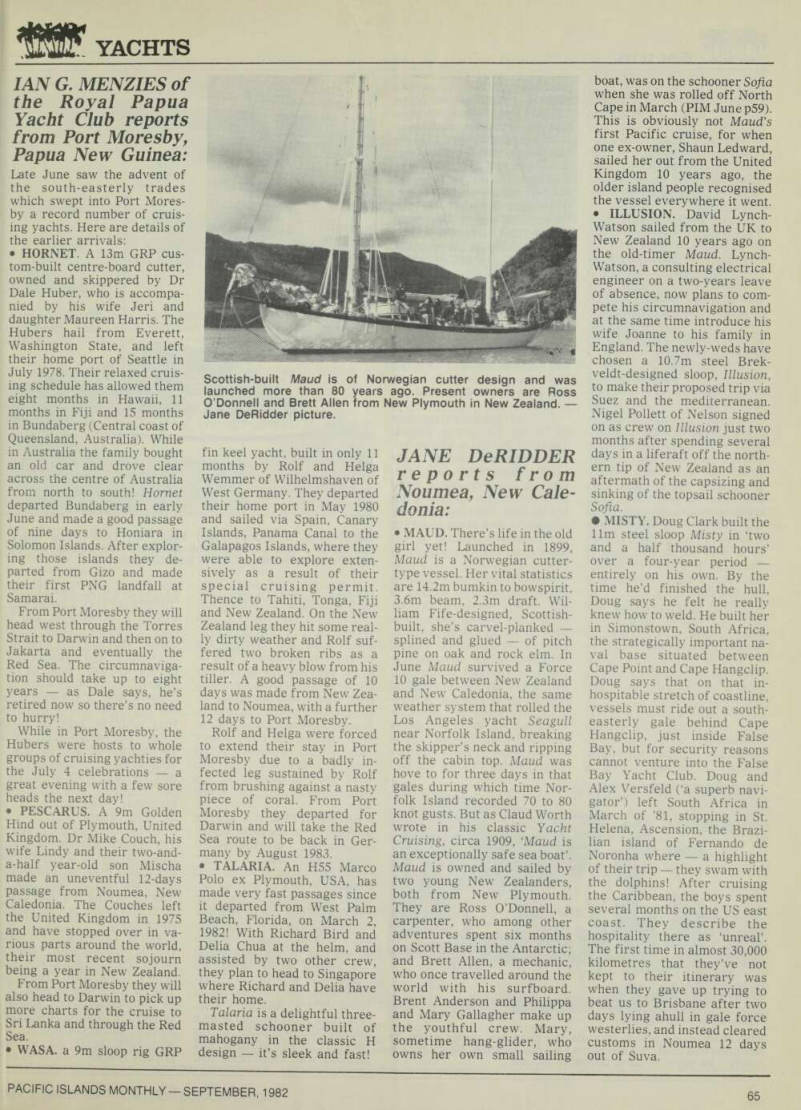
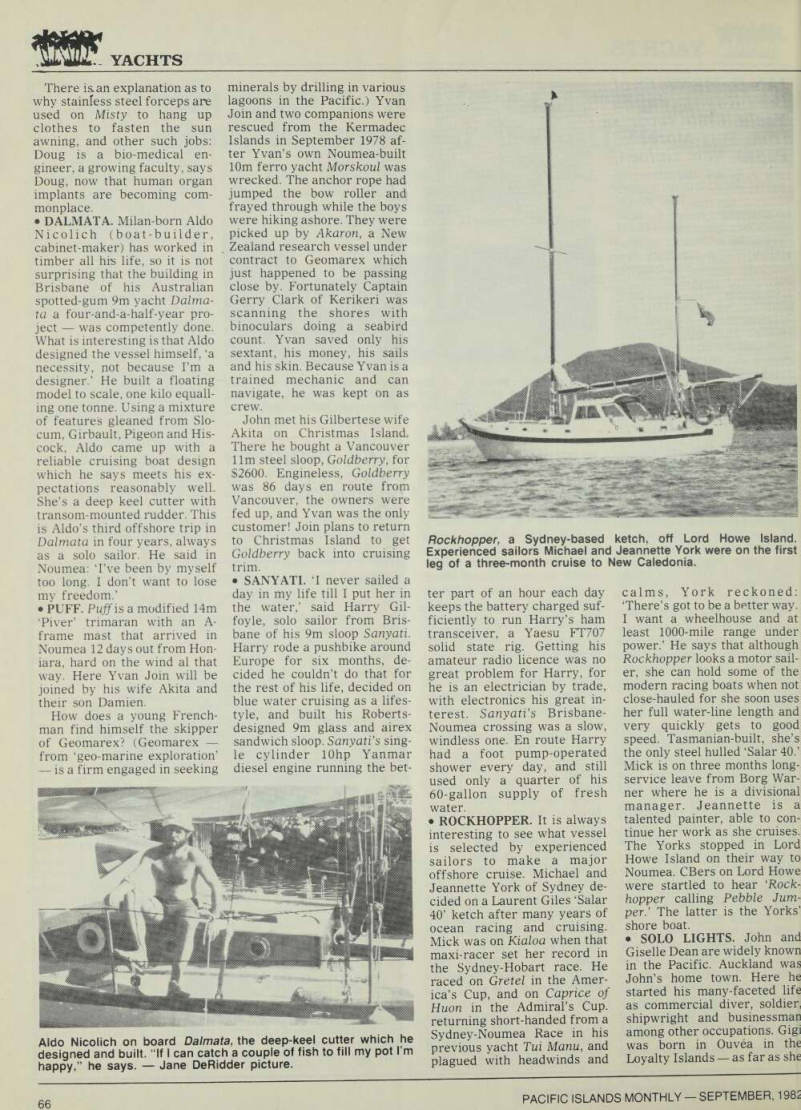
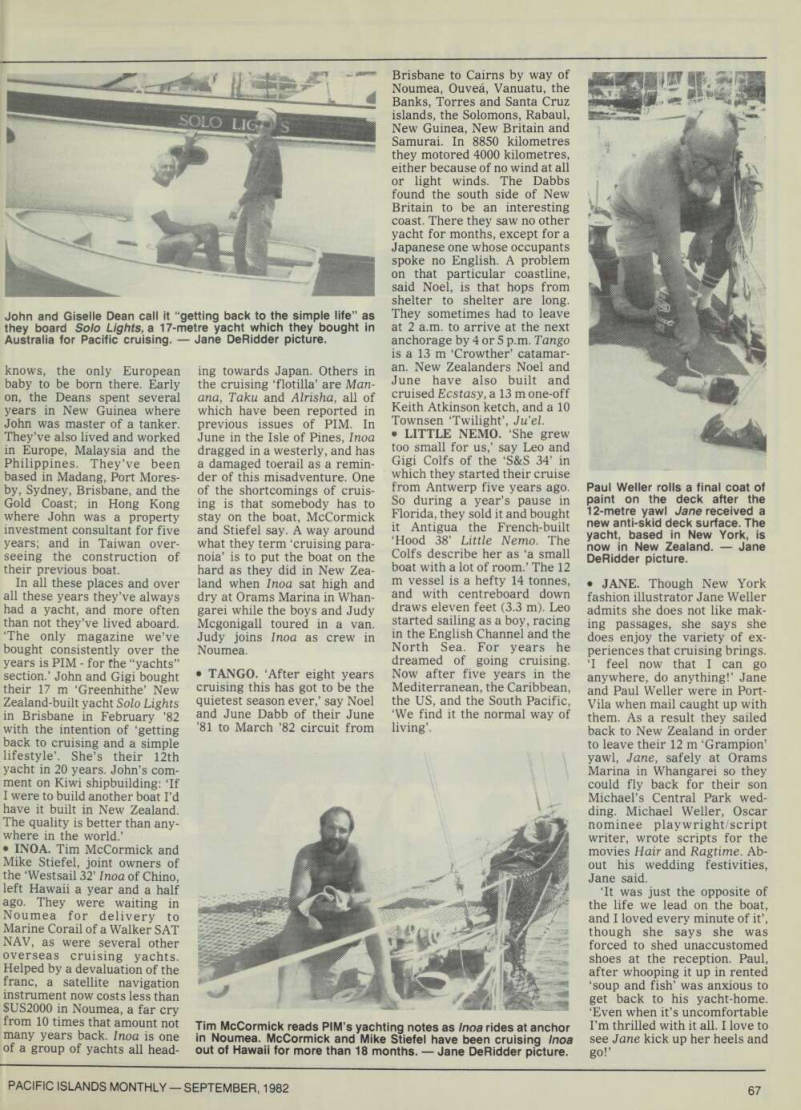
Lan G. Menzies Of
the Royal Papua
Yacht Club reports
from Port Moresby,
Papua New Guinea:
Late June saw the advent of the south-easterly trades which swept into Port Mores by a record number of cruis ing yachts. Here are details of the earlier arrivals:
• Hornet. A 13M Grp Cus
tom-built centre-board cutter, owned and skippered by Dr Dale Huber, who is accompa nied by his wife Jeri and daughter Maureen Harris. The Hubers hail from Everett, Washington State, and left their home port of Seattle in July 1978. Their relaxed cruis ing schedule has allowed them eight months in Hawaii, 11 months in Fiji and 15 months in Bundaberg (Central coast of Queensland, Australia). While in Australia the family bought an old car and drove clear across the centre of Australia from north to south! Hornet departed Bundaberg in early June and made a good passage of nine days to Honiara in Solomon Islands. After explor ing those islands they de parted from Gizo and made their first PNG landfall at Samarai.
From Port Moresby they will head west through the Torres Strait to Darwin and then on to Jakarta and eventually the Red Sea. The circumnaviga tion should take up to eight years as Dale says, he’s retired now so there’s no need to hurry!
While in Port Moresby, the Hubers were hosts to whole groups of cruising yachties for the July 4 celebrations a great evening with a few sore heads the next day! • PESCARUS. A 9m Golden Hind out of Plymouth, United Kingdom. Dr Mike Couch, his wife Lindy and their two-and a-half year-old son Mischa made an uneventful 12-days passage from Noumea, New Caledonia. The Couches left the United Kingdom in 1975 and have stopped over in va rious parts around the world, their most recent sojourn being a year in New Zealand.
From Port Moresby they will also head to Darwin to pick up more charts for the cruise to Sri Lanka and through the Red Sea. • WASA. a 9m sloop rig GRP
fin keel yacht, built in only 11 months by Rolf and Helga Wemmer of Wilhelmshaven of West Germany. They departed their home port in May 1980 and sailed via Spain, Canary Islands, Panama Canal to the Galapagos Islands, where they were able to explore exten sively as a result of their special cruising permit.
Thence to Tahiti, Tonga, Fiji and New Zealand. On the New Zealand leg they hit some real ly dirty weather and Rolf suf fered two broken ribs as a result of a heavy blow from his tiller. A good passage of 10 days was made from New Zea land to Noumea, with a further 12 days to Port Moresby.
Rolf and Helga were forced to extend their stay in Port Moresby due to a badly in fected leg sustained by Rolf from brushing against a nasty piece of coral. From Port Moresby they departed for Darwin and will take the Red Sea route to be back in Ger many by August 1983. • TALARI A. An H 55 Marco Polo ex Plymouth, USA, has made very fast passages since it departed from West Palm Beach, Florida, on March 2, 1982! With Richard Bird and Delia Chua at the helm, and assisted by two other crew, they plan to head to Singapore where Richard and Delia have their home.
Talaria is a delightful three masted schooner built of mahogany in the classic H design it’s sleek and fast!
Jane Deridder
reports from
Noumea, New Cale
donia:
• MAUD. There’s life in the old girl yet! Launched in 1899, Maud is a Norwegian cutter type vessel. Her vital statistics are 14.2 m bumkin to bowspirit, 3.6 m beam, 2.3 m draft. Wil liam Fife-designed, Scottish built, she’s carvel-planked splined and glued of pitch pine on oak and rock elm. In June Maud survived a Force 10 gale between New Zealand and New Caledonia, the same weather system that rolled the Los Angeles yacht Seagull near Norfolk Island, breaking the skipper’s neck and ripping off the cabin top. Maud was hove to for three days in that gales during which time Nor folk Island recorded 70 to 80 knot gusts. But as Claud Worth wrote in his classic Yacht Cruising, circa 1909, ‘ Maud is an exceptionally safe sea boat’.
Maud is owned and sailed by two young New Zealanders, both from New Plymouth.
They are Ross O’Donnell, a carpenter, who among other adventures spent six months on Scott Base in the Antarctic; and Brett Allen, a mechanic, who once travelled around the world with his surfboard.
Brent Anderson and Philippa and Mary Gallagher make up the youthful crew. Mary, sometime hang-glider, who owns her own small sailing
boat, was on the schooner Sofia when she was rolled off North Cape in March (PIM June p 59).
This is obviously not Maud's first Pacific cruise, for when one ex-owner, Shaun Ledward, sailed her out from the United Kingdom 10 years ago, the older island people recognised the vessel everywhere it went. • ILLUSION. David Lynch- Watson sailed from the UK to New Zealand 10 years ago on the old-timer Maud. Lynch- Watson, a consulting electrical engineer on a two-years leave of absence, now plans to com pete his circumnavigation and at the same time introduce his wife Joanne to his family in England. The newly-weds have chosen a 10.7 m steel Brek veldt-designed sloop, Illusion, to make their proposed trip via Suez and the mediterranean.
Nigel Pollett of Nelson signed on as crew on Illusion just two months after spending several days in a liferaft off the north ern tip of New Zealand as an aftermath of the capsizing and sinking of the topsail schooner Sofia. • MISTY. Doug Clark built the 11m steel sloop Misty in ‘two and a half thousand hours’ over a four-year period entirely on his own. By the time he’d finished the hull, Doug says he felt he really knew how to weld. He built her in Simonstown, South Africa, the strategically important na val base situated between Cape Point and Cape Hangclip.
Doug says that on that in hospitable stretch of coastline, vessels must ride out a south easterly gale behind Cape Hangclip, just inside False Bay, but for security reasons cannot venture into the False Bay Yacht Club. Doug and Alex Versfeld (‘a superb navi gator’) left South Africa in March of ’Bl, stopping in St.
Helena, Ascension, the Brazi lian island of Fernando de Noronha where a highlight of their trip they swam with the dolphins! After cruising the Caribbean, the boys spent several months on the US east coast. They describe the hospitality there as ‘unreal’.
The first time in almost 30,000 kilometres that they’ve not kept to their itinerary was when they gave up trying to beat us to Brisbane after two days lying ahull in gale force westerlies, and instead cleared customs in Noumea 12 days out of Suva.
Scottish-built Maud is of Norwegian cutter design and was launched more than 80 years ago. Present owners are Ross O’Donnell and Brett Allen from New Plymouth in New Zealand.- Jane DeRidder picture.
There is an explanation as to why stainless steel forceps are used on Misty to hang up clothes to fasten the sun awning, and other such jobs: Doug is a bio-medical en gineer, a growing faculty, says Doug, now that human organ implants are becoming com monplace. • DALMATA. Milan-born Aldo Nicolich (boat-builder, cabinet-maker) has worked in timber all hfs life, so it is not surprising that the building in Brisbane of his Australian spotted-gum 9m yacht Dalma ta a four-and-a-half-year pro ject was competently done.
What is interesting is that Aldo designed the vessel himself, ‘a necessity, not because I’m a designer.’ He built a floating model to scale, one kilo equall ing one tonne. Using a mixture of features gleaned from Slo cum, Girbault, Pigeon and His cock, Aldo came up with a reliable cruising boat design which he says meets his ex pectations reasonably well.
She’s a deep keel cutter with transom-mounted rudder. This is Aide’s third offshore trip in Dalmata in four years, always as a solo sailor. He said in Noumea: ‘l’ve been by myself too long. I don’t want to lose my freedom.’ • PUFF. Puff is a modified 14m ‘Piver’ trimaran with an A frame mast that arrived in Noumea 12 days out from Hon iara, hard on the wind al that way. Here Yvan Join will be joined by his wife Akita and their son Damien.
How does a young French man find himself the skipper of Geomarex? (Geomarex from ‘geo-marine exploration’ is a firm engaged in seeking
minerals by drilling in various lagoons in the Pacific.) Yvan Join and two companions were rescued from the Kermadec Islands in September 1978 af ter Yvan’s own Noumea-built 10m ferro yacht Morskoul was wrecked. The anchor rope had jumped the bow roller and frayed through while the boys were hiking ashore. They were picked up by Akaron, a New Zealand research vessel under contract to Geomarex which just happened to be passing close by. Fortunately Captain Gerry Clark of Kerikeri was scanning the shores with binoculars doing a seabird count. Yvan saved only his sextant, his money, his sails and his skin. Because Yvan is a trained mechanic and can navigate, he was kept on as crew.
John met his Gilbertese wife Akita on Christmas Island.
There he bought a Vancouver 11m steel sloop, Goldberry, for $2600. Engineless, Goldberry was 86 days en route from Vancouver, the owners were fed up, and Yvan was the only customer! Join plans to return to Christmas Island to get Goldberry back into cruising trim. • SANYATI. ‘I never sailed a day in my life till I put her in the water,’ said Harry Gil foyle, solo sailor from Bris bane of his 9m sloop Sanyati.
Harry rode a pushbike around Europe for six months, de cided he couldn’t do that for the rest of his life, decided on blue water cruising as a lifes tyle, and built his Roberts designed 9m glass and airex sandwich sloop. Sanyati's sing le cylinder lOhp Yanmar diesel engine running the bet-
ter part of an hour each day keeps the battery charged suf ficiently to run Harry’s ham transceiver, a Yaesu FT7O7 solid state rig. Getting his amateur radio licence was no great problem for Harry, for he is an electrician by trade, with electronics his great in terest. Sanyati’s Brisbane- Noumea crossing was a slow, windless one. En route Harry had a foot pump-operated shower every day, and still used only a quarter of his 60-gallon supply of fresh water. • ROCKHOPPER. It is always interesting to see what vessel is selected by experienced sailors to make a major offshore cruise. Michael and Jeannette York of Sydney de cided on a Laurent Giles ‘Salar 40’ ketch after many years of ocean racing and cruising.
Mick was on Kialoa when that maxi-racer set her record in the Sydney-Hobart race. He raced on Gretel in the Amer ica’s Cup, and on Caprice of Huon in the Admiral’s Cup. returning short-handed from a Sydney-Noumea Race in his previous yacht Tui Manu, and plagued with headwinds and
calms, York reckoned: ‘There’s got to be a better way.
I want a wheelhouse and at least 1000-mile range under power.’ He says that although Rockhopper looks a motor sail er, she can hold some of the modern racing boats when not close-hauled for she soon uses her full water-line length and very quickly gets to good speed. Tasmanian-built, she’s the only steel hulled ‘Salar 40.’
Mick is on three months long service leave from Borg War ner where he is a divisional manager. Jeannette is a talented painter, able to con tinue her work as she cruises.
The Yorks stopped in Lord Howe Island on their way to Noumea. CBers on Lord Howe were startled to hear ‘Rock hopper calling Pebble Jum per.' The latter is the Yorks’ shore boat. • SOLO LIGHTS. John and Giselle Dean are widely known in the Pacific. Auckland was John’s home town. Here he started his many-faceted life as commercial diver, soldier, shipwright and businessman among other occupations. Gigi was born in Ouvea in the Loyalty Islands as far as she
Aldo Nicolich on board Dalmata, the deep-keel cutter which he designed and built. “If I can catch a couple of fish to fill my pot I’m happy,” he says. - Jane DeRidder picture.
Rockhopper, a Sydney-based ketch, off Lord Howe Island.
Experienced sailors Michael and Jeannette York were on the first leg of a three-month cruise to New Caledonia.
knows, the only European baby to be born there. Early on, the Deans spent several years in New Guinea where John was master of a tanker.
They’ve also lived and worked in Europe, Malaysia and the Philippines. They’ve been based in Madang, Port Mores by, Sydney, Brisbane, and the Gold Coast; in Hong Kong where John was a property investment consultant for five years; and in Taiwan over seeing the construction of their previous boat.
In all these places and over all these years they’ve always had a yacht, and more often than not they’ve lived aboard. ‘The only magazine we’ve bought consistently over the years is PIM - for the “yachts” section.’ John and Gigi bought their 17 m ‘Greenhithe’ New Zealand-built yacht Solo Lights in Brisbane in February ’B2 with the intention of ‘getting back to cruising and a simple lifestyle’. She’s their 12th yacht in 20 years. John’s com ment on Kiwi shipbuilding: ‘lf I were to build another boat I’d have it built in New Zealand.
The quality is better than any where in the world.’ • INOA. Tim McCormick and Mike Stiefel, joint owners of the ‘Westsail 32’ Inoa of Chino, left Hawaii a year and a half ago. They were waiting in Noumea for delivery to Marine Corail of a Walker SAT NAY, as were several other overseas cruising yachts.
Helped by a devaluation of the franc, a satellite navigation instrument now costs less than SUS2OOO in Noumea, a far cry from 10 times that amount not many years back. Inoa is one of a group of yachts all head
ing towards Japan. Others in the cruising ‘flotilla’ are Man ana, Taku and Alrisha, all of which have been reported in previous issues of PIM. In June in the Isle of Pines, Inoa dragged in a westerly, and has a damaged toerail as a remin der of this misadventure. One of the shortcomings of cruis ing is that somebody has to stay on the boat, McCormick and Stiefel say. A way around what they term ‘cruising para noia’ is to put the boat on the hard as they did in New Zea land when Inoa sat high and dry at Orams Marina in Whan garei while the boys and Judy Mcgonigall toured in a van.
Judy joins Inoa as crew in Noumea. • TANGO. ‘After eight years cruising this has got to be the quietest season ever,’ say Noel and June Dabb of their June ’Bl to March ’B2 circuit from
Brisbane to Cairns by way of Noumea, Ouvea, Vanuatu, the Banks, Torres and Santa Cruz islands, the Solomons, Rabaul, New Guinea, New Britain and Samurai. In 8850 kilometres they motored 4000 kilometres, either because of no wind at all or light winds. The Dabbs found the south side of New Britain to be an interesting coast. There they saw no other yacht for months, except for a Japanese one whose occupants spoke no English. A problem on that particular coastline, said Noel, is that hops from shelter to shelter are long.
They sometimes had to leave at 2 a.m. to arrive at the next anchorage by 4 or 5 p.m. Tango is a 13 m ‘Crowther’ catamar an. New Zealanders Noel and June have also built and cruised Ecstasy, a 13 m one-off Keith Atkinson ketch, and a 10 Townsen ‘Twilight’, Ju’el. • LITTLE NEMO. She grew too small for us,’ say Leo and Gigi Coifs of the ‘S&S 34’ in which they started their cruise from Antwerp five years ago.
So during a year’s pause in Florida, they sold it and bought it Antigua the French-built ‘Hood 38’ Little Nemo. The Coifs describe her as ‘a small boat with a lot of room.’ The 12 m vessel is a hefty 14 tonnes, and with centreboard down draws eleven feet (3.3 m). Leo started sailing as a boy, racing in the English Channel and the North Sea. For years he dreamed of going cruising.
Now after five years in the Mediterranean, the Caribbean, the US, and the South Pacific, ‘We find it the normal way of living’.
• JANE. Though New York fashion illustrator Jane Weller admits she does not like mak ing passages, she says she does enjoy the variety of ex periences that cruising brings.
T feel now that I can go anywhere, do anything!’ Jane and Paul Weller were in Port- Vila when mail caught up with them. As a result they sailed back to New Zealand in order to leave their 12 m ‘Grampion’ yawl, Jane, safely at Grams Marina in Whangarei so they could fly back for their son Michael’s Central Park wed ding. Michael Weller, Oscar nominee playwright/script writer, wrote scripts for the movies Hair and Ragtime. Ab out his wedding festivities, Jane said. ‘lt was just the opposite of the life we lead on the boat, and I loved every minute of it’, though she says she was forced to shed unaccustomed shoes at the reception. Paul, after whooping it up in rented ‘soup and fish’ was anxious to get back to his yacht-home. ‘Even when it’s uncomfortable I’m thrilled with it all. I love to see Jane kick up her heels and go!’
John and Giselle Dean call it “getting back to the simple life” as they board Solo Lights, a 17-metre yacht which they bought in Australia for Pacific cruising. - Jane DeRidder picture.
Tim McCormick reads PIM’s yachting notes as Inoa rides at anchor in Noumea. McCormick and Mike Stiefel have been cruising Inoa out of Hawaii for more than 18 months. - Jane DeRidder picture.
Paul Weller rolls a final coat of paint on the deck after the 12-metre yawl Jane received a new anti-skid deck surface. The yacht, based in New York, is now in New Zealand. - Jane DeRidder picture.
Advertisements & other items, p. 68 (1 item)
Demon
Add New Life To Your Record Enjoyment DEMON has supplied the broadcasting industry with professional equipment for many years and met with
highest acclaim.
DP-60L: “DEMON Quartz”
“Auto Lift" D.D. Turntable.
The straight and the S-shaped type tonearm are compatible, equipped also.
Mirrorfinish, laminated cabinet exhibits clean lines and luxury looks.
DEMON
70 years experience in sound research & development
NIPPON COLUMBIA CO LTD
No. 14-14, AKASAKA 4-CHOME, MINATO-KU,
TOKYO 107, JAPAN
DL-305: “Amorophous boron cantilever” MC type phono cartridge.
DL-303: “Lightest Weight Vibration System” MC type phono cartridge.
DL-301: “High Complicance"
MC type phono cartridge.
Japan
Taiwan
S. Korea
Hong Kong
T aiwan
Singapore
To; Solomon Is., New Caledonia. Fiji. W. Samoa, A. Samoa, Tahiti, Cook Is., Tonga, Vanuatu, Tuvalu,'Nauru To; Guam, Saipan, Truk. Ponape. Majuro, Yap, Koror
Hong Kong
Philippines
Singapore
To: Papua New Guinea. Pacific Islands.
KYOWA SHIPPING CO., LTD.
HEAD OFFICE OSAKA OFFICE:
sth FI.. Suzumaru Bldg. 39-8, 2-chome. Minato-ku, Tokyo, Japan. Okajima Bldg.. 7th Floor, 2T4, Nishihonmachi 1-chome, Nishi-ku, Osaka, Japan Phone 03 437 2885 Hep. Cables: "MARKJL’F.KV Tokyo. Telex: 242-4651 Kyowa J. Phone: 06(533)5821 (Rep.) Cables: "MARIQUEEN” Osaka Telex; 525-6271 Ssjosa J,
KYOWA
YOUR BUSINESS PARTNER
mi 1
AGENTS
S Korea: Dong Sue Shipping-Co.. Ltd.. Seoul Taiwan; Royal Steamship Corp.. Ltd.. Taipei Hong Kong: Dahzun Enterprises Ltd.
Singapore: Ocean Shipping & Enterprises Pte., Ltd.
Philippines: Sky International Inc.. Manila Guam: Maritime Agencies of the Pacific Ltd.. Guam Saipan: Saipan Shipping Company Inc., Saipan Truk: Truk Shipping Co.. Truk Ponape: United Micronesia Development Association, Ponape Yap: Waab Transportation Co., Inc.. Yap Koror: United Micronesia Development Association. Koror Solomon Is; Solomon Taiyo Ltd.. Honiara Vanuatu: Pentecost Pacific S.A., Port Vila New Caledonia: Agence Maritime Du Rond Point Du Pacific, Noumea Fiji: Carpenter Shipping. Suva & Lautoka A Samoa: Polynesia Shipping Services, Inc.. Pago Pago W. Samoa: Morris Hedstrom Ltd.. Apia Tahiti: Compagnie Tahitienne Maritime S.A., Papeete Cooks: Eastern Associates Ltd.. Rarotonga Tonga: E.M. Jones Ltd., Nukualofa Rabaul: Carpenters Shipping Ltd.. Rabaul Port Moresby; J.C. Waller Pty. Ltd., Port Moresby Lae: Robert Laurie New Guinea Pty. Ltd.. Lae Indonesia: P.T. Porodisa Raya Shipping Lines. Jakarta Australia: Hethenngton Kingsbury Pty. Ltd.. Sydney. NSW.
New Zealand: Mckay Shipping Limited, Auckland Nauru: Nauru Cooperative Society.. Nauru
Shipping Schedules
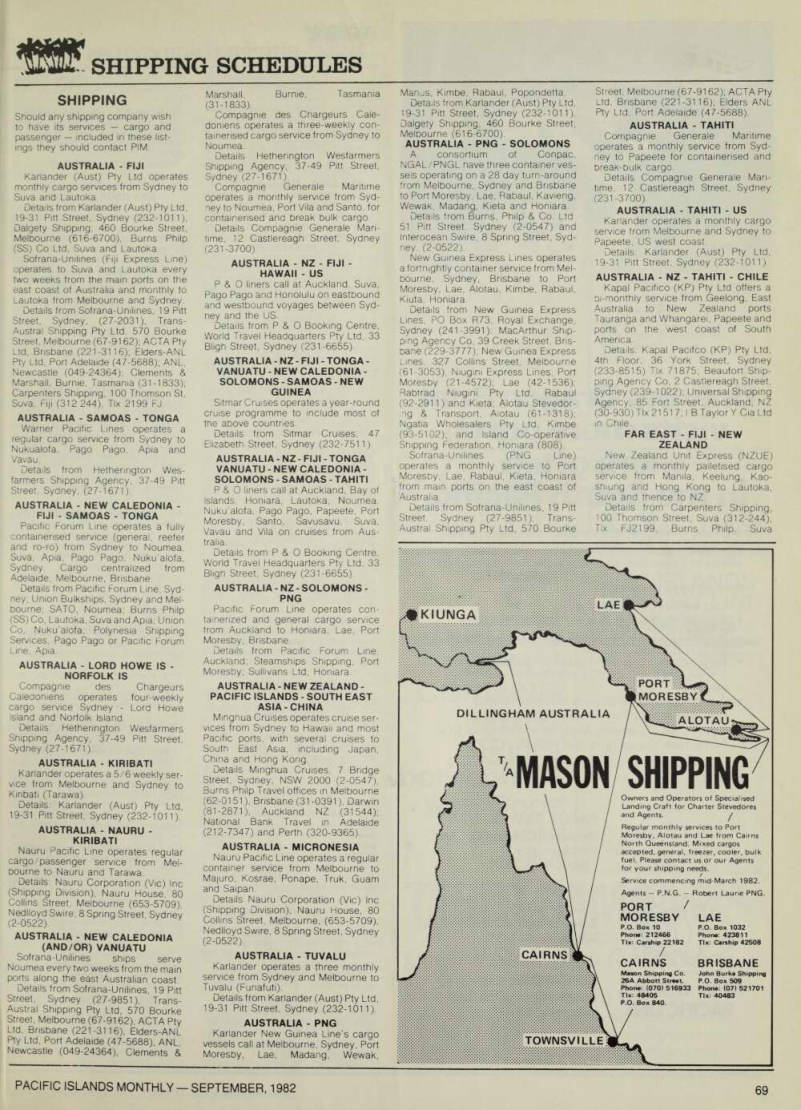
Shipping
Should any shipping company wish to have its services cargo and passenger included in these list ings they should contact PIM.
Australia - Fiji
Karlander (Aust) Pty Ltd operates monthly cargo services from Sydney to Suva and Lautoka.
Details from Karlander (Aust) Pty Ltd, 19-31 Pitt Street, Sydney (232-1011), Dalgety Shipping, 460 Bourke Street, Melbourne (616-6700), Burns Philp (SS) Co Ltd, Suva and Lautoka.
Sofrana-Unilines (Fiji Express Line) operates to Suva and Lautoka every two weeks from the mam ports on the east coast of Australia and monthly to Lautoka from Melbourne and Sydney.
Details from Sofrana-Unilines. 19 Pitt Street, Sydney, (27-2031), Trans- Austral Shipping Pty Ltd, 570 Bourke Street, Melbourne (67-9162); ACTA Pty Ltd, Brisbane (221-3116); Elders-ANL Pty Ltd, Port Adelaide (47-5688); ANL, Newcastle (049-24364); Clements & Marshall, Burme, Tasmania (31-1833); Carpenters Shipping, 100 Thomson St, Suva, Fiji (312 244), Tlx 2199 FJ.
Australia - Samoas - Tonga
Warner Pacific Lines operates a regular cargo service from Sydney to Nukualofa, Pago Pago, Apia and Vavau.
Details from Hethenngton Wes farmers Shipping Agency, 37-49 Pitt Street. Sydney. (27-1671).
Australia - New Caledonia -
Fiji - Samoas - Tonga
Pacific Forum Line operates a fully containerised service (general, reefer and ro-ro) from Sydney to Noumea, Suva, Apia, Pago Pago, Nukualofa, Sydney. Cargo centralized from Adelaide, Melbourne, Brisbane.
Details from Pacific Forum Line, Syd ney; Union Bulkships, Sydney and Mel bourne; SATO, Noumea; Burns Philp (SS) Co, Lautoka, Suva and Apia; Union Co, Nuku’alofa; Polynesia Shipping Services, Pago Pago or Pacific Forum Line, Apia.
Australia - Lord Howe Is -
Norfolk Is
Compagnie des Chargeurs Caledonians operates four-weekly cargo service Sydney - Lord Howe Island and Norfolk Island.
Details: Hethenngton Wesfarmers Shipping Agency, 37-49 Pitt Street Sydney (27-1671).
Australia - Kiribati
Karlander operates a 5/6 weekly ser vice from Melbourne and Sydney to Kiribati (Tarawa).
Details: Karlander (Aust) Pty Ltd 19-31 Pitt Street, Sydney (232-1011).
Australia - Nauru -
Kiribati
Nauru Pacific Line operates regular cargo/passenger service from Mel bourne to Nauru and Tarawa.
Details: Nauru Corporation (Vic) Inc (Shipping Division), Nauru House, 80 Collins Street, Melbourne (653-5709), Nedlloyd Swire, 8 Spring Street Sydney (2-0522)
Australia - New Caledonia
(And/Or) Vanuatu
Sofrana-Unilines ships serve Noumea every two weeks from the main ports along the east Australian coast.
Details from Sofrana-Unilines, 19 Pitt Street, Sydney (27-9851). Trans- Austral Shipping Pty Ltd, 570 Bourke Street, Melbourne (67-9162), ACTA Pty Ltd, Brisbane (221-3116), Elders-ANL Pty Ltd, Port Adelaide (47-5688) ANL Newcastle (049-24364), Clements &
Marshall, Burnie, Tasmania (31-1833).
Compagnie des Chargeurs Cale domens operates a three-weekly con tainerised cargo service from Sydney to Noumea.
Details Hetherington Wesfarmers Shipping Agency, 37-49 Pitt Street, Sydney (27-1671).
Compagnie Generale Maritime operates a monthly service from Syd ney to Noumea, Port Vila and Santo, for containerised and break bulk cargo Details Compagnie Generale Mari time, 12 Castlereagh Street, Sydney (231-3700).
Australia - Nz - Fiji -
Hawaii - Us
P & O liners call at Auckland, Suva, Pago Pago and Honolulu on eastbound and westbound voyages between Syd ney and the US.
Details from P & O Booking Centre, World Travel Headquarters Pty Ltd, 33 Bligh Street, Sydney (231-6655).
AUSTRALIA - NZ - FIJI - TONGA -
Vanuatu - New Caledonia -
Solomons - Samoas - New
Guinea
Sitmar Cruises operates a year-round cruise programme to include most of the above countries.
Details from Sitmar Cruises, 47 Elizabeth Street, Sydney (232-7511).
AUSTRALIA - NZ - FIJI - TONGA
Vanuatu - New Caledonia -
Solomons - Samoas - Tahiti
P & O liners call at Auckland, Bay of Islands, Honiara, Lautoka. Noumea, Nuku'alofa, Pago Pago, Papeete, Port Moresby, Santo, Savusavu, Suva, Vavau and Vila on cruises from Aus tralia.
Details from P & O Booking Centre, World Travel Headquarters Pty Ltd, 33 Bligh Street, Sydney (231-6655).
Australia - Nz - Solomons -
Png
Pacific Forum Line operates con tainerized and general cargo service from Auckland to Honiara, Lae, Port Moresby, Brisbane Details from Pacific Forum Line, Auckland; Steamships Shipping, Port Moresby; Sullivans Ltd, Honiara.
Australia - New Zealand -
Pacific Islands - South East
Asia-China
Minghua Cruises operates cruise ser vices from Sydney to Hawaii and most Pacific ports, with several cruises to South East Asia, including Japan, China and Hong Kong.
Details Minghua Cruises, 7 Bridge Street, Sydney, NSW 2000 (2-0547), Burns Philp Travel offices in Melbourne (62-0151), Brisbane (31 -0391), Darwin (81-2871), Auckland NZ (31544); National Bank Travel in Adelaide (212-7347) and Perth (320-9365),
Australia - Micronesia
Nauru Pacific Line operates a regular container service from Melbourne to Majuro, Kosrae, Ponape, Truk, Guam and Saipan.
Details Nauru Corporation (Vic) Inc (Shipping Division), Nauru House, 80 Collins Street, Melbourne, (653-5709), Nedlloyd Swire, 8 Spring Street, Sydney (2-0522),
Australia - Tuvalu
Karlander operates a three monthly service from Sydney and Melbourne to Tuvalu (Funafuti).
Details from Karlander (Aust) Pty Ltd, 19-31 Pitt Street, Sydney (232-1011).
Australia - Png
Karlander New Guinea Line’s cargo vessels call at Melbourne, Sydney, Port Moresby. Lae, Madang, Wewak,
Manus, Kimbe, Rabaul, Popondetta.
Details from Karlander (Aust) Pty Ltd, 19-31 Pitt Street, Sydney (232-1011), Dalgety Shipping, 460 Bourke Street, Melbourne (616-6700).
Australia - Png - Solomons
A consortium of Conpac, NGAL/PNGL have three container ves sels operating on a 28 day turn-around from Melbourne, Sydney and Brisbane to Port Moresby, Lae, Rabaul, Kavieng, Wewak, Madang, Kieta and Honiara Details from Burns, Philp & Co. Ltd 51 Pitt Street, Sydney (2-0547) and Interocean Swire, 8 Spring Street, Syd ney. (2-0522).
New Guinea Express Lines operates a fortnightly container service from Mel bourne, Sydney, Brisbane to Port Moresby, Lae, Alotau, Kimbe, Rabaul, Kiuta, Honiara.
Details from New Guinea Express Lines, PC Box R 73, Royal Exchange, Sydney (241-3991); MacArthur Ship ping Agency Co, 39 Creek Street, Bris bane (229-3777); New Guinea Express Lines, 327 Collins Street, Melbourne (61-3053); Niugim Express Lines, Port Moresby (21-4572); Lae (42-1536); Rabtrad Niugini Pty Ltd, Rabaul (92-2911) and Kieta; Alotau Stevedor .ng & Transport, Alotau (61-1318); Ngatia Wholesalers Pty Ltd, Kimbe (93-5102); and Island Co-operative Shipping Federation. Honiara (808).
Sofrana-Unilines (PNG Line) operates a monthly service to Port Moresby, Lae, Rabaul, Kieta, Honiara from mam ports on the east coast of Australia.
Details from Sofrana-Unilines, 19 Pitt Street, Sydney (27-9851); Trans- Austral Shipping Pty Ltd, 570 Bourke
Street, Melbourne (67-9162); ACTA Pty Ltd, Brisbane (221-3116); Elders ANL Pty Ltd, Port Adelaide (47-5688).
Australia - Tahiti
Compagnie Generale Maritime operates a monthly service from Syd ney to Papeete for containerised and break-bulk cargo.
Details Compagnie Generale Mari time, 12 Castlereagh Street, Sydney (231-3700).
Australia - Tahiti - Us
Karlander operates a monthly cargo service from Melbourne and Sydney to Papeete, US west coast.
Details; Karlander (Aust) Pty Ltd, 19-31 Pitt Street, Sydney (232-1011).
AUSTRALIA - NZ - TAHITI - CHILE Kapal Pacifico (KP) Pty Ltd offers a bi-monthly service from Geelong, East Australia to New Zealand ports Tauranga and Whangarei, Papeete and ports on the west coast of South America.
Details: Kapal Pacifco (KP) Pty Ltd, 4th Floor, 36 York Street, Sydney (233-8515) Tlx 71875; Beaufort Ship ping Agency Co, 2 Castlereagh Street, Sydney (239-1022); Universal Shipping Agency, 85 Fort Street, Auckland, NZ (30-930) Tlx 21517; l B Taylor Y Cia Ltd in Chile.
Far East - Fiji - New
Zealand
New Zealand Unit Express (NZUE) operates a monthly palletised cargo service from Manila, Keelung, Kao shiung and Hong Kong to Lautoka, Suva and thence to NZ.
Details from Carpenters Shipping. 100 Thomson Street, Suva (312-244), Tlx FJ2199, Burns Philp, Suva
(311-777.), P & O S.N. Co, Wellington (736-477) or Nedlloyd Swire Pty Ltd, Sydney (20-522).
Nedlloyd operates bi-weekly cargo service with four ships from Sourabaya, Jakarta, Bangkok, Port Kelang and Singapore to Suva and NZ ports.
Details from Nedlloyd (Aust) Pty Ltd, 8 Spring St, Sydney (27 3801), Burns Pn.lp (SS) Co Ltd. Suva and Lautoka.
Far East - Mid-S. Pacific
China Navigation’s New Guinea Pacific Line operates a regular con tainer service from Hong Kong, Taiwan, Manila, Port Kelang and Singapore to Port Moresby, Lae, Rabaul and Honiara monthly and to Wewak, Madang and Kieta every three months. Cargo from the same Far Eastern ports to the South Pacific ports of Noumea, Santo, Vila, Papeete, Pago Pago. Apia, Rarotonga and Tarawa will be shipped via Japan on the monthly Bali Hai service.
Details from Steamships Trading Co., Port Moresby (21-2000).
Kyowa Shipping Ltd, operates monthly services from Japan to Guam.
Saipan, Solomons, New Caledonia, Fiji, Western and American Samoa, Tahiti, Cook is., Tonga and Vanuatu.
Details. Hetherington Wesfarmers Snipping Agency, 37-49 Pitt Street, Sydney (27-1671); Carpenters Ship ping. Suva (312-244), Tlx FJ2199.
Japan - Fiji - New Zealand
Kyowa Shipping Co Ltd operates a monthly service from main ports of Japan to Suva and Lautoka and thence to island ports and NZ.
Details from Carpenters Shipping, 100 Thompson St, Suva (312-244), Tlx FJ2199.
Japan - Fiji - Island Ports
Balihai service operates a monthly service from mam ports of Japan to Suva and Lautoka and thence to island ports.
Details from Carpenters Shipping, 100 Thompson St, Suva (312-244), Tlx FJ2199 and Burns Philp, Suva (3ll-777).
Japan - Micronesia
The NYK Shipping Line operates a monthly cargo service from Japan to Micronesia, calling at Kobe, Nagoya, Yokohama, Saipan, Guam, Truk, Ponape and Majuro, returning via Kobe, Nagoya and Yokohama.
Details from Burns, Philp & Co Ltd, 7 Bridge Street, Sydney (2-0547).
Japan - Png
Mitsui O.S.K. Lines operates a monthly service from main ports Japan and Port Moresby, Rabaul, Lae, Madang, Kieta and Kimbe.
Details from Robert-Laurie (PNG) Pty Ltd, Port Moresby (21-2466/ 21-1898).
New Caledonia - Fiji - West
Coast North America
PAD Line operates an approx. 3weekly ro-ro service from Noumea and Suva to Honolulu and West Coast USA and Canadian ports.
Details from Sofrana-Unilines SA, BP 1602, Noumea (27-51 -91), Tlx NMO4B; Carpenters Shipping, 100 Thomson St., Suva (312-244), Tlx FJ2199.
Png - Inter - Mainport
Papua New Guinea Line offers scheduled 10/20-day coastal liner ser vices linking all PNG major ports with containerisation, reefer, heavy lift and transhipment facilities.
Details from PNG Line, Box 543, Port Moresby, PNG, (21-1174), Tlx 22269.
Png - Uk/Continent
The Bank Line operates regular cargo service from Port Moresby, Oro Bay, Kieta, Rabaul, Kimbe, Madang and Lae to Hull, Hamburg, Rotterdam, Antwerp and Le Havre.
Details from The Bank Line (A’asia)
Pty Ltd, 51 Pitt Street, Sydney (27-2041); Burns Philp (PNG) Ltd, PNG ports.
Solomons - Uk/Continent
The Bank Line operates regular cargo service from Honiara to Hull, Hamburg, Rotterdam, Antwerp and Le Havre.
Details from The Bank Line (A'asia) Pty Ltd, 51 Pitt Street, Sydney (27-2041); Tradco Shipping (588).
NZ - COOK IS - NIUE -
Tahiti
Shipping Corporation of NZ Ltd operates cargo services based on pallets and similar units from Auckland to Niue, Cook Islands and Tahiti.
Details from the Shipping Corp of NZ _td, PC Box 3420, Auckland (797-210), Waterfront Commission, PC Box 61, Rarotonga; Cook Islands; Niue Govt Offices, Niue Island Compagme Maritime Polynesienne, BP’ 368, Papeete, Tahiti.
Nz - Fiji
Reef operates a regular 18-day ser vice from Auckland to Suva and Lau toka.
Details from Reef Shipping Agencies, PC Box 3382, Auckland, NZ (77-1221-3); M.V. Fijian Shipping Agencies Ltd, Private Bag, Suva, Fiji (31 1056).
Pacific Line with one ship operates fortnightly ro-ro cargo service New Zealand, Lautoka, Suva.
Details: Sofrana Unilines, 18 Cus toms Street, Auckland (773-279) PO Box 3614, Telex: NZ2313; Carpenters Shipping, 100 Thomson Street, Suva (312244), Tlx. 2199 FJ.
NZ - FIJI - NORTH AMERICA (WC) Blue Star Line Ltd Pacific Coast con tainer services. Only direct service to and from New Zealand. Blue Star ves sels call at Suva and Honolulu on NZ US-West Coast voyages.
Details from Blueport ACT (NZ) Ltd, PO Box 192, Wellington (739-029), Burns Philp (SS) Co Ltd, GPO Box 355, Suva, Fiji (311-777). Tlx. FJ2168 Burship.
NZ - FIJI - SAMOAS - TONGA Pacific Forum Line operates a fully containerised three-weekly service (Gen/Reefer) from Auckland to Lau toka, Suva, Apia, Pago Pago and Nuku’alofa.
Details from Pacific Forum Line, Auckland; Union Co, Auckland, Lau toka, Suva, Apia and Nuku’alofa; Polynesia Shipping Services, Pago Pago or Pacific Forum Line, Apia.
NZ - FIJI - SAMOAS - TONGA Pacific Forum Line operates a fully containerised service (gen/reefer) from Auckland to Lautoka, Suva, Apia, Pago Pago and Nukualofa.
Details from Pacific Forum Line, Auckland; Pacific Forum Line, Apia; Union Company, Suva, Lautoka and Nukualofa.
NZ - N. CALEDONIA - VANUATU -
Png - Solomons
Sofrana Unilines with three ships operates to Vila and Santo, to Honiara and Papua New Guinea and t. Norfolk Island and Noumea.
Details from Sofrana Umlines, 18 Customs Street, Auckland (773-279), PO Box 3614, Telex NZ2313.
Nz - Tahiti
Compagme Tahitienne Maritime SA with one ship operates monthly service New Zealand - Papeete.
Details from Sofrana Unilines, PO Box 3614, 18 Customs St, Auckland (773-279), Tlx NZ2313.
Nz- Tonga - Samoas
Warner Pacific Line services Auck land, Nuku’alofa, Vavau, Apia, Pago Pago fortnightly carrying general and freezer cargoes.
Details from McKay Shipping Ltd, Downtown House, 21 Queen St, Auckland, PO Box 1372 (30-299), Cables MACSHIP, Telex NZ2554; Warner Pacific Line, Box 93, Nukualofa, Tonga; Mealelei (Western Samoa) Ltd, Box 4171, Apia, Western Samoa; Kneubuhl Maritime Services, Box 39, Pago Pago, American Samoa, 96799.
Nz - New Caledonia
Central Pacific Line operates a monthly cargo service from Auckland, Lyttelton, Napier and Mt Maunganui to Noumea.
Details from McKay Shipping Ltd, PO Box 1372, Auckland (9-30229); Tlx 2554 NZ
Europe - Tahiti -
New Caledonia
Compagnie Generale Maritime operates services from Europe and Mediterranean ports to Papeete and Noumea using three ro-ro and multi purpose vessels thus ensuring a bi monthly sailing to and from.
Details Compagnie Generale Mari time, 12 Castlereagh Street, Sydney (231-3700).
Europe-Tahiti-New
Caledonia - New Zealand -
Solomons - Png - Europe
Polish Ocean Lines offers regular monthly sailings for containerised and breakbulk cargo from Hamburg, Ant werp, Dunkirk and Rouen to Papeete, Noumea, New Zealand, Honiara, Lae, returning to Europe via Suez. Other ports in the South Pacific can be served with inducement.
Details from Sotama, BP 9170, Papeete (27805), Tlx. 296; SATO, BP C 2, Noumea (272094), Tlx. 163 NM SATO; Union Steamship Co of NZ, PO Box 50, Apia, Tlx. 25; Williams and Gosling, PO Box 79, Suva (312633), Tlx. 2163; Warner Pacific Line, PO Box 93, Nukualofa (21089), Tlx. 66219; Universal Shipping Agencies, PO Box 2282, Auckland (30930), Tlx. 21517.
EUROPE - TAHITI - W. SAMOA -
Fiji - N. Caledonia
Nedlloyd offers regular cargo ser vices from Northern Europe and UK to Papeete, Apia, Fiji and New Caledonia.
Details Nedlloyd (Aust) Pty Ltd, 8 Spring Street, Sydney (27-3801); Car penters Shipping, 100 Thomson St, Suva (312 244), Tlx 2199 FJ.
EUROPE - TAHITI - W. SAMOA - TONGA - FIJI - SOLOMONS - PNG -
Vanuatu
Columbus Line Reederei GMBH operates regular services from Ham burg, Hull, Rotterdam, Antwerp, Dunkirk, Le Havre, to Papeete, Apia, Suva, Lautoka, Noumea, Port Moresby, Lae, Honiara, Kieta, Rabaul, Lae, and return to Europe.
Details from Columbus Overseas Services Pty Ltd, 333 George Street, Sydney (290-2966), Columbus Mari time Services, 17 Albert Street, Auckland (77-3460); Carpenters Ship ping, 100 Thomson St, Suva (312 244) Tlx 2199 FJ.
Uk - N. Continent - Fiji
The Bank Line operates a regular cargo service from Hull, Hamburg, Bremen, Antwerp, Rotterdam and Le Havre to Suva and Lautoka.
Details from The Bank Line (A’asia) Pty Ltd, 51 Pitt Street, Sydney (27-2041); Burns Philp (South Sea) Co Ltd, Suva and Lautoka.
Uk/N. Continent - Png -
Solomons
The Bank Line operates a regular cargo service from Hull, Hamburg, Bremen, Antwerp, Rotterdam and Le Havre to Port Moresby, Lae, Madang, Kimbe, Rabaul, Kieta and Honiara and
on Inducement to Yandina, Details from The Bank Line (A’asia) Pty Ltd, 51 Pitt Street, Sydney (27-2041); Burns Philp (PNG) Ltd, PNG ports; Tradco Shipping (588).
Uk/N. Continent - Tahiti -
N. Caledonia
The Bank Line operates a regular cargo service from Hull, HamDurg, Bremen, Antwerp, Rotterdam and Le Havre to Papeete and Noumea.
Details from The Bank Line (A’asia) Pty Ltd, 51 Pitt Street, Sydney (27-2041); Ets A M Fare LITE, Papeete; Ets Ballande, Noumea.
US - FIJI - TAHITI - NZ -
Australia
The Bank Savill Line Ltd, operates regular cargo services from US Gulf ports to Australia and NZ. Calls at Suva, Lautoka and Papeete on demand.
Details from The Bank and Savill Line Ltd, 51 Pitt Street, Sydney (27-2041) or Orient Shipping Services, 32 Bridge Street, Sydney (241-2753).
Us - Hawaii - Kiribati -
Micronesia
Philippines, Micronesia & Orient Navigation Co (PM&O Lines) operates regular container service on self sustamed ship with ro-ro capabilities from Oakland, Portland and Honolulu to Tarawa, Ebeye, Majuro, Kosrae, Ponape, Truk, Saipan, Yap and Koror.
Details for Micronesia can be obtained from Larry Guerrero, PM&O Owners Rep, PO Box 803, Saipan, Ml 96950, Cable COMMONTIME. Tlx 783605; PM80; PM&O Lines, 181 t-remont St, San Francisco, California 94105, Cable PMONAV
Us - Hawaii - Nauru -
Micronesia
Nauru Pacific Line operates regular conventional/container and passenger service from San Francisco and Honolulu to Majuro, Ponape, Truk and Saipan. Cargo is accepted for Nauru and Kosrai with transhipment at Majuro and Ponape.
Details from Nauru Corporation (Vic) Inc (Shipping Division), Nauru House, 80 Collins Street, Melbourne (653-5709); North American Maritime Agencies, 100 California St., San Fran cisco, California 9411.
Hawaii - Tahiti - Samoas
Marshall Islands Maritime Co operates a service every 32 days be tween Honolulu, Papeete, Pago Pago and Apia.
Details from the Maritime Co of the Pacific, Honolulu, Hawaii; Morris Hed strom, Apia, Western Samoa and the Marshall Islands Maritime Co, Majuro, Marshall Islands.
Us - Noumea - Fiji
PAD Line operates an approx 3-weekly roro service from West Coast USA and Canada to Noumea and Suva.
Details from Sofrana-Unilines SA, BP 1602, Noumea (27-51 -91), Tlx NMO4B; Carpenters Shipping, 100 Thomson St, Suva (31-2244), Tlx FJ2199; Trans- Austral Shipping, Box R 232 PO, Royal Exchange, NSW (27-2441), Tlx AA21204.
Us - Tahiti - Samoa
Pacific Islands Transport operates a five weekly cargo service from North America west coast ports to Papeete, Pago Pago, Apia.
Details from Polynesia Shipping Ser vices Inc, PO Box 1478 Pago Pago 96799, Polynesia Line operates container and general cargo service from US west coast ports to Papeete and Pago Pago.
Details from Polynesia Shipping Ser vices Inc., PO Box 1478, Pago Pago 96799.
Advertisements & other items, pp. 69-72 (2 items)
Mason
LAE
KIUNGA
PORT K*
MORESBY
DILLINGHAM AUSTRALIA
ALOTAU
MASON
CAIRNS
SHIPPING
Owners and Operators of Specialised Landing Craft for Charter Stevedores and Agents. / Regular monthly services to Port Moresby, Alotau and Lae from Cairns North Queensland. Mixed cargos accepted, general, freezer, cooler, bulk fuel. Please contact us or our Agents for your shipping needs.
Service commencing mid-March 1982.
Agents - P.N.G. - Robert Laurie PNG. /
PORT
MORESBY
P.O. Box 10 Phono: 212466 Tlx: Csrthip 22182 /
CAIRNS
Mason Shipping Co. 26A Abbott Street.
Phone: (0701 516933 Tlx; 48405 P.O. Box 840.
LAE
P.O. Box 1032 Phone: 423811 Tlx: Carthip 42508
BRISBANE
John Burke Shipping P.O. Box 509 Phone: (07) 521701 Tlx: 40483
TOWNSVILLE
Only our Dragon Boat
visits more ports,
more often,
in the South Pacific.
The New Guinea Pacific Line offers the quality handling you're used to, through its exclusive containerised service to Papua New Guinea and the Solomon Islands.
Rely on us all the way. • Fast transit times to all ports. • A guaranteed schedule every 30 days, thanks to berths in Papua New Guinea and Honiara reserved for N.G.P.L. use. • Safe, secure transports goods in containers, both L.C.L., and F.C.L. no more damage or pilferage of cargo. • A wide coverage of all ports with the monthly container service from Hong Kong, Singapore, Taiwan, the Philippines, Malaysia and Bangkok to all Papua New Guinea ports and Honiara.
For further details on our reliable Dragon Boat service contact:
PAPUA NEW GUINEA
Steamship Trading Co., Ltd.
Port Moresby Telephone: 212000
HONG KONG
Swire Shipping (Agencies) Ltd.
Telephone: 5-264311 CD O C\J
NEW GUINEA
PACIFIC UNE
SINGAPORE
Straits Shipping Pte. Ltd.
Telephone: 436071 Q.
O z
MfllK
LOCAL AGENTS AND
REPRESENTATION
428 George St., Sydney.
Cables: Henco Sydney.
G.P.O. Box 3949.
Telephone: 232 5377.
For specialised and personalised buying service throughout the Pacific Islands and the East.
Resident Agents in other Pacific Territories.
PAPUA NEW GUINEA
RABAUL: M. & C. Seeto, P.O. Box 131, Rabaul.
Telephone 92 2919.
MADANG: W. Double, P.O. Box 22, Madang.
Telephone 82 2696.
FIJI
K. Witherington Ltd., P.O. Box 293, Suva.
Telephone 22 356.
VANUATU
John Lum & Associates, P.O. Box 65, Santo.
Telephone 329.
SOLOMON ISLANDS
Mr. Tom Lo, P.O. Box 327, Honiara.
Telephone 399
PACIFIC ISLANDS
TRANSPORT LINE
M.V. SIRIUS
and I U 1
TAHITI SAMOA ?P go
xoc
Qeqeral Stean\ship
General Agents 400 California Street, San Francisco, CA, USA PAPEETE: Agence Maritime Internationale, Tahiti PAGO PAGO: Polynesia Shipping Services, Inc.
APIA: Burns Philp (South Sea) Company, Ltd.
THE BANK LINE
-» r
28 Day Service
United Kingdom and Continent to:
PAPEETE • NOUMEA
PAPUA NEW GUINEA and SOLOMON ISLANDS
PORT VILA & SANTO BY TRANSHIPMENT
* United Kingdom and Continent to: SUVA AND LAUTOKA (FCL LCL & UNITISED ONLY) * Papua New Guinea and Solomon Islands to:
UNITED KINGDOM and CONTINENT
For particulars apply:
THE BANK LINE (AUSTRALASIA) PTY. LTD.
Suite 801, 51 Pitt Street, Sydney 2000. Australia. Tel: 272041. Tlx: 24063.
Shipping Schedules
DEATHS of Islands People
Maika Brown At Levuka, Fiji, on July 13, aged 108.
One of the best known fig ures in the Anglican Church in Fiji, Maika Brown was born in Suva on July 13,1874, the same day of the year as that on which he died 108 years later.
His parents had been black birded to Fiji from the Sol omons, and elected to stay on in the country when their three-years indenture had been completed.
His father died while he was still a boy, and his mother remarried. His stepfather gave him a good education, for those days, and he was accepted for medical training at the old hospital in Suva. But when his stepfather moved the family to Levuka, he needed Maika’s help in establishing a fishing business in Ovalau, so the young man had to leave medical school.
Maika went to work for the Morris Hedstrom company in Levuka, and he remained with the company for the rest of his working life.
He was a lay reader and
preacher with the Church of England in Levuka for 64 years.
In an interview published in PIM (Sept. ’Bl, p 25) Victor Carell wrote of Maika Brown: “He is truly amazing . . . His command of English is excep tional and his memory is sharp. He can quote long sec tions of the Bible and delights in reciting one psalm after another, to be followed by excerpts from the Book of Moses, with no hesitation whatsoever.”
Taking his leave of Mr Brown, Victor Carell asked him how he felt. “I feel fine ... I feel strong ... I can even do a little dance,” he shouted. And he did, 107 years old as he was at the time.
He married his wife Merel ita in 1916. They had 13 chil dren.
John Kalomala In Papua New Guinea in Aug ust, of stab wounds to the head sustained in a hotel brawl.
Mr Kalomala, of Wabag, in Enga Province, had stood with out success as a candidate in PNG’s July general elections.
Madeline Edith Kerkham In Auckland on July 11, aged 86.
Mrs Kerkham (nee Ed wards) was a member of a very old established Fiji fami ly, her parents having arrived in the colony in the year 1876 from Oxford, England. She was born in Levuka in 1895 and lived in Levuka and Suva for more than 70 years.
Daughters Grace and Noeline and sons Onslow and Bruce reside in New Zealand, and sons Richard and Allen in Sydney.
With them are left 19 grandchildren and 11 great grandchildren to mourn her loss. Her husband, Richard Charles Kerkham, who spent a lifetime of service in Fiji with Burns Philp (S.S.) Co. Ltd., died in Suva in 1963. A. S.
Kerkham Rev. Aisake Raratabu In Los Angeles, USA, on May 23.
The Rev Aisake Raratabu died while returning to his home in Fiji after attending an international conference. He had been in Holland for a
meeting of the executive com mittee of the World Associ ation for Christian Communi cations (WACC). Mr Raratabu was chairman for the WACC Pacific Region. Earlier he had worked for the Pacific Council of Churches for eight years, managing Pasifika Produc tions, and he had been an information officer for the council.
Senior Inspector Francis Kumbia Shot dead by another police officer in his Mount Hagen office in June.
One of Papua New Guinea’s most experienced police offic ers, Senior Inspector Kumbia was commander of the Special Police Unit, Highlands Mobile Police.
According to eye-witnesses, he was in his office at Bindon Barracks when his assailant came in with a rifle and started firing wildly.
The attacker himself was shot in the incident. A Mount Hagen Hospital spokesman said the man had been under observation for suspected mental illness.
William Thomas (Darkie) Johnson At Newcastle, Australia, in June, aged 78.
Darkie Johnson went to Papua New Guinea in 1948 as an aircraft engineer, first at Madang and then at Lae, maintaining aircraft for Qan tas, TAA, MAL, Crowley Air ways and others.
After leaving PNG he work
ed for Helicopter Utilities un til his retirement. C. Gane Joshua Hiua At Sulphur Bay, Tanna, Vanuatu, on July 13, after a long illness.
Joshua Hiua was the John Frum member of the TAFEA Island Government Council and had been so since creation of the council in 1981.
Thompson Samuel At Norsup Hospital, Vanuatu, in June, aged 47.
Thompson Samuel had 27 years of service with the New Hebrides/Vanuatu health ser vice, working mainly as a surgical dresser.
He was employed for many years by the Presbyterian Church.
Hira Singh While being rushed to Lautoka Hospital, Fiji, in June, of a heart attack, aged 50.
Mr Singh, an Alliance Party activist, suffered the attack at an election meeting at Votua levu, Nadi.
Bobbie Gaigo
In Port Moresby in Papua New Guinea in August.
For many years Bobbie Gaigo was a self-appointed spokesman for the people of Tatana Village on the outer rim of Port Moresby. In this role he was a controversial and colorful figure, sometimes at odds with the people he repre sented but in recent years increasingly respected. In the days of the Australian admin istration of PNG he was a frequent letter-writer to politi cians and senior officials in Australia. One of his major crusades was for the revision of land tenure legislation.
When Queen Elizabeth visited PNG on one occasion he orga nised a demonstration on land issues. But he freely conceded “the Queen got more attention than I did”.
Advertisements & other items, pp. 73-74 (1 item)
We’ve just made
the ocean smaller!
Polynesia Line's new MS Polynesia 550-container ship provides regular monthly cargo service between Papeete, Pago Pago and Apia in the South Pacific, and Long Beach and Oakland on the US Pacific Coast.
POLYNESIM.INE
Interocean Steamship Corporation General Agent Apia Pago Pago
ooL
& K Q.s O.
TO & 3* aS 5* 3 5* V Papeete «n Port Agents Popeete Morgon-Vemex Botte Postal© 449 Papeete, TaNti Cabte "MOREX"
Pago Pago Polynesia Shipping Services, inc.
PO Box M 73 Pago Pago, American Samoa 96799 Cobte "POLYSHP* Apte Union Steam Sh*p Co. of New Zealand POBoxso Apia. Western Samoa Cabte "UNOT Son Franciaco interoc ean Steamship Corporation 465 California Street Suite KXM San Francisco. CA-94104 (415] 396-2000 Cabte’TNTßKXr Long Beach interocean Steamship Corporation 662 i E Pacific Coast Highway.SyitelOO CA 90803 t213|493-1450 Cabte TNTERCO'' Serving Polynesia is all we do—and we do it better!
REQUIRE
DRIED SHARK FINS
FOR PRICES AND
INFORMATION ETC.,
PLEASE WRITE TO:
S. DADDOW,
ASIA TONGA TRADING,
7 KASAI ROAD,
REPUBLIC OF SINGAPORE
2880.
CABLE; "ASIATONGA”
PORT UOh
* Right in t business cep * A traditioii for comfort and fine food * All rdoms airconditioned t Restaurant * Ba ♦ Banquet hall
A. C. NEUMANN
manager Phone 21-2622 Cable ‘iAFTBJb’
NEW GUINEA
EXPEDITIONS
ADVENTURE
HOLIDAYS
trekking • rafting diving • caving 4-wheel drive sea plane adventure Sepik expeditions PNG specialists For our 20-page fullcolour brochure contact—
NEW GUINEA
EXPEDITIONS
3rd Floor. 28 O'Connell St.
Sydney 2000 Phone (02) 2316066 Telex AA22179 Licence B950
Jfe
80' Steel Fishing Vessel 25 Ton Cap. $550 000 195' Steel Tanker
1071.36 K/L $256 000 US
120' Steel Passenger Cargo Vessel $300 000 90' Steel Twin Screw Landing Barge $300 000 80' Steel Trawler $225 000 52' Alloy Racer Cruiser Yacht Ex Siska III $107 000
Sonar Ships Brokerage
BOX 1811 CAIRNS, OLD.
AUSTRALIA
PH: (070) 515371
BOAT DOCKS
FOR SALE
4 laminated floating wooden docks for single berthing of approx. 65 boats 40 ft. and under.
Mike Barnett,
Hawaii Management
Corporation,
1221 Kapiolani Blvd., Suit 700, Honolulu, Hawaii 96814.
Stay at Aggie Grey ’s . . . the South Pacific’s legendary hotel.
Situated right in the heart of Western Samoa. Enjoy Polynesian-stylc friendliness and service, in cool surroundings, superb entertainment and food.
Magnificent white sand beaches only a short drive away. Airconditioned rooms, swimming pool and full bar facilities.
Bookings through Union Steamship Company of NZ, Pan Am, Air New Zealand or direct to Aggie Grey’s, Apia, Western Sampa. Cables: ‘AGGIES’Apia.
FOR SALE
14” Portable Dredge, Dixie Model CS-14 Series 100 Cat D-346 Main With Thomas Pump, 874 Total Hrs.
Since New Cat D-330 Aux., 1505 Total Hrs. Since New 2 Cutter Heads 2400’ Pipe, 48 Pontoons, Spare Parts & Equipment Van Currently Dry Storage Southern California Excellent Condition Ready to go to work
SUBMARINE ENGINEERING ASSOCIATES
504 31st Street
Newport Beach, California 92663, U.S.A.
(714) 673-5577
Advertising Index
Aggie Grey’s 74 Air New Zealand 26 Air Pacific 54 Aotea Marketing 44 Asia Tonga Trading 74 Australian Trade Dept 6 Bank Line 72 Belau nationhood film 32 Benson and Hedges 42 Besco Jarwil 28 China Navigation Co 70 Clarion 56 De Havilland Marine 60 Denon 68 General Steam Ships 71 Goodyear Tyres 52 Hawaii Management Corp 74 Henry Cumines 71 Hitachi 2 Hudson Homes 48 International Marketing 30 Kyowa Shipping 68 MacQuarrie Industries 57 Mason Shipping 69 Matsushita National 8 McDonnell Douglas 36 Nelson and Robertson 34 New Guinea Expeditions 74 New Zealand Dairy Board 76 Pacific Pump Co 64 Papua Hotel 74 Parker Pen 23 Pioneer 20-21 Polynesia Line 73 QBE Insurance 14 R.M.Gow 62 Sansui Electric 12 Solarex 42 Sonar Ships Brokerage 74 Submarine Engineering 74 Suzuki (vehicles) 75 Suzuki (outboards) 50 Thorn Lighting 31 Toyota 38-39 Trio Kenwood 16
Advertisements & other items, pp. 75-76 (1 item)
SUIUKI the name ol perlormnce.
feSaP l V IV'. ■ ■v At A ■&& % d£Si3 TA. t&m&M SUZUKI Vehicles are shipped to approximately 100 countries throughout the world and are well received by users in those countries. Behind the high-quality of SUZUKI 4wheelers is the in-depth research carried out from all aspects, rigorous tests and an extensive after-sales service net-work. Vehicles that are ready when you need them and which you can trust when driving. SUZUKI Vehicles.
iOLOMON ISLANDS SOLOMON ISLAND SERVICE STATION LTD. NEW CALEDONIA STE. SUPERCAL PAPUA NEW GUINEA JACIFIC AMI VANUATU HENRI LBROUX NIUE ISLAND BURNS PHILP (SOUTH SEA) CO,, LTD. PONAPE LEO ETSCHEIT TAHITI NIPPON AUTOMOTO GUAM & SAIPAN ISLAND CYCLERY, INC, NORFOLK MARTIN'S AGENCIES LTD SAMOA PRODUCTS INC TONriA PAniPir DDPim IPTC IMP MM mi I i— i■ a .
a
ANCHOR
Li!
'•Mut.
FULL CREAM
Ik
POWDER.
Aid
SKIM MILK
POWDER
B hh
r ■ r i anchor
ANCHOR
iS»S MB ill *
NEW
ZEALAND
DAIRY
BOARD
Anchor - prenhium quality dairy produce, packed with all the goodness of the finest pasture in the world.
Fresh to you from the world’s number one dairy producer. New Zealand Dairy Board. \ Enquiries to: PO Box 417 Wellington, New Zeajand
Telex: NZ3348 DAPMARK
Telephone: 724-399